
The extended apron thrust forward across where the orchestra should have been gave many seats at the Palais Garnier – already not renowned for visibility — scant sightlines unless you were in a last row and could stand up and tilt forward. Were these two “it’s a gala/not a gala” programs worth attending? Yes and/or no.
Evening Number One: “Nureyev” on Thursday, October 8, at the Palais Garnier.
 Nureyev’s re-thinkings of the relationship between male and female dancers always seek to tweak the format of the male partner up and out from glorified crane operator into that of race car driver. But that foot on the gas was always revved up by a strong narrative context.
Nutcracker pas de deux Acts One and Two
Gilbert generously offers everything to a partner and the audience, from her agile eyes through her ever-in-motion and vibrantly tensile body. A street dancer would say “the girlfriend just kills it.” Her boyfriend for this series, Paul Marque, first needs to learn how to live.
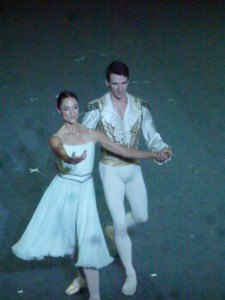 At the apex of the Act II pas of Nuts, Nureyev inserts a fiendishly complex and accelerating airborne figure that twice ends in a fish dive, of course timed to heighten a typically overboard Tchaikovsky crescendo. Try to imagine this: the stunt driver is basically trying to keep hold of the wheel of a Lamborghini with a mind of its own that suddenly goes from 0 to 100, has decided to flip while doing a U-turn, and expects to land safe and sound and camera-ready in the branches of that tree just dangling over the cliff. This must, of course, be meticulously rehearsed even more than usual, as it can become a real hot mess with arms, legs, necks, and tutu all in getting in the way. But it’s so worth the risk and, even when a couple messes up, this thing can give you “wow” shivers of delight and relief. After “a-one-a-two-a-three,” Marque twice parked Gilbert’s race car as if she were a vintage Trabant. Seriously: the combination became unwieldy and dull.
Marque continues to present everything so carefully and so nicely: he just hasn’t shaken off that “I was the best student in the class “ vibe. But where is the urge to rev up? Smiling nicely just doesn’t do it, nor does merely getting a partner around from left to right. He needs to work on developing a more authoritative stage presence, or at least a less impersonal one.
 Cendrillon
A ballerina radiating just as much oomph and chic and and warmth as Dorothée Gilbert, Alice Renavand grooved and spun wheelies just like the glowing Hollywood starlet of Nureyev’s cinematic imagination. If Renavand “owned” the stage, it was also because she was perfectly in synch with a carefree and confident Florian Magnenet, so in the moment that he managed to make you forget those horrible gold lamé pants.
Swan Lake, Act 1
Gently furling his ductile fingers in order to clasp the wrists of the rare bird that continued to astonish him, Audric Bezard also (once again) demonstrated that partnering can be so much more than “just stand around and be ready to lift the ballerina into position, OK?” Here we had what a pas is supposed to be about: a dialogue so intense that it transcends metaphor.
You always feel the synergy between Bezard and Amandine Albisson. Twice she threw herself into the overhead lift that resembles a back-flip caught mid-flight. Bezard knows that this partner never “strikes a pose” but instead fills out the legato, always continuing to extend some part her movements beyond the last drop of a phrase. His choice to keep her in movement up there, her front leg dangerously tilting further and further over by miniscule degrees, transformed this lift – too often a “hoist and hold” more suited to pairs skating – into a poetic and sincere image of utter abandon and trust. The audience held its breath for the right reason.
Manfred
Bewildered, the audience nevertheless applauded wildly at the end of this agonized and out of context solo. Pretending to themselves they had understood, the audience just went with the flow of the seasoned dancer-actor. Mathias Heymann gave the moment its full dose of “ah me” angst and defied the limits of the little apron stage [these are people used to eating up space the size of a football field].
Pas de deux can mostly easily be pulled out of context and presented as is, since the theme generally gravitates from “we two are now falling in love,” and “yes, we are still in love,” to “hey, guys, welcome to our wedding!” But I have doubts about the point of plunging both actor and audience into an excerpt that lacks a shared back-story. Maybe you could ask Juliet to do the death scene a capella. Who doesn’t know the “why” of that one? But have most of us ever actually read Lord Byron, much less ever heard of this Manfred? The program notes that the hero is about to be reunited by Death [spelled with a capital “D”] with his beloved Astarté. Good to know.
Don Q
Francesco Mura somehow manages to bounce and spring from a tiny unforced plié, as if he just changed his mind about where to go. But sometimes the small preparation serves him less well. Valentine Colasante is now in a happy and confident mind-set, having learned to trust her body. She now relaxes into all the curves with unforced charm and easy wit.

R & J versus Sleeping Beauty’s Act III
In the Balcony Scene with Miriam Ould-Braham, Germain Louvet’s still boyish persona perfectly suited his Juliet’s relaxed and radiant girlishness. But then, when confronted by Léonore Baulac’s Beauty, Louvet once again began to seem too young and coltish. It must hard make a connection with a ballerina who persists in exteriorizing, in offering up sharply-outlined girliness. You can grin hard, or you can simply smile. Nothing is at all wrong with Baulac’s steely technique. If she could just trust herself enough to let a little bit of the air out of her tires…She drives fast but never stops to take a look at the landscape.
As the Beatles once sang a very, very, long time ago:
« Baby, you can drive my car
Yes, I’m gonna be a star
Baby you can drive my car
And maybe I’ll love you »
Evening Two: “Etoiles.” Tuesday, October 13, 2020.
 We were enticed back to the Palais Garnier for a thing called “Etoiles {Stars] de l’Opera,” where the program consisted of…anything and everything in a very random way. (Plus a bit of live music!)
Clair de lune by Alistair Marriott (2017) was announced in the program as a nice new thing. Nice live Debussy happened, because the house pianist Elena Bonnay, just like the best of dancers, makes all music fill out an otherwise empty space.
Mathieu Ganio, sporting a very pretty maxi-skort, opened his arms sculpturally, did a few perfect plies à la seconde, and proffered up a few light contractions. At the end, all I could think of was Greta Garbo’s reaction to her first kiss in the film Ninochka: “That was…restful.” Therefore:
Trois Gnossiennes, by Hans van Manen and way back from 1982, seemed less dated by comparison. The same plié à la seconde, a few innie contractions, a flexed foot timed to a piano chord for no reason whatever, again. Same old, eh? Oddly, though, van Manen’s pure and pensive duet suited Ludmila Paglerio and Hugo Marchand as prettily as Marriott’s had for Ganio. While Satie’s music breathes at the same spaced-out rhythm as Debussy’s, it remains more ticklish. Noodling around in an absinth-colored but lucid haze, this oddball composer also knew where he was going. I thought of this restrained little pas de deux as perhaps “Balanchine’s Apollo checks out a fourth muse.” Euterpe would be my choice. But why not Urania?
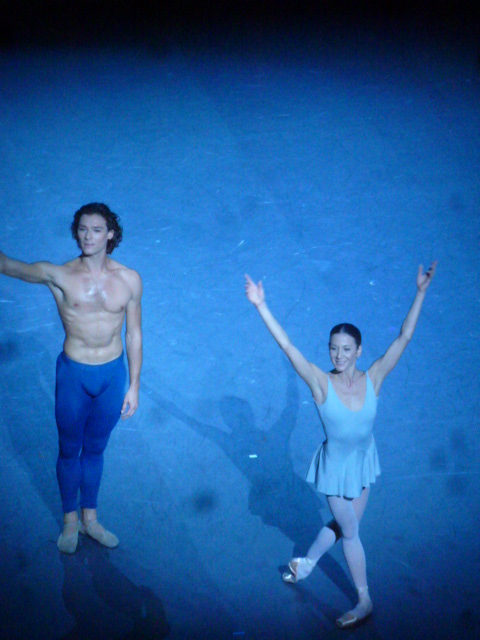
And why wasn’t a bit of Kylian included in this program? After all, Kylain has historically been vastly more represented in the Paris Opera Ballet’s repertoire than van Manen will ever be.
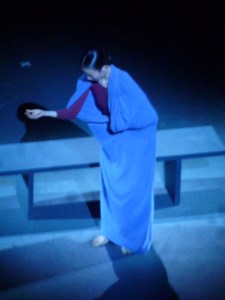 The last time I saw Martha Graham’s Lamentation, Miriam Kamionka — parked into a side corridor of the Palais Garnier — was really doing it deep and then doing it over and over again unto exhaustion during yet another one of those Boris Charmatz events. Before that stunt, maybe I had seen the solo performed here by Fanny Gaida during the ‘90’s. When Sae-Un Park, utterly lacking any connection to her solar plexus, had finished demonstrating how hard it is to pull just one tissue out of a Kleenex box while pretending it matters, the audience around me couldn’t even tell when it was over and waited politely for the lights to go off and hence applaud. This took 3.5 minutes from start to end, according to the program.
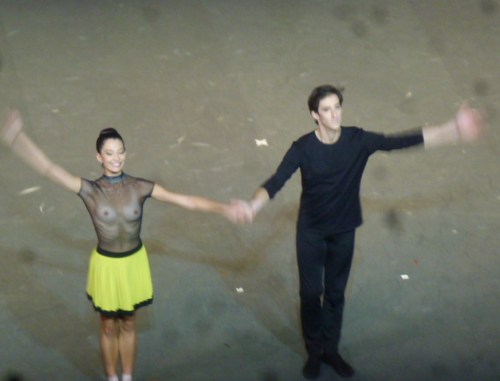
Then came the duet from William Forsythe’s Herman Schmerman, another thingy that maybe also had entered into the repertoire around 2017. Again: why this one, when so many juicy Forsythes already belong to us in Paris? At first I did not remember that this particular Forsythe invention was in fact a delicious parody of “Agon.” It took time for Hannah O’Neill to get revved up and to finally start pushing back against Vincent Chaillet. Ah, Vincent Chaillet, forceful, weightier, and much more cheerfully nasty and all-out than I’d seen him for quite a while, relaxed into every combination with wry humor and real groundedness. He kept teasing O’Neill: who is leading, eh? Eh?! Yo! Yow! Get on up, girl!
I think that for many of us, the brilliant Ida Nevasayneva of the Trocks (or another Trock! Peace be with you, gals) kinda killed being ever to watch La Mort du cygne/Dying Swan without desperately wanting to giggle at even the idea of a costume decked with feathers or that inevitable flappy arm stuff. Despite my firm desire to resist, Ludmila Pagliero’s soft, distilled, un-hysterical and deeply dignified interpretation reconciled me to this usually overcooked solo. No gymnastic rippling arms à la Plisetskaya, no tedious Russian soul à la Ulanova. Here we finally saw a really quietly sad, therefore gut-wrenching, Lamentation. Pagliero’s approach helped me understand just how carefully Michael Fokine had listened to our human need for the aching sound of a cello [Ophélie Gaillard, yes!] or a viola, or a harp — a penchant that Saint-Saens had shared with Tchaikovsky. How perfectly – if done simply and wisely by just trusting the steps and the Petipa vibe, as Pagliero did – this mini-epic could offer a much less bombastic ending to Swan Lake.
Suite of Dances brought Ophélie Gaillard’s cello back up downstage for a face to face with Hugo Marchand in one of those “just you and me and the music” escapades that Jerome Robbins had imagined a long time before a “platform” meant anything less than a stage’s wooden floor. I admit I had preferred the mysterious longing Mathias Heymann had brought to the solo back in 2018 — especially to the largo movement. Tonight, this honestly jolly interpretation, infused with a burst of “why not?” energy, pulled me into Marchand’s space and mindset. Here was a guy up there on stage daring to tease you, me, and oh yes the cellist with equally wry amusement, just as Baryshnikov once had dared. All those little jaunty summersaults turn out to look even cuter and sillier on a tall guy. The cocky Fancy Free sailor struts in part four were tossed off in just the right way: I am and am so not your alpha male, but if you believe anything I’m sayin’, we’re good to go.

The evening wound down with a homeopathic dose of Romantic frou-frou, as we were forced to watch one of those “We are so in love. Yes, we are still in love” out of context pas de deux, This one was extracted from John Neumeier’s La Dame aux Camélias.
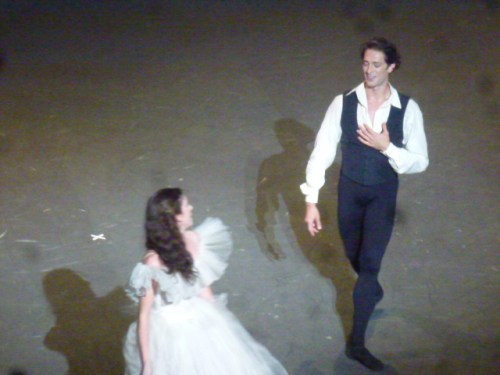
 An ardent Mathieu Ganio found himself facing a Laura Hecquet devoted to smoothing down her fluffy costume and stiff hair. When Neumeier’s pas was going all horizontal and swoony, Ganio gamely kept replacing her gently onto her pointes as if she deserved valet parking. But unlike, say, Anna Karina leaning dangerously out of her car to kiss Belmondo full throttle in Pierrot le Fou, Hecquet simply refused to hoist herself even one millimeter out of her seat for the really big lifts. She was dead weight, and I wanted to scream. Unlike almost any dancer I have ever seen, Hecquet still persists in not helping her co-driver. She insists on being hoisted and hauled around like a barrel. Partnering should never be about driving the wrong way down a one-way street.
 Soirée du 13 octobre













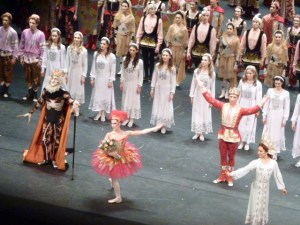 Firebird, avec son décor inspiré des icônes byzantines, sa musique subtilement étrange, ses monstres, ses sortilèges, et sa chorégraphie oscillant entre la danse de caractère (la cour de Kostcheï) et le tableau vivant (la simplicité des cercles de princesses enchantées qui séparent Ivan de la belle Tsarevna) fut certes un enchantement. Itziar Mendizabal, toujours très à l’aise dans l’allegro, le parcours et le saut, donnait une présence charnelle et animale à son oiseau de feu. À aucun moment on ne la sentait se soumettre totalement à Ivan Tsarevitch : vaincue certes, mais seulement momentanément, elle rachète sa liberté avec une fierté un peu altière. L’oiseau ne sera jamais apprivoisé. Dans le rôle du prince, essentiellement mimé, Benett Gartside développe intelligemment son personnage. Très peu prince au départ, voire mauvais garçon, il semble naïvement découvrir les rudiments de la politesse formelle lorsqu’il salue la princesse et ses sœurs dans le jardin enchanté. Dans son combat contre le magicien Kostcheï (un truculent Gary Avis, à la fois effrayant lorsqu’il remue ses doigts démesurés et drôle lorsqu’il se dandine d’aise à la vue de la bacchanale réglée au millimètre et avec ce qu’il faut de maestria), il fait preuve d’une inconscience toute juvénile. Triomphant finalement grâce à l’oiseau, revêtu de la pourpre devant le somptueux rideau de fond de Gontcharova, il lève lentement le bras vers le ciel. Mais ce geste martial est comme empreint de doute. Avant d’élever sa main au dessus de la couronne, on se demande si Ivan ne cherche pas à la toucher pour s’assurer que son destin n’est pas un songe.
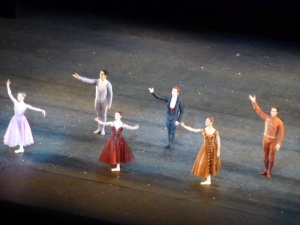 Passer de cette rutilante iconostase au simple ciel étoilé d’In The Night n’est pas nécessairement très aisé. Il ne s’agit pas que d’une question de décor ; la proposition chorégraphique est diamétralement opposée. Dans In the Night, la pantomime se fond tellement dans la chorégraphie qu’on oublie parfois qu’elle existe. Et dans l’interprétation du Royal, elle est parfois tellement gommée que l’habitué des représentations parisiennes que je suis a été d’autant plus troublé. Dans le premier couple, celui des illusions de la jeunesse, Sarah Lamb et Federico Bonelli ont fait une belle démonstration de partnering, dès la première entrée, les deux danseurs sont bien les « night creatures » voulues par Robbins. Mais cette atmosphère créée, elle reste la même durant tout le pas de deux. Dans le passage du doute, on cherche en vain un quelconque affrontement, même lorsque les danseurs se retrouvent tête contre tête dans la position de béliers au combat. Reste tout de même le plaisir de voir la mousseuse Sarah Lamb, ses attaches délicates et l’animation constante de sa physionomie ainsi que son partenaire, Bonelli, essayant de dompter sa bouillonnante nature dans l’élégant carcan créé par Robbins. Dans le second pas de deux, Zenaida Yanowsky et Nehemiah Kish font preuve à la fois des mêmes qualités mais aussi des mêmes défauts que Lamb-Bonelli. Leur couple a l’élégance et le poids requis, mais les petites bizarreries chorégraphiques propres à Robbins sont par trop adoucies. Lorsque la femme mûre s’appuie le dos sur le poitrail de son partenaire, on aimerait voir sa quatrième devant tourner plus dans la hanche car à ce moment, la compagne soupire par la jambe. L’emblématique porté la tête en bas est également négocié d’une manière trop coulée. On en oublierait presque que le couple vient d’avoir un furtif mais tumultueux désaccord au milieu de son océan de certitudes.
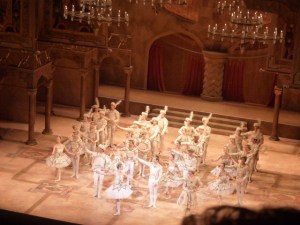 Après ce pic émotionnel, Raymonda, Acte III demande de nouveau un sévère effort d’ajustement. D’une part parce que les fastes petersbourgeois et académiques du ballet paraissent là encore aux antipodes de l’impressionnisme sensible de Robbins mais aussi parce qu’il faut oublier les harmonies cramoisies et or de la version parisienne pour le crème de cette production datant (un peu trop visiblement) des années soixante. Quelques idées seraient cependant à emprunter par Paris à cette présentation : le montage qui réunit dans cet acte III toutes les variations dévolues à Henriette et Clémence sur les trois actes et l’usage d’un décor (quoique moins outrancier que ce délire romano-byzantin pâtissier que possède le Royal). En revanche, si la reprise londonienne de Raymonda Acte III se voulait un hommage à Noureev, le but ne semble pas atteint. Le corps de ballet, aussi bien dans la Czardas que dans le grand pas classique hongrois émoussait par trop la chorégraphie polie par Noureev d’après l’original de Petipa. On se serait plutôt cru devant une version « russe » que devant une interprétation « occidentalisée » de ce classique.
 James
James Albertina
 Cléopold
 Fenella
 Les Balletonautes
 Mini Naila
 Les Balletonautes