Ballet du Capitole de Toulouse, « Maîtres américains » (Hindemith, Adams, Balanchine, Martins). Représentation du dimanche 18 octobre 2026.
Le ballet du Capitole de Toulouse présentait en début de saison un programme « Maîtres américains ». C’était notamment l’occasion de revoir un des chefs-d’ œuvres incontournables du répertoire néoclassique du XXe siècle, les « Quatre Tempéraments » de George Balanchine, qu’on n’a pas revu depuis 2008 à l’Opéra de Paris, trop occupé à engranger les œuvres mineures du maître sous les directions Millepied et Dupont.
******
************
Néanmoins, on est étonné de lire dans la plaquette que « L’Opéra national du Capitole de Toulouse remercie l’Opéra national de Paris – Direction Alexandre Neef pour le prêt des costumes des Quatre Tempéraments. ». Car l’histoire du ballet de Balanchine est en partie marquée par un rejet de la production d’origine par le chorégraphe lui-même. En effet, en 1946, le ballet avait été présenté avec les costumes de l’artiste surréaliste Kurt Seligmann qui avait pris au pied de la lettre le propos symbolique et psychologique de la partition. Les danseurs et danseuses étaient affublés de costumes colorés asymétriques et de casques ou de perruques outrancières. Le ballet, conçu par Balanchine comme une sorte de Thèmes –car il y en a trois- et variations –au nombre de quatre- ressemblait plutôt aux ballets symphoniques lourdement symboliques conçus à la même époque par Léonide Massine. Balanchine se débarrassa définitivement de la production Seligmann en 1952 et opta pour des justaucorps noirs et collants clairs pour les filles et des justaucorps blancs et collants noirs chez les garçons. C’est l’uniforme qu’il employa d’emblée pour Agon en 1957. Les « Black & White Ballets » sont sensé être exécutés en costume de répétition. On sourit donc à l’idée qu’il ait fallu recourir à un prêt pour présenter l’un d’entre eux au Capitole.
Mais faisons fi de l’anecdote. Car dès les premières mesures de la partition motoriste de Paul Hindemith, élégante et mystérieuse sous la baguette de Michael Balke et avec Mihaly Berecz au clavier, on a déjà la chair de poule.
Dans le premier thème, Aleksa Zikic et Aleksandra Sudoreeva, très sobres, exposent la base grammaticale du ballet. Les développés-quatrième au sol et les flexes sont mis en valeur de manière exquise. Ils contrastent à merveille avec le duo dynamique défendu avec brio et musicalité par Kayo Nakazato et Alexandre De Oliveira Ferreira. On y trouve, comme motif d’exposition, tout le répertoire du partenariat penchés-décalés, exécutés en promenade, qu’on retrouvera plus tard dans les variations. De même, apparaissent les portés où la danseuse, exécutant des entrechats, se retrouve en écart sur les jambes en seconde de son partenaire qui seront utilisés par l’ensemble des couples solistes lors du final. Le troisième thème convainc un peu moins. Jeremy Leydier, excellent partenaire, nous semble un peu grand pour Nina Queiroz, pourtant juste ce qu’il faut serpentine. Le porté-poisson inversé souffre un peu de cette différence d’échelle. Du coup, il nous parait trop subreptice.
Les Quatre Tempérament. Mélancolique. Kleber Rebello, Sofia Camininti et Juliette Itou. Photographie David Herrero.
Dans le mouvement Mélancolique, le soliste masculin est aux prises avec deux solistes, représentant les pensées noires auxquelles s’ajoutent quatre autres qui rentrent en fond Cour en exécutant une série de grands battements agrémentés d’oscillation du bassin. Kleber Rebello y est tout à son affaire. Il a été jadis dirigé à Miami par Edward Villella, un des danseurs masculins les plus emblématiques de Balanchine et fondateur de la compagnie. On retrouve dans son interprétation ce qui nous avait marqué lorsque le Miami City Ballet était venu aux Etés de la danse en 2011 : la préservation de l’inspiration expressionniste de la chorégraphie trop souvent lissée aujourd’hui. Au-delà des jetés planés ou des arabesques tenues suspendues, Rebello assume crânement aussi les contorsions tourmentées voulues par le chorégraphe. On admire aussi la souplesse de son dos lors de sa sortie en marche arrière, les bras étirés vers la coulisse.
Le mouvement Sanguin, un pas de deux aux inflexions jazzy met aux prises une danseuse un peu mystérieuse et distante avec un partenaire qui semble effectuer un exercice périlleux de domptage tandis qu’un corps de ballet féminin rend visible, par des marches agressives sur genoux pliés, la tension sous-jacente qui ne demande qu’à exploser. Le couple de cette matinée ne convainc pas. Natalia de Froberville, pas assez dans le sol, avec des déhanchés coquets et un sourire plaqué « flirty » semble avoir confondu « Four Ts. » et « Who Cares ? ». Ramiro Gomez Samon est pourtant un excellent et solide partenaire.
Les Quatre Tempéraments. Flegmatique. Simon Catonnet, Nino Gulordava, Solène Monnereau, Emilie Reijnen et Marie Varlet.
Avec Flegmatique, on se souvient qu’avec Balanchine le grand ballet académique de Petipa n’est jamais loin. Ce solo masculin accompagné de quatre solistes féminines multiplie pourtant les poses hétérodoxes : en dedans, ports de bras et mouvements de poignets contournés. Mais quand Simon Catonnet, qui tire parti de ses grands abatis, danse, il se transforme, notamment durant le passage de danse de caractère, en véritable chat digne d’un troisième acte de la Belle. La pose finale avec les filles offre une forme de respiration suspendue. Un peu refroidi par le passage précédent, nous voilà de nouveau entièrement captif du ballet.
Les Quatre Tempéraments. Colérique. Tiphaine Prévost (et Nina Queiroz, Kayo Nakazato, Natalia de Froberville et Aleksandra Sudoreeva). Photographie David Herrero.
Et ce n’est pas le mouvement Colérique qui nous en a fait sortir. Dans ce passage, Tiphaine Prévost est un modèle d’autorité et de célérité. Il y a une acuité dans sa technique qui contraste merveilleusement avec des moments plus moelleux : les ronds de jambes au sol avec ports de bras qui succèdent aux combinaisons étourdissantes de pirouettes toujours terminées net. On admire la leading lady qui semble commander tous les solistes et l’excellent corps de ballet du Ballet du Capitole vers ce final à la fois géométrique et aérien qui nous donnera sans doute toujours des frissons. Comme on regrette de ne pas l’avoir vu dans le pas de deux Sanguin aux côtés de Philippe Solano également distribué sur le mouvement Mélancolique.
Les Quatre Tempéraments. Final. Photographie David Herrero.
******
************
Après Four Temperaments, Fearful Symetries peut paraître un peu léger. On pourrait bien questionner sa place dans un programme « maîtres américains ». Peter Martins fut certes un danseur charismatique dans les années 1970, très souvent partenaire de Suzanne Farell. A la mort de Balanchine en 1983, il devint co-directeur artistique du New York City Ballet avec Jerome Robbins puis dirigea seul la compagnie lors d’un –trop- long règne qui ne s’est achevé qu’en 2017. Mais son empreinte chorégraphique est somme-toute mineure. Martins fut un faiseur, pas toujours inspiré, qui recycla des décennies durant l’héritage de Balanchine et de Jerome Robbins.
Néanmoins, Fearful Symetries est une de ses plus authentiques réussites. Sans présenter la fantaisie du Vers un Pays Sage de Jean-Chistophe Maillot, posée sur la même partition, il développe un répertoire bien construit des acquis du néo-classique américain. Avec la musique répétitive de John Adams, le début du ballet ressemblerait presque à une version édulcorée de Glass Pieces de Robbins. Les éclairages rouges sont soignés et les costumes aux harmonies de rose, de pourpre et de mauve sont plaisants à l’œil.
Fearful Symetries. Natalia de Froberville et Ramiro Gomez Samon. Photographie David Herrero.
Le matériel chorégraphique joue sur la répétition de motifs comme la musique le fait par l’ostinato : on distingue beaucoup de temps levés arabesque, des sauts en tournant avec développés 4e devant pour les garçons et des entrées en piqué arabesque pour les filles. La musicalité est bien un tantinet plaquée et illustratrice du rythme ou de la mélodie mais l’équilibre entre les groupes et les solistes est bien assurée.
Natalia de Froberville semble plus à sa place dans ce ballet. On apprécie sa célérité et son beau ballon. Ramiro Gomez Samon déploie la bonne énergie. Le Quatuor des demi-solistes est très bien servi par quatre danseurs puissants et justes. Kleber Rebello, associé avec Alexandra Sudoreeva dans un pas de deux, soutient de la hanche et de la poitrine les arabesques en déséquilibre de sa partenaire avant de la manipuler vers une arabesque penchée. On penserait presque à une section du pas de deux de Diamonds. Le duo Solano-Nakazato est un vrai duo des chats avec poignets cassés et touchés-évitements. Ces deux danseurs sont toujours palpitants ensemble ou en solo.
Fearful Symetries. Kayo Nakazato et Philippe Solano. Photographie David Herrero.
Comme pour la pièce de Maillot vue à Paris, le ballet se termine de manière intimiste, ici sur les deux couples.
L’ensemble est esthétique. Cela passe bien en fin de programme et, contrairement à Quatre Tempéraments, le Capitole n’a pas eu à demander des prêtes de costumes puisque le ballet était entré au répertoire du temps de la direction de Nanette Glushak. « Maitres américains », en dépit du fait qu’il ne comporte que deux ballets, est donc un programme bien construit qui brille de mille feux tant il est délivré avec conviction et maestria par le Ballet du Capitole.
Aller ensemble à une représentation et savoir que l’on va écrire chacun à ce sujet peut vous gâcher une soirée. Les entractes sont rien moins que récréatifs. Relire ses notes ou les écrire, ne pas polluer les impressions de l’autre avec les siennes propres. Quel sujet de conversation reste-t-il dans l’attente de la sonnerie? « Tu y crois, toi, que c’est notre dernière saison à Garnier avant cinq ans? » … « Really! Shut up! Too depressing« . Voilà un peu l’exercice auquel se sont astreints Cléopold et Fenella.
Et puis il y a découverte du texte de l’autre. Et disons que cette soirée de Manon du 7 octobre a fait l’unanimité. Nos rédacteurs ont-ils été victimes d’un phénomène paranormal de transfert de pensée? Où s’agit-il d’une intervention occulte de Poinsinet, le vrai fantôme de l’Opéra, qui s’était pourtant tenu fort tranquille ces dernières saisons?
******
************
My cast for October 7th changed in the last minute due to injury. That is totally normal. Alas, in this case, the stars whirled around each other but never managed to form a constellation.
I’ve long been softly disappointed by Baulac/Louvet, too often cast together since the beginning of their careers. Both are lovely dancers, yet they only bring out the best in their partners — and themselves — when they get paired with others. (For example, recently Louvet magnetized Sae-Un Park in Giselle and Baulac unleashed Paul Marque in La Bayadère). I was hoping that this time, with maturity, the spark would ignite.
It didn’t.
Germain Louvet continues to dance with his innate and extended suave elegance. He acted up a storm. Dramatic intention infused every yearningly-stretched arabesque from toe up to finger. But he was acting in a void.
With only one of them “on” and the other not incandescent, the partnering inevitably lacked élan and daring. Léonore Baulac was most striking only at those extreme moments when Louvet was not in her radar at all: her horrified reaction to the rat seller, her howl at her brother’s death, her almost imperceptible fade into nothingness as she was taking her last breath (by now totally unaware her lover was still there). He was tenderness incarnate throughout. She was…nice.
In real life, when you are young, you are confused and make an awful lot of stubborn mistakes. You aren’t quite the “you” you will become, but already a real person with at least some opinions. Baulac’s very delicate, exceedingly passive, Manon seemed to have no inner life at all: a blank slate that even she observed from the outside. Who on earth coached Baulac into this “I’m not really of this world” persona? On stage you need to project that at least you have some idea of who your character is. On the way home on the metro I found myself humming a bit of The Witch’s song from Sondheim’s Into the Woods: “You’re not good, you’re not bad, you’re just nice.” I couldn’t remember the next line at first. Aha. Baulac’s Manon could have been this with stronger coaching: “I’m not good, I’m not bad. I’m just right.”
As to the second couple, Manon’s brother Lescaut (Antoine Kirscher) and his mistress (Silvia Saint-Martin), the less said about them the better. He was jerky and bouncy and look-at-me. Why on earth would a Des Grieux accept any life hacks from this Jack-In-The-Box? Saint-Martin as the Mistress struck me as overly business-like and borderline aggressive. Saint-Martin also didn’t get the flirty charm that can be infused into the toe-tap swishes and just fumbled over them instead (at least that’s what it looked like). What united these characters was, alas, their utter lack of charm/ a sense of humor/play. The “drunken pas de deux” managed not to inspire a single giggle out of the audience and not one hand clapped once it was over.
But to end on a positive note, Osiris Onambele-Ngono has blossomed into a skillful character actor who crafts his minor, but essential, roles with scenic intelligence. As Catalabutte recently, Onambele-Ngono was one of the few in all the Sleeping Beauties I’ve ever seen who approached the role as an exercise in wounded dignity rather than in high camp. His turn as The Jailor on October 7th kind of saved the evening for me. What MacMillan devised for The Jailor clearly signals lascivious sadist from the get-go. All you have to do is let the role speak for itself. If you overplay it, yuck, it becomes so beyond vulgar you tune out. The Jailor has rarely scared me more: here we had a monolithic brute of few words. Onambele-Ngono underplayed the role with a laconic gravitas that chilled me to the core.
******
************
La saison a commencé pour moi –est-ce de mauvaise augure ?- par un changement de distribution pour cause de blessure. Bleuenn Battistoni, qui devait être Manon aux côtés de Marc Moreau, a dû abandonner ses premières dates. J’ai fait contre mauvaise fortune bon cœur parce qu’après tout, j’avais envie de découvrir aussi la Manon de Léonore Baulac qui nous a gratifié d’une très émouvante Nikiya en fin de saison dernière. On allait certes troquer un Quentin de la Tour (Battistoni) pour un François Boucher (Baulac) mais on restait dans le XVIIIe siècle teinté d’anachronique créé par le décorateur et costumier Nicholas Georgiadis.
Malheureusement, toute la distribution n’avait pas été changée et Antoine Kirscher était Lescaut. Ce premier danseur est toujours trop tendu dans la technique : ainsi, sa première variation est seiche, sans aisance, et toujours au bord du déséquilibre quand on attendrait sureté et maîtrise durant cette scène d’exposition. A l’inverse, dans la scène de soulographie à l’acte 2, les déséquilibres manquent cruellement. Les chutes apparaissent négociées et le comique est cousu de fil blanc. Il avait mieux réussi son incarnation lors de la dernière reprise. Soyons gré à l’Opéra d’avoir trouvé à monsieur Kirsher une partenaire à sa mesure dans la Maîtresse. Sylvia Saint-Martin est au moins aussi minérale que son acolyte. Ses redescente de pointes dans la variation chez Madame sont douloureusement brusques. Si je n’ai jamais vraiment vu Antoine Kirscher détendu sur scène, j’ai des souvenirs autres mais désormais lointains de Sylvia Saint-Martin. On espère toujours une épiphanie chez cette danseuse qui fut jadis élégante et moelleuse.
Le reste de la distribution ne nous convainc pas non plus. En ce soir du 7 octobre, Rubens Simon, qui fut la saison dernière un palpitant Mercutio, cochonne ses pirouettes attitude en premier mendiant. Ni Florimond Lorieux en Monsieur G.M. ni Sofia Rossolini en Madame ne retiennent particulièrement notre attention. En petite prostituée travestie, Charlotte Ranson se montre fort insipide. Seul le duo antagoniste des courtisanes, celui du croc en jambe final, fonctionne. Eléonore Guérineau est particulièrement à son affaire.
En Des Grieux, Germain Louvet fait une jolie entrée, mélange de timidité et de charme. Dans sa variation de séduction, on aurait bien aimé un piqué arabesque devant Manon plus soutenu mais son personnage de jeune tendron un tantinet naïf et idéaliste passe bien la rampe. Il reste spectateur des manœuvres de Lescaut, triche à son corps défendant, et a des désespoirs lyriques. Malheureusement, sans doute en raison du remplacement inopiné de la distribution initiale, le partenariat avec Léonore Baulac accroche un peu. Il y a du négocié dans les portés et les chutes-embrassements finales se font toujours un peu avant ou après la musique.
On aurait pu aisément passer sur ces aspects techniques et se laisser malgré tout emporter par l’histoire. Malheureusement, Léonore Baulac peine à retrouver son personnage de 2023. On l’attendait ingénue un peu inconsciente et on la découvre perdue. Durant les deux premiers actes, elle n’est ni pure ni séductrice. La chorégraphie n’est pas incarnée. On ne parvient pas à lire ses intentions dans le trio avec Lescaut et G.M. à l’acte 1 et la scène avec les gentilshommes chez Madame à l’acte 2 semble traîner en longueur. On a bien un léger espoir au moment de l’épisode du bracelet qui clôt l’acte mais tout cela s’essouffle au moment de la dispute.
En fait, le seul moment où l’on croit dans la Manon de Baulac, c’est dans la scène assez insoutenable avec le geôlier à l’acte 3. Monolithique et implacable, Osiris Onambele-Ngono est effrayant et Léonore Baulac, brisée et pantelante, donne enfin un aperçu de ce que pourrait être un jour sa Manon. Ajoutez à cela un Germain Louvet touchant dans sa variation de désespoir et on serait prêt à se laisser emporter –enfin. Las, le pas de deux de la mort retombe dans la technique assurée plus qu’incarnée : la tête en bas dans les bras de Louvet, Baulac développe ses jambes en écart d’une manière si décidée qu’on perd de vue la mourante.
On s’attriste donc de sortir de notre cher Palais Garnier avec le cœur vide et l’œil sec.
La suite des aventures de vos rédacteurs pour des représentations isolées, bientôt sur Les Balletonautes!
Léonore Baulac : Manon en 2023Germain Louvet lors du Grand défilé 2026Antoine Kirscher : Lescaut en 2023Sylvia Saint-Martin lors du Grand défilé 2026
Une nouvelle saison est lancée et, comme la tradition encore récente le veut, elle l’a été par une soirée de Gala.
Passage obligé du pince-fesse, attendu et convoité par tout balletomane qui se respecte, est le Grand Défilé du Corps de ballet : 154 danseurs, une grosse centaine d’élèves de l’Ecole de Danse de Nanterre et 24 membres du Junior Ballet. Le lent et grandiose cérémonial avait une résonnance particulière cette saison puisqu’il s’agissait de la dernière descente de plateau pour Dorothée Gilbert qui fera ses adieux à la scène dans l’Histoire de Manon le 15 octobre. Le défilé sera répété le jour suivant pour la soirée Paysages intérieurs qui ouvre la saison, mais c’est Amandine Albisson –déjà !- qui fermera le bal des Dames.
Dorothée Gilbert accomplit sa descente avec la grâce sans affèterie qui l’a caractérisée pendant toute sa carrière. On se dit déjà qu’elle va cruellement manquer au public et à la compagnie. Fenella la verra une dernière fois en Manon le 12 octobre.
Passé ce moment d’émotion, lesté d’un peu de nostalgie supplémentaire par la présence de Mathias Heymann, le doyen des étoiles masculines qui n’apparait plus guère que dans ce défilé, on se préparait à un traditionnel programme de gala, fait de petits morceaux de danse sans réelle cohérence programmatique.
*********
************
Force est d’avouer que nous avons été agréablement surpris même si la première pièce nous a semblé un peu anecdotique. Ring of Saturn, par le chorégraphe brésilien Juliano Nunes, est un pas de deux pour Hugo Marchand et Germain Louvet posé sur le très suave Agnus dei de Samuel Barber. Vêtus de chemises identiques à grosses rayures aux tons vifs, signées Chanel, les deux danseurs étoiles de l’Opéra exécutent un pas de deux à doux-nœuds et multiples promenades attitude et autres grandes arabesques penchées. Les bras en anse forment de coquets entrelacs censés sans doute, avec l’aide des motifs des chemises, figurer l’anneau satellitaire qui donne son nom à la pièce. C’est joli et sans aspérité. Cela s’oublie aussi vite qu’on l’a vu mais a présenté l’avantage de porter la première partie du spectacle au-delà de la demi-heure syndicale.
On se dit néanmoins qu’on n’est décidément pas convaincu par l’apport esthétique de la maison Chanel dans le domaine du costume de danse, que ce soit sur le défilé des étoiles féminines ou sur les intermèdes d’occasion.
On attend la suite.
********
************
Et celle-ci est illuminée par le Chef-d’œuvre attendu de la soirée : Vers un Pays Sage de Jean-Christophe Maillot, une pièce de 1995 défendue par douze excellents danseurs de la compagnie qui nous donnent l’impression qu’ils sont le double tant ils déploient d’énergie.
On analysera ce ballet plus en détail lorsqu’il sera associée au Rearay de William Forsythe à l’occasion du programme Paysages intérieurs. On le verra le 2 novembre prochain.
********
************
Busk, une pièce de 2009 par la chorégraphe Aszure Barton, qui après un second entracte clôt ce programme de gala, ne démérite pas après Vers un Pays Sage et s’intégrera certainement bien dans le programme Paysages intérieurs.
Le rideau se lève sur une scène noire où est positionné, au fond, un escalier-estrade. Côté jardin sur le devant de scène, un couvre-chef est abandonné retourné près d’un corps étendu, emmitouflé. Sur l’escalier, un danseur en pantalon, hoodie noir et gants blancs commence à ce mouvoir. Sa gestuelle est énergique et cartoonesque. Tel un clown, il s’administre des claques à répétition. Il est ensuite rejoint par neufs autres danseurs, vêtus du même attirail sombre. Ils se meuvent d’abord sur des chœurs profanes empruntant la même gestuelle saccadée. Les marches sur genoux pliés scandent le pot-pourri musical diffusé par des enceintes. Le groupe, qui compte jusqu’à dix-huit danseurs et danseuses, figure une cohorte de moines facétieux qui s’agrègent ou se séparent, formant parfois une hydre qui se déploie en éventail. Les visages, éclairés à la lumière rasante, se détachent des capuches comme des masques de comédie. Busk offre aussi une variation masculine sur des airs qui évoquent la musique d’Europe centrale ou le danseur, torse nu, développe une gestuelle plus fluide avec beaucoup de ports de bras. Un autre solo encore plus intimiste se fait tandis qu’une boule à facettes propage ses pastilles lumineuses dans la salle. Ces passages soli alternent avec le groupe monacal très énergique. La chorégraphie réagit et fait corps avec la musique. Selon la glose, qu’on n’avait pas encore lue, Busk est « une rébellion contre un Monde qui passe sans s’attarder et contre un système qui ne considère pas assez ses artistes ». On est heureux de l’apprendre après coup. Reste que la pièce, en dépit de son propos abscons, est assurément efficace.
On sort donc de l’Opéra avec le sentiment d’avoir vu deux pièces substantielles. Quel meilleur début de saison pouvait-on espérer ?
Après l’explosion chromatique des danses basques au Parc Mazon, on s’est dirigé vers le théâtre du Colisée, la salle dédiée aux spectacles plus intimistes. Le fil semblait devoir se poursuivre. Mizel Théret, natif d’Hasparren, a commencé sa formation par les danses traditionnelles basques. Si son histoire a évolué vers la danse contemporaine, il a choisi pour sa création Hegoak les compositions pour piano d’Elodie Buffalo Mellodi qui, selon la note d’intention, utilise parfois des thèmes basques.
********
************
Samedi 12 septembre : le lent, le lent et le rapide…
La rupture est néanmoins drastique. La scène est nue. Le mur brut de fond de scène est peint en noir. Mizel Théret entre à jardin sur le devant de scène. Il propose d’emblée une gestuelle de bras sémaphorique : l’un tendu géométriquement, l’autre replié à angle droit. Pendant toute la pièce, il évolue souvent dos au public. Sa chorégraphie est faite de marches de côté par croisement des pieds. Le buste s’anime enfin. On reconnait alors des soupçons de technique Cunningham : une jambe de terre et dégage seconde au sol en parallèle, des triplettes esquissées, un certain rythme dans leur exécution.
Par ses marches courbées avec croisement des jambes et bras étendus vers l’arrière, par une forme de proskynèse à un moment, on reconnait les évolutions d’un volatile (« Hegoak » signifie « Ailes » en Basque). On hésite entre un cormoran ivre ou une mouette cherchant sa pitance sur la plage. Le danseur-chorégraphe fait le tour du plateau avec des pas de côté en-dedans en-dehors et des roulis d’épaule.
HEGOAK, chorégraphe et interprète MIZEL THERET. Photographie de STEPHANE BELLOCQ.
Une marche sur genoux pliés, l’amorce d’une demi-pointe semblent suggérer un envol bientôt contrecarré par une galipette en arrière. Les sauts sont pratiquement inexistants. La danse est ancrée dans le sol.
A part une section plus syncopée où Théret se couche et roule sur lui-même, le rythme général de la pièce reste uniformément lent. La gestuelle développée par le chorégraphe est assurément captivante mais l’absence de développement de la pièce questionne sur sa durée. Méritait-elle vraiment une heure de spectacle?
********
Le Spectacle suivant, au Théâtre Quintaou d’Anglet, semblait rester dans une tonalité similaire, dans le noir et dans la lenteur. Contre-nature de Rachid Ouramdane commence avec ses interprètes émergeant au milieu des fumigènes. Ils se mettent en avant puis s’effacent individuellement. Les premiers embrassements des corps sont subreptices. Puis viennent des premiers portés à l’épaule à deux ou à trois alors que d’autres danseurs jouent les satellites, à moins qu’ils ne soient des pivots. On admire déjà la gestion des groupes. On s’étonne également de la réelle homogénéité dans la langage dansé des dix interprètes, réunis à l’occasion de cette pièce (la Compagnie de Chaillot est un collectif et non une troupe permanente), masculins ou féminins, qui viennent indifféremment du monde de la danse contemporaine, de l’acrobatie et de la voltige.
On est tenu captivé par des changements de rythme dans la pièce. Une section rapide et spectaculaire avec des lancés de danseurs, dont les pieds ne semblent plus toucher le sol, des portés inattendus – le porté « statue », les glisses spirales – nous soulèvent littéralement de notre siège. Mais on n’est jamais emmené sur le terrain de la simple pyrotechnie. De triples portés sur les épaules suivis de chûtes vertigineuses à couper le souffle nous parlent avant tout de confiance en l’autre. Les multiples roulés boulés des danseurs qui parfois ne semblent pas poser un pied sur scène alors qu’ils sont « voyagés » par leurs partenaires d’une coulisse à l’autre nous plongent dans une vague constante d’interactions humaines.
Lors d’un retour à la lenteur, sur fond vert ou sur cyclo à projections sylvestres, un mystérieux personnage en hoodie apparaît. On se demande s’il représente une menace. Vient alors une section ou des danseurs, groupés par quatre ou cinq semblent ostraciser un danseur resté seul. Le groupe s’agrège et le rôle de l’ostracisé passe à un autre danseur. Après cette section d’exclusion, on accueille presque avec soulagement un duo de garçons exécutant des galipettes en duo, charnelles sans être à proprement parler sexuelles. Dans la scène finale, une voix off nous parle du rapport d’un enfant avec la mer qui «voudrait nager comme un dauphin… » : il s’agit sans-doute du mystérieux être encapuchonné de la section précédente qui nous avait d’abord paru représenter une menace potentielle.
Enfin, c’est le retour au calme et au vide. On n’a pas senti l’heure passer…
********
************
Dimanche 13 septembre : fraternité, sororité
Le jour suivant, retour au Parc Mazon toujours écrasé de soleil. Au sol, un lino d’un jaune pétant. La compagnie Skorpeion présentait « From the ground » du chorégraphe hip-hop Brice Larrieu. Avant le début de la représentation, les cinq interprètes, tout de noir vêtu, s’étreignent pour se communiquer l’énergie nécessaire à la performance qui va suivre.
La pièce commence sous les accords d’une musique atmosphérique avec chœurs éloignée à priori de la danse hip hop. Un danseur isolé, étendu au sol, se relève péniblement. On attend des bourdonnements ou des sons de canons. Sommes-nous propulsés au milieu d’une guerre ? Les danseurs chutent au ralenti puis avancent comme sous des tirs ennemis. Ils se tiennent par le poignet. Quelle ligne noire veulent-ils briser ? Le groupe s’agrège parfois pour soutenir l’avancée ou empêcher le recul. On est pris dans une vague de tournoiements hip hop. On entend des respirations. Il y a des tournoiements au ralenti décalés ou à l’unisson. Le poids au sol est rendu palpable, ce qui rend les street-révoltades aériennes encore plus impressionnantes. Les danseurs font également des sortes de diagonales en chaine accompagnées de portés acrobatiques. Les bassins oscillent et les bras se tendent vers le ciel. Cette gestuelle est captivante et la composition est vraiment maîtrisée et fluide.
A partir d’une section où la bande son délivre des paroles à messages, la pièce se perd un peu. La gestuelle reste captivante mais la danse ne nous raconte plus d’histoire à l’instar de cette dernière section, efficace, avec l’ensemble des danseurs, accomplissant des sauts pyrotechnique. On a passé sommes toutes, un excellent moment.
********
Au Théâtre du Casino municipal, la palette chromatique des costumes de danse reste la même. Le Collectif Ibawa qui présente Gaua (« La Nuit » en Basque), rassemble quatre interprètes féminines vêtues de robes noires corsetées évoquant un XIXe siècle tardif, celui de La Casa de Bernarda Alba. Trois formes rondes sont suspendues en l’air. Les quatres danseuses émergent de la pénombre sur une musique atmosphérique anxiogène. La gestuelle extrêmement lente. Cette première apparition est intrigante. Les danseuses ressemblent à une hydre aux multiples bustes qui lèveraient les poings. On pense aussi à la statuaire. Elles ressemblent à quelques suppliciées de Rodin ou de Camille Claudel.
Mais passé cette première séquence bien construite, on tombe dans un répertoire de poncifs. Cris silencieux, transes, rires tournant aux pleurs, grands pliés seconde qui ouvrent les jupes, contraposti suggestifs en culottes à franges, bras agités et gratouillis compulsifs de joue, tout semble appartenir à un attirail revendicatif éculé.
Des rugissements muets en spasmes d’accouchement, de passages du suave à l’animal par des femmes confrontées à leur rôle social attendu, on comprend d’emblée que la femme est oppressée. C’est malheureusement vrai mais sous cette forme, cela a été dit et redit au point d’être démonétisé. C’est d’autant plus dommage que la maîtrise du langage chorégraphique est bonne. Une section avec des jetés en groupe ou des spirales Bauschiennes font leur effet. Les danseuses se muent parfois en derviches tourneurs. Mais les chorégraphes et interprètes semblent plus à l’aise dans a miniature chorégraphique que dans le temps longs qui les conduit à la redite. Il faudra gagner en souffle pour porter véritablement ce propos nécessaire.
********
************
Voilà déjà une nouvelle édition du Temps d’Aimer la Danse qui s’achève pour nous. Qu’on soit entièrement conquis ou qu’on ait des réserves à apporter, on est reconnaissant de pouvoir être confronté année après année à des courants de la danse actuelle. A chaque fois, les rencontres ont été esthétiquement et intellectuellement stimulante.
En attendant la prochaine session, sous une autre direction…
Commentaires fermés sur Le Temps d’Aimer la Danse 2026 (3/3) : Solitudes ou Rencontres en Noir
Thierry Malandain a créé le CCN Malandain Ballet Biarritz. Pourtant, il aimait à dire qu’il n’était pas arrivé sur une terre vierge ou en friche. La danse basque a une histoire peut-être aussi ancienne que sa langue et sa culture mystérieuse et ancestrale. Pour cette édition du Temps d’Aimer 2026, elle était d’ailleurs particulièrement à l’honneur.
********
************
Samedi 12 septembre…
Leinua Dantza Taldea. Place Saint-Charles
Ma première étape était sur la charmante place Saint-Charles, située sur les hauteurs, au-dessus de l’Eglise russe et du Grand Hôtel de l’Impératrice. On a beau n’être qu’à 500 mètres de la Grande plage, on se croirait sur la place d’un village. Les commerces de bouche le disputent aux restaurants et, en ce jour de fête, les barnums qui ont éclos sur l’agora sont remplis de tables couvertes de nappes en papier n’attendant que leurs convives qui ne tarderont pas à arriver. C’est dans ce cadre évocateur que le groupe Leinua, une troupe de jeunes interprètes amateurs, présente Harilka, un moment dansé condensant la tradition des danses festives. Les trois chorégraphes, tous issus de la compagnie et aujourd’hui danseurs professionnels, ont construit une séquence qui déploie de manière graduelle les caractéristiques de ces danses traditionnelles et sociales.
Les jeunes interprètes ne sont pas affublés des impressionnants et couteux costumes des cavalcades ou des mascarades. Ils portent des chemises longues bordées de dentelle et ceinturées de bleu à la taille et aux bras. Leurs grands bérets, du même azur sont parsemés de fleurs. Sous les culottes et les chaussettes hautes en crochet, les espadrilles sont agrémentées de rubans assortis.
La danse commence très simplement par une chaîne ou Soka-Dantza. Les danseurs s’inscrivent en cercle sur la place publique. Au début, il semble ne s’agir que de simples marches mais on se rend compte assez vite des angles que prennent les jambes, de profil quand les bustes sont de face ou au contraire avec des épaulements quand les jambes s’alignent avec le bassin. Les pas basques s’infusent lentement dans la chaine. Les danseurs la brisent subrepticement pour marquer un tour en l’air. Apparaissent des formes de temps levés et des cabrioles simples. Puis la chaîne offre à chaque danseur un moment individuel où il accomplit, selon ses compétences du moment, un pas de répertoire : on reconnait le répertoire des Jauziak (avec sa forme de cabriole). Les plus chevronnés présentent le travail batterie en espadrille, une pratique qui ne cesse de me fasciner. La séquence suivante permet de voir les danseurs évoluer par deux pour une évocation de quadrille. Une danse des bâtons très bien réglée, dansée sans musique et scandée par la voix des danseurs, y succède. La représentation s’achève par un retour à la chaine initiale. On a été enchanté par ce joli raccourci de danse basque sur cette place inondée de soleil.
********
************
Changement de décor l’après-midi où le public s’amasse sur les gradins du fronton du parc Mazon. Des rangées de chaises en plein soleil de part est d’autres de l’espace de représentation sont d’abord boudées avant d’être investies. Au centre et au fond de cette scène de fortune, un curieux amas de franges de laine colorées figure une sorte de bête mythique. Sur des sons saturés, les cinq interprètes du Collectif Bilaka (un groupe de danseurs et musiciens implantés à Bayonne) font irruption en courant. L’un d’entre eux se place derrière les écheveaux bariolés. C’est le musicien et compositeur qui accompagne d’instruments traditionnels utilisés de manière hétérodoxe les évolutions des quatre danseurs (une fille et trois garçons) vêtus d’un thème et variation de costume noir unisexe. Les pantalons, jupes et crop-tops dégenrés font à la fois écho et contraste avec les costumes uniques mais blanc éclatant des jeunes danseurs de Leinura sur la place Saint-Charles.
Et on y reconnait bientôt aussi les mêmes dessins. Même lorsqu’ils ne se tiennent pas la main, les interprètes évoquent les cercles fermés et les chaînes de la danse basque. Les angles de jambe ou d’épaulement sont également là : même aux quatre coins de l’espace, les danseurs restent connectés. Les ports de bras sont plus élaborés et le groupe se dissocie en écho. Mais tout le répertoire de la danse basque est là : les grands rond-de-jambes, les bras frappant les cuisses et surtout le répertoire des jauziac. Le groupe se fige parfois avant de reprendre ses évolutions.
Le musicien est le premier à s’affubler des franges de laine colorées, suivi bientôt par chacun des danseurs. Les accoutrements évoquent les ours et autres monstres des temps de Carnaval. Là aussi la danse est scandée par la langue basque. Les sauts se succèdent et les chassés en tournant prennent un caractère hypnotique. La pièce s’achève presque comme elle a commencé, dans une course échevelée.
Derrière les grilles du fronton, des créatures bariolées observent les bourgeons contemporains de la tradition vivante qu’ils représentent.
DANTZARI TOPAKETA, Photographie de STEPHANE BELLOCQ.
********
************
Car prenant la suite des danseurs professionnels du collectif Bilaka, près de 150 danseurs « amateurs » de cinq groupes traditionnels basques, répartis de part et d’autre de la frontière franco-espagnole, ont envahi le large espace du double fronton dans une explosion de couleurs et de musique.
La tradition des cavalcades, mascarades et parades charivariques est en effet l’occasion d’une débauche jouissive de costumes extravagants, bardés de ganses, de plumes, de miroirs et souvent de grelots. Ouvrant le bal, la Maritzuli Kompainia de Biarritz défend à la fois l’héritage dansé des Basques mais aussi le savoir-faire et l’inventivité des costumiers pour la danse. La plupart des oripeaux déployés par les groupes successifs ont été produits par ses ateliers.
DANTZARI TOPAKETA, MARITZULI KONPAINIA. Photographie de STEPHANE BELLOCQ.
Les danseurs de la Maritzuli portent des tonnelets et des jaquettes militaires blanches bardées de deux ceintures en bandoulière, l’une jaune et l’autre bleue. Dans le passé, il n’était pas rare d’emprunter des vestes d’uniformes militaires ou civils (comme celles des facteurs) pour danser en groupe. Aucune forme n’est donc absolument fixe. Les costumes d’aujourd’hui ne sont ainsi pas figés et témoignent de l’inventivité constante de la tradition des danses basques. Pour son passage, la Maritzuli Kompainia présente des petits tours intégrés dans sa chaine de danseurs : une danse des cannes, variation de la danse des bâtons.
Le deuxième groupe est l’ensemble Bildu d’Irissarry, qui lors de trois passages alternant avec d’autres compagnies, présente des extraits de sa cavalcade, un évènement pluridisciplinaire qui n’est pas sans rappeler la forme des ballets de cour du XVIIe siècle associant musique, chant, danse et parade équestre. Les costumes sont blancs à croisillons de rubans jaunes et bleus. Les hautes coiffes d’évêque agrémentées de miroirs sont l’apanage des hommes tandis que les femmes portent des bérets.
DANTZARI TOPAKETA, IRRISSARIKO KABALKADA, Photographie de STEPHANE BELLOCQ.
Pour leur premier passage, les danseurs présentent des séquences de rondes avec batterie puis, pour la deuxième séquence, des sections en couples. La troisième intervention met hommes et femmes sur deux lignes et semble plus proche d’un quadrille.
Les groupes de la partie « espagnole » du Pays basque sont à plus grand effectif. La compagnie Udaberri de Tolosa présente ses nombreux danseurs costumés de blanc avec des ceinturages rouges et des sortes de turbans de corsaire assortis. Ils se déplacent en lignes en tenant des lances au son des binious et des tambours. Les danseurs accomplissent d’abord des assemblés et des jetés sans lâcher leurs armes de parade puis des ronds de jambe et des tours en l’air lorsqu’ils s’en sont émancipés. Ils forment finalement une grande haie d’honneur pour le groupe d’Irissarry qui vient faire son deuxième passage ; une délicate attention car les différents groupes de danseurs cultivent traditionnellement une forme de rivalité.
DANTZARI TOPAKETA, DUGUNA IRUNEKO DANTZARIAK. Photographie de STEPHANE BELLOCQ.
DANTZARI TOPAKETA, IRRISSARIKO KABALKADA, Photographie de STEPHANE BELLOCQ.
Puis vient l’ensemble Leinua de Saint Pierre d’Irube. Le groupe d’adulte, où l’on reconnait l’un des jeunes danseurs de la place Saint-Charles, présente son drapeau bleu et jaune. Les costumes sont assortis à la bannière. Il y a parmi eux un Homme cheval. Au répertoire déjà vu chez d’autres ensembles, il faut ajouter une danse en sabots. Six personnages des deux sexes en costume sombre portent des masques qui ne sont pas sans évoquer la commedia del Arte. Sont-ils les notables que viennent saluer les danseurs lors des fêtes villageoises ? Les danseurs exécutent également un fandango. Deux d’entre-eux, porte-drapeaux, tombent le béret et sont couronnés d’un couvre-chef rouge. On est fasciné par ces rituels dont la symbolique nous échappe.
La célébration chorégraphique s’achève avec la Duguna Iruneko de Pampelune. Ce groupe, particulièrement important, est central dans l’ouverture des fameuses ferias de la ville. Ici, une quarantaine de danseurs portent de grands tonnelets blancs, des guêtres à sonnailles, des plastrons rouges et des coiffes à plumes. Des danseuses « polichinelles » se glissent dans le public et plaisantent avec les enfants. Sommes-nous face à une parade charivarique ? Mais le groupe de Pampelune nous gratifie également d’une conséquente Ezpata Dantza : Les danseurs tiennent des épées de bois en plusieurs lignes serrées qui se croisent pour un effet très ballet équestre. A un moment, les danseurs se placent en arc de cercle tandis qu’un groupe au centre, en formation circulaire, soulève deux danseurs en l’air et les fait lentement pivoter. Quatre danseurs exécutent des cabrioles et de la batterie. A ce stade, on est presque ivre de danse et les spectacles en salle du soir n’ont même pas encore commencé.
DANTZARI TOPAKETA, DUGUNA IRUNEKO DANTZARIAK. Photographie de STEPHANE BELLOCQ.
Cette danse basque, même dans ses formes apparemment les plus classiques, ne cesse de se réinventer. Les chorégraphies de cette grande parade œcuménique sont pour la plupart des interprétations libres des danses folklorique traditionnelles. Tout cela démontre l’extrême richesse et l’avenir de cette pratique amateur en communauté.
Commentaires fermés sur Le Temps d’Aimer la Danse 2026 (2/3) : Thème et Variations basques
Le premier weekend de la session 2026 du Temps d’Aimer la Danse a bénéficié d’une météo glorieuse, permettant d’apprécier pleinement l’équilibre des spectacles en extérieur, gratuits, et les spectacles en salle. Cette année, on a pu alterner les émotions chorégraphiques entre la place Saint Charles, le fronton du Parc Mazon, le promenoir de la Grande Plage enfin pour une gigabarre sous la direction d’un danseur du Grand Opéra Avignon. Les spectacles en salle nous auront conduit une fois encore du Colisée à la Gare de Midi en passant par le Théâtre du Casino municipal ou le Théâtre Quintaou d’Anglet. des conditions idéales qui nous ont parfois fait presque oublier que cette édition est la dernière sous la direction de Thierry Malandain.
********
************
Prométhée de Martin Harriague. Ballet de l’Opéra Grand Avignon. Théâtre de la Gare du Midi. 19/09/2026 à 21 heures.
PROMETHEE. Ballet de l’Opéra Grand Avignon. Martin Harriague. Photographie de Stéphane Bellocq.
Alors que la passation entre Thierry Malandain et Martin Harriague au Ballet Biarritz est désormais imminente, le chorégraphe présentait Prométhée avec la compagnie dont il est l’actuel et éphémère directeur : Le Ballet de l’Opéra Grand Avignon.
Dans Prométhée, Harriague utilise la musique de l’unique ballet Beethoven, remixée par le compositeur Fabien Cali. Chorégraphié à l’origine à Vienne par l’Italien Salvatore Vigano, Les Créatures de Prométhée fut également l’œuvre d’intronisation « par effraction » de Serge Lifar à l’Opéra (il remplaça au pied levé un Balanchine souffrant mais ne rendit jamais la place). Au début des années 2000, Thierry Malandain lui-même avait réglé sur cette même partition une limpide petite Histoire de la Danse en accéléré.
Dans cet opus créé sur les danseurs du Grand Ballet Avignon, on est heureux de trouver Martin Harriague dans une posture assez proche de celle de Thierry Malandain sans renier pour autant ses propres spécificités. En effet, il offre au public un Ballet et non une simple pièce constituée d’additions de différentes séquences chorégraphiques. Il regarde lui aussi vers l’Histoire de la danse sans se départir d’une bonne dose d’humour pour éviter de tomber dans le pompeux. On est charmé par ce numéro d’équilibrisme truffé de surprises visuelles.
PROMETHEE. Ballet de l’Opéra Grand Avignon. Martin Harriague. Photographie de Stéphane Bellocq
Le premier tableau commence sur une note sombre : on se trouve dans une sorte de morgue avec deux charriots d’autopsie. Les personnages s’y meuvent au ralenti. Mais le passage offre vite sa première surprise. L’homme et la femme sur les tables de fer sont soudain manipulés par deux gaillards qui se lancent dans un concours hilarant d’ostéopathie sur-vitaminée. Les deux corps sont mis dans des positions aussi géométriques qu’improbables. Ils sont retournés à la volée tel des crêpes à la chandeleur. Le grand gars bien découplé (Kyril Matantsau) et son rival, plus compact (Evan Inguanez), ne sont autres que Prométhée –le prévoyant- et Epiméthée –l’impulsif. Ainsi agis sans ménagement, les deux corps semblent pourtant prendre vie. Prométhée, qui gagne le concours de manipulation acrobatique, continue d’expérimenter avec les deux créatures. Il semble s’amuser à faire des nœuds corporels avec ses nouveaux jouets, faisant acte de chorégraphe pour un pas de deux qui s’avère parfois récalcitrant.
La gestuelle propre à Martin Harriague est reconnaissable. On y trouve une forme de contorsionisme. Les danseurs prennent le pied dans la main pour des équilibres précaires qui débouchent sur des chutes en arrière (Prométhée). La créature du début que j’ai fini par identifier comme « Adam » fait des développés seconde le buste et les épaules projetés vers l’avant.
PROMETHEE. Ballet de l’Opéra Grand Avignon. Martin Harriague. Photographie de Stéphane Bellocq
Les pas deux quant à eux ont un petit Battle entre deux garçons ou pour une femme et un homme. Les corps ne sont néanmoins jamais simples objets performants : ils restent des êtres de chair.
La gestion du groupe est très maîtrisée. L’ensemble apparait d’abord au pas de course. Il s’intègre dans une scénographie maline qui vous plonge dans la narration non sans une subtile pointe d’humour. Dans un tableau à contre-jour, tous les danseurs s’affublent d’attributs et se figent dans une pose plastique qui n’est pas sans évoquer Canova ou le code de Terpsichore de Carlo Blasis. Mais lesdits attributs sont juste ce qu’il faut surdimensionnés pour créer une distance amusée chez le spectateur. A un moment, le corps de ballet s’agrège en un amas de corps au centre de la scène. Deux accessoires posés de part et d’autres de ce groupe suffisent à évoquer la ruse des offrandes aux dieux.
La production de Martin Harriague est à la fois belle et limpide. Le vol du feu est évoqué par un cyclo où sont projetés des flammes qui apparaissent dans l’interstice formé par deux murs de fond de scène. Lorsque le précieux magma est en possession de Prométhée, il est symbolisé d’abord par un spot rouge pointé vers le public. Par la suite, une sphère craquelée et incandescente, sorte de planète en voie de refroidissement symbolisera le don du Titan bienveillant. La scène du supplice est également très effective. Un rocher est apporté sur scène et le corps de ballet entier scande le moment en frappant le sol de la main ou encore des avant-bras. Prométhée se couche le dos au rocher et les lumières s’éteignent.
PROMETHEE. Ballet de l’Opéra Grand Avignon. Martin Harriague. Photographie de Stéphane Bellocq
Personnellement, ce tableau final aurait suffi à mon bonheur. Mais le ballet continue. Prométhée est ramené sur scène sur un des charriots roulants puis il devient le centre d’une célébration presque joyeuse où, badigeonné de blanc, il semble figurer une statue cultuelle. Il n’y a rien à redire sur la composition, mais ce moment nous apparait un tantinet superflu.
PROMETHEE. Ballet de l’Opéra Grand Avignon. Martin Harriague. Photographie de Stéphane Bellocq
********
************
Qu’importe car au fond, avec Prométhée, Martin Harriague montre clairement qu’il sait mettre en valeur une compagnie tout en développant de manière personnelle l’idiome néoclassique qu’on verra avec plaisir alterner avec des pièces de conception plus contemporaine. C’est exactement ce genre de d’avenir qu’on souhaite pour le Ballet Biarritz dont Martin Harriague va bientôt prendre la direction après presque trois décennies du glorieux règne de Thierry Malandain.
Commentaires fermés sur Le Temps d’Aimer la Danse 2026 (1/3) : Prométhée de Martin Harriague. Feu sacré
Spartacus (Sergei Bobrov). Photography courtesy of Varna International Ballet
I must admit that I have had a particular inability to take anything “Roman gladiator” seriously ever since that Saturday morning when Bugs Bunny encountered a Martian decked out in full Spartan gear, replete with scrub-brush-topped helmet, on my parents’ old TV. That goes for films as well as for ballet. So, what was I thinking as the Varna State Opera Ballet company’s Spartacus was about to begin? Uh oh.
But the desire to giggle quickly faded as I got swept up in an unusually lively and absorbing piece of total theater. On the night of July 17th in Bulgaria, Sergey Bobrov’s intelligent and subtle rethinking of an old, and odd, ballet finally convinced me that Spartacus may not be such a bad subject for a ballet after all.
While this choreographer’s training is rooted in Soviet-era hyper-athleticism and the explosive Moiseyev school of folk-dance, he gives them new verve and focus. His intelligent mélange — to which he has added a verismo approach to stage fighting, an incredibly complex vision of partnering, as well as a refreshing rejection of the old-fashioned hero/villain paradigm – serves to create a tightly narrated and endlessly inventive ballet that sweeps us along through two swift acts. The minutes of music cut from Khachaturian’s original 1954 score? I didn’t miss them at all.
This is the first time I’ve ever sat through a Spartacus with neither a sigh nor a yawn.
Bobrov is abetted in his endeavor by a vigorous company of polished dancers who share such a coherent style that you cannot tell which ones were trained in Europe or South America rather than Russia. My admiration for them only increased when, during an unexpectedly long intermission, the audience learned that during the entire first act the stage floor had been slick with condensed water due to a freak climate event. I mean, as wet as in “I just dumped three buckets on the floor.” (This would continue to be the case during Act Two, despite the heroic efforts of the cleaning crew). These kids were risking their necks, but no one out in the audience saw anything other than a committed and absorbing performance. The choreography, the narration, was that strong.
Historical Context:
The saga of the Third Servile War that ended in a bloodbath in 71 BCE, as later recounted by Plutarch and Appian, is fairly straightforward. Spartacus, a proud Thracian reduced to the status of slave-gladiator, instigates a small revolt which ultimately swells into an improvised army of around 70,000 angry men. The Romans are gob-smacked. It is noted he has a wife. His nemesis is praetor Marcus Licinius Crassus, an ambitious and brutal general, future consul of Rome. These two men have good reasons for wanting to kill each other. Although he outsmarts and outfights the Romans numerous times, to the point of almost taking out Crassus himself, in the end Spartacus was certainly killed. His body was never found; we only know that 6,000 of his followers – which included anyone from household slaves to fellow gladiators to shepherds who had just had enough – ended up crucified and left to rot all the way down the Via Appia.
History of Ballet Context:
Aram Khachaturian had composed a quite catchy Lenin-Prize winning ballet score in 1954. The subject was a clever choice, given that Spartacus had been one of Marx’s great heroes in the history of class struggles. It would be first choreographed by Leonid Jacobson for the Bolshoi in 1956. But Jacobson’s Fokine-correct abandonment of pointe shoes in the service of realism was not appreciated. Then Igor Moiseyev tried his hand at one in 1958. Ten years later Yuri Grigorovich and the Hungarian László Seregi simultaneously produced their own still-performed readings, both of which I have seen on stage.
When I first saw the Grigorovich version of Spartacus as a teenager during a Bolshoi tour to New York, I was perfectly aware that this tale of a doomed slave uprising in Ancient Rome was a piece of Agitprop, created by a man of his time and place. But I was willing to give it try.
The many things I remember I disliked about his ballet were confirmed during a Bolshoi tour to Paris in 2008: its Manichaeism; its reductive politics (it should not take three hours to illustrate the existence of slave/master and proletariat/bourgeois). Its extreme gendering also really got up the nose of this feminist: there was a muchness of manly men, and then there were “ze vimin,” also either good [wailing females in chiffon waving their arms about] or just bad [scheming hetaerae stabbing their pointe shoes into the floor]. Overly aestheticized and stylized stage battles and the etcetera of what has long come to be known as “Soviet Style Acrobatics” left me cold. It was loooong .
Seregi’s version for the Budapest Ballet seemed mildly less didactic, softer, with more focus on private drama. What I vaguely remember (it’s been a few decades) is that the subtext was an easy read: “the Russians now do unto Czechs and Hungarians as the Romans once did to their colonial subjects”.
Spartacus (Sergei Bobrov). Photography courtesy of Varna International Ballet
Good Guys/Bad Guys
One of my problems with the Grigorovich had been the paucity of vocabulary, and even how absolutely every turn or combination got done to the right.
Spartacus? A lot of head-clutching and splayed-finger angst, plus superfast chainés or rabid pirouettes to signal torment. A steady dose of grands jetés: regular, scissored, en tournant. Another problem was that Crassus the Roman General’s vocabulary didn’t differ all that much from Spartacus’s, down to the fist-clenching, the pop-out jumps, and those explosive folk-dance leaps where arms, legs and torso all arch backwards.
In Bobrov’s new Spartacus – despite the use of a full dose of classic acrobatics and heroic bouncing around — the immense inventiveness he brings to combinations means that the choreography – even when those vehement pirouettes take off — never got predictable, boring, stale. Every character had their own vocabulary. Not once did I feel a dance was being done simply because thirty-six bars of music needed to be filled.
That new thrills that can happen onstage is rare, and I praise Bobrov’s pursuit of innovation. He keeps reimagining the classic flying configurations that we in the West have oohed and aahed about ever since our first look at “Spring Waters”. But he builds upon the potential of last-second catches and holds to the point that you no longer remember which way is up or down. The variety proved energizing. My notebook ended up full of question marks. What could these things possibly be called? Chair lifts? Lap lifts? Scoop lifts? Tumble lifts? Even when Spartacus ends up only dancing with a veil (attached to…I’m not telling), the fabric responds to him and seems to be dancing itself.
Spartacus (Sergei Bobrov). Photography courtesy of Varna International Ballet
The intently focused Danylo Motkov brought fascinatingly elegant stretch and bounce to his Spartacus along with a most welcome manly softness. He humanized this superhero from the moment he ripped off his gladiator’s mask. His Spartacus never veers off into the melodramatic even when repeatedly whipping off superfast pirouettes of grief or rage (yes that one, again) or when he launches into those arched leaps with knees bent back (or forward, or in between). Motkov is also a most skilled and considerate partner. Despite the use of spectacular, sometimes impossible-looking, lifts that get pushed skywards and sideways, Spartacus’s duets with his mate, here called Achillea [Phyrgia in other versions], each have a different kind of lyricism because they are anchored in an evolving narrative.
And here Crassus concentrates more on his lovers. This really helps push the narrative along and pulls this ballet back from the manosphere. His contemptuous hatred of Spartacus will explode to a whole other level after the gory demise of one of his lovers. He’s an antagonist, not a caricature of motiveless malevolence. Crisp and complex in the role of Crassus, Vladimir Mozgovoj is a peacock in public who lets his guard down in private. I should mention that all of Mozgovoj’s manèges with double tours en tournant positively sizzled.
You wanna fight?
Spartacus (Sergei Bobrov). Photography courtesy of Varna International Ballet
Whereas in the Grigorovich version, the group movements consisted of soldiers (or rebels) prancing side by side in formation, here the cohorts got de-aestheticized, and engaged with each other in what looked like actual combat. Despite the small size of the open-air stage in Varna, entrances and exits were planned to full effect. Dancers keep pouring in and out from three and more directions. Here the soldiers and gladiators really broke loose.
You could hear clanging of metal against metal throughout this ballet. The angle of swords ferociously planted “into” an opponent are so precisely calibrated that the action felt surprisingly real. The falls of the fallen were superbly untheatrical, heavy.
Bobrov succeeds at making that abstraction, “the people,” zing by specifically allotting certain steps to only one group or personage. For example, we know shepherds had joined Spartacus’s rebellion, but Grigorovich kind of blended them into generic crowd formations. Here the Shepherds hoist their crooks, root them around earthily during folkloric roundabouts, do awkward squats, and even inch out backwards from the wings in a stunningly inventive – as well as hilarious – bent over forwards conga line that any other choreographer who sees it will definitely want to steal.
The battles are not only full of surprises but always end with flair. Bobrov turns out to be a master of the tableau vivant that pays off both visually and dramatically. Just about every scene ends with a striking visual (which I would rather not divulge).
Ze Vimin
Spartacus (Sergei Bobrov). Photography courtesy of Varna International Ballet
The women in the older productions? Lots of passive bourrée-ing around and turned-in passés for the good women as they express. Wispy arms alternate with developés front/side/back and that’s about it. The bad women do splits and wiggle their shoulders while leaning back on their knees in that decadent gypsy dance manner. Duh.
In Bobrov’s choreography the female domestic slaves are kittenish and assertive in a manner straight out of Puss n’Boots. They have swing. But most of all, Bobrov finally gets at least half of the females out of the bedroom by introducing a most refreshing and welcome plot twist that is anchored in historical record. Did you know that the Ancients do mention that the powerful and dexterous cohort of gladiators included enslaved women? Therefore, here Spartacus is conjoined to an equal with a mind of her own, a fighter, rather than to a weeping willow. As Achillea, the valiant Natalia Bobrova shape shifts from strong as a rock to pliant as a vine in a split second. Always on the alert for the next challenge, she seems to not even sweat. I rooted more for her than for Spartacus, even. Her sword drawn once again, Achillea will even face off with Crassus himself and die like a man.
The several pas de deux for Crassus and his Persian concubine Roxana (the regal, alternately flirtatious and ferocious, Roberta Pereira) contrasted vividly with those of Achillea and Spartacus both in intent and in feeling: sharper, swifter, knottier. Roxana wrapped herself around the general like a…pretzel?…a boa constrictor? Their specific vocabulary included upside-down splitting that a brave and virtuous gladiatrix like Bobrova’s Achillea would find beneath contempt.
All the women in this Varna production bristled with confidence and determination. When Natalia Bobrova whipped out fouettés with both angry conviction and a sword in each hand during Act Two, the audience whooped at yet another demonstration of dancing machisma. [Amusingly, spell-check keeps insisting I revert to the masculine version of this word].
Spartacus (Sergei Bobrov). Photography courtesy of Varna International Ballet
Gaydar
We know the Romans where quite open to sexual adventure, especially when it came to the exploration of tasty younger males. More than that, the philosophers often spoke of true transformative love only taking place between men rather than between men and women.
Whether it’s in a ballet, movie, or comic book, the sight of buff sweaty bare-chested guys decked out in leather should set off at least some bells, don’t you think? No prior choreographer of Spartacus ever dared to address the obvious. I should add that this was not only due to Communist prudes: in Hollywood’s 1960 blockbuster, the scene where Crassus salaciously propositioned his male slave with the come-on “my taste includes both snails and oysters” swiftly landed on the cutting room floor.
Bobrov is the first ever to grab the bull by its horns, so to speak. He has added a fifth lead, and a clearly loud and proud one at that. Far from being a camp distraction, Azar the Persian Slave adds a most welcome dynamic to this tale of love and loss.
This role is clearly custom-made for the unique talents of the witty and double-jointed Vittorio Scole. His splits and hip swivels and 2 p.m. (aka way beyond 12 o’clock) extensions, plus his knowing sass, will be hard for someone else to replicate one day. His, um, “I’ll just use my own pole to amuse myself, thank you” solo, which made for a gleeful moment of respite from all the drama, was delightful.
Inserting an ambitious and endearingly flawed queen into the relationship between Crassus and that scheming dominatrix Roxana would serve, most of all, to further humanize the general. He’s clearly more at ease with Miss Thing than with the Agrippina wannabe. Crassus’s full-bodied reaction to Azar’s violent demise reinforced the ballet’s premise that no guy is ever a totally bad person. Life is not lived in black and white. It’s full of grey zones and blood-soaked reds.
Spartacus (Sergei Bobrov). Photography courtesy of Varna International Ballet
A ballet for our time?
Whether they speak truth to power or bend to power, works of art are always rooted a time and a place. The concluding scenes of all the theatrical incarnations of Spartacus demonstrate this. The last scenes of the Kirk Douglas Spartacus film, for example, paid wildly obvious homage to the solidarity of those who had refused to “name names” during the American Red Scare.
Grigorovich and Seregi (as I imagine Jacobson and Moiseyev, too) knew they had to provide uplifting finales. The people might lose this war, but the moral high ground soldiers on.
Bobrov’s finale? Nobody wins in the slightest. A mournful, abstract, and anti-heroic tableau turns out to have been inspired by the origin story of a flower we don’t even think about twice. Two gladiators (one probably Spartacus himself) had refused to fight to the death. They had instead thrust their swords into the ground, knowing that neither of them would be spared. In their place, the…gladiola sprouted. Did you know that this flower represents comradeship, solidarity, non-violence?
Women without men, sheathed in long black chiffon [thank goodness sparingly used in this production], pensively – at one point even angrily – dance with swords sheathed in that flower. When crossed mid-air, these instruments of death even form butterfly shapes, as if they want to fly away. But then they were pointed at us and loudly stabbed down into the floor of the stage. To hell with this never-ending violence!
Bobrov’s epic, slated to tour European venues next season, proves more than relevant given that great powers still feel they are entitled to abuse entire populations they deem inferior to them.
Therefore, it was most fitting to premiere this ballet in Spartacus’s homeland on the Black Sea, formerly known as Thrace, now called Bulgaria. As I wandered out to the beach the next morning, still mulling over the performance, I could not believe that I was only a stone’s throw away from more of mens’ pointless carnage.
Spartacus (Sergei Bobrov). Photography courtesy of Varna International Ballet
********************
*****************************
Spartacus in Varna : de retour dans la Comté
Spartacus (Sergei Bobrov). Photography courtesy of Varna International Ballet
Je dois avouer que j’ai du mal à prendre au sérieux tout ce qui touche aux gladiateurs romains depuis ce samedi matin où, sur le vieux téléviseur de mes parents, j’ai vu Bugs Bunny croiser un Martien en tenue complète de Spartiate, casque à crête inclus. Cela est aussi valable pour le cinéma que pour le ballet. Alors, quel était donc mon état d’esprit alors que « Spartacus » par le ballet de l’Opéra d’État de Varna allait débuter? Un certain scepticisme.
Mais l’envie de glousser s’est vite dissipée, balayée par une œuvre de « théâtre total » d’une vivacité et d’une force immersive rares. En ce 17 juillet, en Bulgarie, la relecture intelligente et subtile proposée par Sergey Bobrov de ce ballet ancien — et singulier — m’a finalement convaincu que « Spartacus » n’était peut-être pas, après tout, un si mauvais sujet de ballet.
Bien que la formation de ce chorégraphe soit ancrée dans l’hyper-athlétisme de l’ère soviétique ainsi que dans l’explosive tradition folklorique de l’école Moïsseïev, il insuffle à ces éléments une énergie et une rigueur nouvelles. Ce savant mélange — auquel s’ajoutent une approche réaliste des combats scéniques, une conception incroyablement complexe du travail de duo et un rejet rafraîchissant du schéma classique opposant héros et méchant — donne naissance à un ballet à la narration serrée et à l’inventivité inépuisable, qui nous emporte à travers deux actes au rythme soutenu. Quant aux minutes de musique supprimées de la partition originale de Khatchatourian (1954), elles ne m’ont absolument pas manqué.
C’est la première fois que j’assiste à « Spartacus » du début à la fin sans soupirer ni bâiller.
Bobrov est secondé dans son entreprise par une troupe vigoureuse aux danseurs accomplis ; ils partagent une telle cohérence stylistique qu’il est impossible de distinguer ceux qui ont été formés en Europe ou en Amérique du Sud de ceux qui l’ont été en Russie. Mon admiration pour eux n’a fait que croître lorsque, durant un entracte d’une durée inhabituelle, le public a appris que le sol de la scène avait été rendu glissant par de la condensation tout au long du premier acte, en raison d’un phénomène climatique exceptionnel. Je parle d’un sol si détrempé que si on y avait déversé trois seaux d’eau. La situation a perduré durant le deuxième acte, malgré les efforts héroïques de l’équipe de nettoyage. Ces jeunes artistes prenaient des risques considérables, mais personne dans la salle n’a rien perçu d’autre qu’une interprétation engagée et captivante tant la narration chorégraphique était forte.
Contexte historique :
La relation de la troisième guerre servile, qui s’acheva dans un bain de sang en 71 av. J.-C. et fut relatée plus tard par Plutarque et Appien, est assez simple. Spartacus, fier Thrace réduit au statut d’esclave-gladiateur, fomente une révolte qui finit par prendre de l’ampleur au point de former une armée de fortune d’environ 70 000 hommes en colère, stupéfiant les Romains. On sait qu’il a une épouse. Son grand rival est le préteur Marcus Licinius Crassus, général ambitieux et brutal, futur consul de Rome. Ces deux hommes ont de bonnes raisons de vouloir s’entretuer. Bien qu’il ait surpassé les Romains par la ruse et au combat à maintes reprises — manquant de peu d’éliminer Crassus lui-même —, Spartacus finira par trouver la mort. Son corps ne fut jamais retrouvé ; on sait seulement que 6 000 de ses partisans — un groupe hétéroclite allant des esclaves domestiques aux compagnons gladiateurs, en passant par des bergers à bout de patience — furent crucifiés et laissés à l’abandon le long de la Via Appia.
Contexte de l’histoire du ballet :
Aram Khatchatourian avait composé, en 1954, une partition de ballet très entraînante, récompensée par le prix Lénine. Le sujet était un choix judicieux, Spartacus figurant parmi les grands héros de Marx dans le cadre de la lutte des classes. L’œuvre fut d’abord chorégraphiée par Leonid Jacobson pour le Bolchoï en 1956. Toutefois, le choix de Jacobson d’abandonner les pointes au nom du réalisme — une démarche pourtant fidèle à l’esprit de Fokine — ne fut pas apprécié. Igor Moiseyev s’y essaya ensuite en 1958. Dix ans plus tard, Iouri Grigorovitch et le Hongrois László Seregi montèrent simultanément leurs propres versions, toujours à l’affiche aujourd’hui et que j’ai toutes deux vues sur scène.
Lorsque je découvris la version de « Spartacus » signée Grigorovitch alors que j’étais adolescente — lors d’une tournée du Bolchoï à New York —, j’étais parfaitement consciente que ce récit d’une révolte d’esclaves vouée à l’échec dans la Rome antique relevait de l’agitprop : œuvre d’un homme marqué par son époque et son milieu. J’étais néanmoins prêt à lui laisser sa chance.
Les nombreux aspects de son ballet qui m’avaient déplu ont été confirmés lors d’une tournée du Bolchoï à Paris en 2008 : son manichéisme; sa vision politique réductrice (il ne devrait pas falloir trois heures pour illustrer les oppositions binaires maître/esclave ou prolétariat/bourgeoisie). La manière dont les genres y étaient marqués à l’extrême a également beaucoup agacé la féministe que je suis : d’un côté, une profusion de messieurs très virils ; de l’autre, des dames, soit « bonnes » [femmes en mousseline gémissantes agitant les bras], soit « mauvaises » [courtisanes intrigantes plantant leurs pointes dans le sol]. Les combats scéniques enfin, excessivement esthétisés et stylisés, ainsi que tout l’arsenal de ce qu’on appelle depuis longtemps les « acrobaties de style soviétique », m’ont laissé de marbre. C’était… loooong.
La version de Seregi pour le Ballet de Budapest m’avait semblé un peu moins didactique, plus douce, et davantage centrée sur les drames intimes. Ce dont je me souviens vaguement (car c’était il y a quelques décennies), c’est que le sous-texte était limpide : « les Russes font désormais aux Tchèques et aux Hongrois ce que les Romains faisaient autrefois à leurs sujets colonisés ».
Spartacus (Sergei Bobrov). Photography courtesy of Varna International Ballet
Gentils contre méchants
L’un des problèmes que j’avais avec la version de Grigorovitch tenait également à la pauvreté du vocabulaire chorégraphique, et même au fait qu’absolument chaque tour ou chaque enchaînement était exécuté à droite.
Spartacus ? Beaucoup de gestes où l’on se prend la tête à deux mains et d’expressions d’angoisse avec les doigts écartés, sans oublier des déboulés ultra-rapides ou des pirouettes frénétiques pour traduire le tourment. Une dose constante de grands jetés : classiques, en ciseaux ou en tournant. L’autre problème était que le vocabulaire du général romain Crassus ne différait pas essentiellement de celui de Spartacus, jusque dans les poings serrés, les sauts explosifs et ces bonds inspirés de la danse folklorique où bras, jambes et buste se cambrent tous vers l’arrière.
Dans le nouveau « Spartacus » de Bobrov – malgré une bonne dose d’acrobaties classiques et de bonds héroïques –, l’immense inventivité déployée dans les combinaisons fait que la chorégraphie, même lorsque ces pirouettes impétueuses se déploient, ne devient jamais prévisible, ennuyeuse ou répétitive. Chaque personnage possède son propre vocabulaire gestuel. Pas une seule fois je n’ai eu l’impression qu’une danse était exécutée simplement pour combler trente-six mesures de musique.
Il est rare de vivre de telles sensations inédites sur scène, et je salue la quête d’innovation de Bobrov. Il réinvente sans cesse ces figures aériennes classiques qui, en Occident, nous ont émerveillés depuis notre première découverte de « Spring Waters ». Mais il exploite le potentiel des rattrapages et des portés de dernière seconde au point de nous faire perdre tout repère spatial. Cette variété s’est révélée stimulante. Mon carnet de notes a fini par se remplir de points d’interrogation. Comment nommer ces figures ? Portés chaise ? Portés sur les genoux ? Portés en cuillère ? Portés acrobatiques ? Même lorsque Spartacus danse uniquement avec un voile (attaché à… je n’en dirai pas plus), l’étoffe réagit à ses mouvements et semble danser d’elle-même.
Spartacus (Sergei Bobrov). Photography courtesy of Varna International Ballet
Danylo Motkov, d’une concentration absolue, a conféré à son Spartacus une élégance fascinante, faite d’extension et de ressort, tout en y apportant une douceur virile très bienvenue. Il a humanisé ce super-héros dès l’instant où il a arraché son masque de gladiateur. Son Spartacus ne sombre jamais dans le mélodrame, même lorsqu’il enchaîne à toute vitesse des pirouettes exprimant le deuil ou la rage (oui, encore elles), ou lorsqu’il se lance dans ces sauts en cambré, genoux pliés vers l’arrière (ou vers l’avant, ou dans une position intermédiaire). Motkov se révèle également être un partenaire extrêmement habile et attentionné. Malgré l’utilisation de portés spectaculaires – parfois d’apparence impensable – propulsés qu’ils sont vers le haut ou sur les côtés, les duos de Spartacus avec sa compagne, ici nommée Achillea [Phrygia dans d’autres versions], possèdent chacun un lyrisme singulier, car ils sont ancrés dans une narration en constante évolution.
Ici, Crassus se concentre davantage sur ses différents amants. Cela contribue réellement à faire avancer l’intrigue et permet au ballet d’échapper à une vision purement masculine et guerrière. Sa haine méprisante envers Spartacus atteindra un paroxysme après la mort sanglante de l’un de ses partenaires. C’est un antagoniste, et non une caricature de malveillance gratuite. Incisif et complexe dans le rôle de Crassus, Vladimir Mozgovoj fait le paon en public mais baisse la garde dans l’intimité. Il convient de souligner que ses enchaînements de doubles tours en tournant étaient absolument électrisants.
Tu veux la bagarre?
Spartacus (Sergei Bobrov). Photography courtesy of Varna International Ballet
Alors que dans la version de Grigorovitch, les mouvements d’ensemble mettaient en scène des soldats (ou des rebelles) évoluant côte à côte en formation, ici, les cohortes perdent leur aspect purement esthétique pour s’affronter dans ce qui s’apparente à un véritable combat. Malgré l’exiguïté de la scène en plein air de Varna, les entrées et les sorties sont orchestrées pour un effet maximal. Les danseurs surgissent et disparaissent de toutes parts, dans trois directions ou plus. Ici, soldats et gladiateurs se déchaînent véritablement.
Tout au long du ballet, on entend le fracas du métal contre le métal. L’angle dans lequel les épées sont plantées avec férocité « dans » l’adversaire, est si précisément calculé que l’action paraît étonnamment réelle. Les chutes des combattants abattus sont superbement dénuées d’artificialité; elles sont lourdes et vraies.
Bobrov parvient à donner du relief à cette abstraction qu’est « le peuple » en attribuant des pas spécifiques à un groupe ou à un personnage précis. Par exemple, nous savons que des bergers ont rejoint la révolte de Spartacus, mais Grigorovitch avait tendance à les fondre dans la masse anonyme de la foule. Ici, les pâtres brandissent leurs houlettes, les ancrent dans le sol avec rusticité lors de rondes folkloriques, exécutent des accroupissements maladroits et progressent même à reculons depuis les coulisses en une « chenille » incroyablement inventive — et hilarante — où ils avancent buste penché en avant ; une trouvaille que tout chorégraphe voyant ce spectacle sera assurément tenté de reprendre à son compte.
Les batailles sont non seulement pleines de surprises, mais elles se concluent toujours avec panache. Bobrov s’avère être un maître du tableau vivant, une approche payante tant sur le plan visuel que dramatique. Presque chaque scène s’achève sur une image saisissante (que je me garderai bien de dévoiler).
Les Faaaaaaames!
Spartacus (Sergei Bobrov). Photography courtesy of Varna International Ballet
Les femmes dans les anciennes productions ? Beaucoup de piétinés passifs et de retirés en parallèle pour les gentilles, comme moyen d’expression. Des bras frêles alternant avec des développés devant/sur le côté/derrière, et c’est à peu près tout. Les méchantes font le grand écart et ondulent des épaules en se penchant en arrière sur les genoux, dans une manière de danse gitane décadente. Évidemment.
Dans la chorégraphie de Bobrov, les esclaves domestiques sont espiègles et affirmées, à la manière du Chat Botté et la Chatte Blanche. Elles ont du swing. Mais surtout, Bobrov sort enfin au moins la moitié des femmes de la chambre à coucher en introduisant un rebondissement des plus rafraîchissants et bienvenu, ancré dans l’histoire. Saviez-vous que les Anciens mentionnent que la puissante et agile cohorte de gladiateurs comprenait des femmes réduites en esclavage ? Ainsi, Spartacus est ici uni à une égale, une combattante, plutôt qu’à un saule pleureur. Dans le rôle d’Achillea, la vaillante Natalia Bobrova passe de la force du roc à la souplesse d’une liane en un instant. Toujours prête à relever le prochain défi, elle semble même ne pas transpirer. J’ai dû même la soutenir plus que Spartacus quand, son épée à nouveau dégainée, elle affrontait Crassus en personne avant de mourir en homme.
Les nombreux pas de deux de Crassus et de sa concubine perse Roxane (interprétée avec majesté par Roberta Pereira, tour à tour coquette et féroce) contrastaient fortement avec ceux d’Achillea et de Spartacus, tant par leur intention que par leur émotion : plus incisifs, plus rapides, plus complexes. Roxane s’enroulait autour du général comme… un bretzel ?… un boa constrictor ? Leur vocabulaire spécifique incluait des grands écarts inversés qu’une gladiatrice courageuse et vertueuse comme l’Achillea de Bobrova aurait méprisés.
Toutes les femmes de cette production de Varna rayonnaient de confiance et de détermination. Lorsque Natalia Bobrova a exécuté des fouettés avec une conviction farouche, une épée dans chaque main, au cours de l’acte II, le public a acclamé cette nouvelle démonstration de virilité dansante. [Curieusement, le correcteur orthographique insiste pour que j’utilise la forme masculine de ce mot].
Spartacus (Sergei Bobrov). Photography courtesy of Varna International Ballet
Gaydar
Nous savons que les Romains étaient plutôt ouverts aux expérimentations sexuelles, surtout lorsqu’il s’agissait de découvrir de jeunes hommes séduisants. Qui plus est, les philosophes affirmaient souvent que le véritable amour, celui qui transforme l’être, ne pouvait naître qu’entre hommes, et non entre hommes et femmes.
Que ce soit dans un ballet, un film ou une bande dessinée, voir des hommes musclés, torse nu et en sueur, vêtus de cuir, devrait éveiller quelques soupçons, ne trouvez-vous pas ? Aucun chorégraphe ayant travaillé sur « Spartacus » auparavant n’avait osé aborder cette évidence. Il faut dire que la faute n’en incombait pas qu’aux puritains communistes : dans le blockbuster hollywoodien de 1960, la scène où Crassus faisait des avances lubriques à son esclave masculin — avec cette phrase d’accroche : « J’aime aussi bien les escargots que les huîtres » — a été rapidement coupée au montage.
Bobrov est le tout premier à prendre le taureau par les cornes, si l’on peut dire. Il a ajouté un cinquième rôle principal, et un personnage qui assume pleinement et fièrement sa nature. Loin d’être une simple distraction kitsch, Azar, l’esclave perse, apporte une dynamique très bienvenue à ce récit fait d’amour et de perte.
Ce rôle semble taillé sur mesure pour le talent unique de Vittorio Scole, artiste plein d’esprit et d’une souplesse incroyable. Ses grands écarts, ses déhanchements et ses extensions dépassant largement le 180°, sans oublier son impertinence malicieuse, seront difficiles à égaler. Son solo — « je vais utiliser ma propre barre pour m’amuser, merci » — a offert un moment de répit joyeux au milieu de tout ce drame ; un pur délice.
L’introduction d’une ambitieuse Queen, aux imperfections attachantes, au sein de la relation entre Crassus et Roxana — cette dominatrice manipulatrice — sert avant tout à humaniser davantage le général. Il est manifestement plus à l’aise avec cette « diva » qu’avec celle qui se prend pour Agrippine. La réaction viscérale de Crassus face à la mort violente d’Azar a renforcé le postulat du ballet : aucun homme n’est jamais totalement mauvais. La vie ne se résume pas au noir et au blanc ; elle regorge de zones grises et de rouges imprégnés de sang.
Spartacus (Sergei Bobrov). Photography courtesy of Varna International Ballet
Qu’elles défient le pouvoir ou qu’elles s’y soumettent, les œuvres d’art sont toujours ancrées dans une époque et un lieu donnés. Les scènes finales de toutes les adaptations théâtrales de « Spartacus » en témoignent. Le dénouement du film avec Kirk Douglas, par exemple, rendait un hommage on ne peut plus explicite à la solidarité de ceux qui avaient refusé de « dénoncer leurs semblables » durant la « Peur rouge » aux États-Unis.
Grigorovitch et Seregi (tout comme, j’imagine, Jacobson et Moïsseïev) savaient qu’il leur fallait offrir des finals exaltants. Le peuple a beau perdre la guerre, la supériorité morale, elle, perdure.
Qu’en est-il du final de Bobrov ? Personne ne sort vainqueur, loin de là. Ce tableau funèbre, abstrait et aux antipodes de l’héroïsme, s’inspire en réalité de la légende d’une fleur à laquelle nous prêtons rarement attention. Deux gladiateurs (dont probablement Spartacus lui-même) avaient refusé de s’entretuer. Ils avaient préféré planter leurs épées dans le sol, sachant qu’aucun des deux ne serait épargné. À cet endroit précis a jailli… un glaïeul. Saviez-vous que cette fleur symbolise la camaraderie, la solidarité et la non-violence ?
Des femmes sans hommes, drapées dans de longues tenues de mousseline noire [utilisée avec parcimonie dans cette production, Dieu merci], dansent pensivement — ou avec colère — en maniant des épées gainées de cette fleur. Lorsqu’ils se croisent dans les airs, ces instruments de mort dessinent même des formes de papillons, comme s’ils aspiraient à s’envoler. Mais soudain, elles sont braquées vers nous avant d’être violemment plantées dans le plancher de la scène. Au diable cette violence sans fin !
L’épopée de Bobrov, dont une tournée européenne est prévue pour la saison prochaine, s’avère plus que jamais d’actualité à une époque où les grandes puissances s’estiment encore et toujours en droit d’opprimer des populations entières qu’elles jugent inférieures. Il était donc tout à fait opportun de présenter ce ballet en avant-première sur la terre natale de Spartacus, au bord de la mer Noire — une région autrefois appelée Thrace et aujourd’hui connue sous le nom de Bulgarie. Le lendemain matin, alors que je me promenais sur la plage en repensant au spectacle, j’avais du mal à croire que je me trouvais à deux pas d’un autre carnage absurde perpétré par les homme
Spartacus (Sergei Bobrov). Photography courtesy of Varna International Ballet
Commentaires fermés sur Spartacus in Varna : There And Back Again
Vient-on à une soirée pour les bonnes raisons lorsqu’on s’y rend pour voir les rôles secondaires ? Sans doute pas. On s’expose à l’ennui pendant les scènes essentielles du ballet et peut-être, cela arrive, à la déception face aux prestations des seconds couteaux qu’on était venu admirer.
En cette soirée du 6 juillet, la déception aura été du côté de l’Idole dorée de Lorenzo Lelli. En dépit de ses évidentes qualités, notamment saltatoires, le jeune danseur a cochonné la plupart de ses réceptions à genoux. Surtout, on a fini par être agacé par la préciosité de ces idoles 2026. La variation, créée sur lui-même dans les année 30 par l’Homo Sovieticus par excellence, Vaktang Tchaboukiani, devrait être une démonstration de puissance et non une danse des doigts. Jadis, Emmanuel Thibaut avait rompu avec la tradition héroïque pour mettre en valeur ses propres qualités, allant jusqu’à porter des extensions de digitales et une peinture dorée opaque. L’approche était fascinante parce que c’était Emmanuel Thibaut et sa technique immaculée qui l’animaient. A ce jour, personne, pas même monsieur Lelli, n’a encore approché ce niveau.
Lorenzo Lelli (Idole dorée).
Pour le positif, on a néanmoins pu admirer le Fakir de Chun-Wing Lam, sur le fil, avec une forme de gestuelle restreinte et juste et une danse à la fois ciselée et énergique : pas de danse des poignards embarrassante en vue avec ce danseur. Lam trouve l’équilibre entre le classicisme et la couleur locale inhérente à ce ballet. On regrettera assurément la saison prochaine ce jeune danseur qui a drastiquement et courageusement réorienté sa carrière …
Chun-Wing Lam (le Fakir)
Et puis il y a la Gamzatti d’Inès McIntosh. Dramatiquement, la danseuse maîtrise à merveille son texte : princesse qui apprécie son lot, elle lance un regard plein d’expectations vers le portrait de Solor puis marque son approbation avant de laisser poindre sa jubilation. Le choix de haut profil de son père pour ses noces confirme le statut qu’elle tient dans son cœur et dans sa cour. Fabien Révillion donne d’ailleurs du Rajah une interprétation originale, celle d’un homme aimant et aimable complètement dévoué à sa fille. Lorsque Solor se fige à l’annonce de ses desseins matrimoniaux, Révillion semble occulter l’épisode, tant il est enthousiasmé par son idée d’alliance. Sa colère face aux révélations du Grand Brahmane passe par différents stades très lisibles : incrédulité d’abord puis déception, et enfin colère.
Gamzatti-Inès fonctionne sur le même registre dramatique : durant la scène de rivalité, elle sait à la fois monter tristesse puis détermination. Elle ralentit certains gestes pantomimes, les rendant visibles sans avoir besoin de les figer en pose. Elle se révèle enfin implacable dans sa ire et son désir de vengeance. La danse est dans la droite lignée de ce jeu : nette, élégante et précise dans la variation, une authentique princesse, et impériale enfin dans la coda avec une série de fouettés de haute volée.
Inès McIntosh et Paul Marque (Gamzatti et Solor).
Une telle interprétation de ce rôle secondaire essentiel du répertoire aurait pu suffire à justifier cette énième Bayadère. Mais une surprise nous attendait pourtant.
On n’a, c’est le moins que l’on puisse dire, pas été des amateurs de la première heure de Sae Eun Park ni même de Paul Marque. Depuis quelques saisons cependant, chacun de ces danseurs a su nous toucher individuellement. Sae Eun Park s’est notamment révélée dans le rôle-titre de Giselle aux côtés de Germain Louvet et Paul Marque a déployé un charme dévastateur dans l’Aminta de Sylvia. Pourtant, le couple Park Marque nous a toujours laissé sur le bas-côté de la route. Les deux danseurs ont longtemps été frappés du syndrome du bon élève. Très souvent associés, ils ont formé un binôme efficace, précis, pertinent et, pour toutes ces bonnes raisons assemblées, peu excitant.
Pourtant, en ce soir du 6 juillet, quelque chose de nouveau a émergé. Sae Eun Park commence par interpréter une belle flute serpentine, même si le visage reste un peu fermé, tandis que Marque, qui a fait une belle entrée en grands jetés et discuté de manière animée avec le Fakir, s’enflamme littéralement à la vue de sa Nikiya. Le premier pas de deux, sans être éminemment personnel, a cependant une fluidité et une vitalité qui nous permet de rentrer dans l’histoire.
A l’acte deux, Sae Eun Park émeut dans la robe orange. Ses arabesques suspendues sont dans l’aspiration et ses prières moelleuses parlent d’abandon du coeur. Dans ce moment difficile pour le danseur principal, Paul Marque, qui a auparavant accompli un grand pas quasi parfait (les pirouettes en dedans finies arabesque sont encore un peu pressées) aux côtés d’Inès McIntosh, marque très bien le contraste entre les moments de désir nostalgique et la dissimulation presque veule. Park porte la confrontation finale avec véhémence et rend glaçante la jubilation vengeresse de Gamzatti, protégée par un père aveuglément aimant. La course désespérée de Marque vers son amante assassinée termine l’acte sur une note tragique.
A ce stade, la soirée bien amorcée pouvait encore rester à l’état de promesse non tenue car les actes blancs de Sae Eun Park demeurent aujourd’hui encore des points d’achoppement chez la danseuse. Elle a en effet tendance à les cantonner dans une perfection formelle un tantinet « clinique ». Mais après une scène du narguilé intense et urgente de la part de Paul Marque et une belle descente des ombres suspendue et poétique par le corps de ballet, Nikiya-Park apparait avec un haut de corps toujours en mouvement et des inflexions de cou qui font osciller la tête comme une corole de fleur sous la brise. Ses ports de bras « viens me rejoindre » à la fin de la première rencontre sont de vrais appels et l’on peut ensuite se laisser porter par un couple qui allie sa coordination habituelle avec un lâcher-prise qui permet la vision élégiaque. Enfin ! Après toutes ces années…
On est ressorti heureux de pouvoir envisager de prochaines soirées Park-Marque avec plus d’expectations positives que jadis. Mais Paul Marque vient d’annoncer qu’il allait à découverte d’autres horizons la saison prochaine. Il faudra donc patienter pour voir si le miracle d’un soir est amené à se reproduire.
Quoi qu’il en soit, il s’agissait d’une bien jolie fin de saison pour votre serviteur.
Why on earth did we get so many tickets to this thing? After being stuck in a room endlessly watching endless rehearsals for La Bayadère on the phone during Covid, what did we get when the theaters reopened? More Baya. And now it’s back to Baya. I arrived at my first performance in a state of advanced gloom.
But during the overture I perked up. To my delight, for once the musicians in the pit had decided to take “ballet music” seriously and behave. Without the usual cringe-inducing woops and boops and jam-ups, Minkus sounded like real music. Koen Kessels’s reactive conducting made it evident for once that if someone was off the beat you knew whom to blame. This series was going to be bearable after all.
********
************
June 17th: An Enchanted Flute
Léonore Baulac’s poignant Nikiya immediately enveloped herself in the music. Dare I call her a dancing flute? A tuning fork? Sound and emotion shiver through her body and find release through her arms. She is melancholy, wistful, bust carefully placed forward … Giselle in Act II. Viscerally disgusted and shaken by the Grand Brahmin’s overtures, with Solor her back suddenly opened up and her arms grew even longer. This Nikiya believes completely in her handsome savior. When her hero swears his faith upon the pyre, she is clearly convinced, like Giselle, that true love lasts forever.
Léonore Baulac is at that “sweet spot” in her career where physical ability and artistry coincide. This allows her to take her roles to another level. Baulac’s Nikiya reacts with seemingly unrehearsed spontaneity to every situation she encounters.
In the Confrontation Scene — as with her Judith in Pina Bausch’s Bluebeard — she became increasingly like a small defenseless animal in pain, biting back as best as she could with tiny sharp teeth. In Act II, as Baulac began her fraught lament, I had the weird impression that she had lost weight during intermission. Emotions flickered, flowed, and intensified in cadence to the music. In Act III, our heroine seemed completely weightless, a gentle breeze. The way she held back a microsecond then echoed and amplified Solor’s movements made it clear that she was a delicate figment of his opium-induced dreams.
The best actors don’t “act,” they listen. Alas, given the rest of this cast on the 17th, Baulac could only rely upon the orchestra for support and release. Let’s face it, the much-maligned Minkus knew how to cue emotional verismo. This Nikiya, as graceful and fragile as a glass figurine, was stuck a world of tin soldiers.
Paul Marque had first jetéd in with soft, even languorous, authority. He knows how to make his grand leaps hover up there. His pantomime discussion with Daniel Stokes’s twitchy Fakir was clear and slow. But this gravitas evaporated the moment he returned to dancing. A kind of gritty determination – especially in pirouettes – more suited to a competition, took over. This continued to be a problem. He acted out surprise and unease at his forced marriage but then seemed to forget all about it during the Grand Pas. He’s been dancing a lot. Exhaustion plus adrenalin? In Act III he continued to interpret rushing as a kind of default mode for expressing despair.
As Gamzatti, Bluenn Battistoni continues to rely upon her technical finesse but, as an Étoile, she really needs to start working on her projection. Maybe I shouldn’t say this, but I’ve seen her now how many times yet have trouble recalling her face, identifying a persona. Is it her coach? Does she need contacts? Is it stage-fright? But ever since her Beauty a year ago, she only seems to begin to start to glow during a third act. And then she’s just lovely. The problem is that Gamzatti doesn’t have a third act… Battistoni’s Wedding Pas had an uneven feel. During the adagio she seemed coolly triumphant in a Black Swanny way but then disappeared into a very careful, hemmed-in variation that didn’t take advantage of the massive space on stage. Everything got tighter from pirouettes to arabesques, nothing stretched nor reached. Her Italian into regular fouetté’s were strong and perfect in the wrong way: she cranked them out with a kind of scary force.
Paul Marque and Léonore Baulac (Solor and Nikiya)Bleuenn Battistoni (Gamzatti)Paul Marque et Léonore Baulac (Solor et Nikiya)
********
************
June 29th: The Violin’s Plaint
Dorothée Gilbert. The audience, of course, exploded when she made her entrance.
Her Nikiya reminded me more of an Odette than a Giselle, cooler and warier than Baulac. I really did wonder whether this Nikiya hadn’t once been a real princess who had gotten trapped in a temple dancer’s body due to some evil spell or reincarnation gone wrong. She was damsel in distress, certainly, but wise beyond her years and neither vulnerable nor naïve. Just one sharp suspicious glance – plus a regal “you high caste, me not” snippet of pantomime – made the Grand Brahmin (Yann Chailloux, very King and I) wither. Gilbert’s distinctive face has long reminded me of that of the young Joan Crawford in her early days on screen. Like the actress, Gilbert radiates an inner strength and calm assurance, but beneath that façade wounds can plunge in deep.
Gilbert’s Nikiya throbbed more to the sound of plucked strings than to the call of the flute. Her sense of gravity is more vertical than Baulac’s: hers is a spine that refuses to bend just because the winds say so.
Hugo Marchand’s Solor started out as a flirtatious and playful suitor, an Albrecht confident that everything always ends well.
Gilbert sang quiet duets with her partner of long standing. They’ve had a much commented-upon alchemy since the beginning of their pairing. He can literally tell where she is even with his back turned to her, which made Act III even more compelling. Fans of G/M don’t kill me, but I found one flaw in this performance: it’s very uncommon for Gilbert to search for her balances. She seemed to be unable to release some tension in her shoulders which, through osmosis, spread to her partner.
Roxane Stojanov’s Gamzatti – no Black Swan, but an entitled Bathilde who expects protocol be followed — put a full stop to this romance. An Albrecht instead of a warrior, Marchand was much more visibly discomfited by the princess than Paul Marque had been on June 17th. You really saw him try to rebel against the Rajah’s dictates as he lurked and peeped from behind corners while trying to figure out what to do. When Act II took off, Stojanov’s Gamzatti knew she’d won and led all the way through the pas de deux with sovereign ease, not force. Marchand reacted progressively to his beloved’s pain in a way the other Solor visibly hadn’t. At one point, “I want to sink into a hole in the ground” was quite readable.
Act III allowed us to bask in Gilbertmarchand’s aura. We had the same soloists for the variations both nights and my impressions were mixed. Hohuyn Kang is usually a dance-y dancer. Like so many who have been cast in the First variation for years now, Kang needs to be told this simple fact: you just don’t need to lift that side leg up so high in the sissonne/developé/assemblé. This displaces your center, disrupts the flow of the combination, makes the music sound clunky, and, frankly, ruins the overall line. Inès McIntosh’s second variation impressed the audience with her combination of technical maestra and naturally shaped lines. Everything was luminous, nothing was overdone. That’s just the way she always dances. As Number 3, the talented Bianca Scudamore gave a surprisingly unmusical, even heavy, interpretation that progressed nowhere. No build-up, no humorous response to the the oom-pah-pah heft of the score. Scudamore is scheduled to dance Gamzatti when I go on July 8th. Let’s see what happens.
Dorothée Gilbert and Hugo Marchand (Solor and Nikiya)
********
************
July 3rd: A Muted Harp
I was, alas, bewildered and disappointed by Heloïse Bourdon’s Nikiya on July 3rd. The elegant simplicity and easy control of her dance remains evident, but here somehow the character seemed to elude her. More the pity because Germain Louvet’s impeccable and feverishly eager Solor did bring something out of her in Act 1, a kind of complicit, gleeful, bodily confidence that then vanished again once she got back to work as a devadasi. I had the feeling she been coached to a such a deep point of interiority that her Nikiya became mainly inscrutable. I held out hope when the Kingdom of the Shades began: Bourdon seemed to remember being alive, she followed the sound of the harp, her calls to Louvet with her arms were so warm that his Solor could only follow. Then, boom, for the rest of the act, the gentle ghost vanished, replaced by some kind of zombie. Literally expressionless, yet dominant, as if trying to wipe out their story rather than preserve it.
Bourdon had been, however, toweringly ferocious when she refused to be pushed around by Gamzatti è tutti quanti. You could see emotional pain running down Bourdon’s spine as her body reached out to tell her story during Act II. “How can you forget us so fast, Solor?” Aha, I thought, so this is why Myrtha’s is still so pissed off after almost two centuries. Have you ever wondered about the Queen of the Wilis’s backstory? Well, here you have it.
And who wouldn’t be infuriated by Clara Mousseigne’s simpering Gamzatti? A princess? Nah. Louvet/Solor’s deftly acted slow burn of realization that this Bathilde 2.0 turns out to be just an empty shell in good clothes made you hope he’d go off script, grab that snake, and shove it down her bodice.
Mousseigne has always danced with efficiency but without a drop of that generosity, lift, or distilled feminine elegance is the very definition of a ballerina. Her extensions don’t extend beyond her toes. Her double attitude turns that finish in arabesque plié, for example, didn’t thrill precisely because she seemed to be saying “I control this and make the music – and everybody — wait for me.” She knows exactly how to fouetté for maximum applause. She can show off but clearly does not use her body to serve the persona that is embedded in the music. She flaps her hands instead.
My antipathy for this dancer would be reconfirmed by her variation as the First Shade on July 8. A mechanical doll with a tin ear? Worse, she was the only Shade who smiled all the way through Act III. Isn’t it great to be dead?
Clara Mousseigne (Gamzatti)Germain Louvet (Solor)Héloïse Bourdon (Nikiya) et Keita Belali (le Fakir)
********
************
La Bayadère. Corps de Ballet des ombres. Saluts
July 8th: Encore
Léonore Baulac again, but with a new lover and a new nemesis.
Guillaume Diop soars in, more connected to his feet than I’d seen lately. He demonstrates a new kind of maturity and adult manliness. Rubens Simon’s rabbity Fakir doesn’t overdo the “yes, massa” stuff and shows a bit of stage intelligence: just why were all the other Fakirs clapping so hard when the whole point is not to wake up the Grand Brahmin?
Baulac and Diop fit well together. Their lines and rhythms, their sense of call and response, match. Indeed, both unfurl their arms with the same soft inflections. Their arms together reminded me of tendrils or the lianas in the set design. This gave their partnering a delicious Art Nouveau look. This pliant couple is not in the throes of passion but in the giddy bliss of innocent love.
As an actress, Bianca Scudamore was most believable as Gamzatti. When this sheltered princess realizes that there is something called “a rival,” her astonishment feels real, intense, and not overcooked. Indeed, these three made you feel that they were all equally naïve.
The way Scudamore crafted her character’s emotional arc from perplexed surprise into viperine fury was positively operatic. She offered Baulac, the most reactive of acting dancers, a real sparring partner. You could almost hear high notes. If someone ever concocts “Aida: The Ballet,” Scudamore would be my first choice for Amneris.
In the Grand Pas, Scudamore put on a cat that swallowed the canary face and led the dance. I chuckled when she gripped Diop’s hands and sharply pulled him closer, already a wife who insists upon proprieties in public. Her dance was strong and precise, if sometimes a bit earthbound. She smoothed over a few moments of not really being in tune with the music and roused the audience with plenty of double fouettés.
Of all the Gamzatti’s, Scudamore’s stayed the most reactive while seated to the side during Nikiya’s big moment, growing increasingly wistful as Diop’s Solor kept avoiding her gaze. In the original Giselle, Bathilde shows up in the forest to take a devastated Albrecht back home to the castle. I could see this Gamzatti doing just that.
Meanwhile, I haven’t mentioned the Golden Idols. Antoine Kirscher’s on June 17th and July 3 were, how to most kindly to describe it, lopsided and clenched. Thomas Doquir’s tight arabesque and heavy reliance on the beat limited his more solid, but overly careful, version on the 29th. But on this night, Andrea Sarri – alternately sharp and smooth, hieratic and almost human – reminded us that he is supposed to be a metal statuette brought to life by music.
On the 3rd and 8th of July, Act III also provided other casts for the variations. In the first, Camille Bon on the 3rd did find the right balance and avoided the trap of that raised leg. Her developés unfolded as, and into, part of a larger sense of movement. Saki Kuwabara’s second variation on the 3rd, brisk and fluid, holds up when compared to Marine Ganio’s on the 8th. I don’t know how many times I’ve seen Ganio in this variation, but you can never tire of her creamy precision. Her dance is like a string of pearls. I was immensely lucky to see Nine Seropian twice as the Third Shade. A dancer with fine musical and theatrical intelligence, she clearly understood that this is a waltz, and that a waltz is not “one-two-three-wait” but “one-two-three-aaand.” Let me put it this way: I’ve had more than enough of La Bayadère for now, but the day either Seropian or Ganio gets cast as one of the leads, I’ll be ready for more..
Léonore Baulac and Guillaume Diop (Solor and Nikiya).
Il y a quelque chose de fascinant à retourner voir un même ballet dans une même production saison après saison. Combien de nuances différentes du même personnage et de la même chorégraphie peuvent bien se révéler représentation après représentation ?
Au soir du 3 juillet, Héloïse Bourdon offre une vision très clivée de l’héroïne Nikiya. A l’acte 1, après une sortie du temple presque trop décidée, elle semble accomplir son devoir de bayadère d’une façon hiératique mais fermée… Il y a fort peu de spiritualité dans ces gestes appris, presque rabâchés (on retrouvera ce même détachement lors de l’adage de l’esclave durant la scène 2). La danseuse-prêtresse aurait-elle perdu la foi ? Elle s’anime pourtant après son interaction avec le Fakir. Elle devient alors rayonnante dans son deuxième solo, semblant même converser avec la cruche. Lui rappelle-t-elle des rencontres passées avec le guerrier Solor. Germain Louvet justement entre, prince aux belles lignes et à la séduisante prestesse. Dans le pas de deux le partenariat fluide montre cependant un décalage entre les deux protagonistes. Germain-Solor semble confiant tandis qu’Héloïse-Nikiya est déjà inquiète, presque défaite.
Clara Mousseigne (Gamzatti).
Lors de la scène deux, Germain Louvet accentue bien sa pantomime de tergiversation et d’acceptation à contrecœur de la fille du Rajah. On le comprend. Clara Mousseigne donne de la princesse Gamzatti l’image d’une fille à papa pourrie-gâtée et colérique. Sa pantomime, sémaphorique, accentue encore le côté prosaïque qu’elle donne au personnage.
Pendant la scène de rivalité, Bourdon se montre admirable dans l’emportement. On la sent littéralement recevoir les insultes de la princesse comme s’il s’agissait de crachats. La pantomime du « là-bas, devant le feu sacré… » est presque vengeresse et l’épisode du couteau atteint des sommets d’intensité dramatique.
Héloïse Bourdon est une Nikiya véhémente.
A l’Acte 2, Héloïse Bourdon fait une entrée à la fois outragée et lyrique. Ses épaulements et ses directions du corps ne laissent aucun doute sur qui sont les personnes qu’elle fixe de manière réprobatrice -Gamzatti-Mousseine qui a confirmé l’impression donnée à l’acte 1 dans un pas de deux truffé de petits gestes secs parasites dans l’entrada et l’adage et de fioritures de poignets agaçantes dans sa variation- ou implorante -Solor-Louvet, aux grands jetés héroïques mais surtout au jeu de regards à contretemps extrêmement bien réglé. Pour un temps, comme en atteste la variation de la corbeille, jubilante et pleine d’allure, l’héroïne semble reprendre foi dans son destin. Le contraste avec la violence de la scène du serpent n’en est que plus saisissant.
Héloïse Bourdon est une Nikiya révoltée contre l’injustice…
Est-ce cette injustice de trop qui fait que l’Acte des Ombres offre bien peu de fenêtre de rédemption à Solor ? Durant ce beau moment de lyrisme contrôlé seuls la première entrée et l’adage, particulièrement poétiques et élégants, donnent le sentiment que l’héroïne martyre installe une connexion spirituelle avec son partenaire. Après avoir disparu en piétiné à reculons dans la coulisse, Nikiya devient une belle souveraine lointaine. Germain Louvet semble vraiment sauter, parfaitement éperdument, vers un idéal désormais inaccessible.
Germain Louvet (Solor) et Héloïse Bourdon (Nikiya)
Bien qu’on a passé une agréable soirée grâce notamment à certains rôles secondaires bien dessinés (Nine Seropian, primesautière en Manou et troisième ombre savamment accentuée ; Camille Bon aux développés élégants et harmonieux en première ombre ; Keta Belali enfin, vigoureux Fakir), on ressort un peu attristé par l’accent quelque peu démoralisant de cette bayadère désenchantée, qui, à force d’être trahie, a perdu la foi en son étoile.
La Bayadère. Trois ombres (Camille Bon, Saki Kubawara et Nine Seropian)


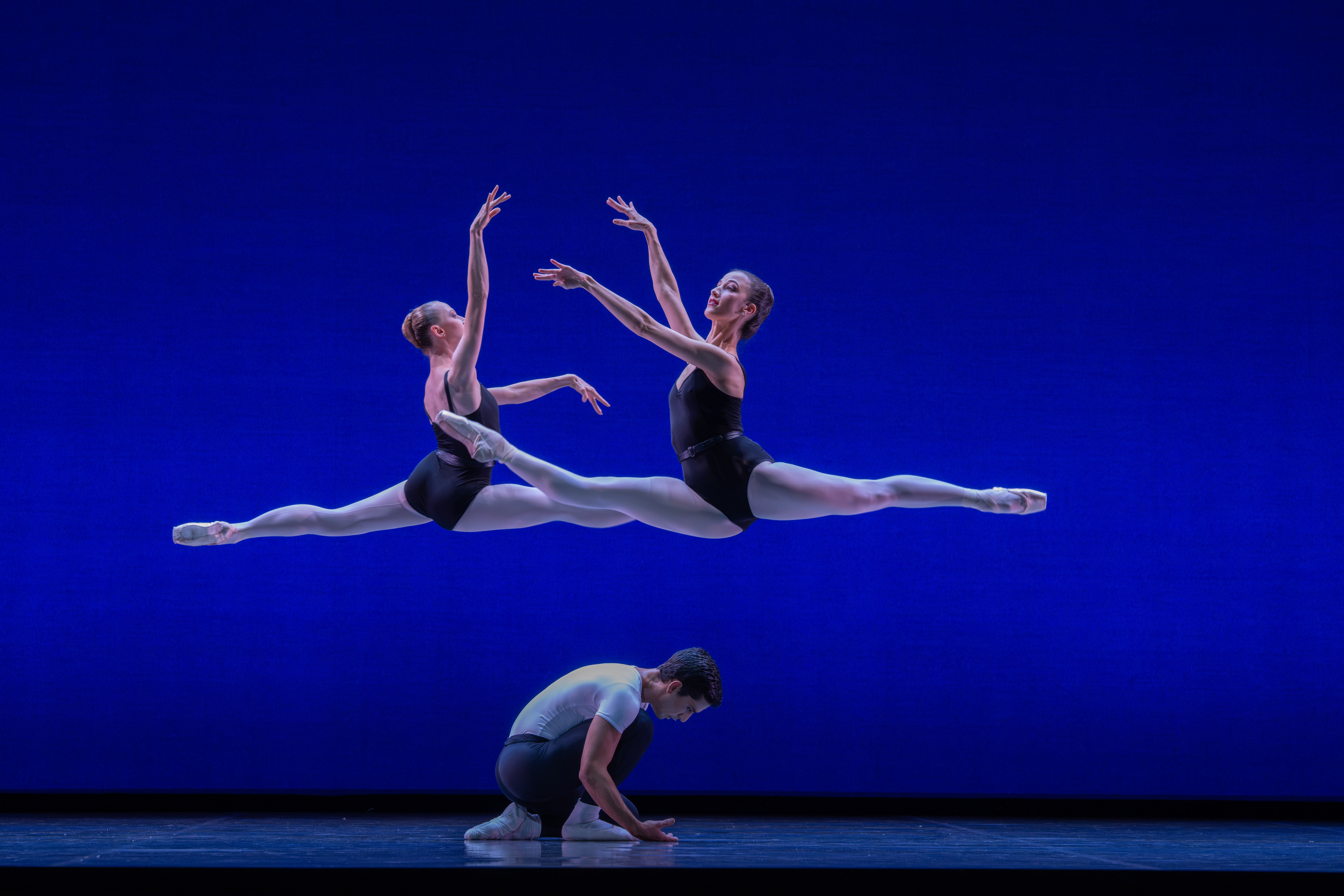
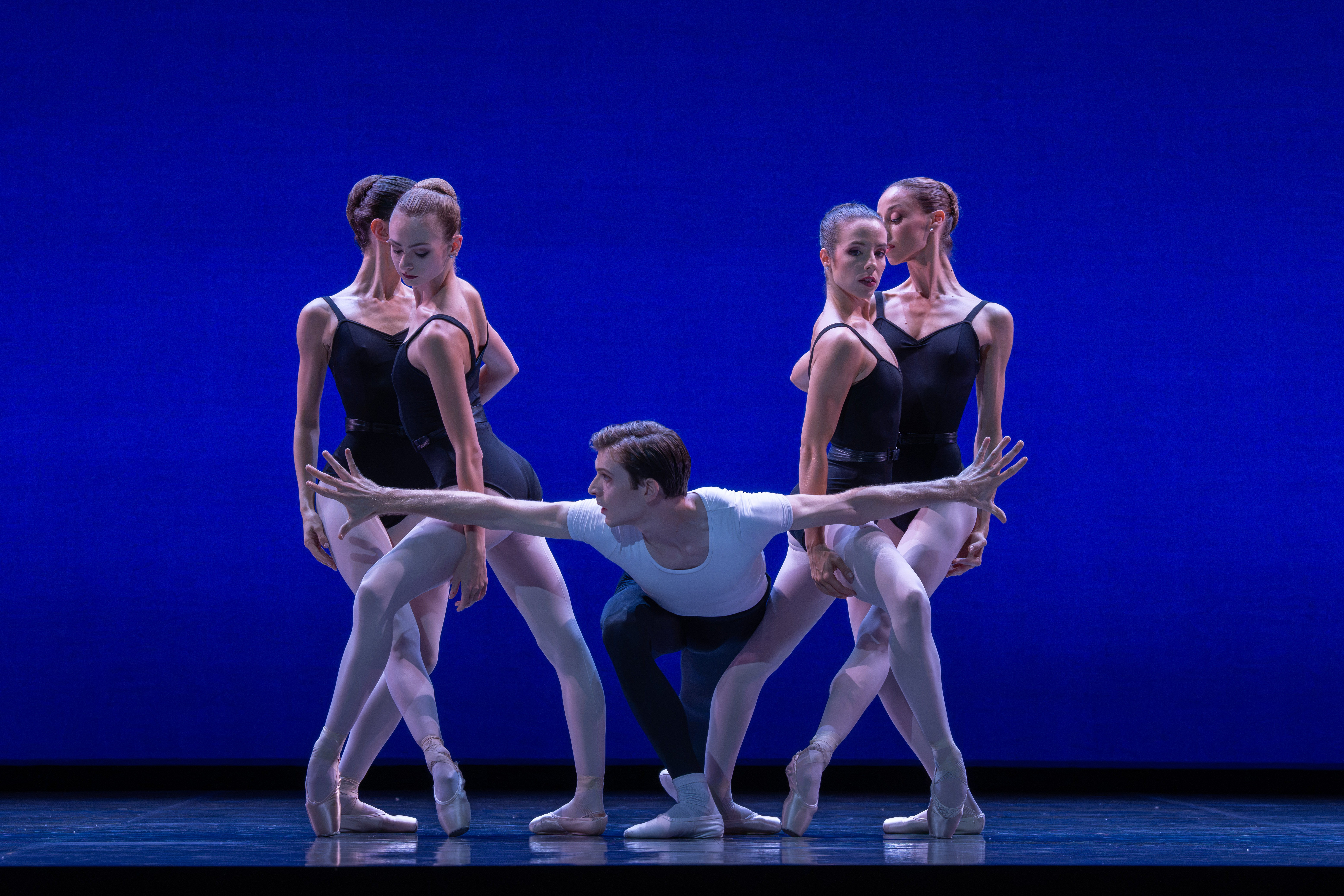
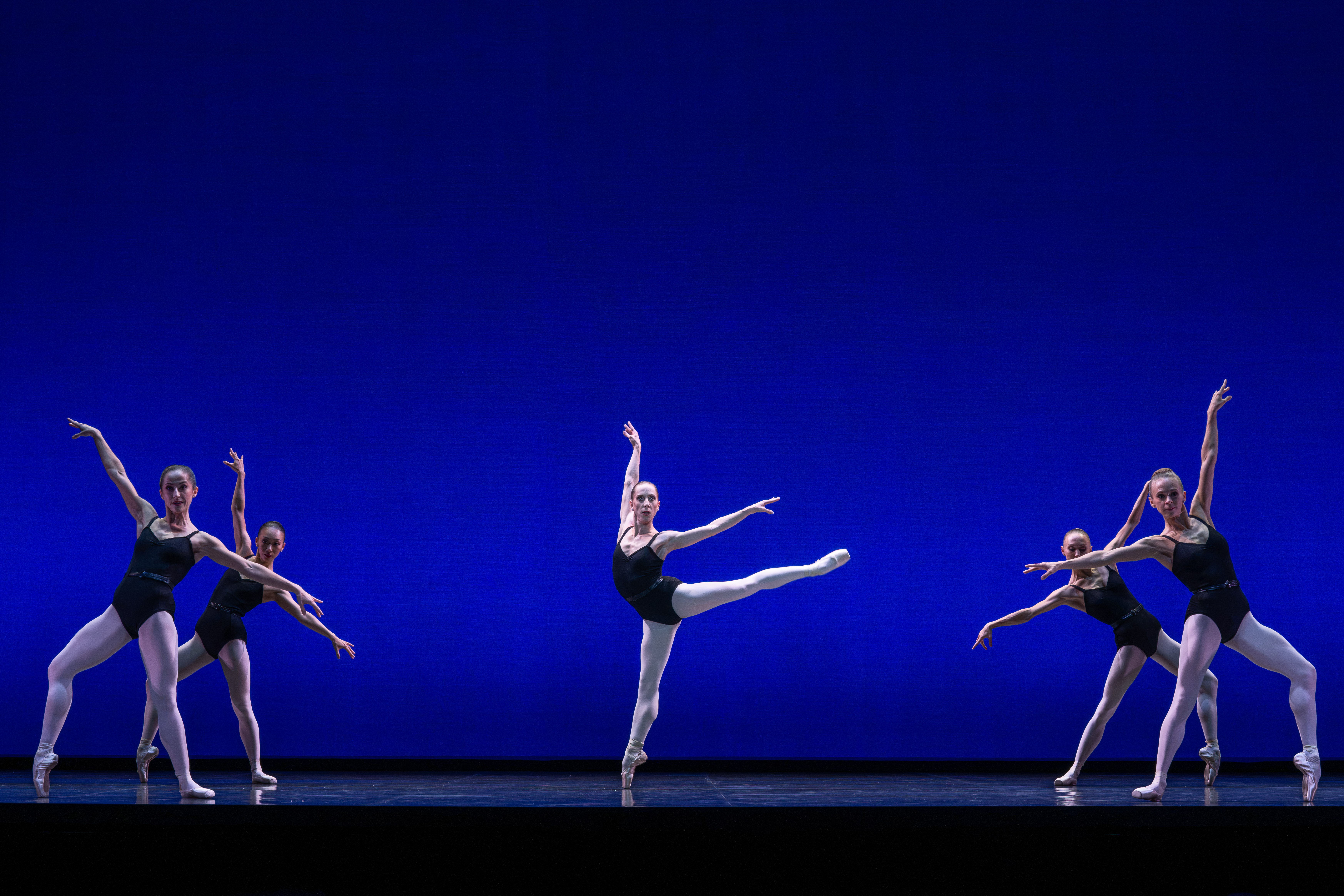
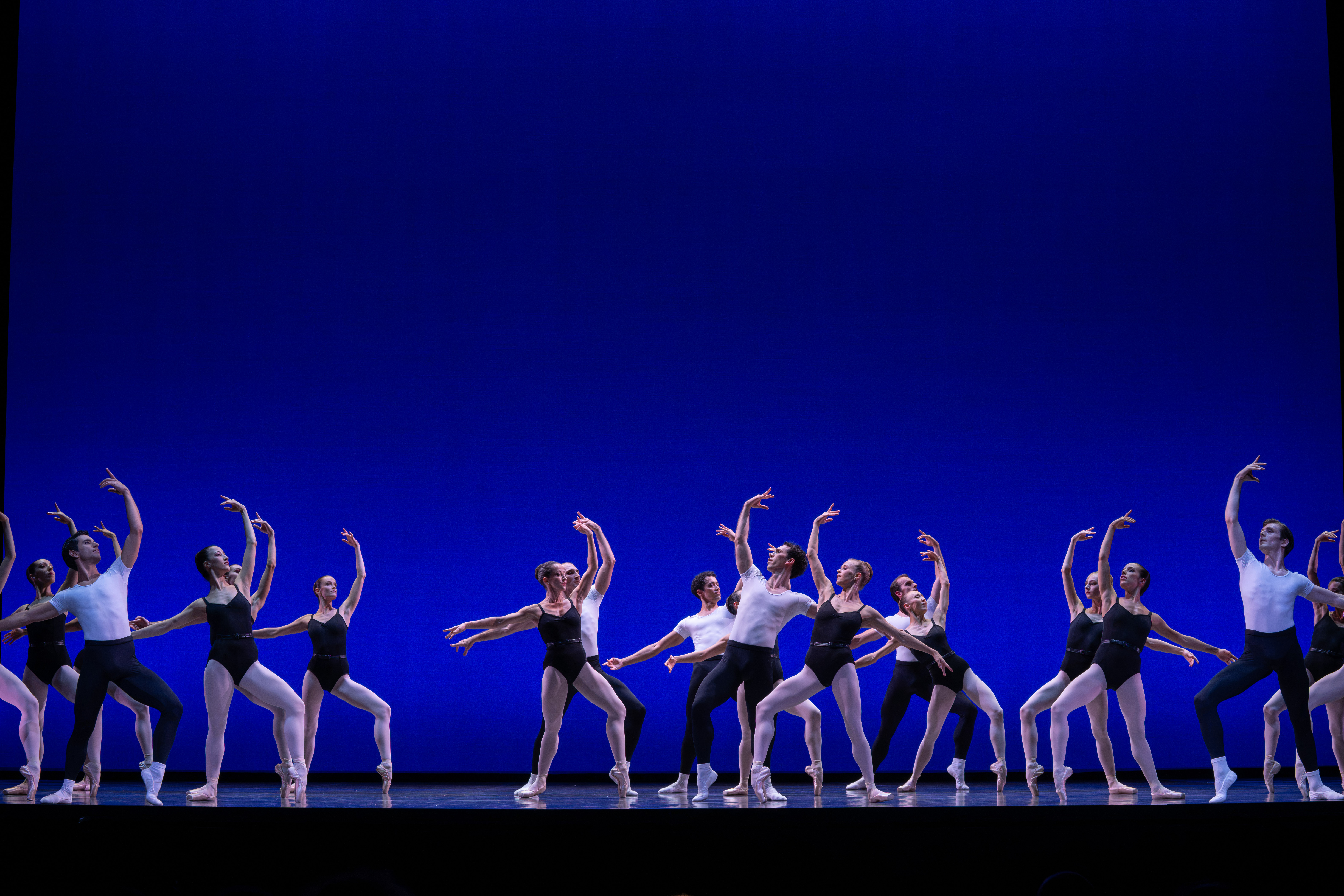
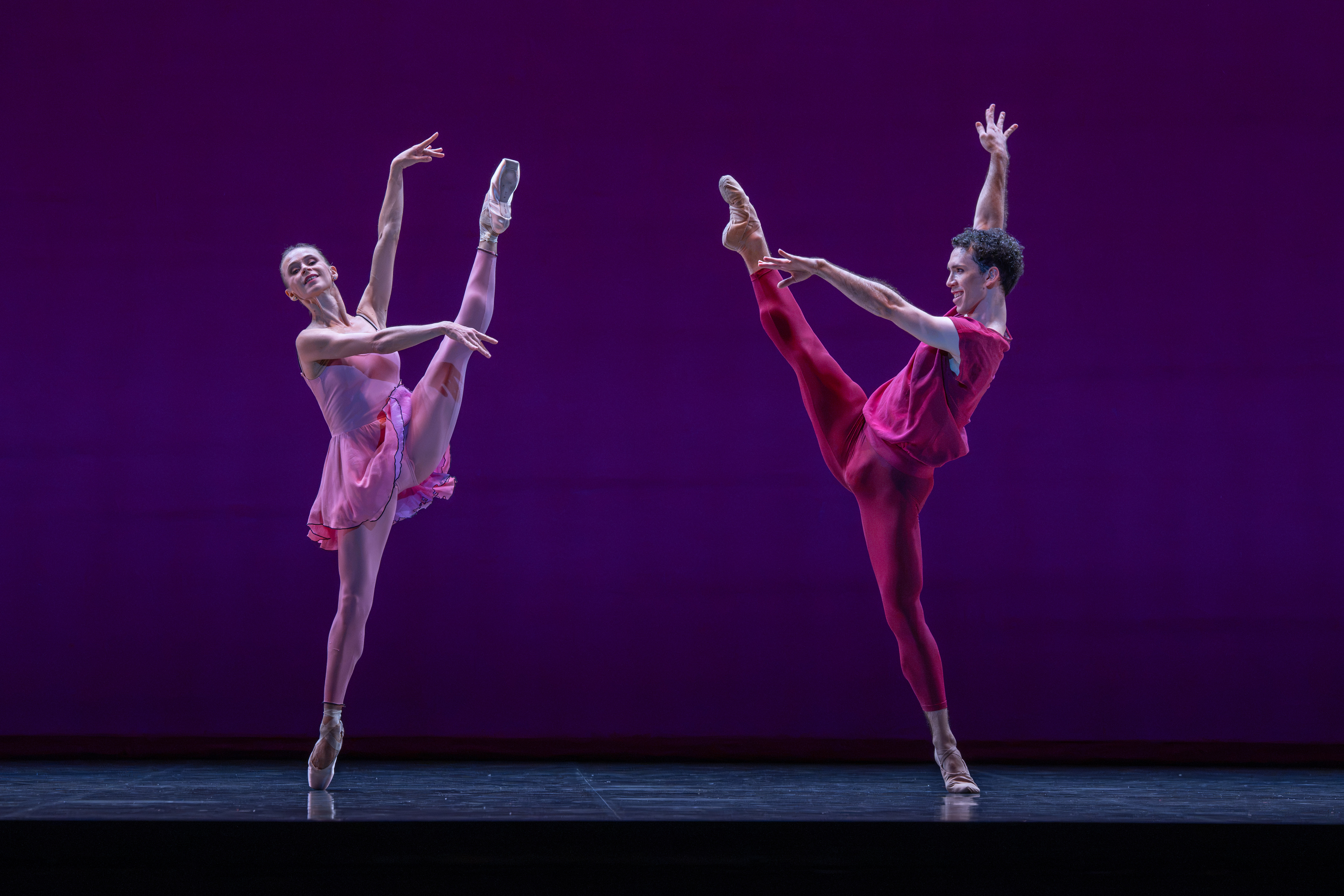
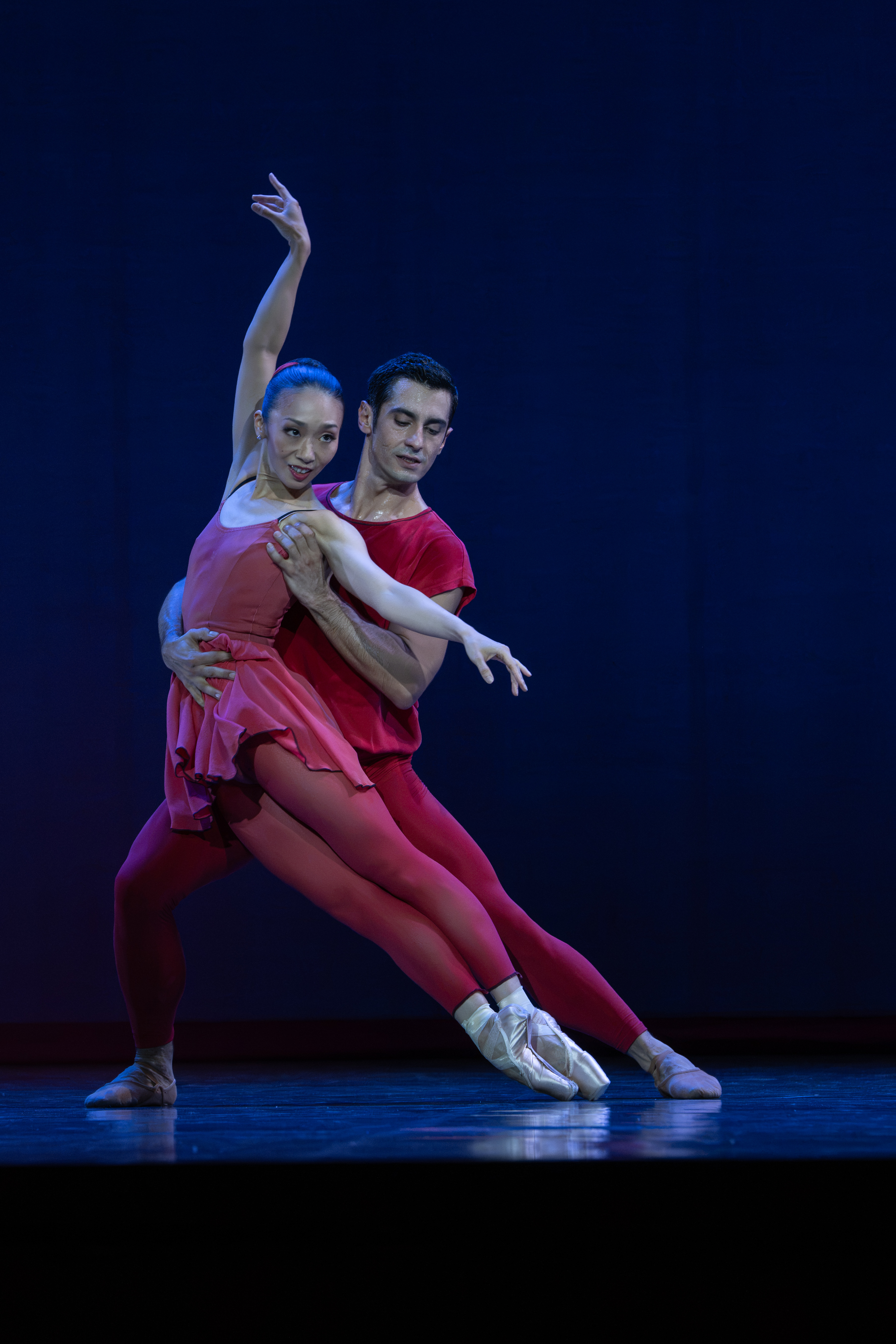

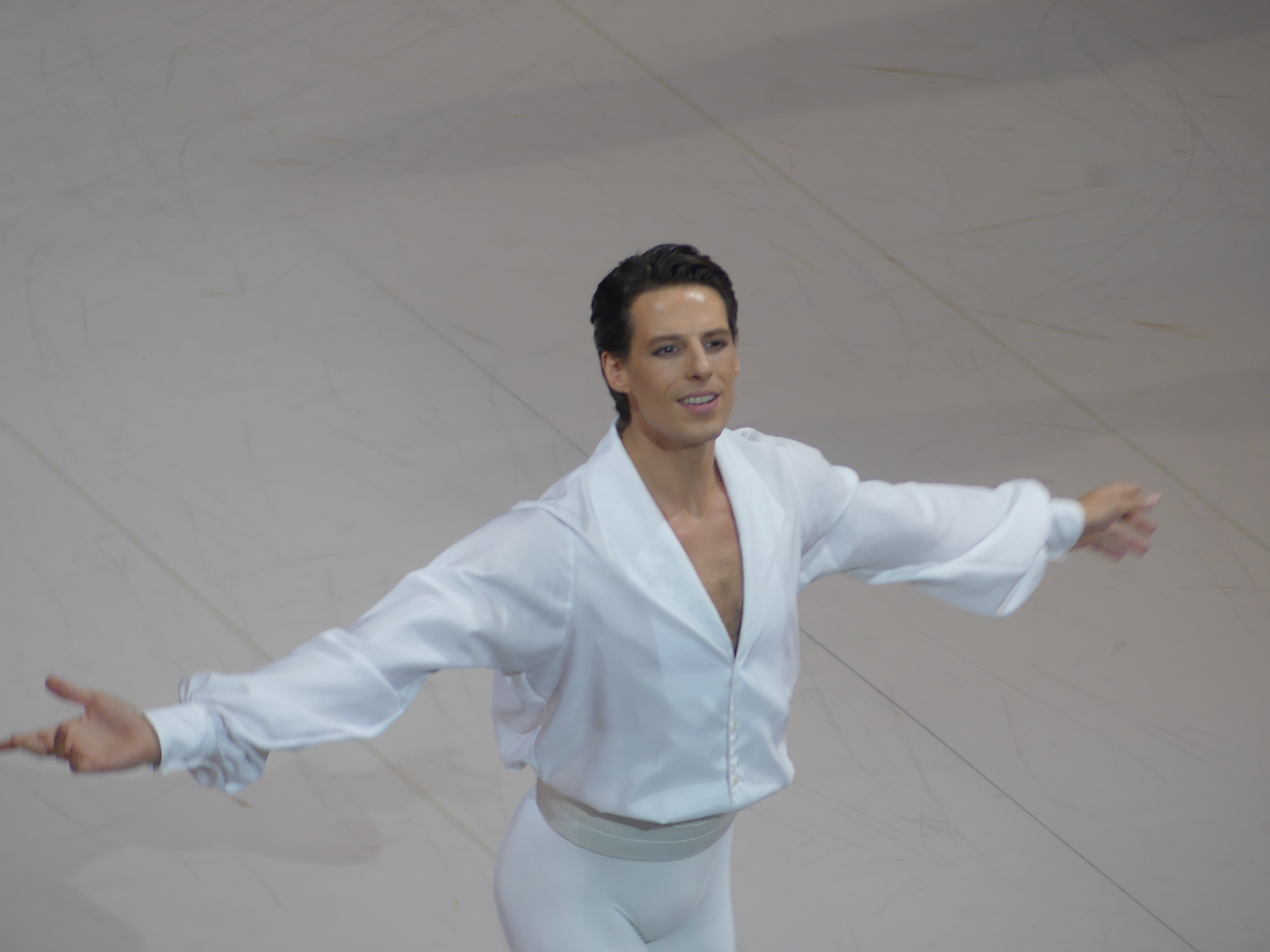
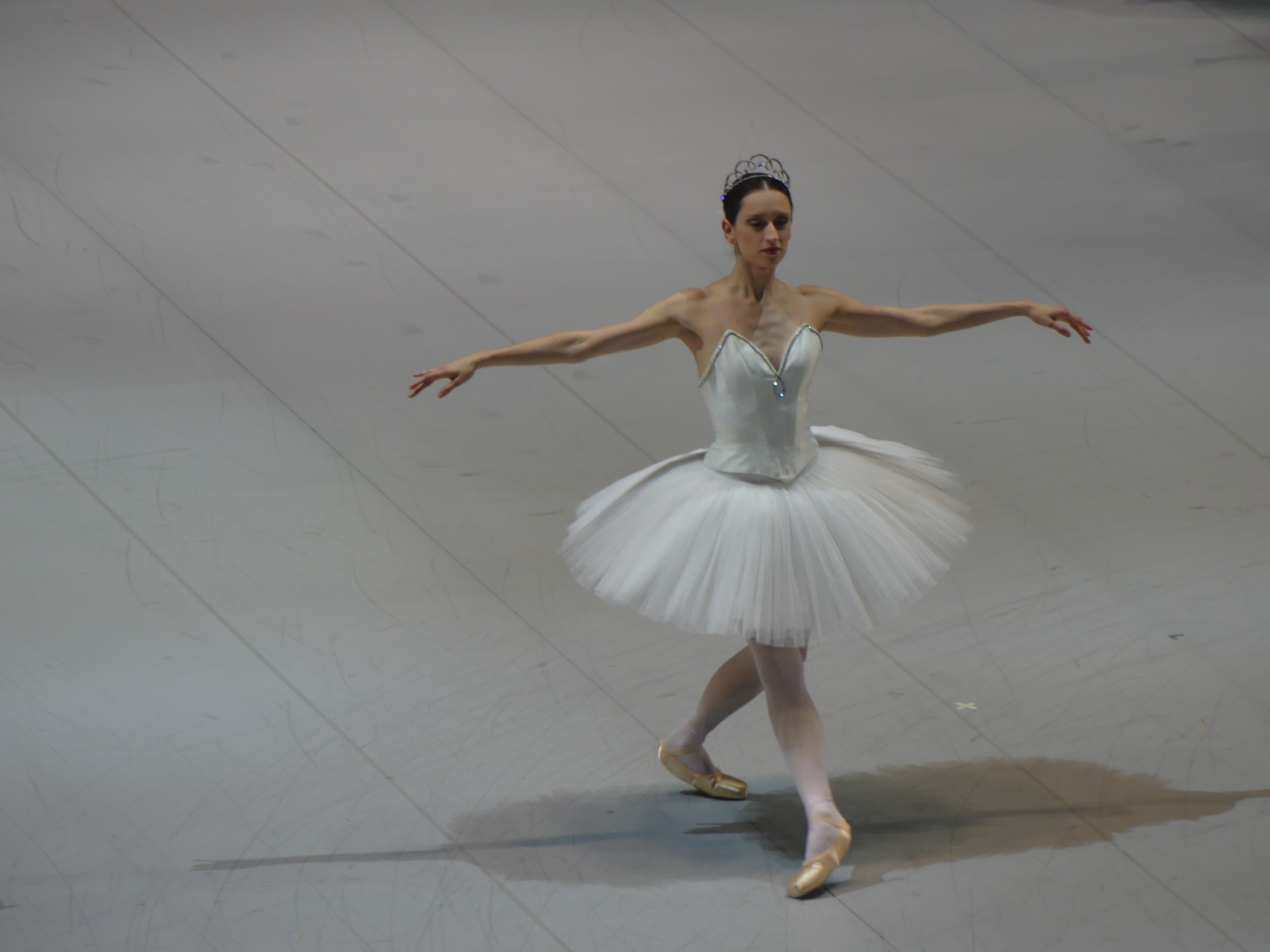
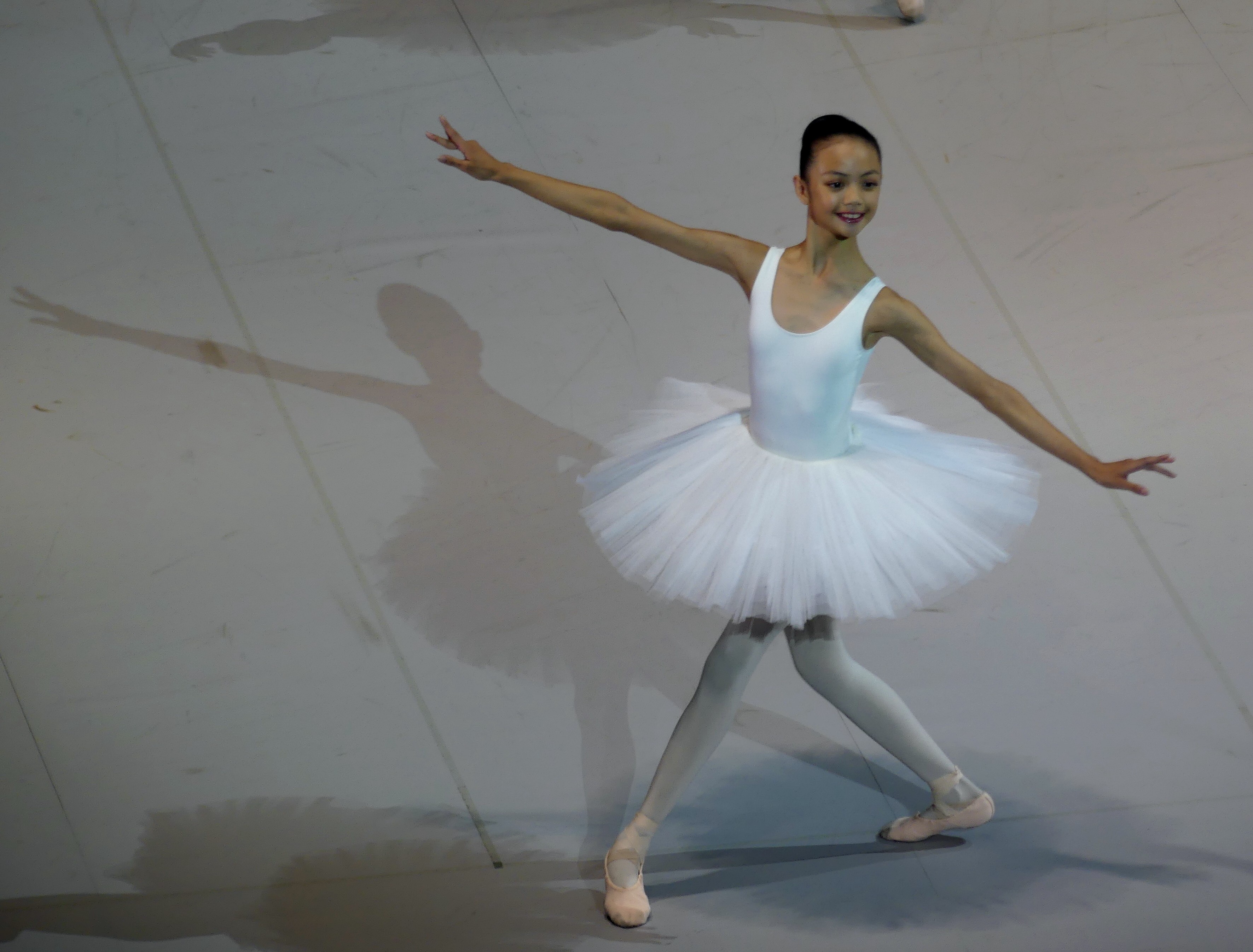
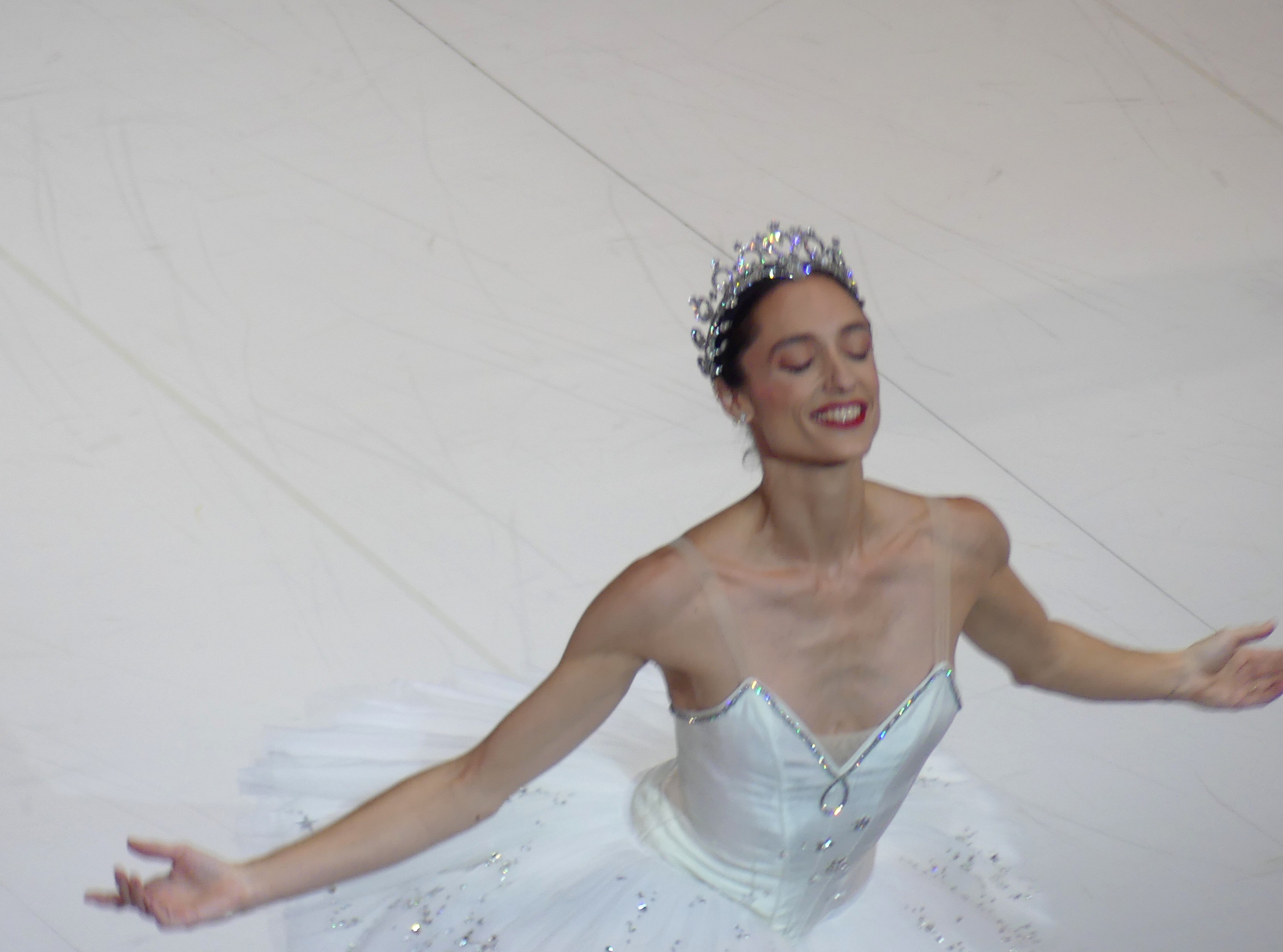
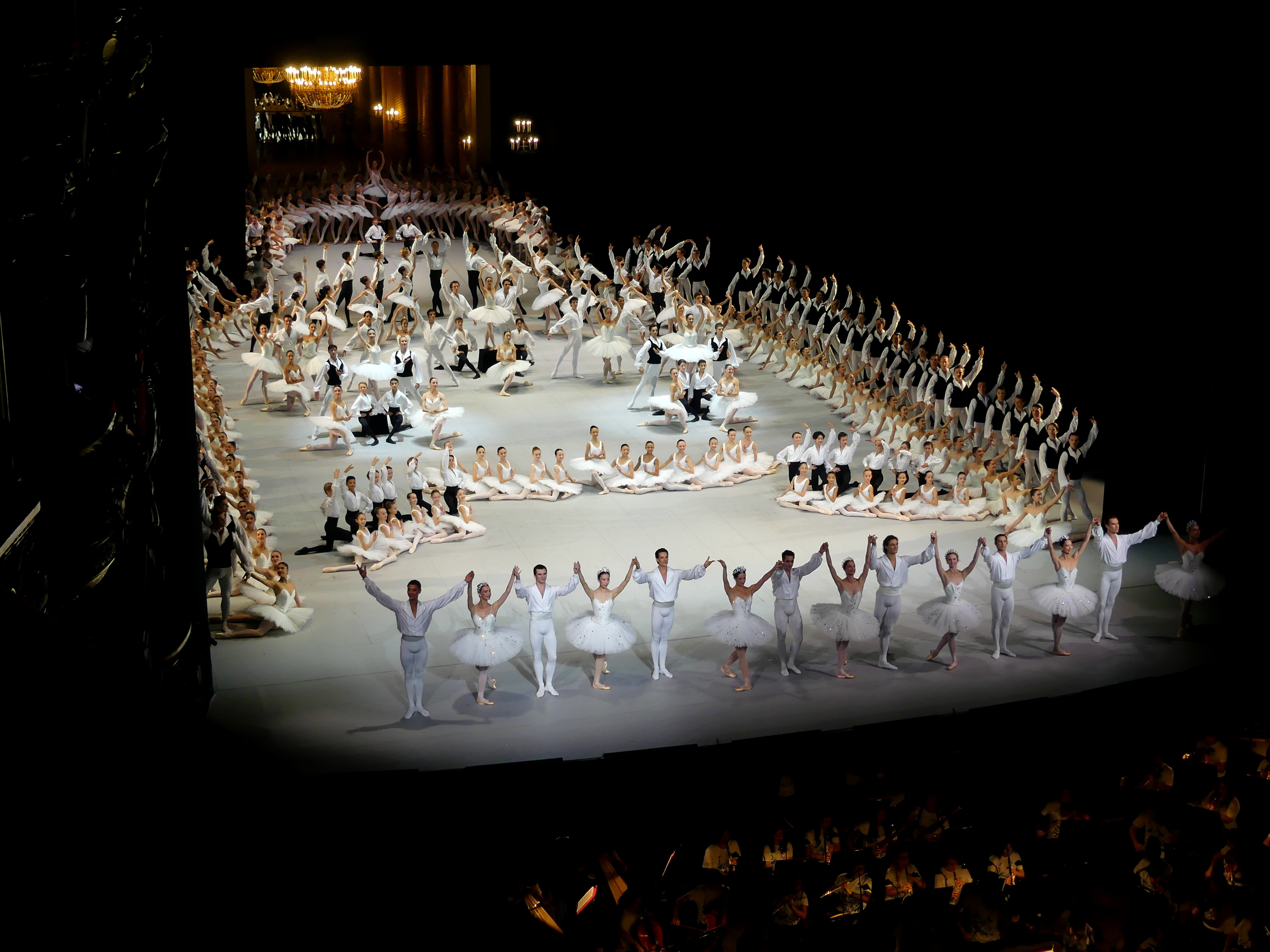
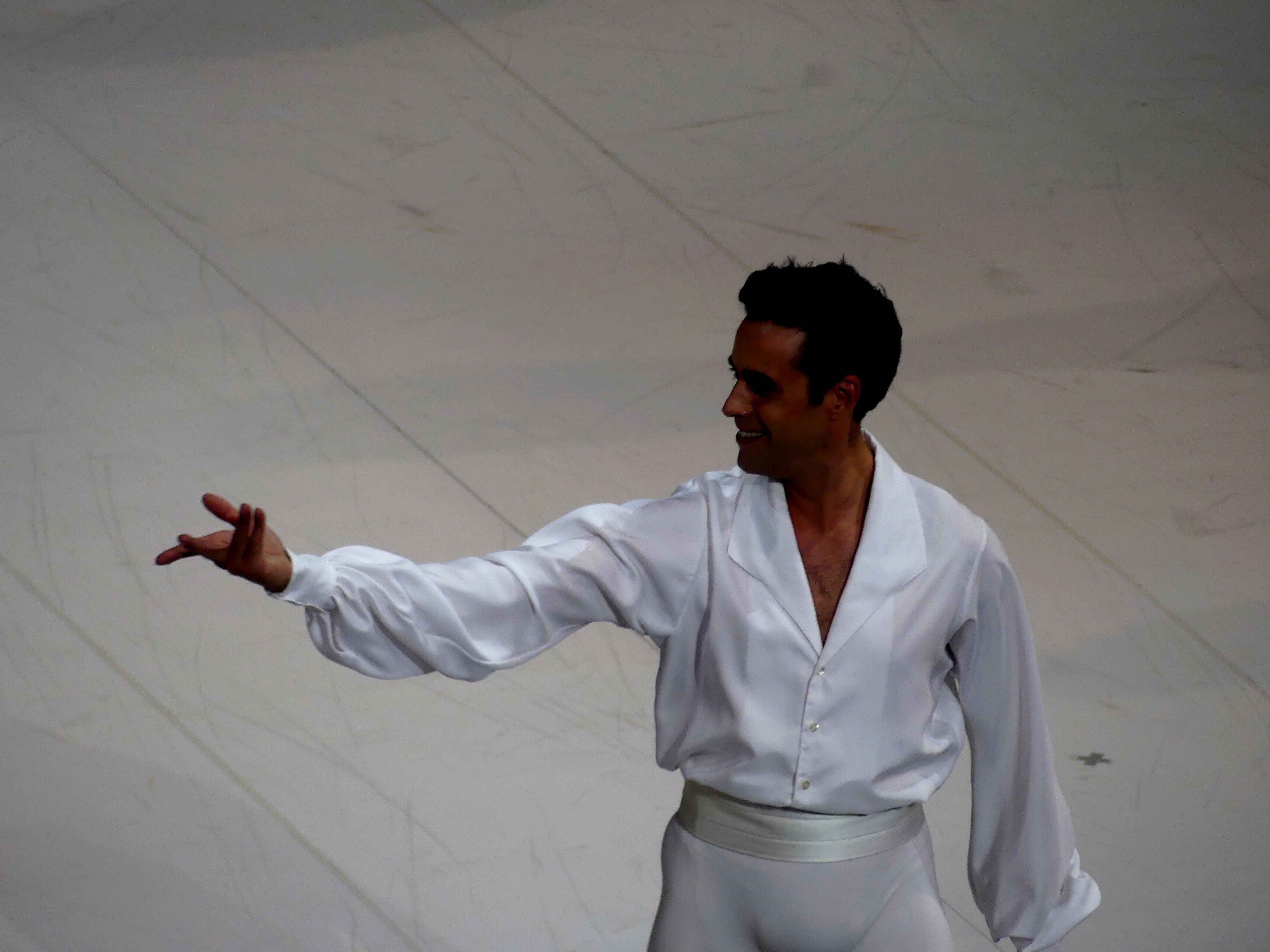
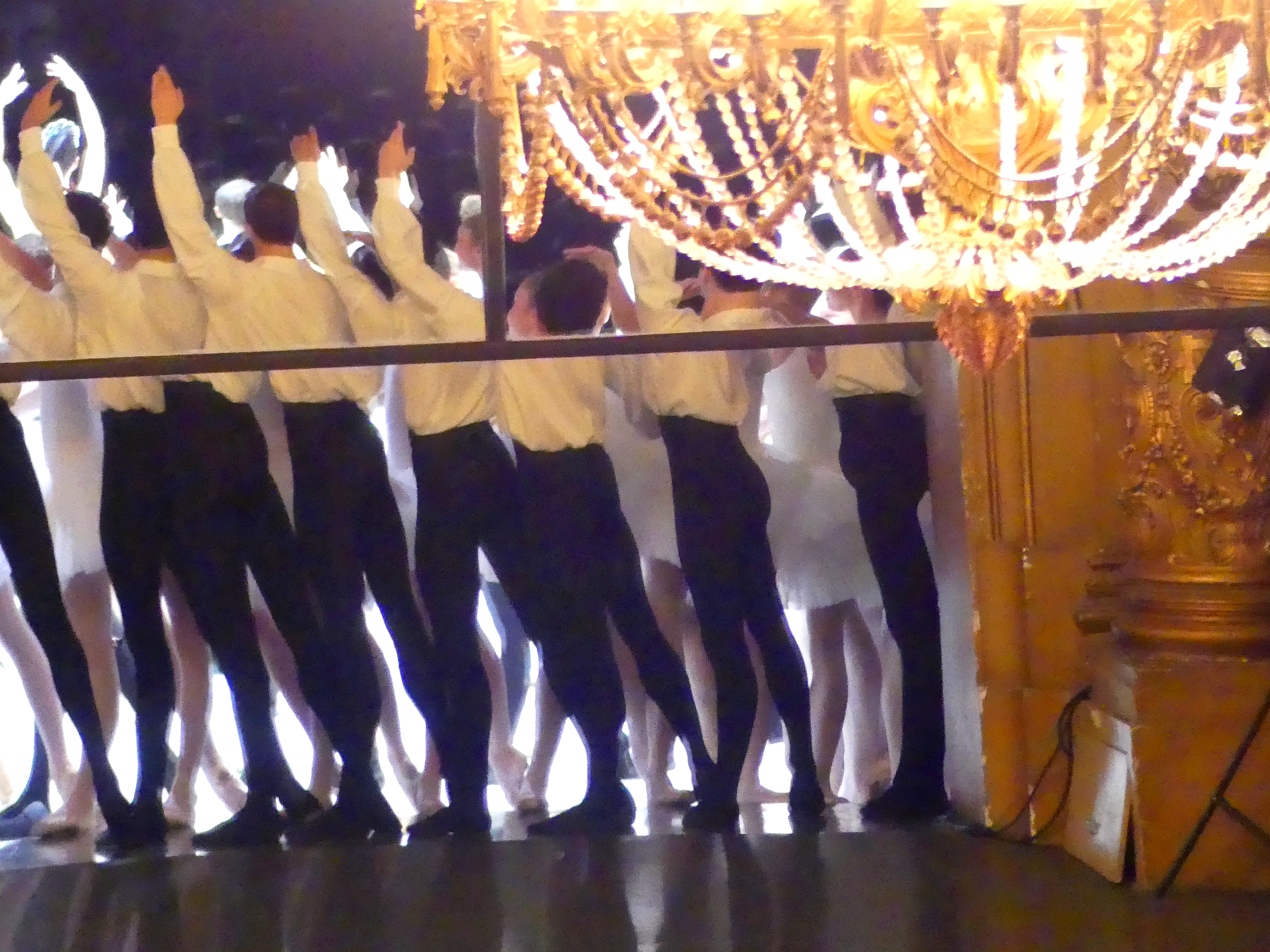
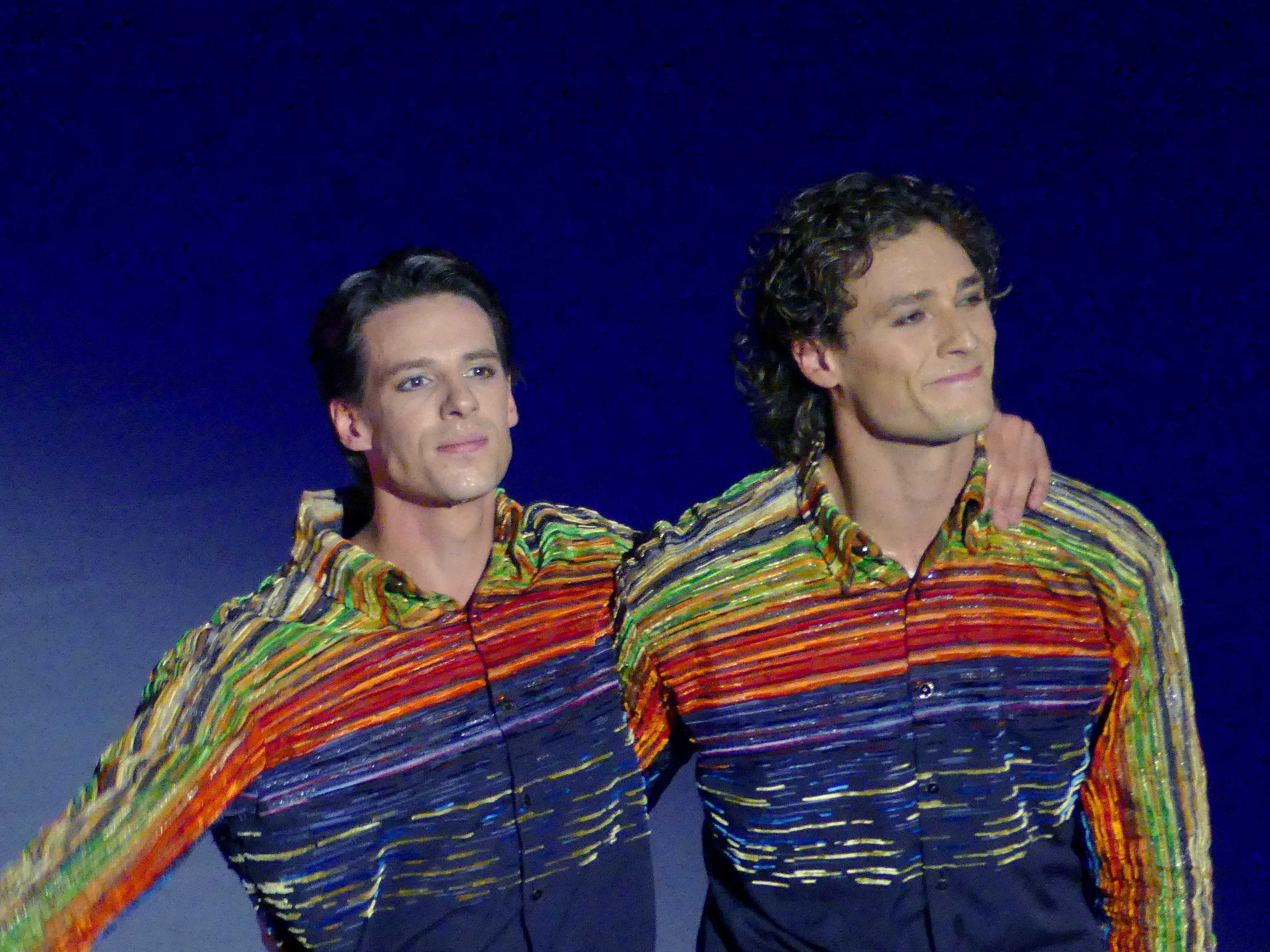
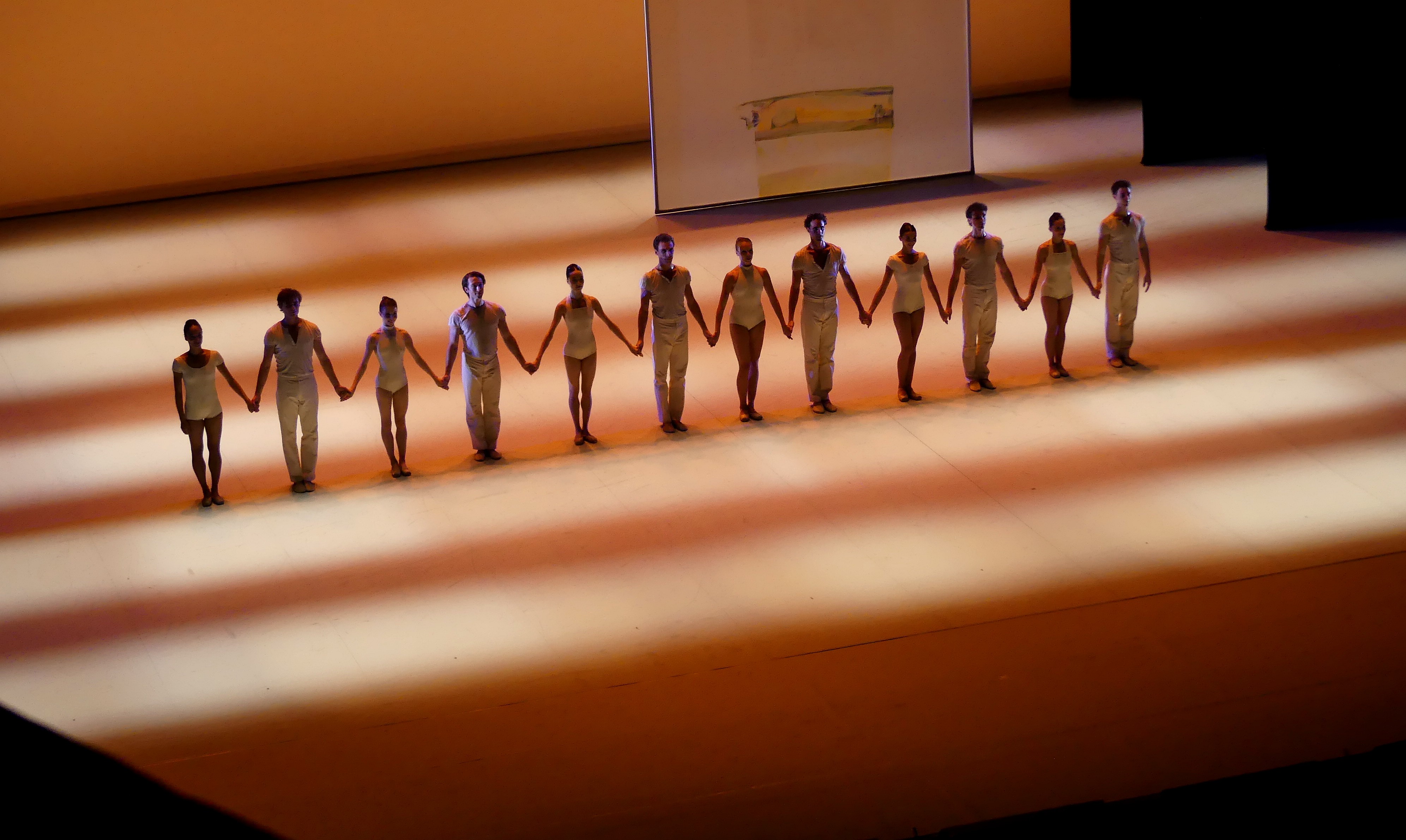
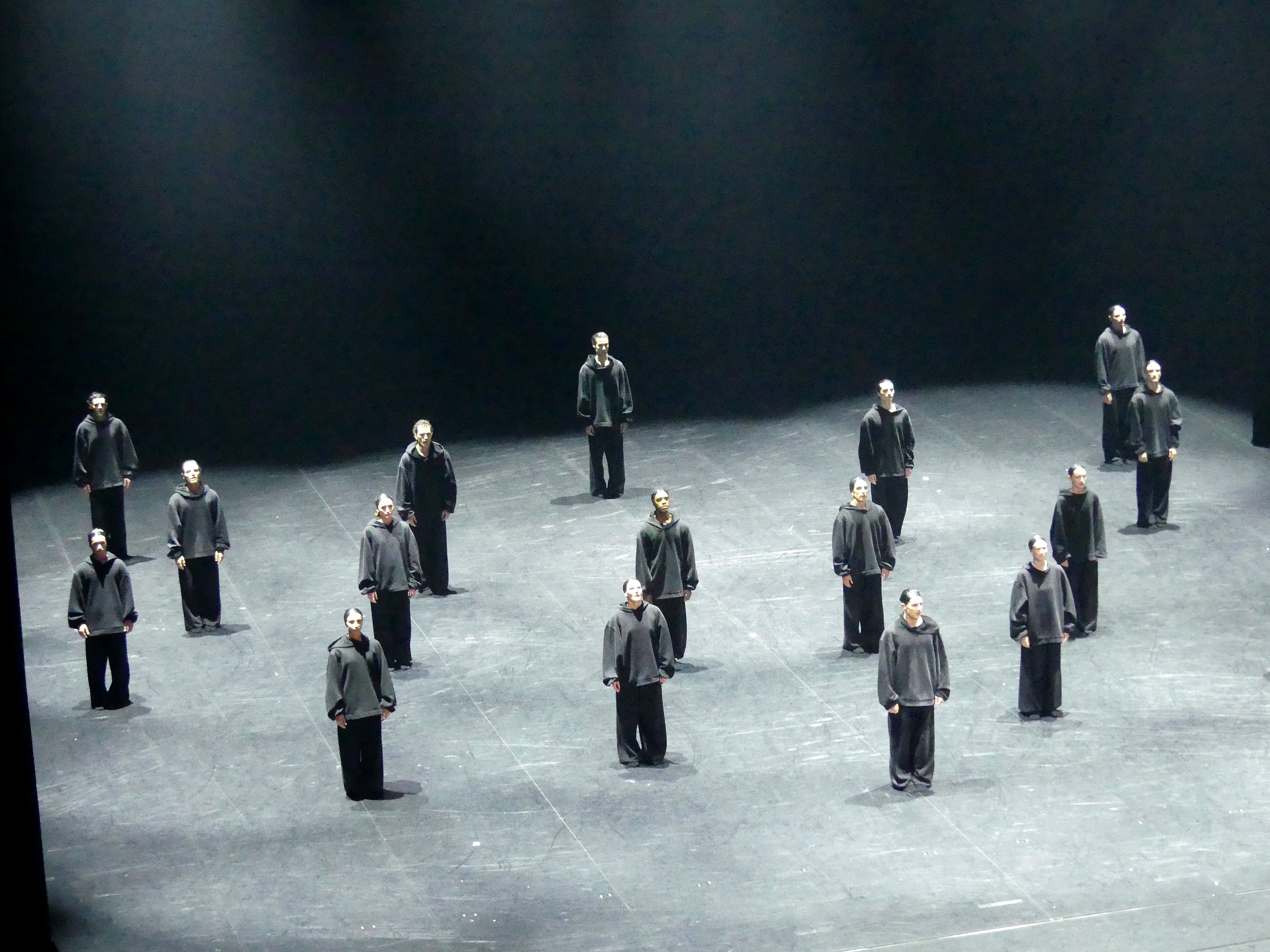
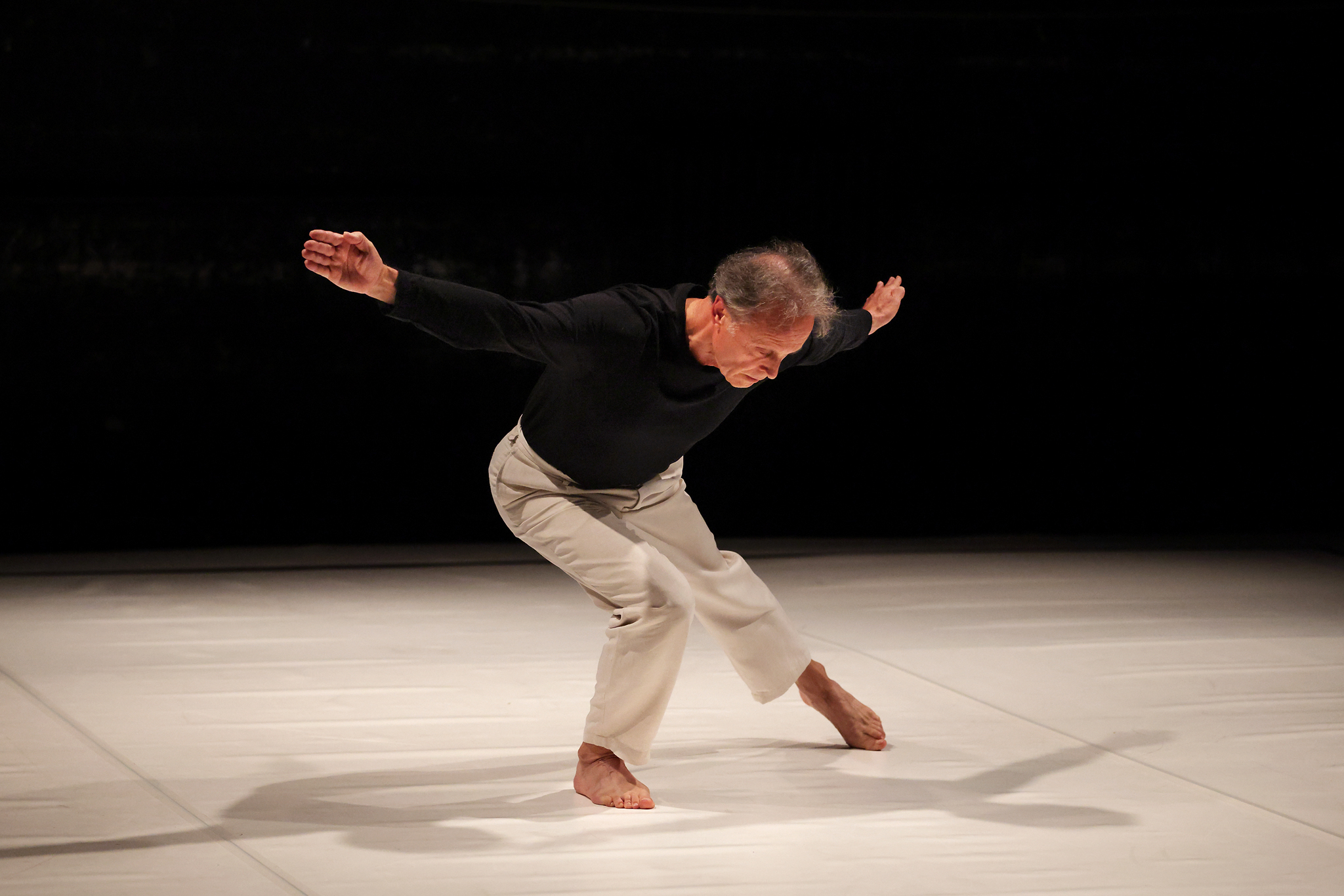
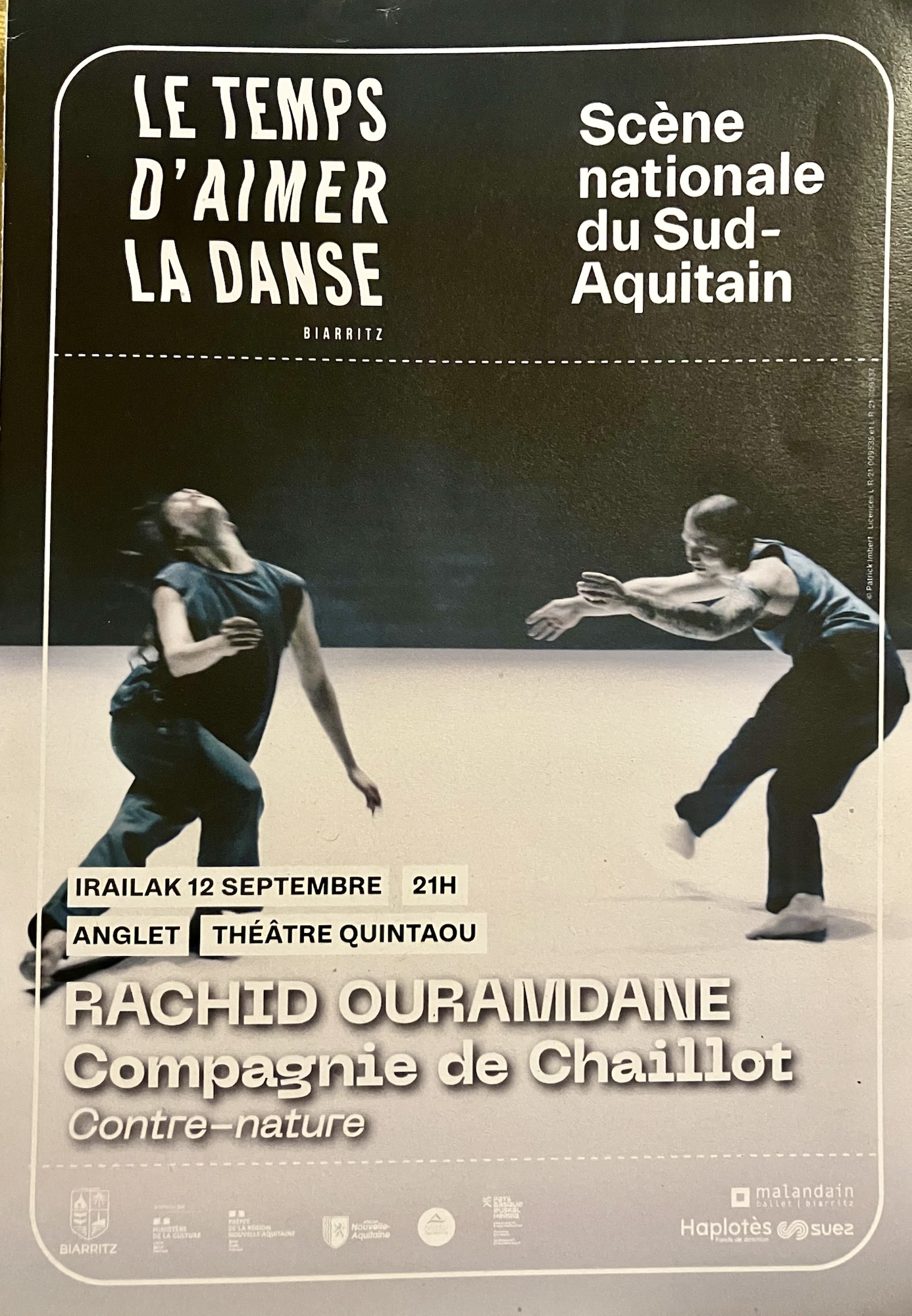
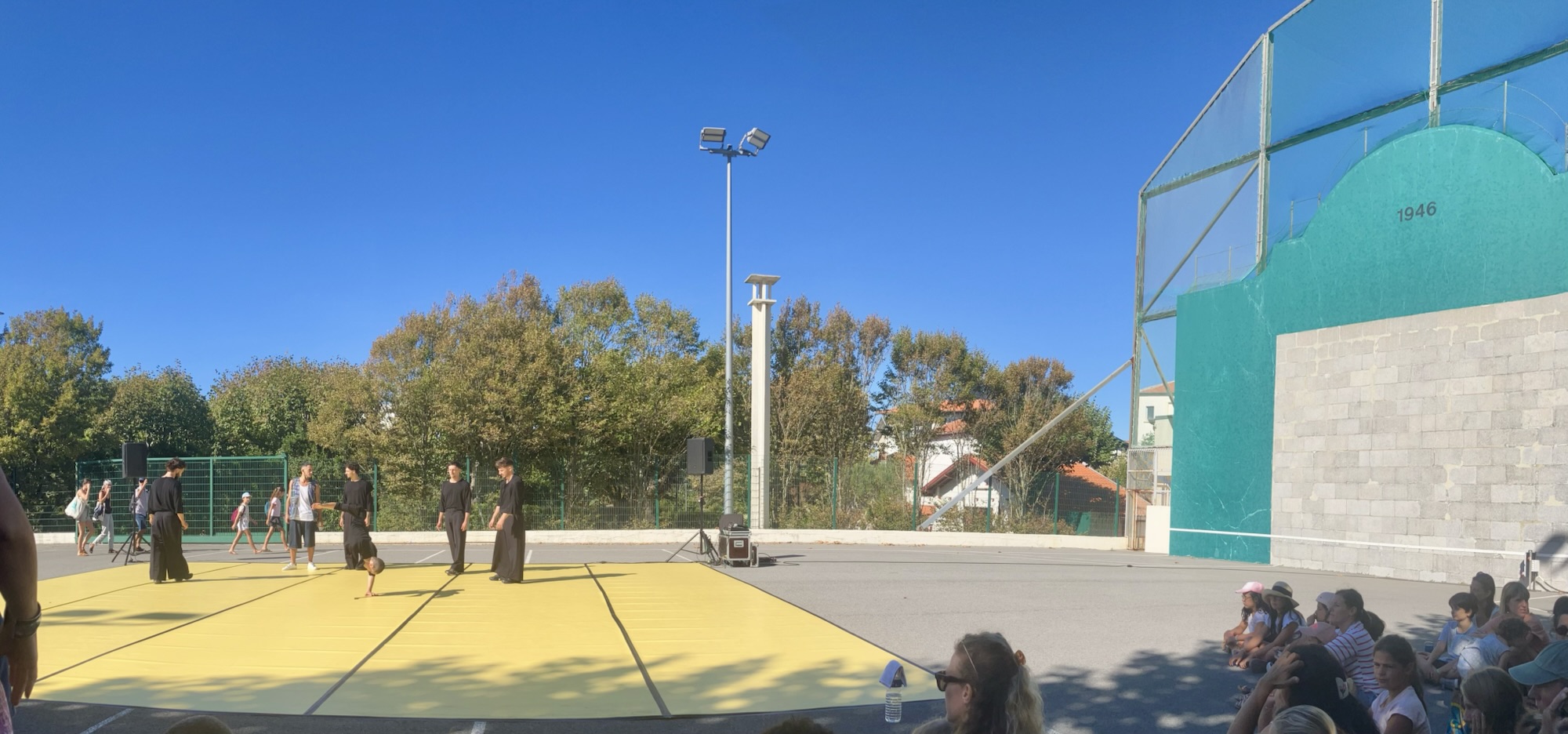
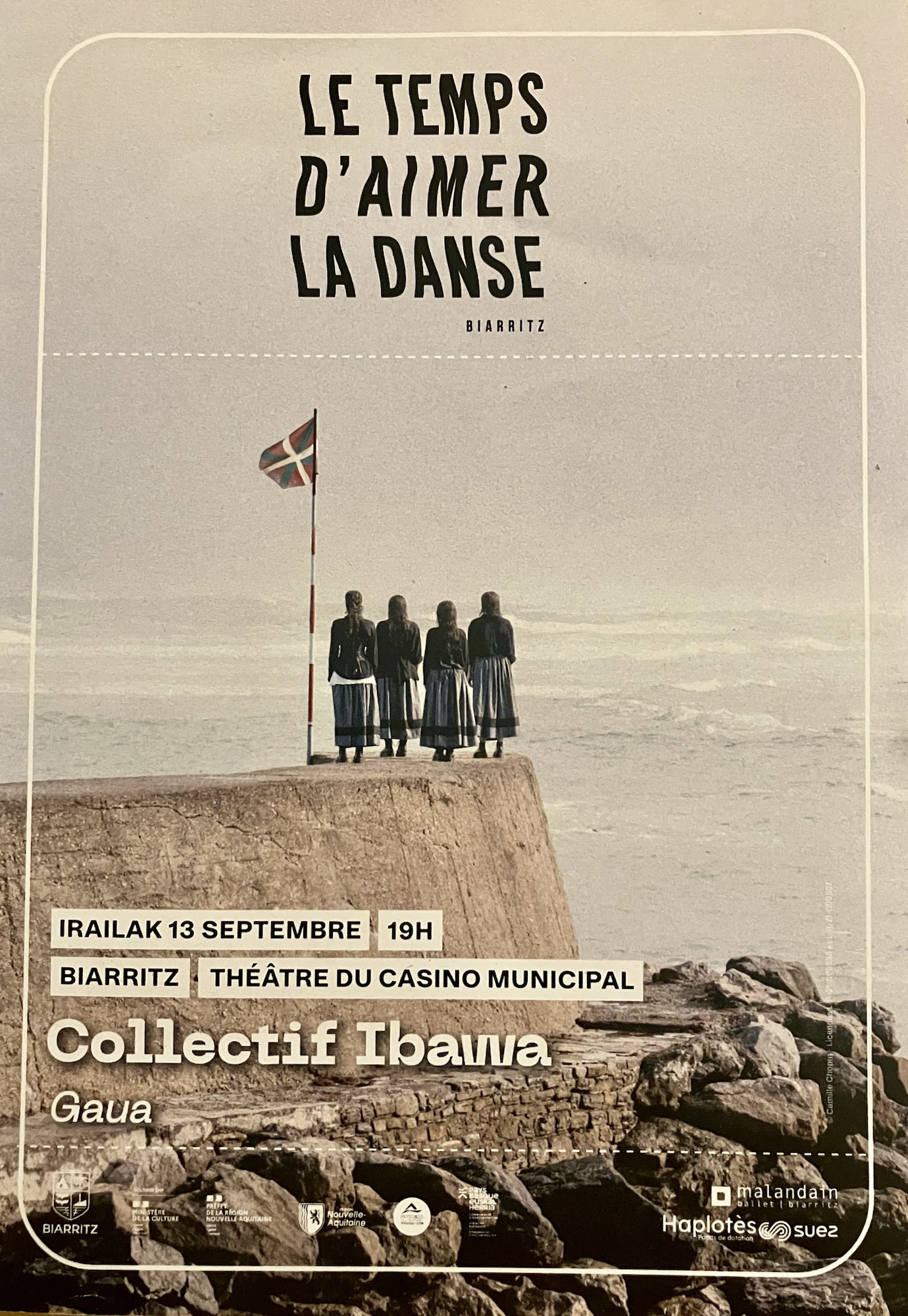
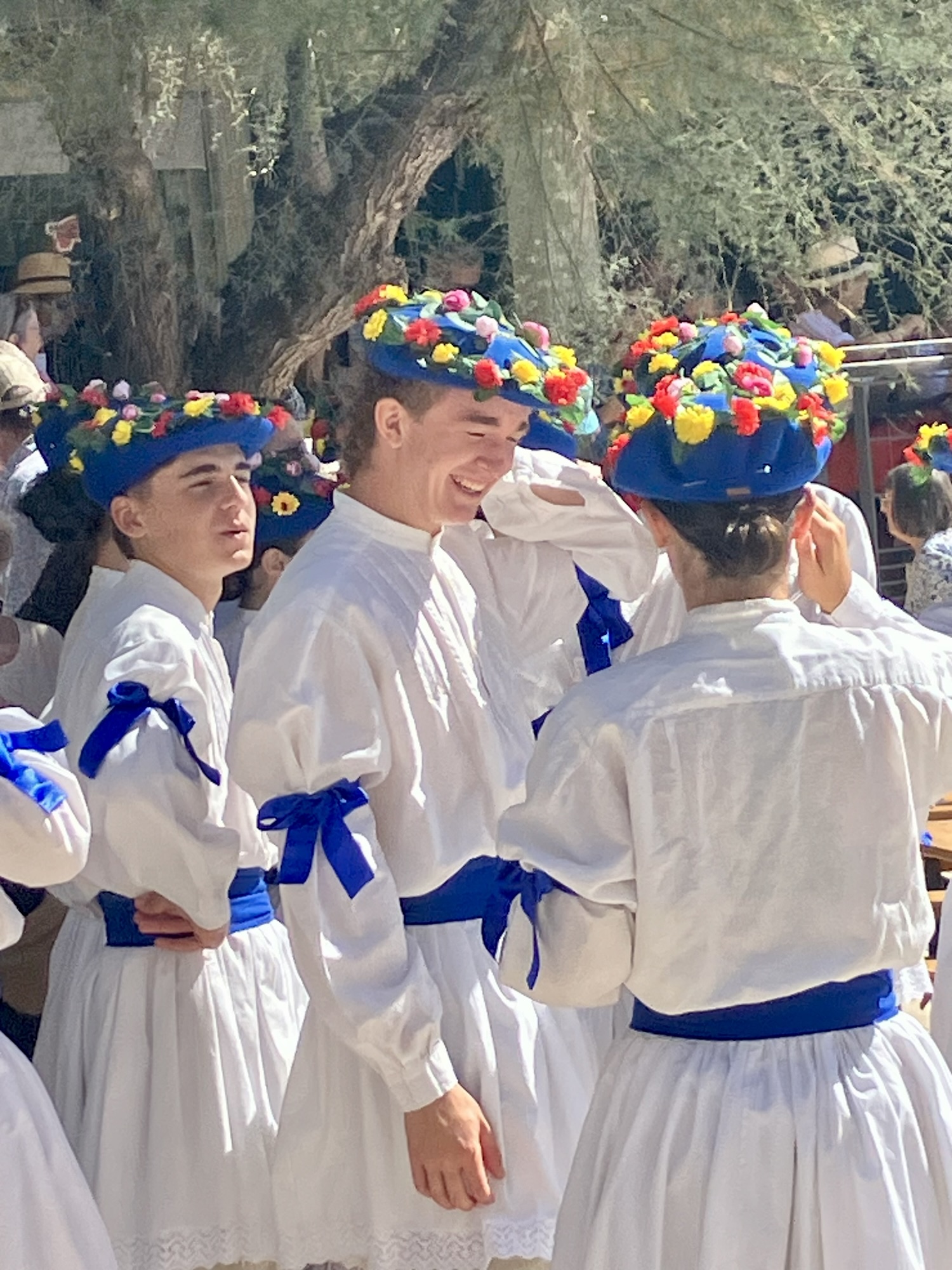
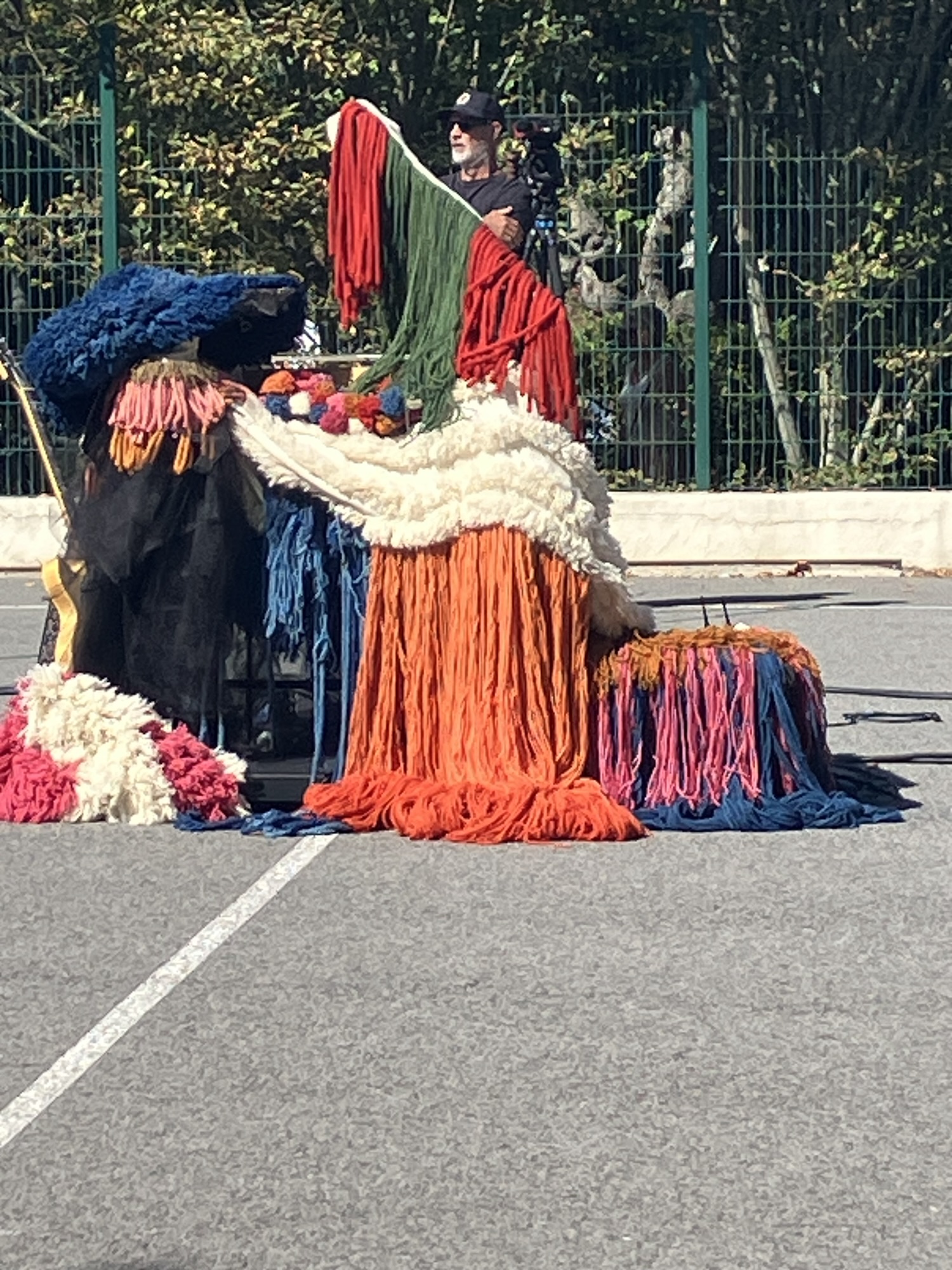
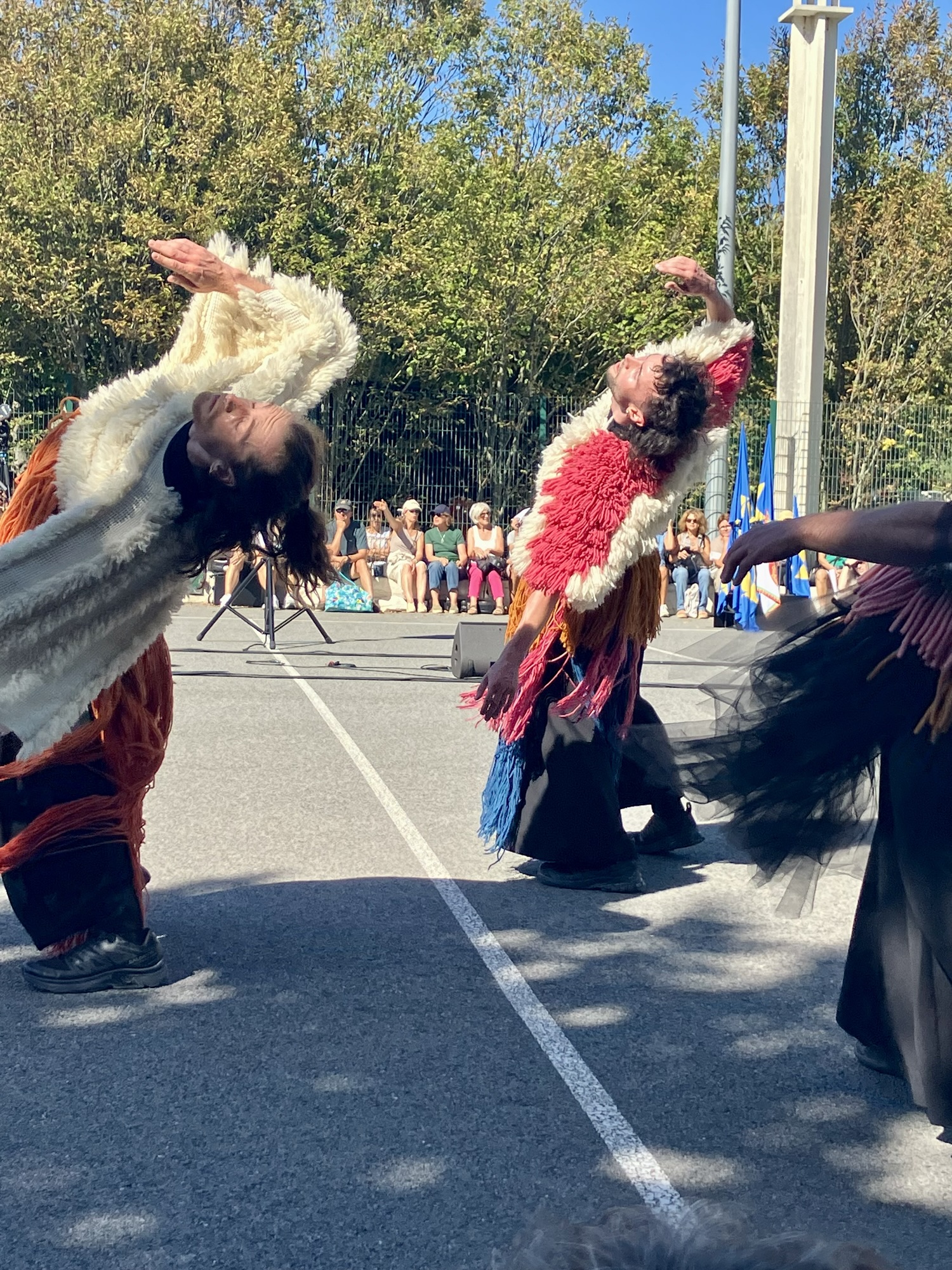
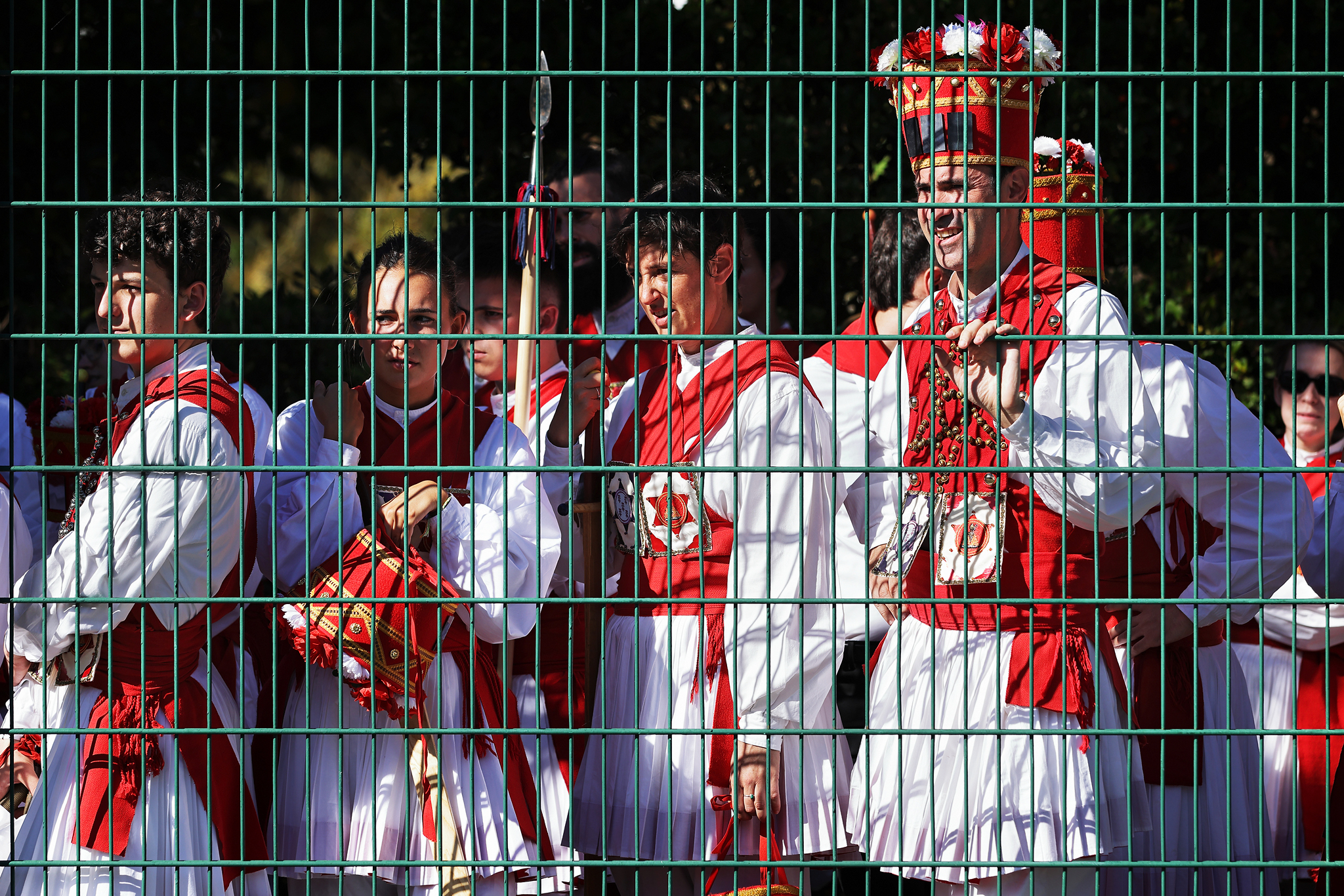
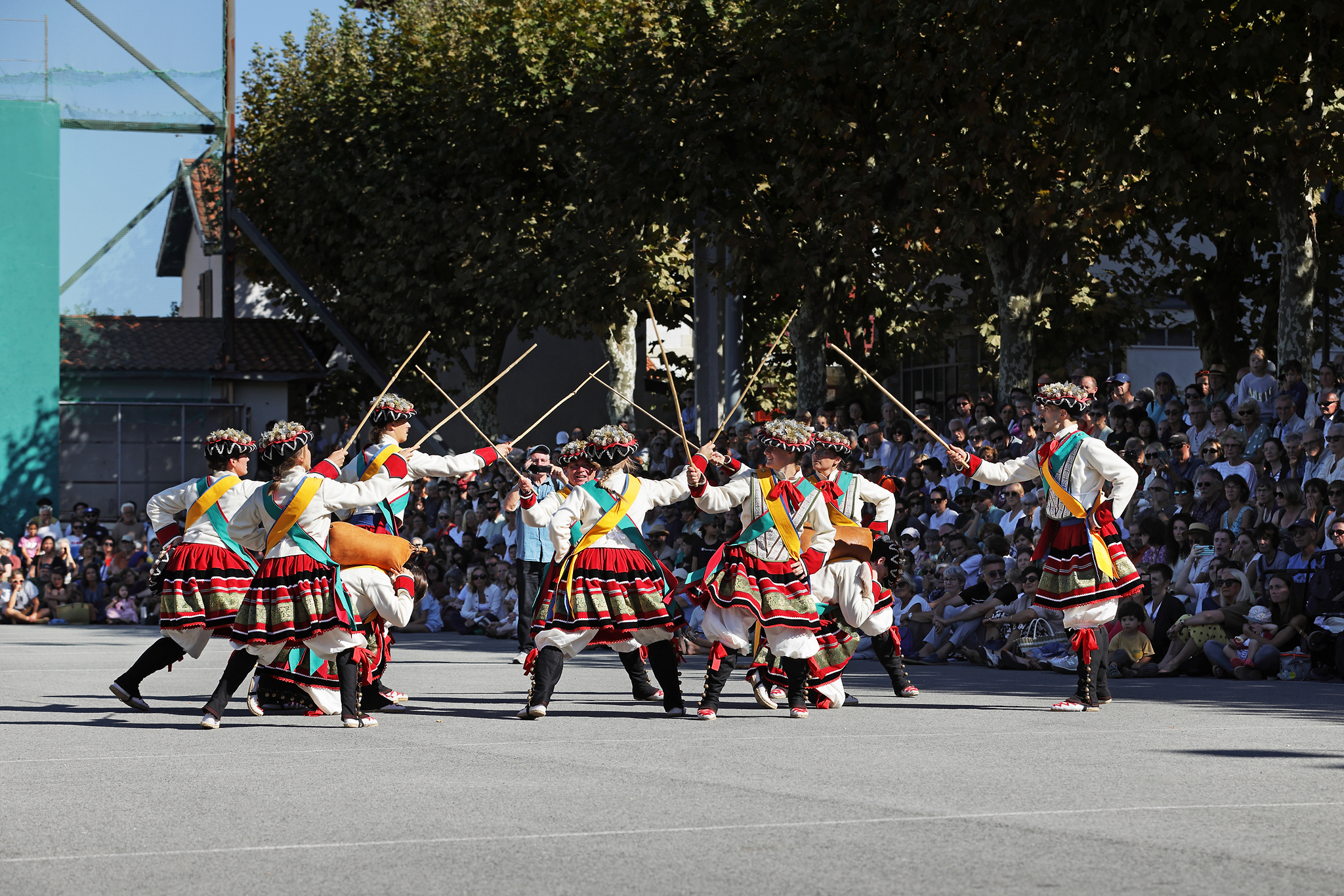
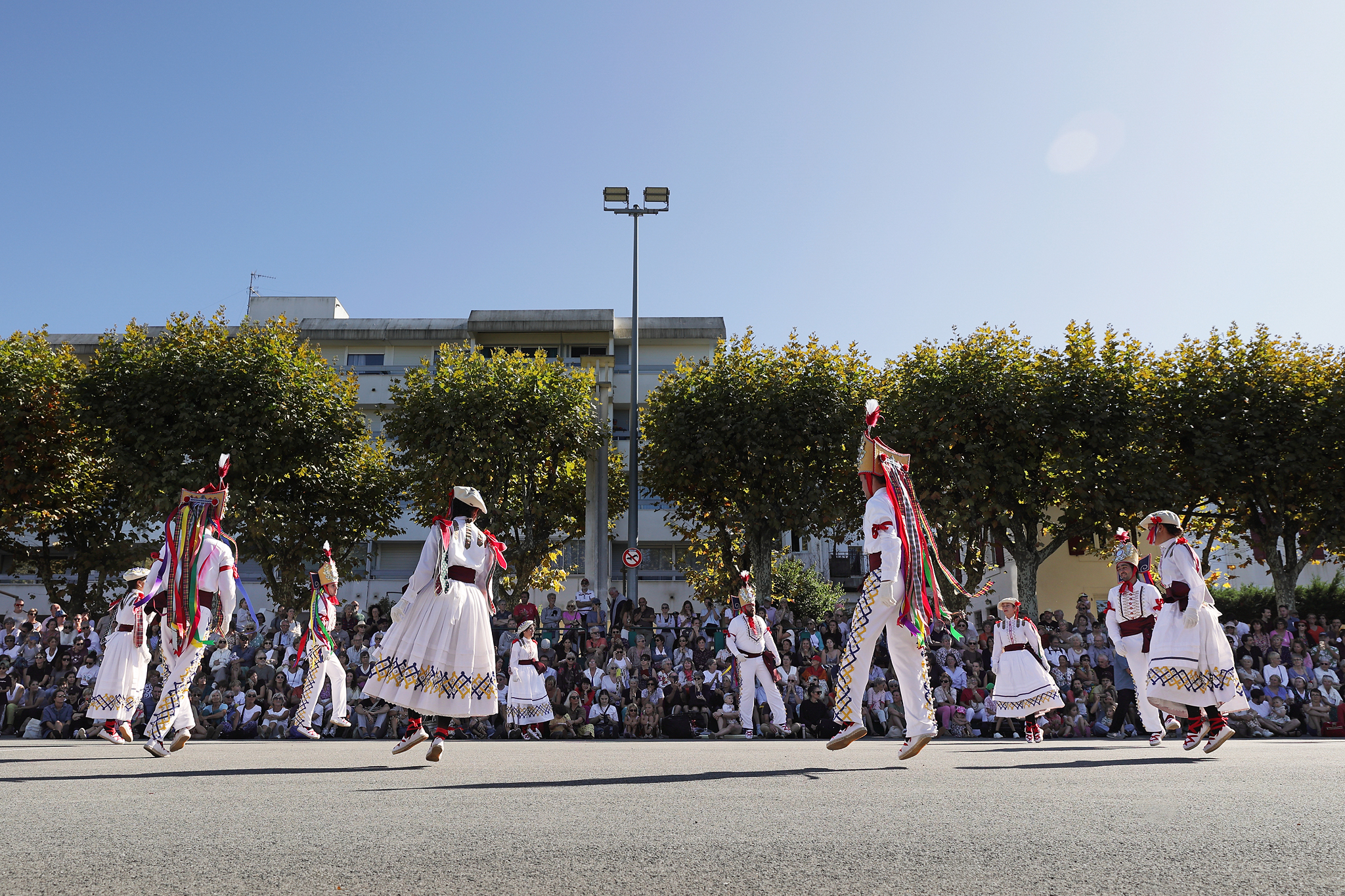
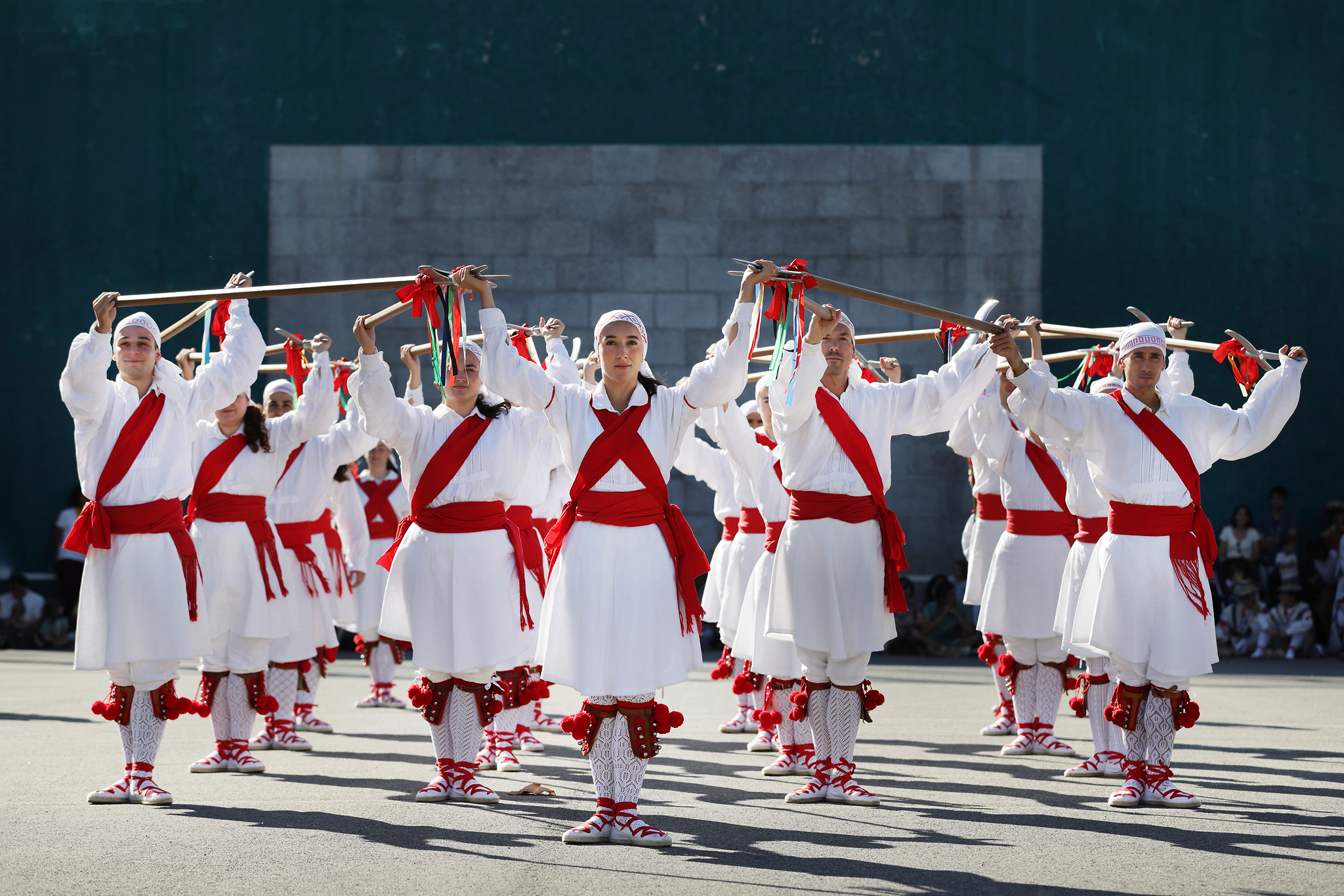
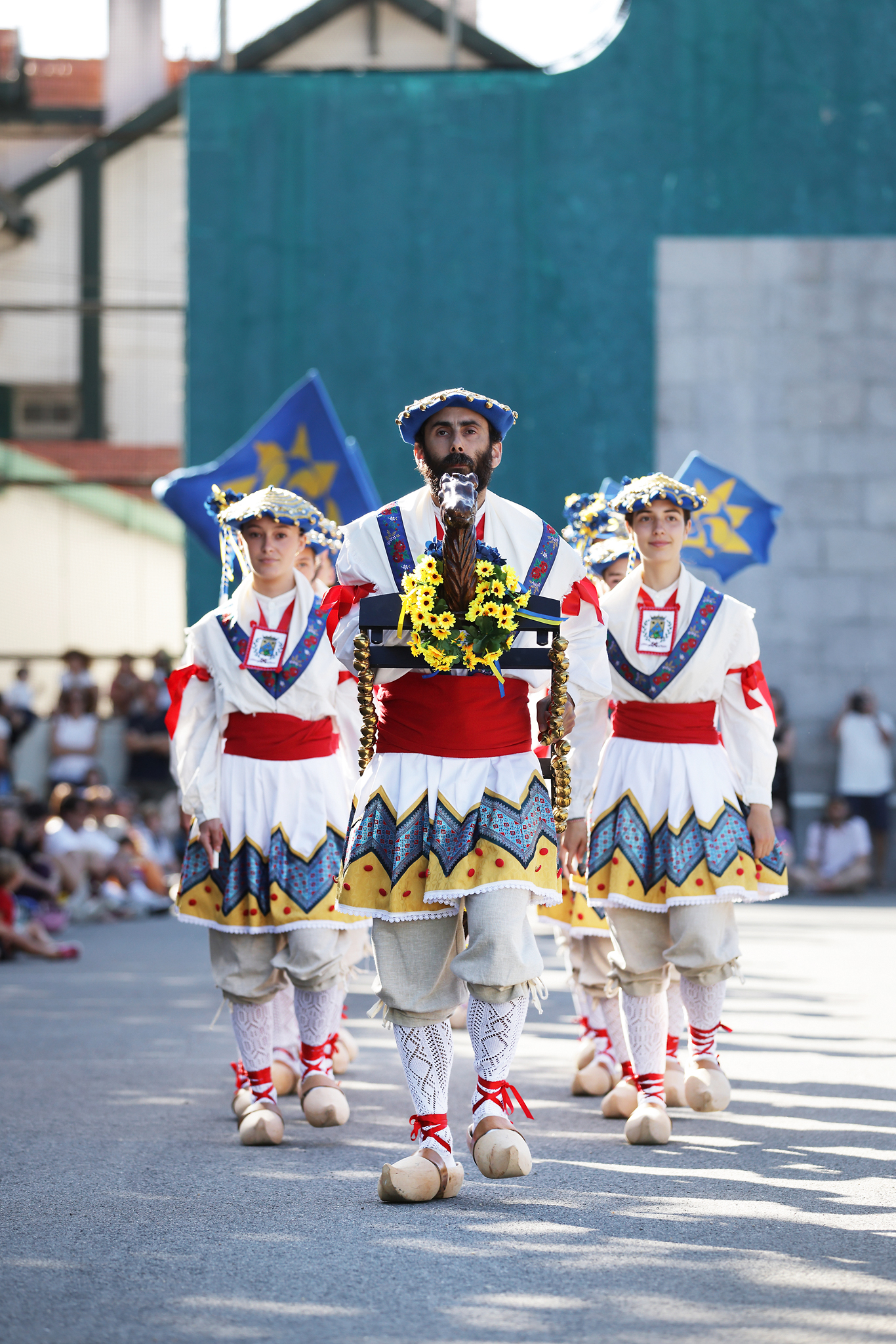
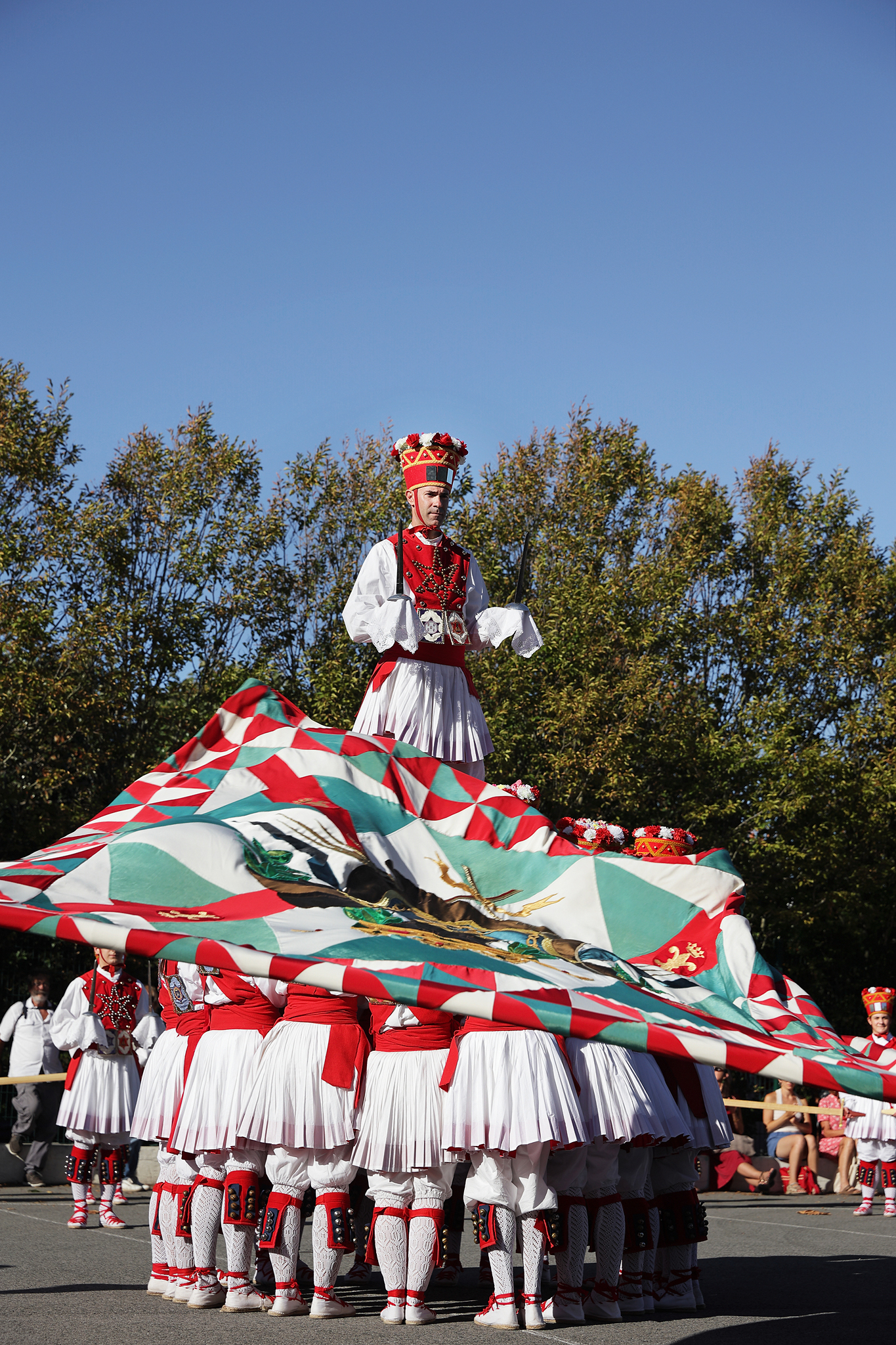
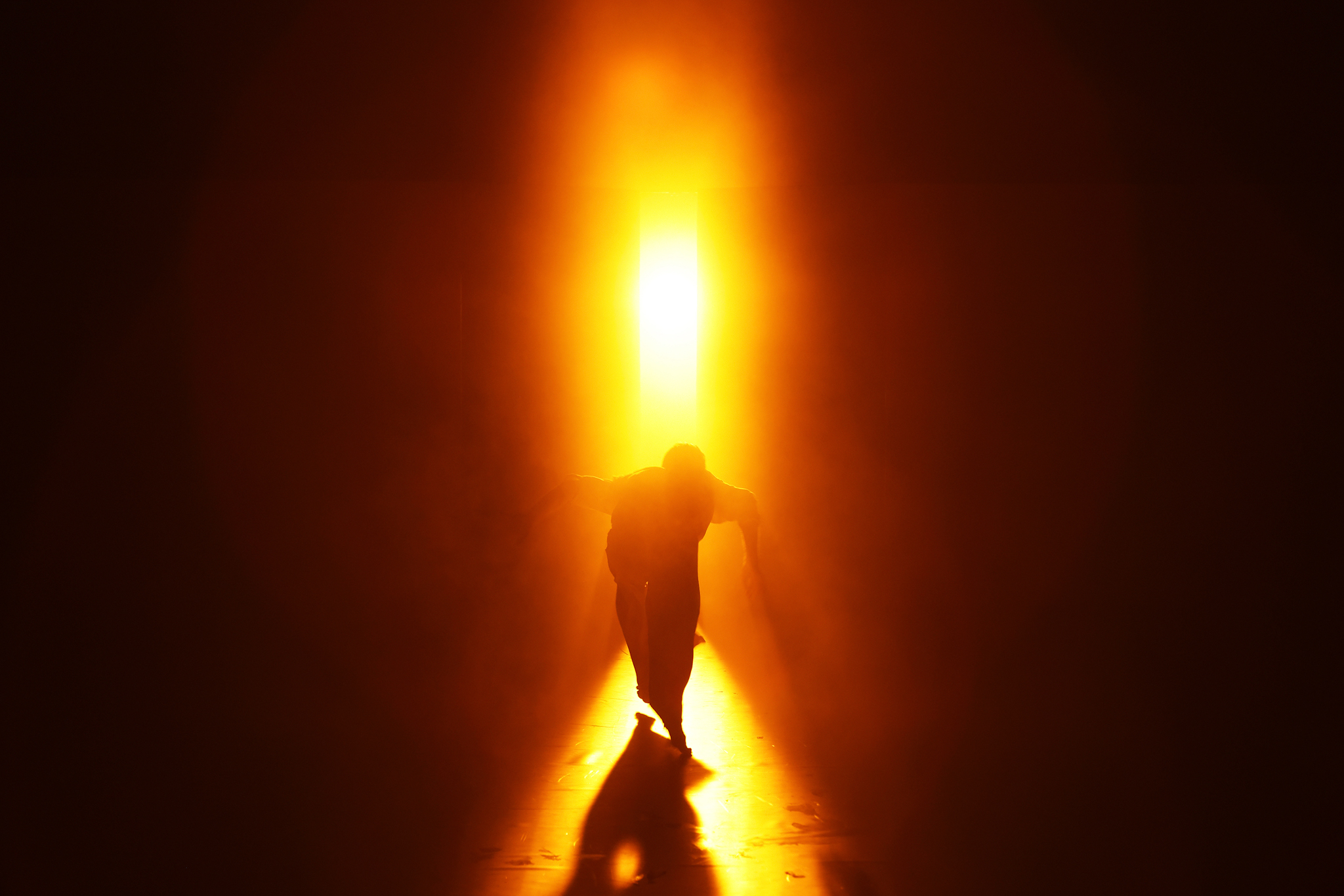
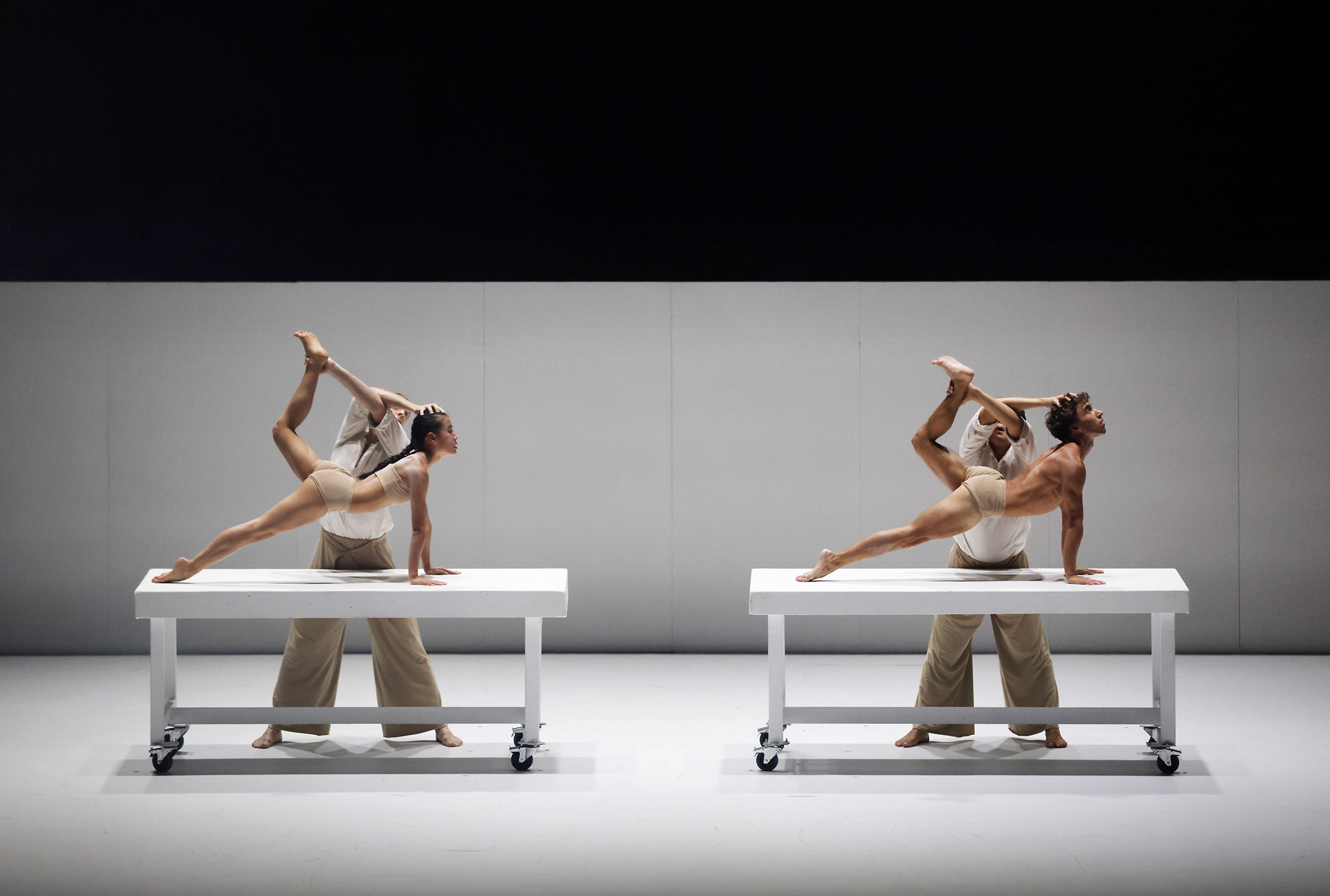
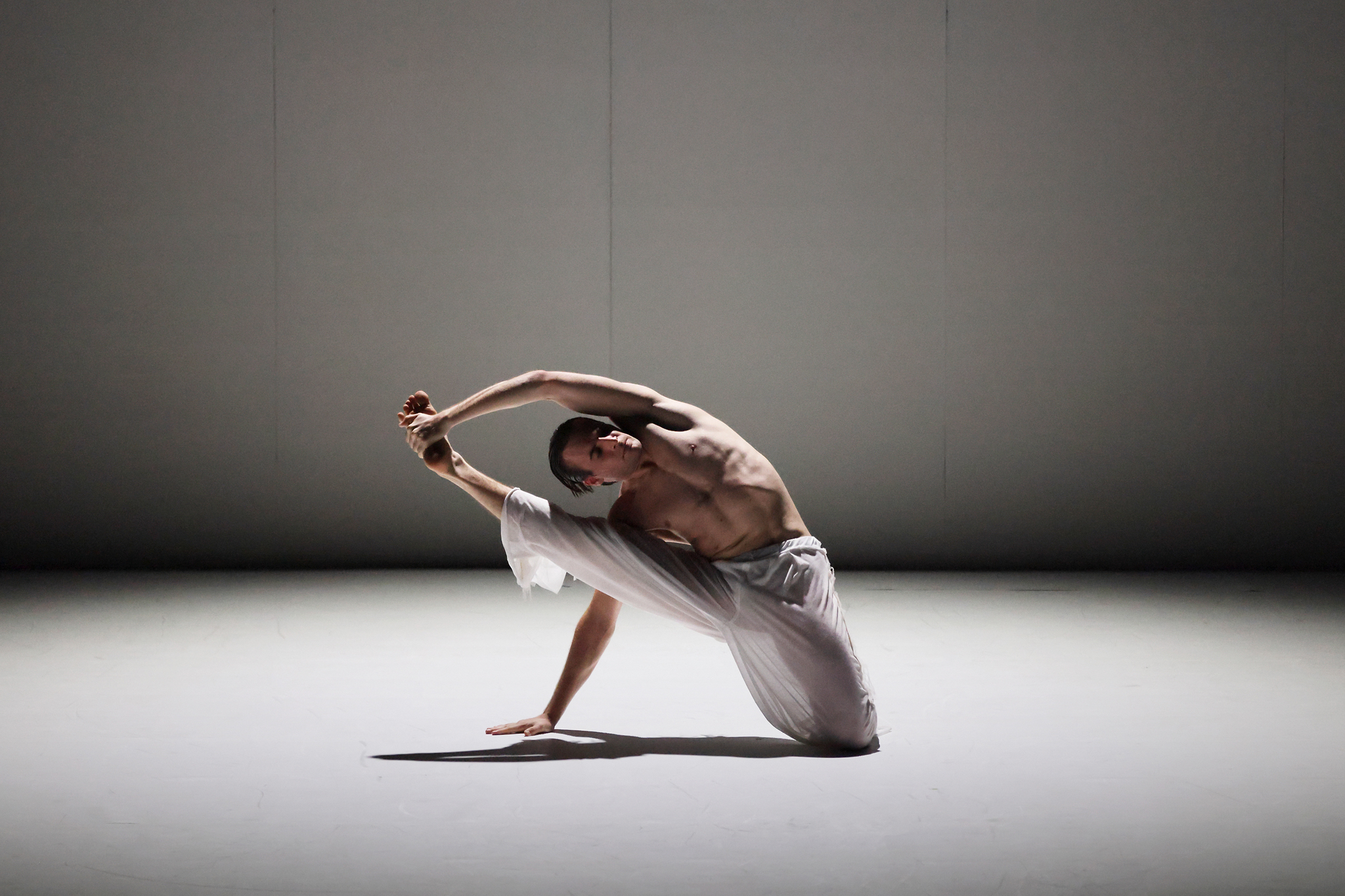
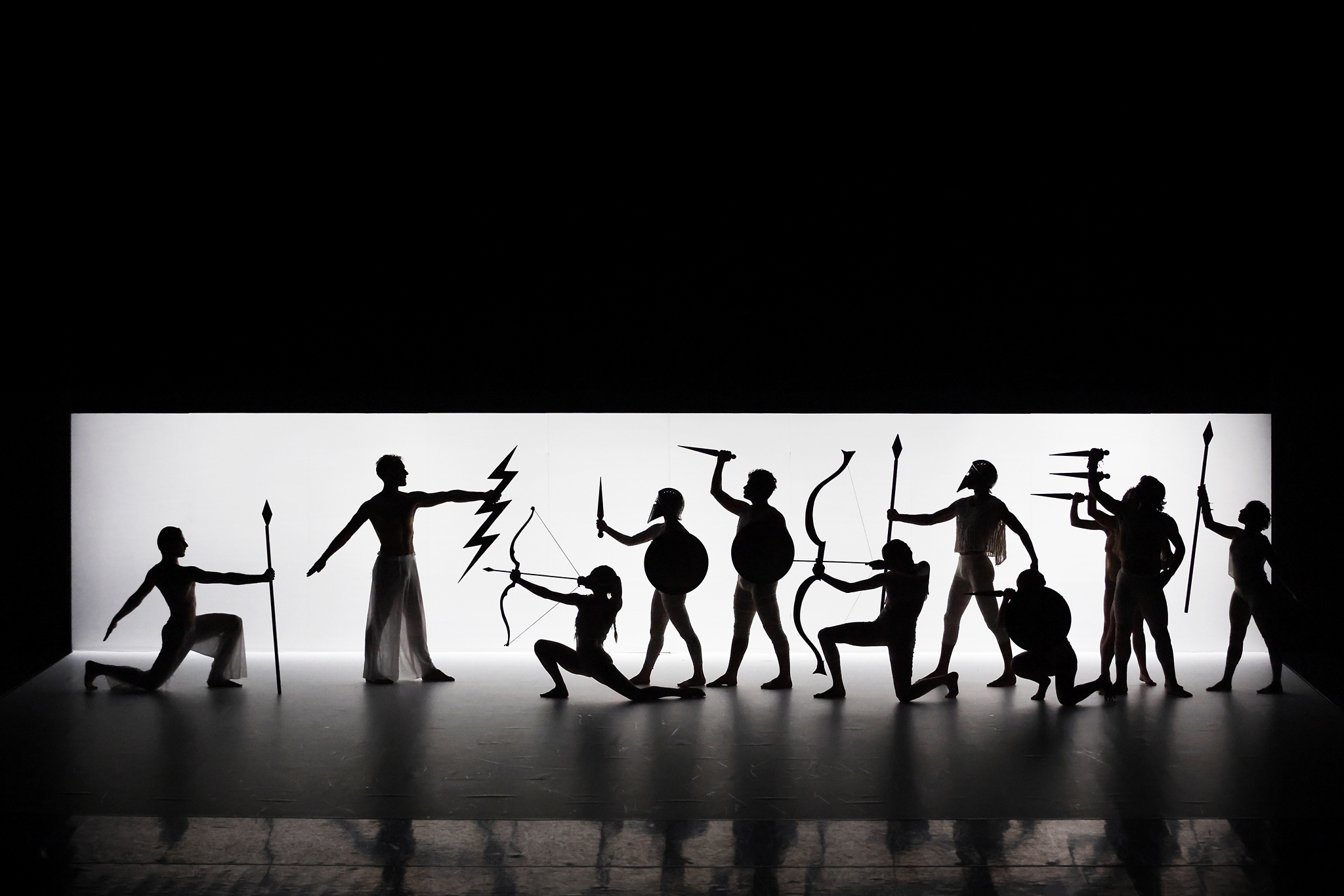
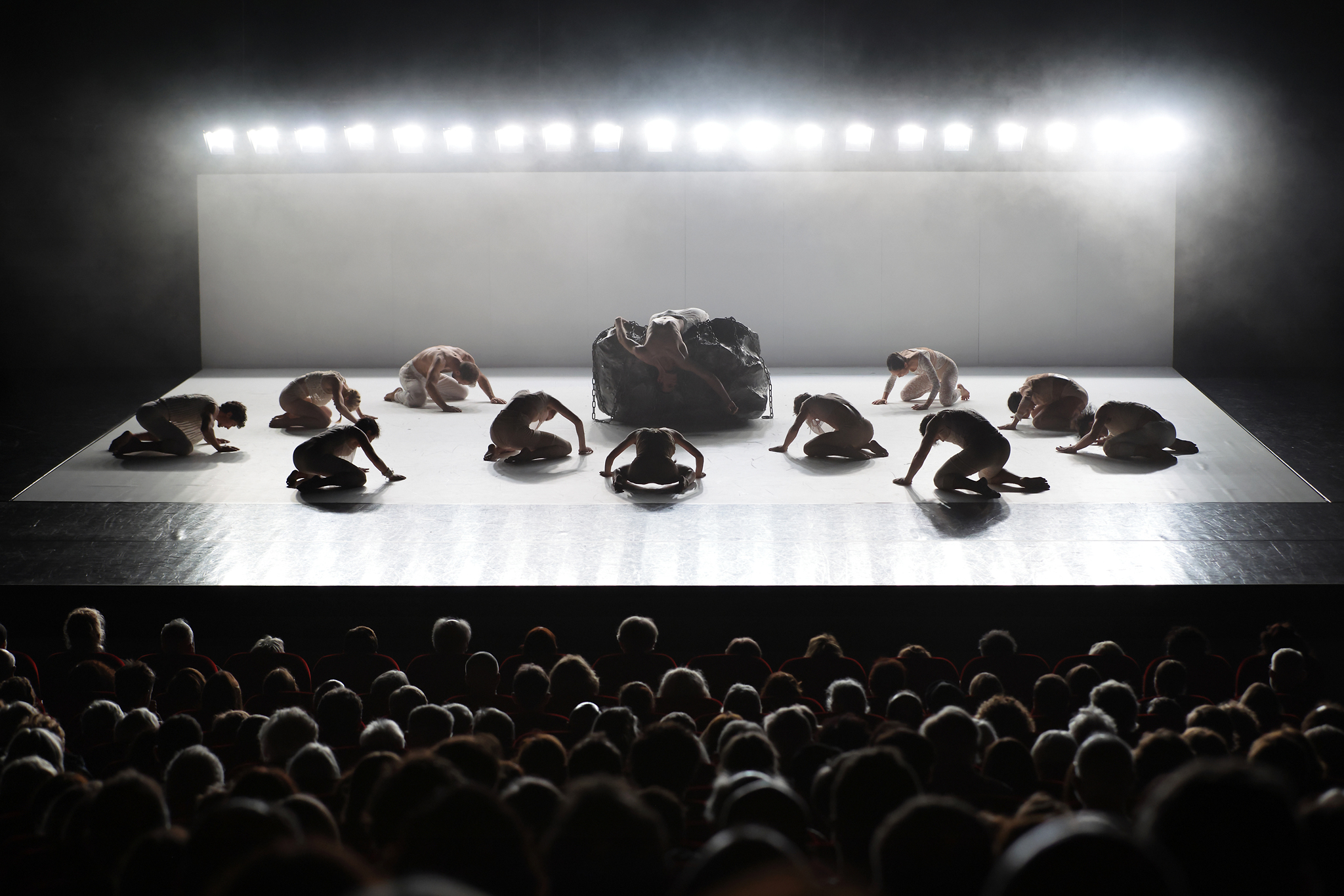
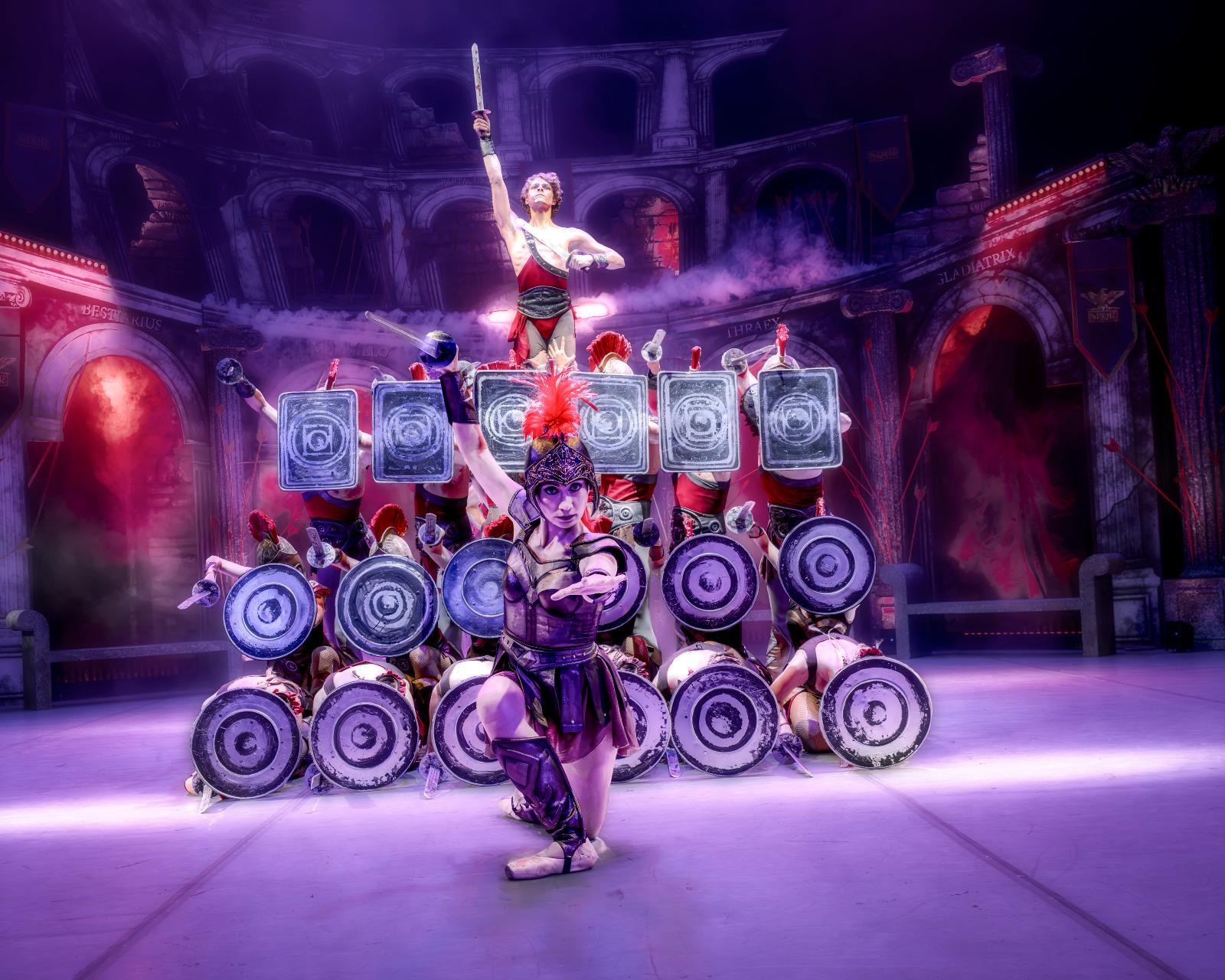
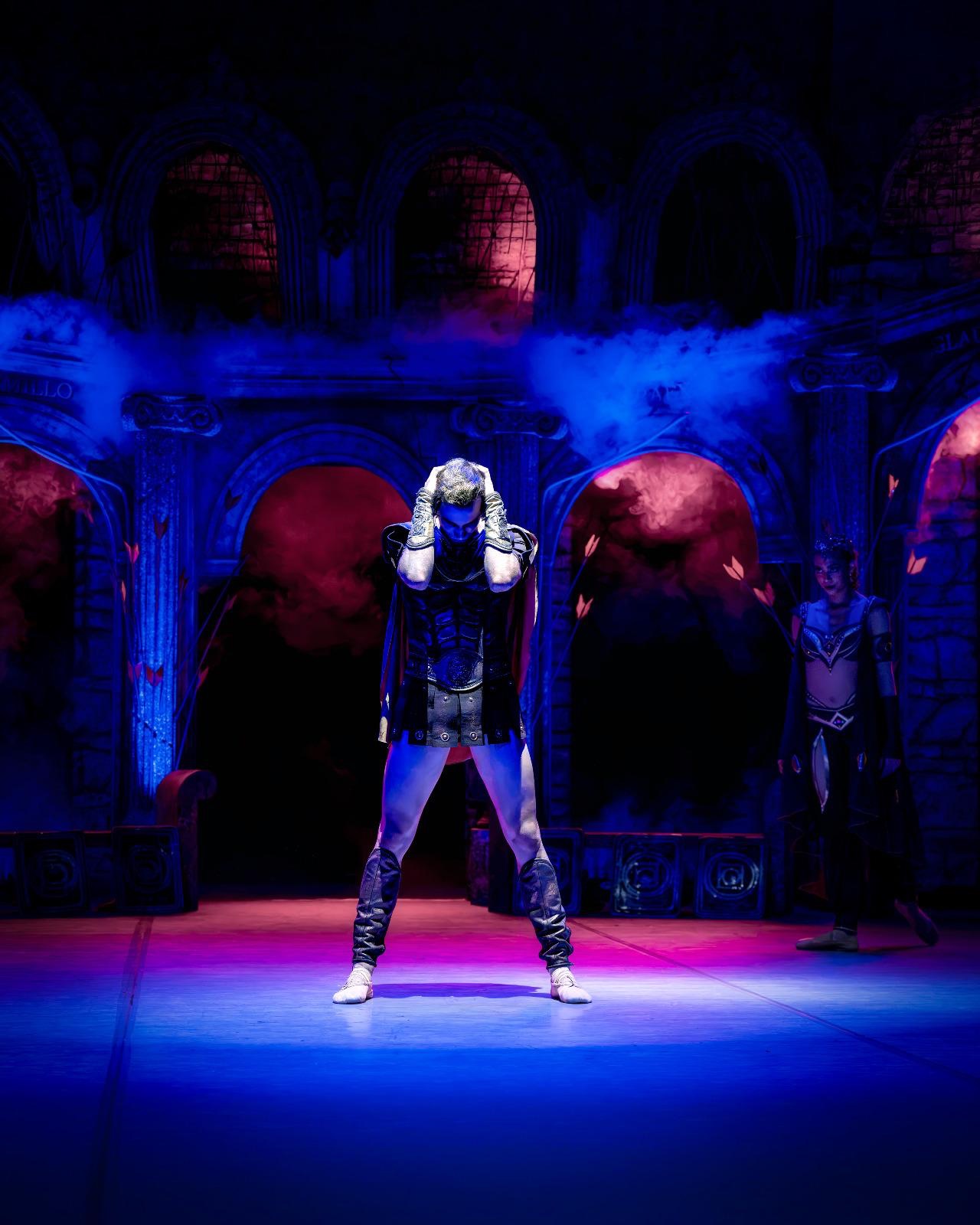
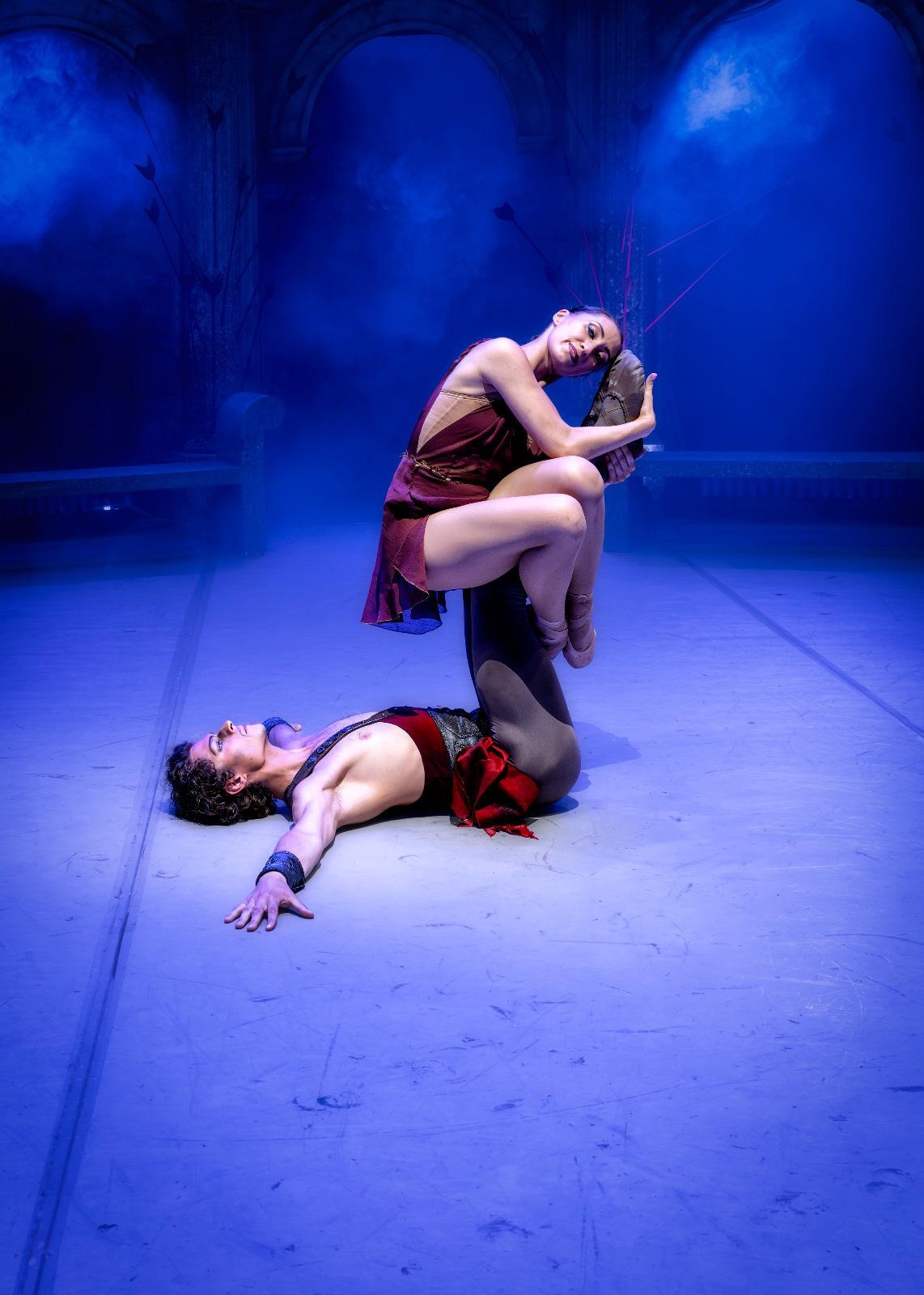
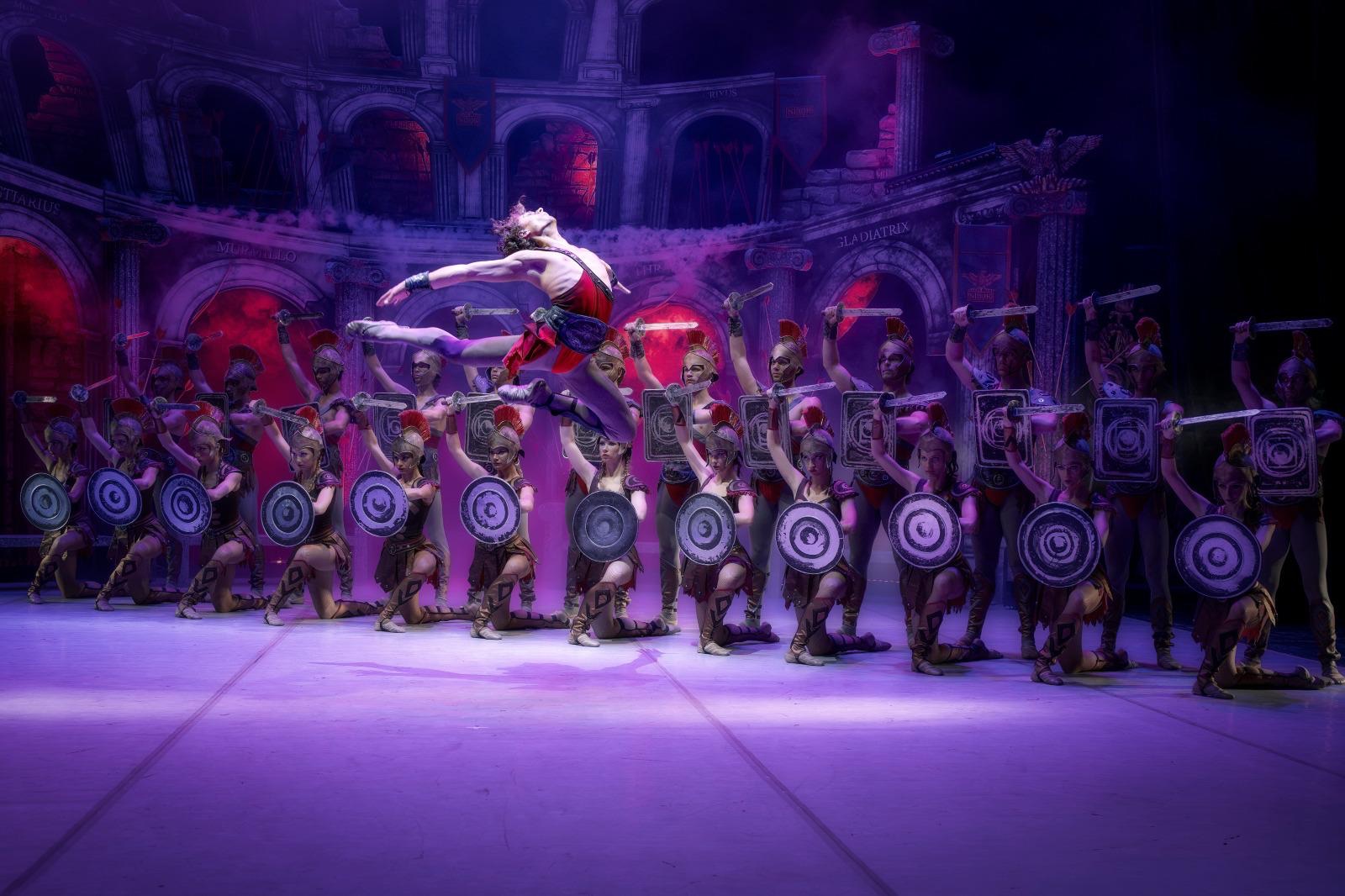
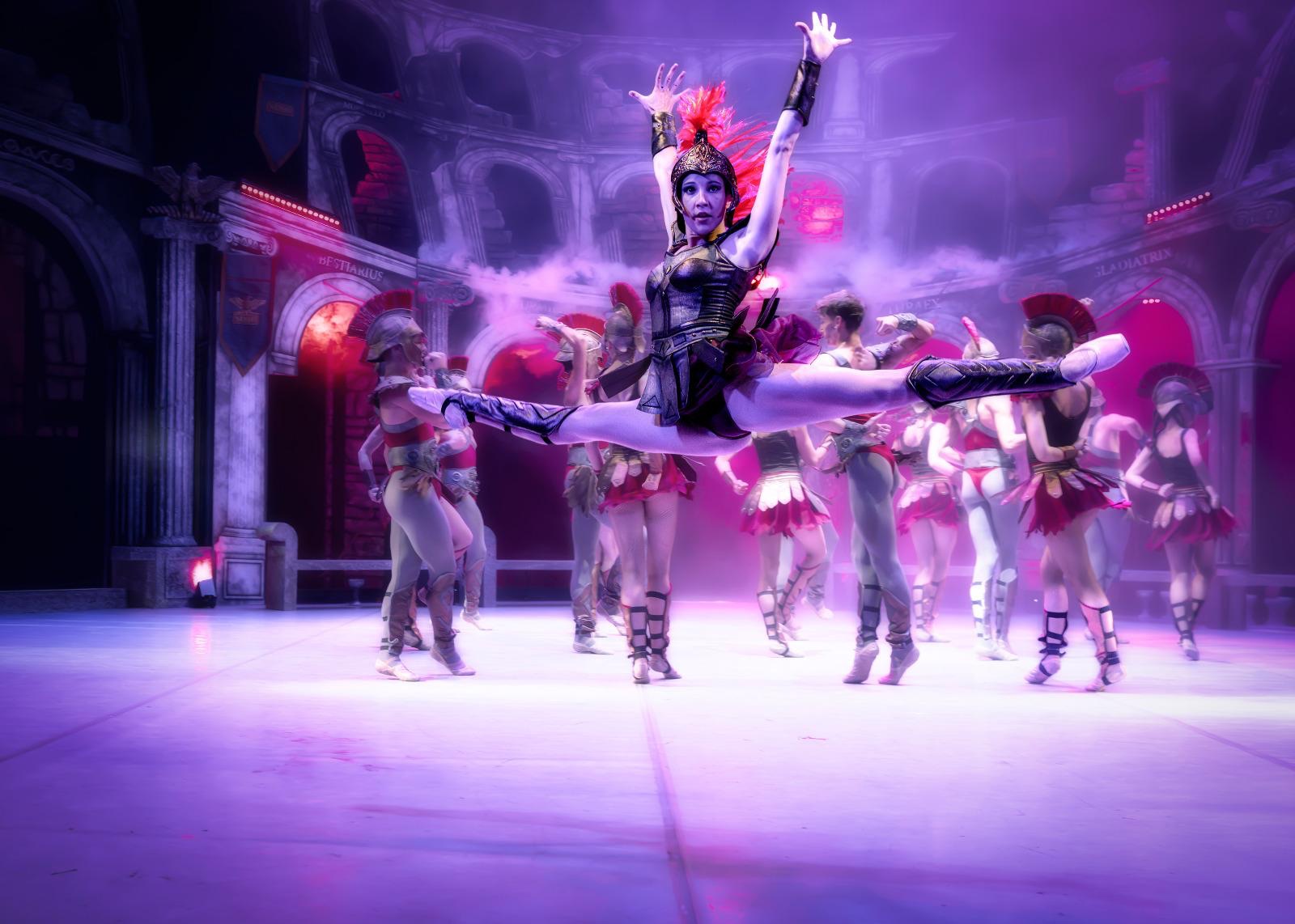

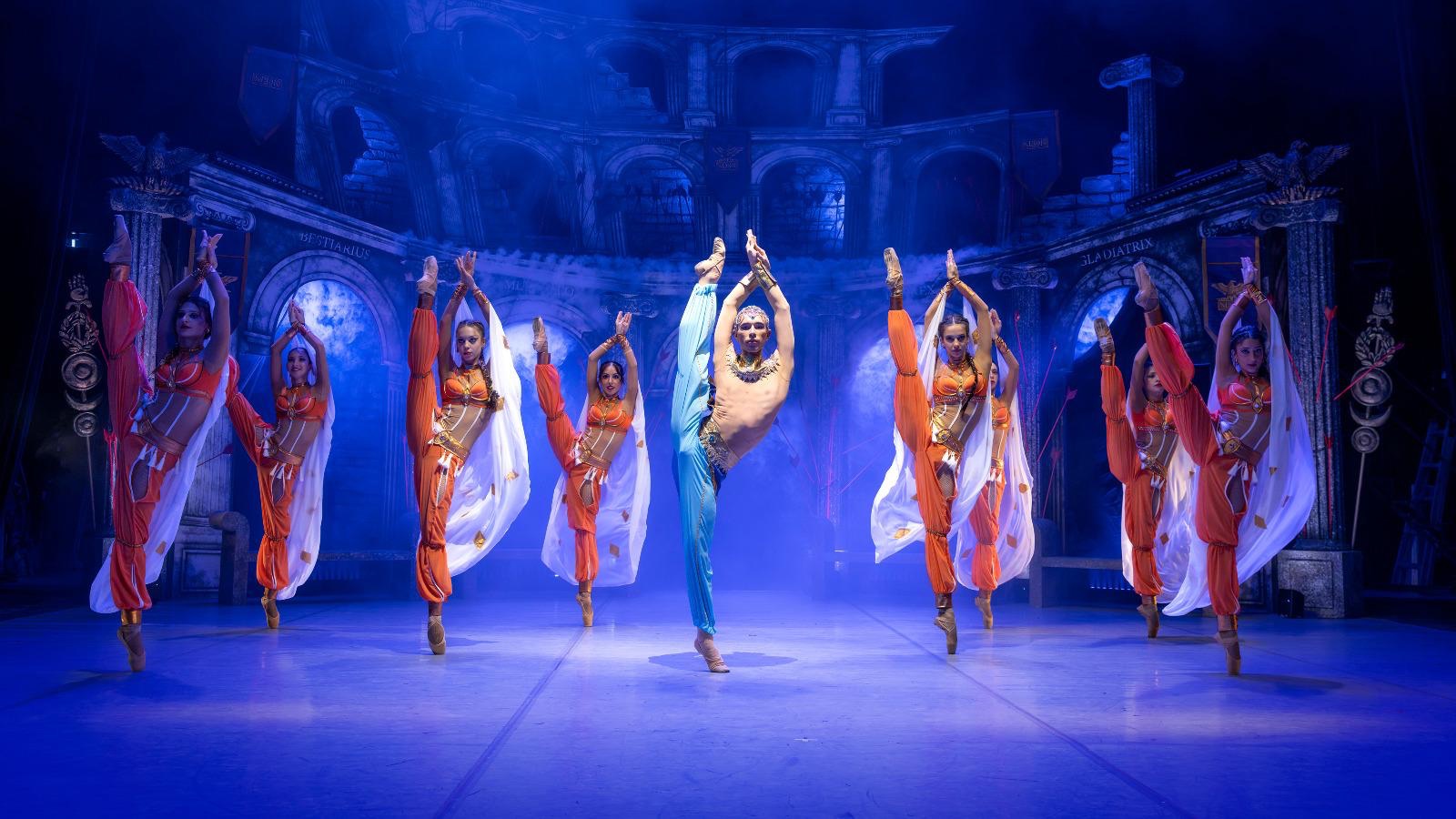
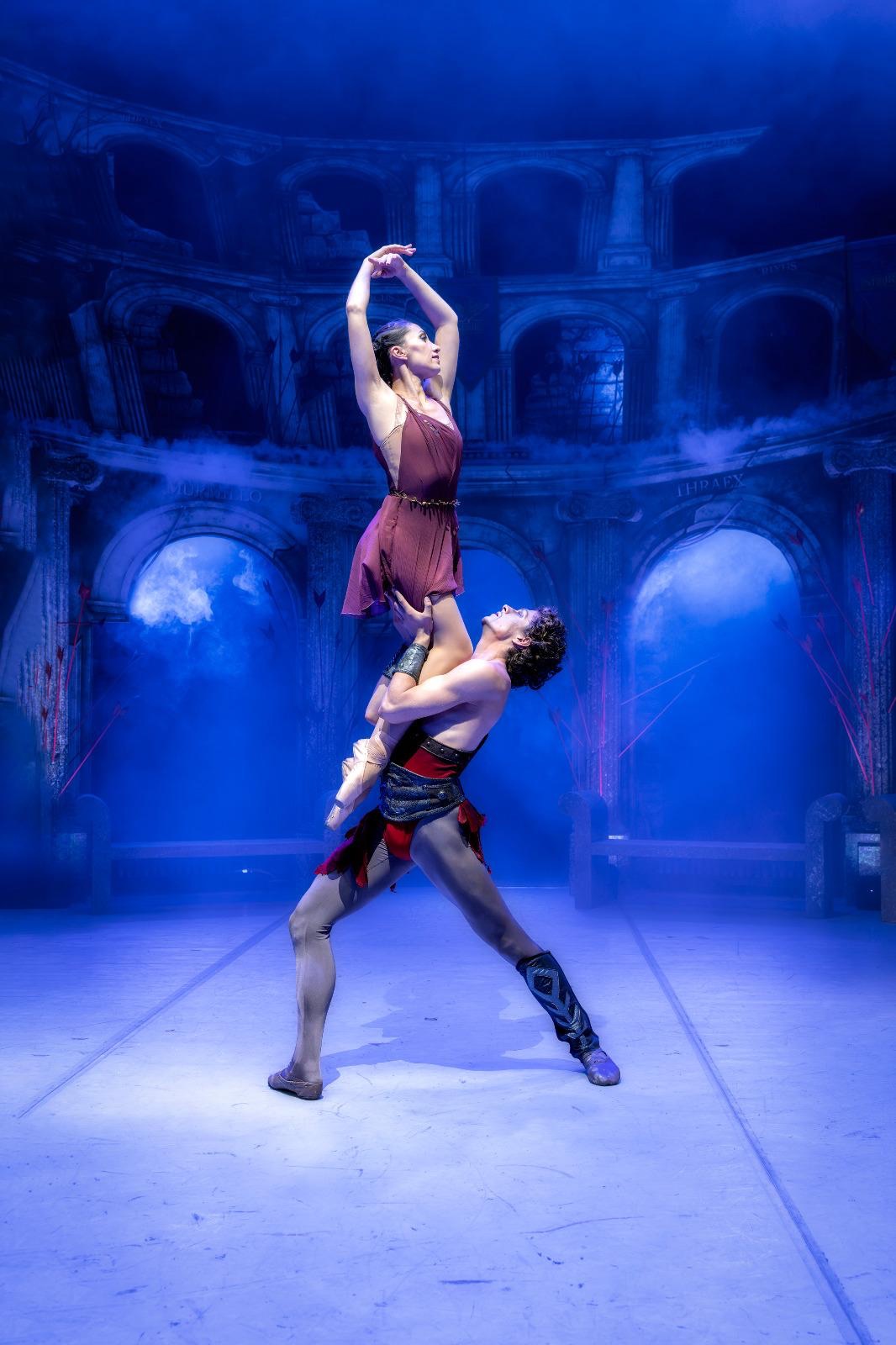
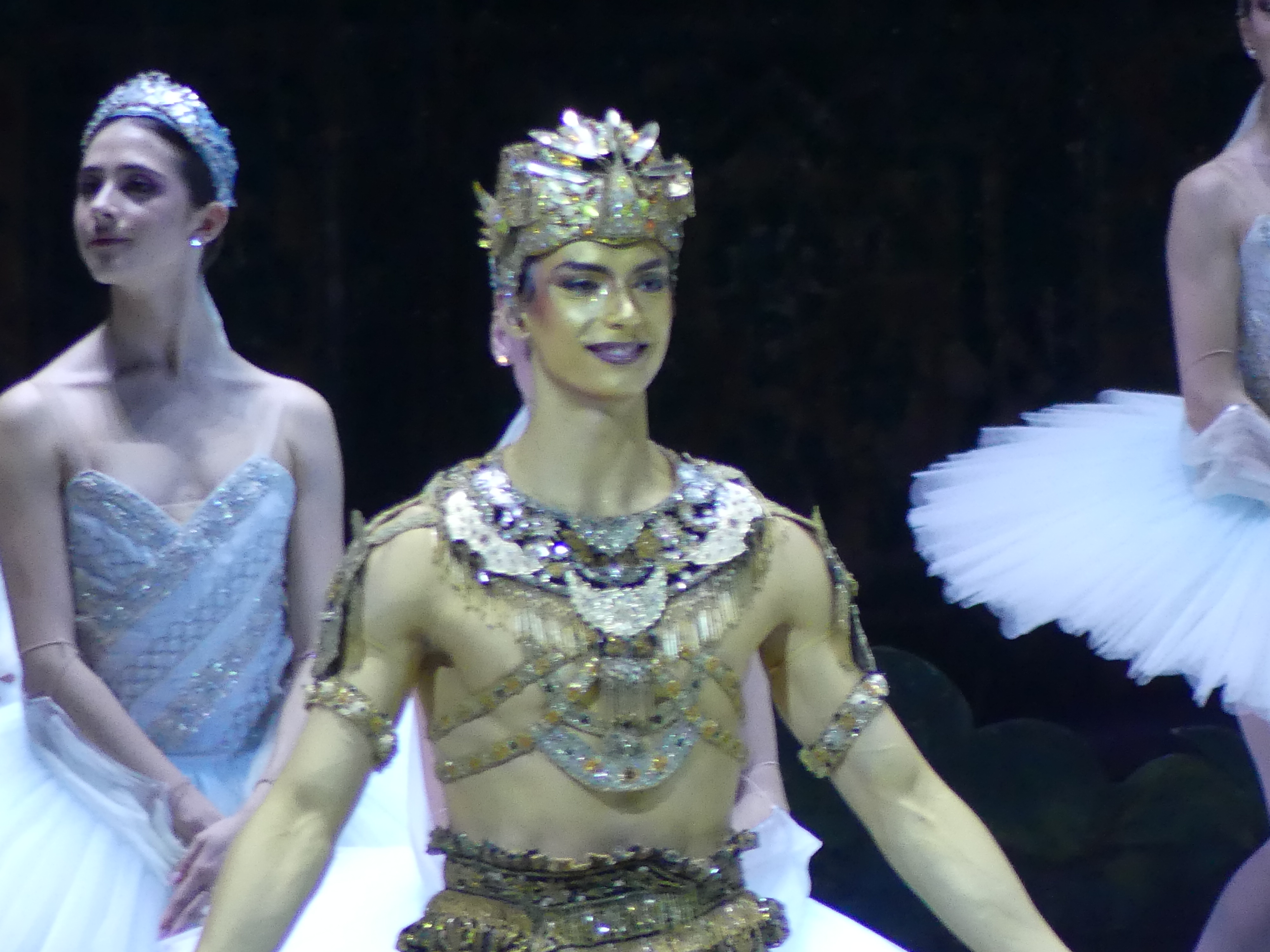
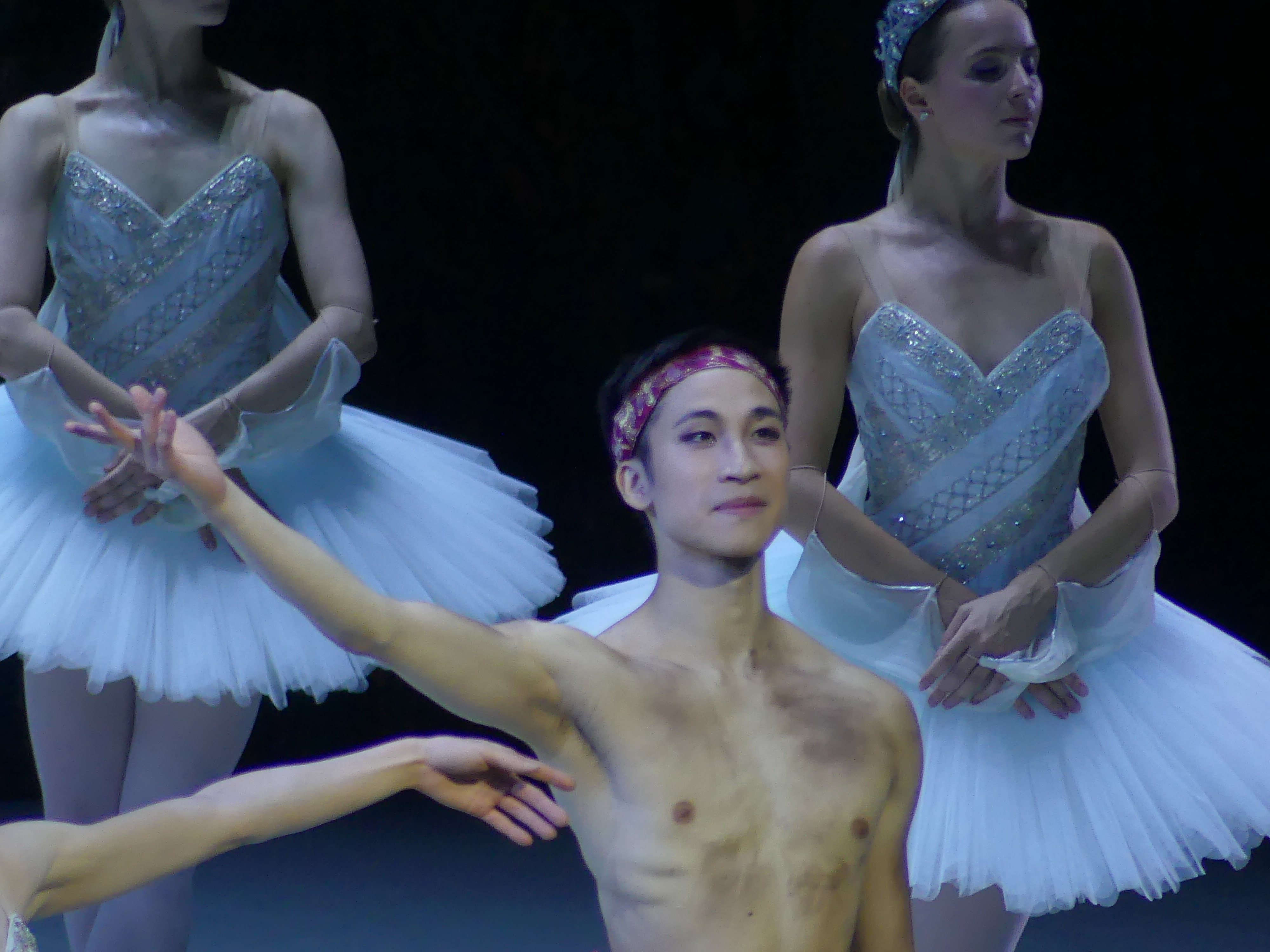
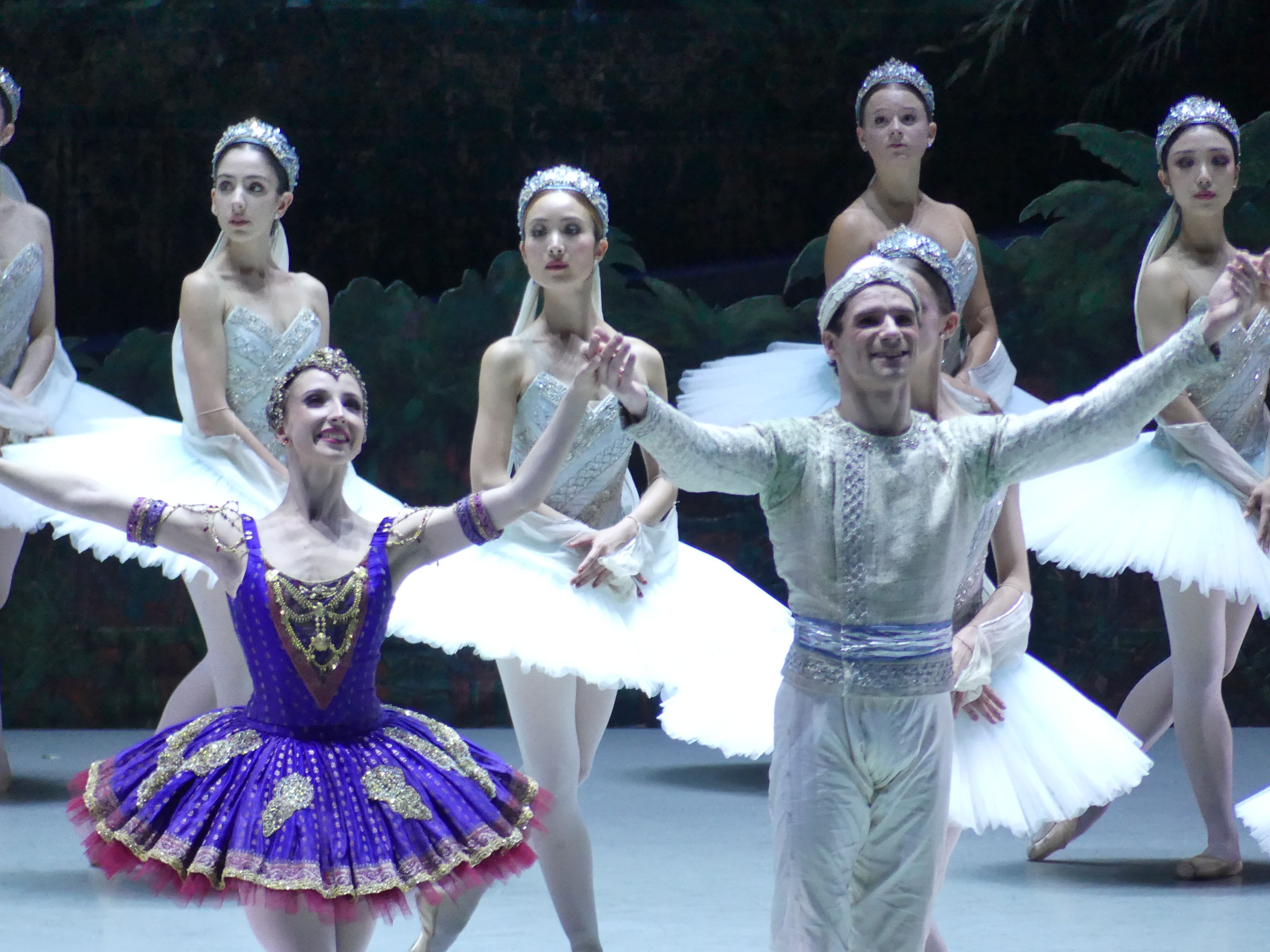
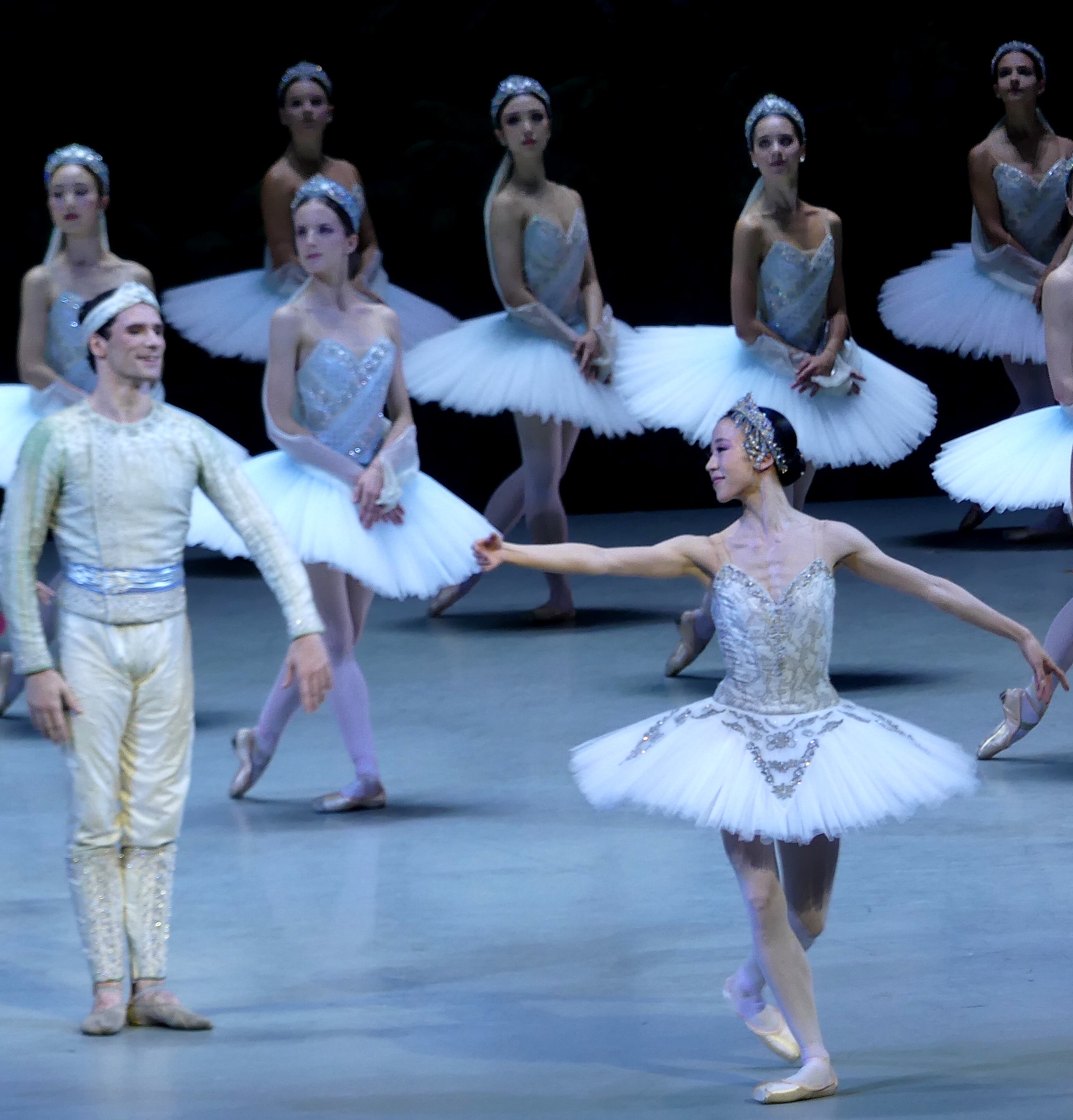
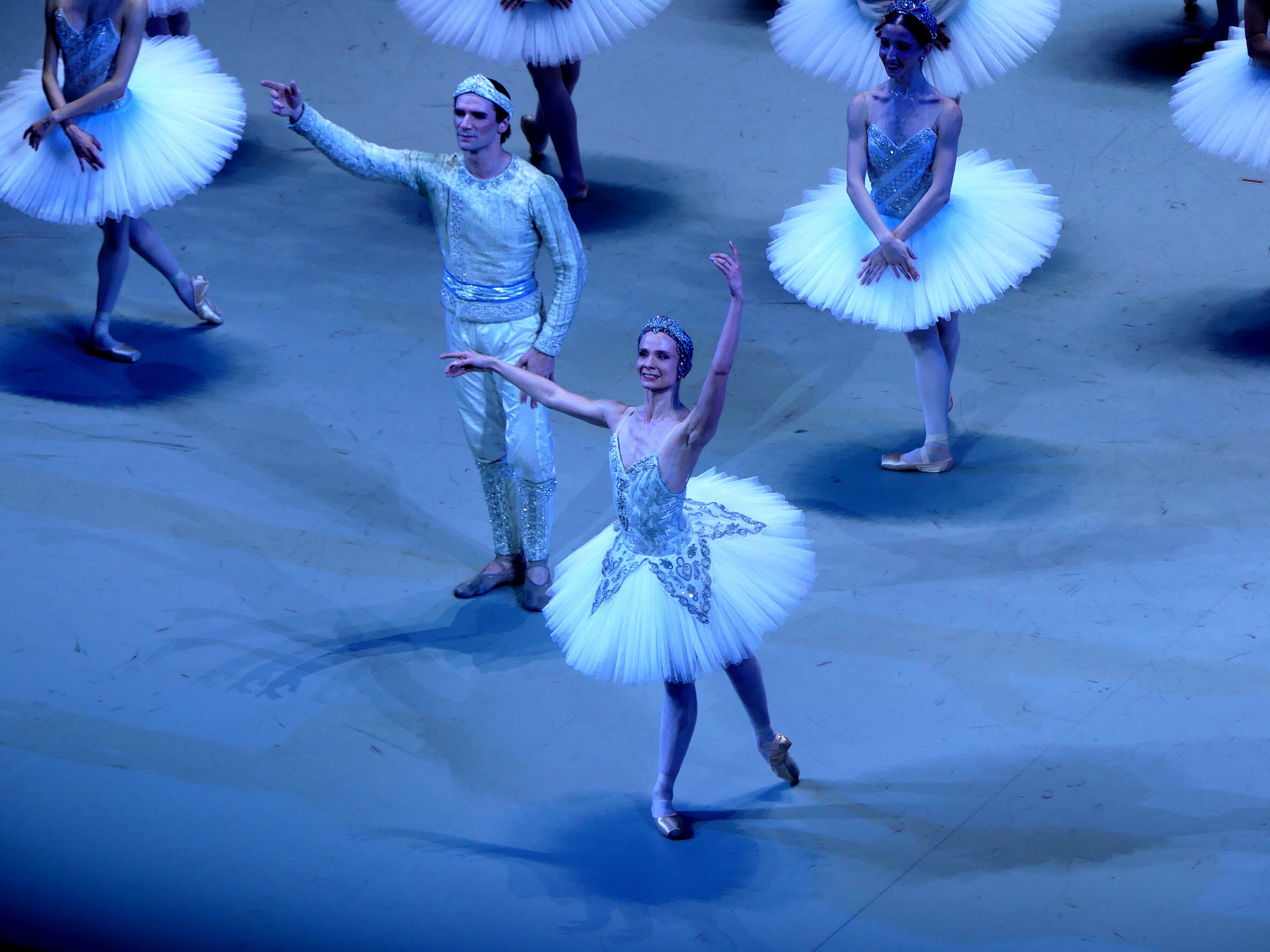
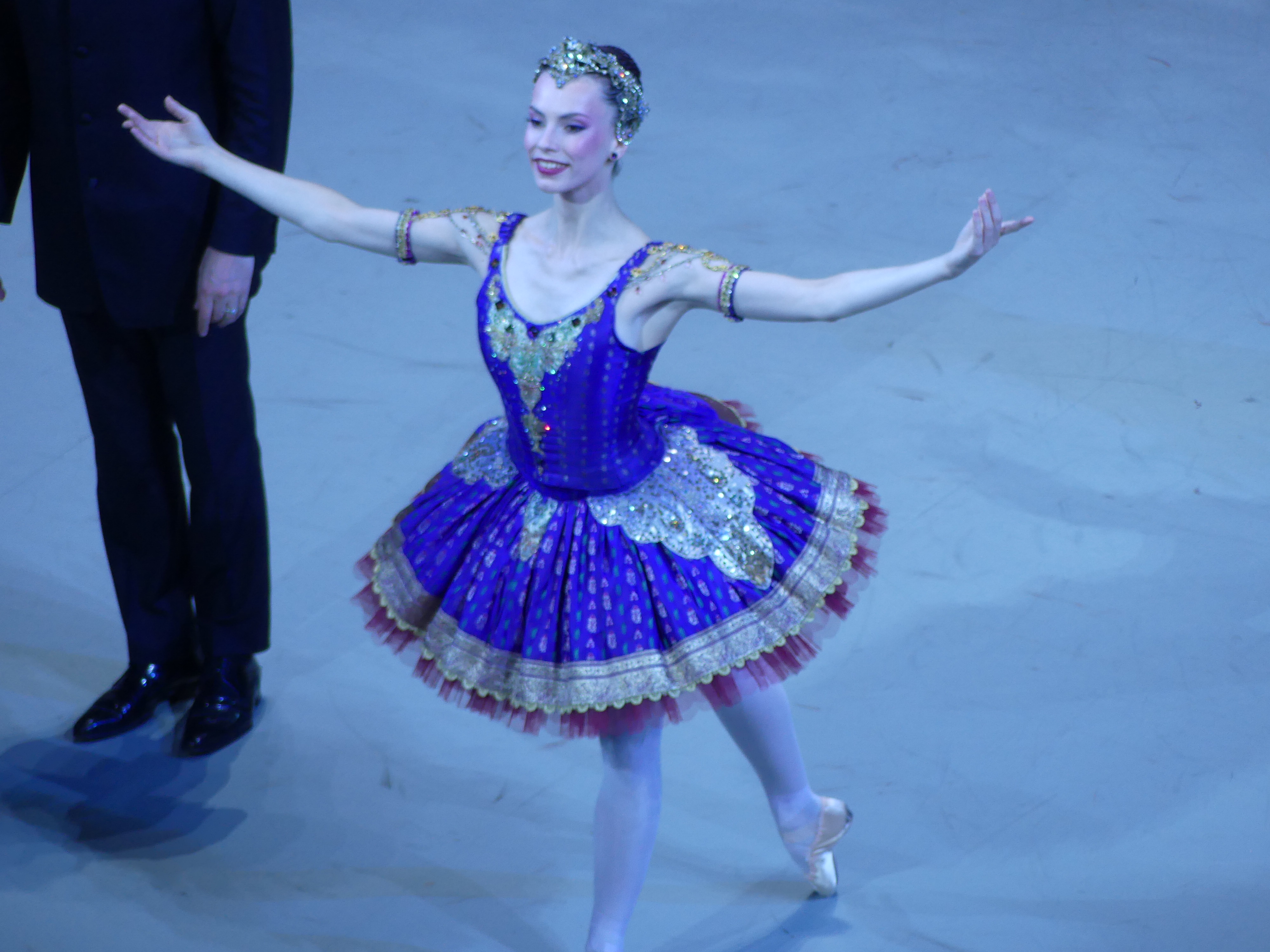


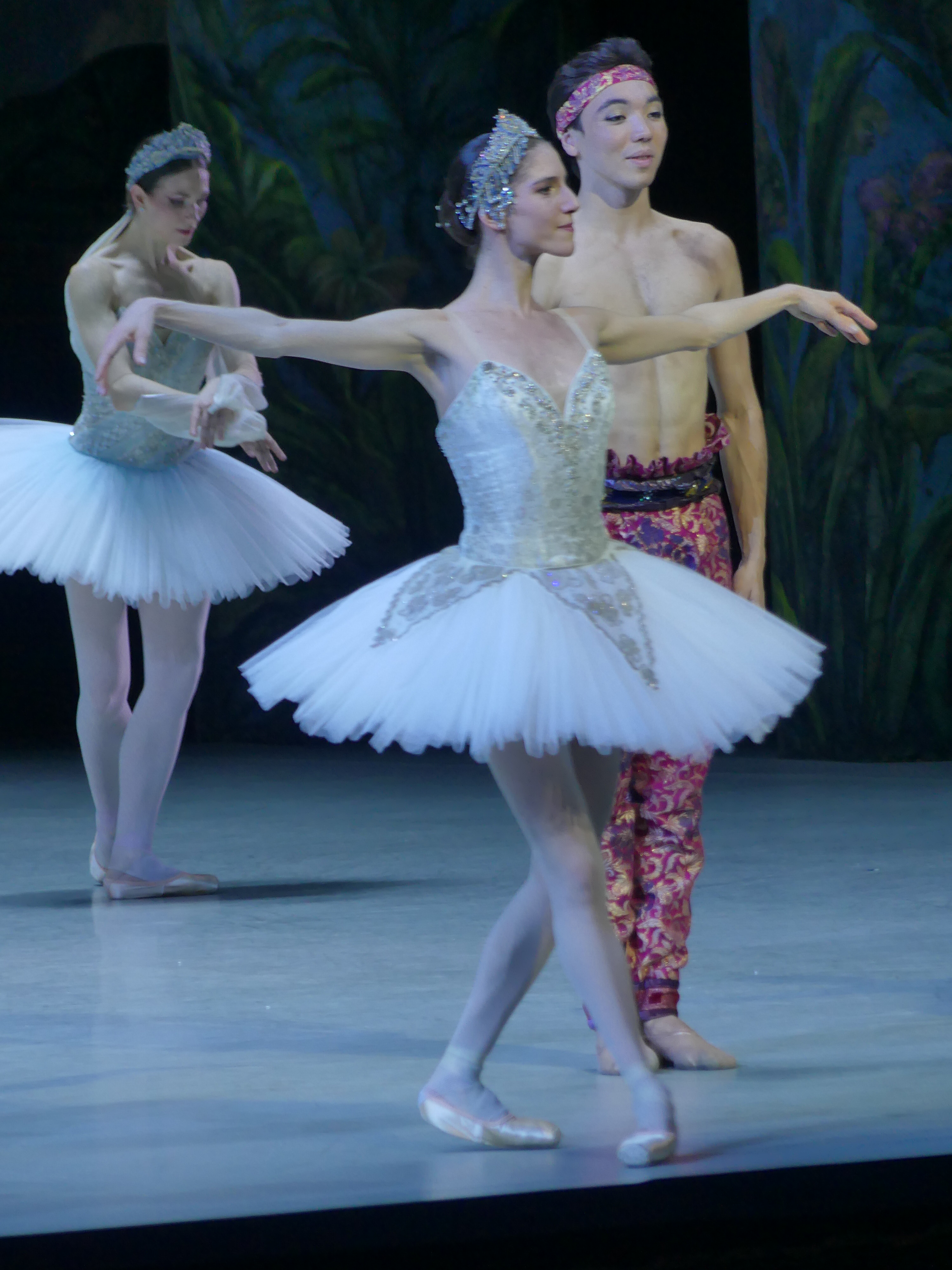
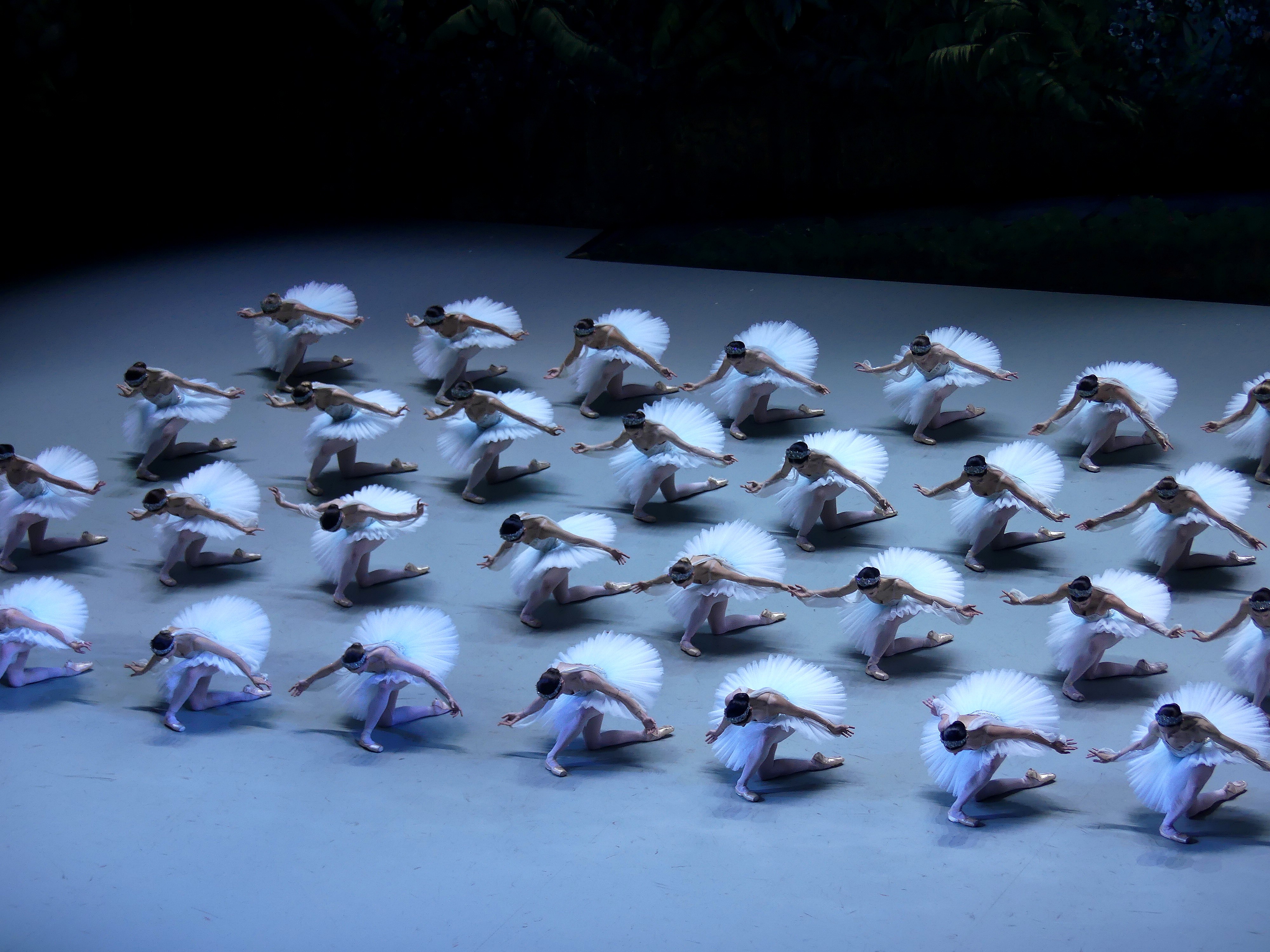
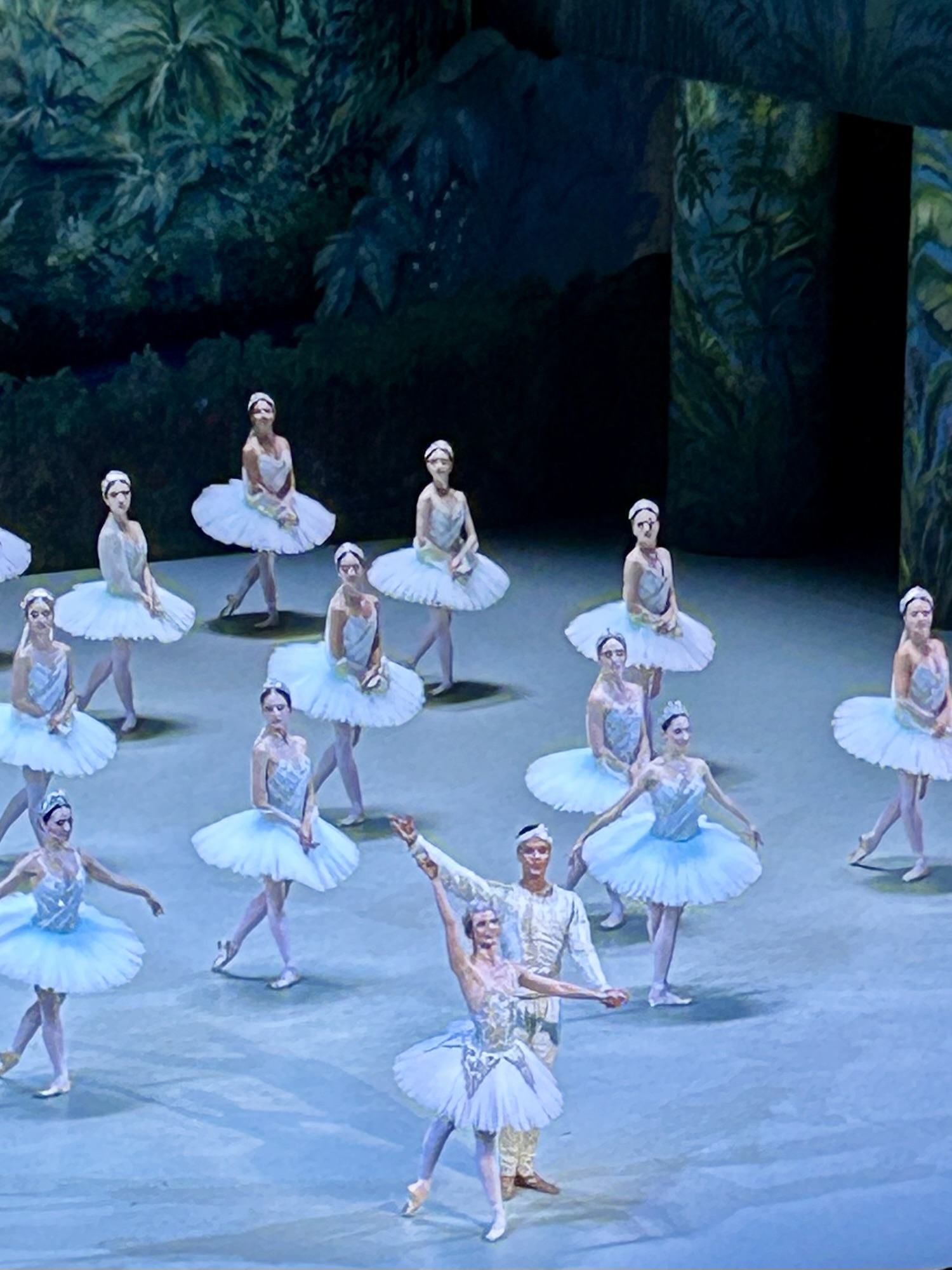


 James
James Albertina
 Cléopold
 Fenella
 Les Balletonautes
 Mini Naila
