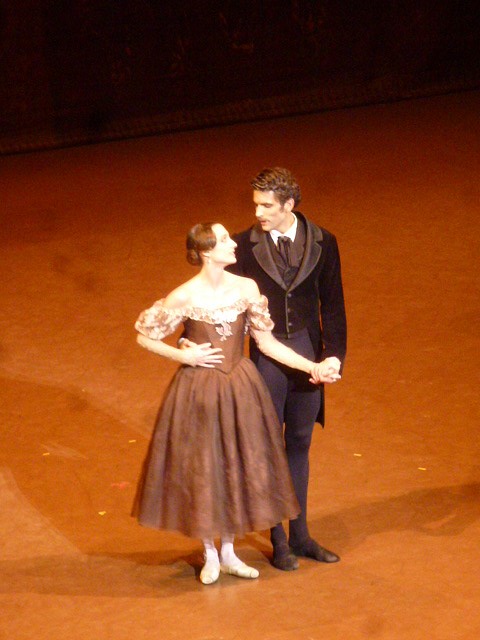
Rudolf Nureyev filmed in Raymonda (1984). Screen shot.
RAYMONDA: Choreography by Rudolf Nureyev(1983), inspired by Marius Petipa’s original ballet (1898) Music by Alexander Glazunov Paris, L’Opéra Bastille. In repertory from December 3rd to the 31st, 2019
Way before he actually turned out to be the most celebrated choreographer of the 19th century, Marius Petipa first had to leave his native Marseille and wing it all over Europe as a hired dancer. Then he landed a permanent post in Russia. Once done with the famous trilogy with Tchaikovsky — Sleeping Beauty, The Nutcracker and Swan Lake – Petipa went on to produce full-length ballets where he used a tried and tested formula: an exotic setting (often one he had experienced during his enforced travels, where he had absorbed the local dance forms into his bones); a dramatic love triangle (like most operas, duh); and an acclaimed “dream scene” (which the French call a ballet blanc) where the heroine – the ideal woman — is infinitely refracted by a corps of ballerinas all clad in identical tutus.
In 1961, while on tour in France, the great dancer Rudolf Nureyev defected, choosing the world over Soviet Russia. If he left a few material possessions behind, in his head and body he carried out an overstuffed memory-suitcase of all of Petipa’s evening-length story ballets. Among these jewels that dated back to the Tsarist era, some had been rarely seen abroad, such as…the full-length “Raymonda.”
This story, set during the Crusades, revolves around a French princess who finds herself torn between the love of a dishy Arabo-Mauresque chieftain and that of a “verry parfit gentil knight” [as Chaucer was wont to say] in the service of the King of Hungary. The male characters’ names — Abd-el-Rahman, Jean de Brienne, and André II – are indeed taken from history but lived during different eras, alas. The plot – and the heroine – are pure invention let fly as a pretext for dancing.
While respecting what original choreography had survived, Nureyev would always add one thing to all of his productions: much more dancing for the men than was the norm in Petipa’s time (or even in “the West” of Nureyev’s own lifetime). Here, in particular, he expanded the role of the Saracen chief – more of a standard mime in the original production – into a major protagonist whose slinky moves are clearly more inspired by the modern dance techniques that Nureyev had learned to love than by that “Petipa local color” once so beloved in the 19th century.
ACT ONE : (1 hour 10 minutes)

Versailles. Salles des croisades. Marguerite de France mène les Hongrois à la croisade.
Scene 1: somewhere in Provence, France, early in the 13th century.
An arranged wedding is in preparation. The aging Countess de Doris of Provence, without issue, has betrothed her niece Raymonda to a French knight in the service of André II, King of Hungary. But the Countess gets distracted by her niece’s friends, a jolly quartet of joyous young troubadors: Henriette and Clémence and their boyfriends Bernard and Béranger.
The Countess does a long pantomime, beating her breast. How can these kids be so silly when in fact the town is under siege? Crazed Arabs are pressing against the gates! She mimes the back-story: when the town is in danger a mysterious white lady (look up to the left, the direction towards which she shakes her fists) “always returns from the other world to protect us…unless we have been too frivolous and forgotten our duties.” Our future heroine’s four flirty BFFs are not impressed by all this gloomy karma.
The Countess’s niece, Raymonda, fi-na-lly, appears and proves so light on her feet she can spin while plucking up roses. She is bright and innocent. The King of Hungary hands her a scroll which heralds the imminent return to France one of his knights…and unfurls a tapestry depicting a gorgeous cliché of a prince-handsome. Raymonda is suitably delighted by this manly mirage that her aunt and the king have chosen for her.
The Countess dances, as do Raymonda’s four friends. Everything is perfect but suddenly…
Abderam, the Saracen (i.e. Arab) chieftain, the one who has been besieging the city, bursts in. Offering jewels and slaves and –ooh-la-la!– even himself, he throws all that he has at the feet of the astounded Raymonda.

Versailles. Salles des croisades. Rencontre de Richard Coeur de Lion et de Philippe Auguste. Détail.
Scene 2: The dream.
Raymonda, picking at her lute, is now perplexed. Her four friends dance about and hope to distract her. Hoping to distract them, she dances with her wedding veil, but she would rather be left alone.
Exhausted by this emotionally demanding day, Raymonda definitely needs to take a nap. But instead of really checking out she starts to dream of:
The White Lady, who points to the tapestry and suddenly HE appears:
Jean de Brienne, a knight in shining armor all dressed in white, who descends from the tapestry and –literally—sweeps her off her feet. He is truly the man of her dreams. Or so she thinks.
Her friends reappear, now dressed in silvery costumes, and a swarm of dancers dressed in black and white dance an incredibly complicated fugue: this is the Valse fantastique. This interlude proves one of Nureyev’s most complex, inventive, and exhilarating additions to the beautiful repertoire of the corps de ballet.
Henriette, Clémence, Jean de Brienne and Raymonda each dance in turn.
To her shock, Raymonda’s dream lover morphs back into the smoldering Abderam.
Awakened by her friends, Raymonda realizes that she is torn between two utterly opposite dreamboats.
INTERMISSION (20 minutes)
ACT TWO: (40 minutes)

Versailles. Salle de Croisades
Abderam, willing to offer peace in return for the hand of Raymonda, pulls out all the stops: a fabulous tent, wild and exotic entertainment, his body and soul…anything her heart could desire. But Raymonda, albeit quite titillated, persists in remaining demurely unmoved.
Completely frustrated and bursting with desire, Abderam decides to kidnap the reluctant maiden. Then all of a sudden, who should appear in the flesh but the real Jean de Brienne, replete with gleaming white tights, freshly back from the Crusades! The two men duel…a joust is followed by a swordfight. Guess who loses?
INTERMISSION (20 minutes)
ACT THREE : (35 minutes)

Appartement de Noureev à Paris. Quai Voltaire.
The Wedding Festivities:
Here the ballet reaches its climax by being reduced to essential shapes and patterns. A Hungarian czardas, led by the Countess and the King, is followed by delicately different and difficult variations: solos, a chorale for four men, a love duet, group dances. The highlight is an atmospheric solo for Raymonda [her seventh!] — the music’s essence consists of a trilling piano backed by a few plucked strings—an orchestration so pared down that the score was deemed shockingly modern in 1898. Dripping with weighty jewels and clapping her hands together with newfound authority, this princess-bride is certainly ready to become a queen.
As the ballet roars to its end, you may yearn to hoist your gilded chalice aloft and drink to the health of the adorable couple. [Unless you find yourself regretting – as I often do – that no one thought to invite Abderam to the party].

Rudolf Noureev avec Michelle Phillips dans « Valentino », film de Ken Russell
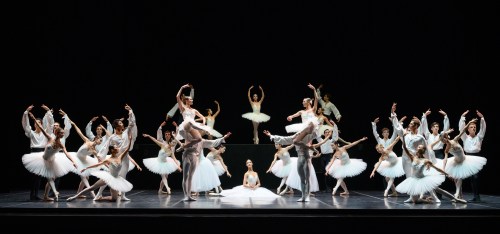
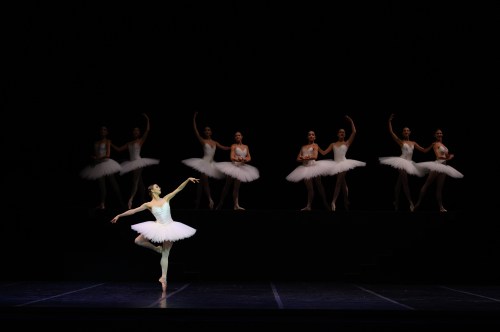
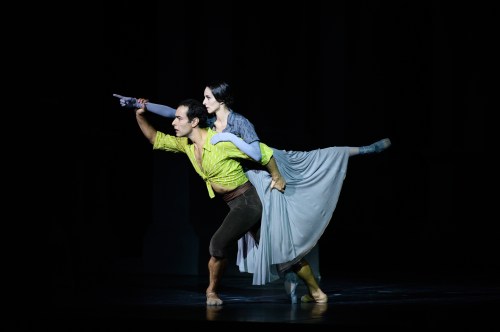
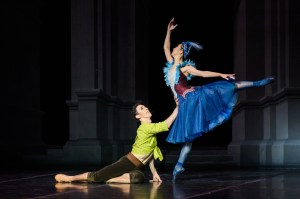

 Le Lac des Cygnes, Paris Opera Ballet, March 11, 2019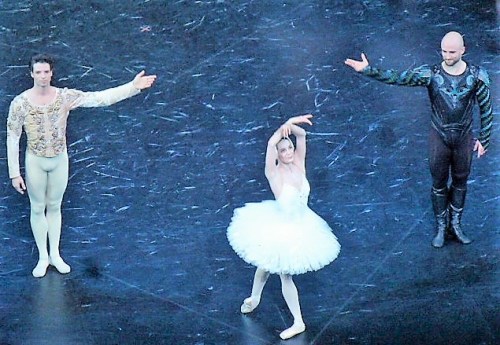
 La Dame aux camélias, Chopin-Neumeier, Paris Opera Ballet, Palais Garnier, December 7th and 14th, 2018.


 A Paris, à l’Opéra Bastille, du 26 novembre 2018 au 2 janvier 2019.
  La belle mère et les deux sœurs par alliance de Cendrillon, méchantes et dépourvues de talent, se disputent, cousent et se disputent encore sous le regard de la pauvre fille. Lorsqu’elle se retrouve seule pour un moment, Cendrillon se permet des rêves d’étoile… ou, au moins, que son père cesse d’abuser de la bouteille. Sorti de nulle part, un mystérieux inconnu qui semble avoir été victime d’un accident routier s’effondre dans leur living room. Cendrillon est la seule qui tente de l’aider.


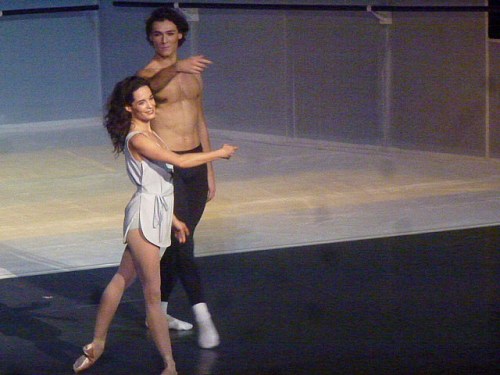
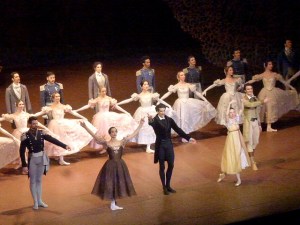 John Cranko’s Onéguine by the Paris Opera Ballet at the Palais Garnier, Feb 14, 2018
 As Prince Gremin, the husband Tatiana has finally settled for, Florian Magnenet calibrated his interpretation in light of this very pensive and poised Tatania, whose thoughts always seemed to be elsewhere. As opposed to his rapport with Pagliero’s Tatania on the 13th, something about the way he was too careful in embracing and partnering Gilbert, made you realize that this wife of his had not told him everything and remains a bit of a mystery. But what man wants to be told to his face that his wife has felt passion only once in her life, and not with him? Better let sleeping dogs lie.
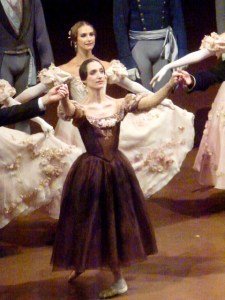 As the ballet hurtles towards its end, Bezard rushed in, only to stop dead in his tracks. Gilbert seemed to have been turned into marble by the letter on her desk. Her frozen stillness made you wonder whether she was still breathing. She, too, was in as much pain as Onegin. She is still that good girl. Writing one love letter three years ago had been her first and last moment of élan, of independent action, of breaking the rules. Both seemed to be thinking of the main result of her one moment of spontaneity: not the broken dreams of the living, but the lost future of her sister’s fiancé, dead.