Archives d’Auteur: Fenella

Avatar de Fenella

À propos de Fenella

Pour ne pas rester muette, car je n'ai pas les deux pieds dans le même sabot, i will write in English.

Charmatz at the Opéra : “Fate is a foolish thing…Take a chance”*

P1100764

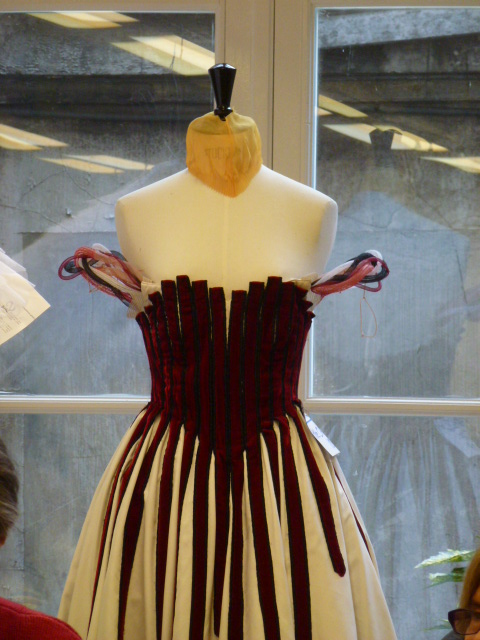
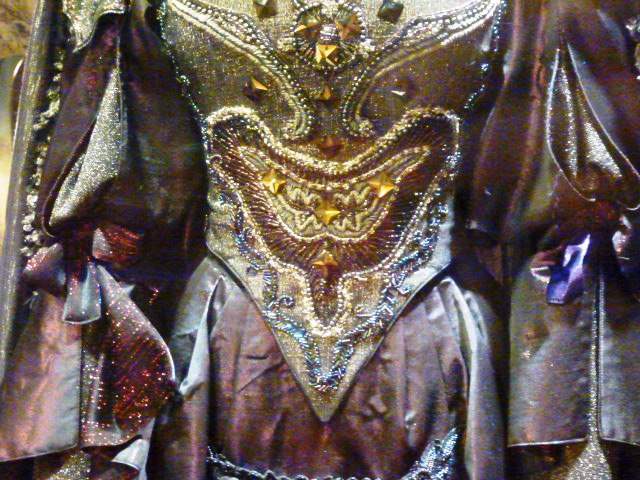
The evil fairy’s costume from Nureyev’s « Sleeping Beauty, » trapped in a glass case. Her dancer spirit roamed the halls of the Palais Garnier.

20 danseurs pour le XXe siècle. Palais Garnier. September 30th

The public spaces outside the auditorium of the Palais Garnier are designed for circulation, a bit of people-watching, but certainly not for strap-hanging.

I feared getting around Boris Charmatz’s seemingly random collage of dance and dancers would feel like being stuck in the Paris metro. God, another accordionist. You rush to the car behind, but then get your nose crushed against the door. Moments later you find yourself waist-high in a school group. Then, abruptly, it all thins out and you are gawking at two boys rapping and doing back-flips in the aisle. Maybe, with luck, you get to sit.

That’s why I only took one chance on 20 Danseurs pour le XXe siècle as adapted for the Paris Opéra dancers. The Charmatz/Musée de la danse concept sounded borrowed from what has, in the space of twenty years, become a theatrical staple. Actors spread out throughout an a-typical space repeat scenes – fragments of a story – and are gawked at. You use your legs to trace a path, choose how long you want to stand in one doorway, and worry about what’s going on elsewhere. Chances are you will construct a narrative that makes sense to you, or not. I find this genre as annoying as where — just when you start to get into the novel you are eaves-reading – your seatmate hops off at her stop.

I was so wrong. Instead of a half-overheard conversation in a noisy train, here we were treated to an anthology of coherent one-page short stories. It was the hop-on-hop-off tour bus: only a three-day ticket lets you get to enough of the sights. But even one day in Paris is definitely worth the trip.

If, as Fred Astaire’s Guy Holden says, “chance is the fool’s name for fate,”* somehow I was fated (pushed and pulled?) to stopping off at those stations that housed tiny but complete narratives of sorrow. (A Balletonaut has told me I missed much happy, even foolish, fun. Next time, I’m travelling with him).

“How do you do? I am delightful”*

Perhaps the oddest thing for both conductor and passengers is finding themselves face to face. When the lights are out in a theater, the auditorium looks like a deep dark tunnel from the stage…not like these hundreds of beady eyes now within touching distance. And even we were uneasy: one wall had been broken down, but where to put eye contact? We did what we usually do at the end of each snippet: applauded and moved on. Very few dared to actually approach and speak to the ferociously focused dancers. Thank god joining in some kind of conga-line was not part of the plan. Instead:

I stumbled across Stephanie Romberg, loose and intense, unleashing all of Carabosse’s furious curse within the tiny rotunda of the “Salon du soleil.” As in each case here: no set, no costume. It felt almost obscene to be peeping at a body sculpting such purely distilled rage. Think: the crazy lady, with a whiff of having once been a grande dame, howling to herself while dangerously near the edge of the subway platform.

Myriam Kamionka’s luminous face and warm and welcoming persona then drew me over into a crowded curving corridor. Casually seated on a prop bench in front of a loge door, she suddenly disappeared into the folds of Martha Graham’s Lamentations. I wound up experiencing this dance from total stage left. Pressed between tall people, my cheek crushed against the frilly jabot of Servandoni’s marble bust, I felt like someone pretending not to be looking directly at the person collapsed on the station floor. And then I couldn’t stop staring. You could almost feel the air thicken as Kamionka drew us into her condensation of despair. Even the kiddies, just a few feet away, sat silent and wide-eyed and utterly motionless. As they remained for the next story: a savagely wounded swan in pointes and stretch jeans dying, magnificently.

Ce diaporama nécessite JavaScript.

In search of air to clear my head I wound up behind two visions of Stravinsky’s Sacre. The view from the wrong end of the station, as it were, was so cool: this is the corps’ or the stagehands’ view!

In Pina Bausch’s version, Francesco Vantaggio pushed against the limits of the long and narrow Galerie du Glacier like a rocking runaway train. His muscular, dense, weighted, rounded and fully connected movement projected deep power, unloosed from the earth. When he repeated that typical Pina shape that’s kind of a G-clef – arms as if an “s” fell on its side (rather like an exploded 4th), body tilted off legs in passé en pliant – I thought, “man, Paul Taylor’s still alive. Get on the subway and go barge into his studio…now!” Yet when it was over, as he moved away and sat on the floor to the side to decompress and I was trying to catch my own breath back…I feared making eye-contact. (Forget about, like, just walking over and saying “Hi, loved it, man.” You don’t do that in Paris, neither above the ground nor underneath it).
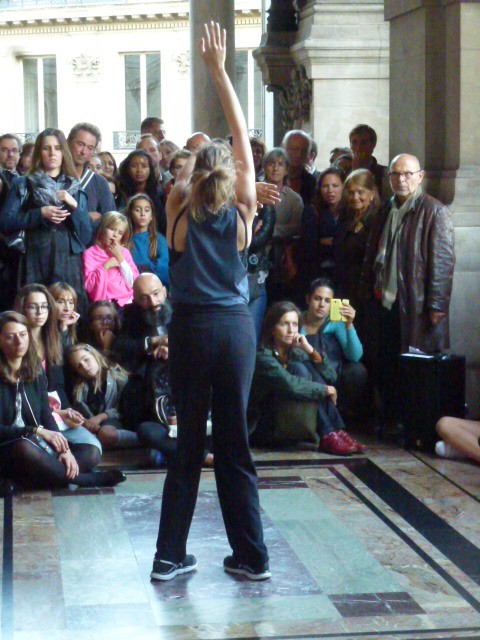
Marion Gautier de Charnacé. Nijinsky's Rite of Spring

Marion Gautier de Charnacé possessed by Nijinsky’s Rite of Spring

Marion Gautier de Charnacé, on the outdoors terrace, then made the honking horns and sirens accompanying “The Chosen One’s” dance of death seem like part of the score. All our futile rushing about each day was rendered positively meaningless by the urgency of Nijinsky’s no-way-out vortex of relentless trembles and painful unending bounces. Even if she was wearing thick sneakers, I since have been worrying about this lovely light-boned girl repeatedly pounding her feet on a crushed stone surface over thirteen days. Make-believe sacrifice, yes. Shin-splints, no.

Finally I cast my eyes down from an avant-foyer balcony to spy upon Petroushka’s bitter lament of love and loss, as Samuel Murez – making it look as if his limbs were really attached by galvanized wires — let the great solo unfold on the Grand Escalier’s boxy turnabout. A moment of grace arrived. Two little girls framed within the opening to the orchestra level behind him could not resist trying to mirror his every movement. Not for us, but for themselves. As if they really believed he was a life-size puppet and were trying to invite him home to play. The barrier between audience and performer, between real and unreal, the prosaic and the magical, had finally given way. Too soon, it was all over. Time to wave goodbye.

P1100746

Beyond the rainbow: Samuel Murez conjures Petroushkins.

“Chances are that fate is foolish.”*

Back on the metro the next morning, I got a seat and quietly began to concentrate on my thoughts. But then at the next station that woman got on who still gives us no choice but to endure three stops’ worth of “Besame mucho” whether we want it or not.

* Quotes are from Fred and Ginger’s 1934 The Gay Divorcée, especially as mangled by Erik Rhodes’s enchanting “Alberto Tonnetti”

2 Commentaires

Classé dans Retours de la Grande boutique

Alvin Ailey American Dance Theatre in Paris : longing for intimacy

Accueil-1600x1200aaadt

Jamar Roberts (c) Andrew Eccles

Les étés de la danse 2015: Alvin Ailey American Dance Theater at the Théâtre du Châtelet, Paris. Saturday evening, July 18.

“Push on – keep moving.” [Thomas Morton, “A Cure for the Heartache.” 1797]

Alvin Ailey’s company brings the Paris Opera Ballet’s dancers to mind. You can relish how their respective teachers and coaches have a coherent vision of a similar and specific style. Both troupes share powerfully-rooted épaulement that spreads up from the deepest part of the back of the spine and spirals out. Their arms work as endless extensions of expressive shoulders. The head belongs completely to this part of the curve. This then connects down to grounded supple feet and legs completely controlled even as freely released from strong and relaxed hips Nothing self-conscious blocks any source of energy. Such full-bodied dance convinces you that this is the natural way to be, to live, to breathe. Such dancers provide the key to expressing what music and choreography yearn to make us feel. Neither company panders to us, but asks us to share in their delight of movement. Nothing is “now I do the gymnastic extension you expect and approximate the rest.”

A fully-inhabited body can prove ferocious.

Despite being danced more than full out and with total commitment of body and soul, the three choreographies for this evening however — each ostensibly about a spiritual journey — gladdened me less.

“For my part, I travel not to go anywhere, but to go. I travel for travel’s sake. The great affair is to move.” [R.L. Stevenson, “Cheylard and Luc.”]

“Lift,” by Aszure Barton, started to weigh on me quite quickly. The program notes celebrate her “unique working process” which involves talking to the dancers (that’s unique?) and her rejection of “ideas” in search of “atmosphere.” (Um, yes, the lighting was quite complicated and often dark and smoky). What I watched seemed to be a super-professional-level dance class that had started around a collegial camp-fire. Everything was group movement (“Line one please, then line two.”) with a few people stepping out to stamp out a marshmallow – vibrantly, but never distinctly enough for me to say: “ ah, there is a specific persona embodied in a step.” Mostly the goal of the movements seemed to be about how to leave the stage in a rhythmic and sculptural way. Slap your thighs, step together, go off; step together, go off. Slap your thighs. “Go, go, go!” danced with absolute authority and clarity and belief.

One moment would prove to be a rare one in this evening of high energy and zero adagios (even if at least one section of each of the scores – commissioned soundscape for Barton, “various composers” for the others — could have afforded more of such moments). A woman planted the crown of her head into the torso of a man blocking the exit stage left. What happened evolved slowly and horizontally to stage right. Something started to happen. Then it was gone.

AAADT – LIFT (Aszure Barton) (c) Rosalie O Connor

“Exodus” by Rennie Harris, the sweet-heared guru of theatricized street dance, remained a group project. Alas, with a gunshot to start and a gunshot heard at the end, this piece is of its time. Bodies are lazarus-ed by a man at the outset and then get domino-ed at the end. The lives of each, again grouped, sometimes tremulous, then relentlessly pursued, all got mixed into the same soup. A calm moment of communal embrace, broken down for once into all kinds of couples, let us focus on the utter beauty of this company’s arching necks and warm arms. And made me think: hey, two ballets in and not a single nice and juicy and long pas de deux? So that’s why I was both fascinated by the group aesthetic but reluctantly bored out of my skull. Like the audience, I just loved the “up off the solid ground” energy the performers offered. But I wanted relief from group-think. I wanted intimacy.

Alvin Ailey American Dance Theater – Grace (Ronald K. Brown) (c) Paul Kolnik

I was starting to die inside. This was getting way too 60’s in the “we are all brothers and sisters and individuals don’t matter” groove. (Have you noticed that I have not mentioned a single dancer so far?)

Thus we got to Ronald K. Brown’s “Grace” from 1999. Groups again. Whether the costumes are white or red, this piece is mostly as horizontal as a Muybridge sequence. Yet it plays around and manages to be less earthbound than the other two that went before: sometimes, they juuump. But then again, even when the music is slow, all is about dancing as full out and as fast as you can all over the place. Too busy, even if at one moment the dancers finally do embrace.

“Between idea/ and the reality/ Between the motion/ And the act/ Falls the Shadow.” [T.S. Eliot, “The Hollow Men.”]

I certainly understand how the company’s director, Robert Battle, has fought to find a new balance where the troupe is no longer beholden to nor eaten alive by the endless repetition of Ailey’s ballets. Nor to seek “stars,” but to cherish a troupe. We must not live in the past. But an entire overheated evening where dancers rarely touch each other, lift off of each other, interact more than in terms of a glance and a smile and a small push and the occasional clumping together proved too…democratic.

Alvin Ailey American Dance Theater – Exodus (Rennie Harris) (c) Paul Kolnik

Upon returning home on the full metro this Saturday evening, I caught myself – just in time before they noticed — staring at a clump of partying young kids. Their voices were loud, but their bodies listless and heavy and pulled back and away from each other. I pitied them and wished they could discover what their feet and spines and arms could really feel…that they speed up, dig in, slow down, and start to understand the glorious muscles and bones they had been blessed with.

A fully inhabited body can prove ferocious. But even so, it needs another, not just a crowd.

Commentaires fermés sur Alvin Ailey American Dance Theatre in Paris : longing for intimacy

Classé dans Blog-trotters (Ailleurs), France Soirs

“Now run along, and don’t get into mischief.” (Old Mrs. Rabbit)

P1100212La Fille mal gardée, Palais Garnier, Saturday, July 4, 2015

While the program notes speak of how Constable and Wordsworth inspired Sir Frederick Ashton’s vision of “La Fille mal gardée,” Saturday night’s performance made me rush home to dig up my worn little volumes of Beatrix Potter.

The first thing you can’t help noticing about Eléonore Guerineau/Lise are her unusually pliant big bunny feet which in the course of the evening will effortlessly propel her into soaring grand jétés which seem to hover mid-air. With a most supple back and softly precise – never cookie-cutter – épaulement, her huge and open arabesques delight the eye. I’ve rarely seen more buttery and skybound temps-levé fouettés. The choreography really tests just about all facets of a ballerina’s technique and this debutante seems to have not only that but the gift of expression. From way up there, I didn’t need my binoculars.

P1100210Osbert Lancaster must have borrowed Colas’s costume from Peter Rabbit. As he sneaks into this forbidden garden the music says “rascally rabbit.” Fabien Révillion’s characterization, however, feels more like “joyous country gentleman.” His elegant dance varies in attack and works through phrases that often slightly decelerate at the end to call your eyes to one last flourish, as in the “wine bottle” turns in attitude. While he can turn slightly in at times, he always catches that and pulls himself back into place with flair.

When these two got together, their lines and musical timing fit so naturally that I hope Paris will keep casting this adorable couple. They share the same poise and ballon, have that same feeling for letting energy out and pulling it back in, for a rallentando that lets steps breathe. They hear the same music, their arms float into matching shapes, they even tilt their heads the same way. The ribbon metaphor – where are they heading if not to “tie the knot?” – gets expressed through the lilting partnering itself. They spool and unspool in endless ways. I particularly admired how he whooshed her delightful arabesques across the floor.

It comes as no surprise that this Colas keeps tenderly nibbling bits of Lise at every opportunity. He’ll make a most attentive husband and most reliable son-in-law.

Aurélien Houette has used the years to peel away at how Widow Simone, with all the spanking and slapping and ear-pulling she indulges in, can be kind of creepy. Mrs. Samuel Whiskers has been refined into a Mrs. Tiggywinkle with a touch of mischief. Dreadfully nostalgic about once having been the life of the party, you do feel she is related to her daughter (this is not always the case). Both brim with life.

Our Alain, Mathieu Contat, was less of a dorky clown and more of a cross between a dandy and Mr. MacGregor’s scarecrow. His arms hung really loose and the strings that attached his flapping hands were stretched to the breaking point. Intentionally stiff, small, almost abortive, plies and really tiny steps unexpectedly added a touch of dignity. This Alain, while faithful to his umbrella, clearly wants Lise…if only to add her to his menagerie. I am convinced this one’s bedroom at the manor is stuffed full of birdcages, goldfish bowls, and hamster wheels. The only thing he doesn’t have yet is a soft little bunny to call his own.

At the very end, Révillion’s gentleness in readjusting Lise’s dress before the final pose provoked a whispered “awwwh” from my neighbor. This couple really does deserve to be blessed with a litter of ten. Before James can beat me to it, I award them the “bread and milk and blackberries for supper” Balleto d’or.

P1100214

Commentaires fermés sur “Now run along, and don’t get into mischief.” (Old Mrs. Rabbit)

Classé dans Retours de la Grande boutique

Trances in Toulouse

Toulouse, La Halle aux Grains

Toulouse, La Halle aux Grains

« Eh bien dansez, maintenant! ». Toulouse. Ballet du Capitole. Saturday, June 27th.

“The fever called ‘Living’/ Is conquered at last.”

As Johan Inger’s “Walking Mad” began, I suddenly recalled an old cartoon. A sage, replete with toga and sandals, points his staff at an X in the corner of the map of a university philosophy department. The caption asks: “why are you here?”

Demian Vargas, trench-coated and bowler-hatted, wandering near the front row, has clearly lost his map. This Magritte-like apparition soon clambers up on to the stage as Ravel’s unsettling “Bolero” begins. We — and a company of beings seemingly even more feverish  and seemingly more broken –will seek the answer together.

 Out of the dark depths of the stage, an evil and fleet-footed protean wall sneaks up on him. As does a vision in white, Solène Monnereau, who makes concentrating on scooping up the limp T- shirts littering the floor a Bauschian moment.  Briefly distracted by our hapless intruder, she lets herself be scooped up by the deft Valerio Mangianti.  The mere touch (and then real power) of Mangianti’s hovering arms cannot be resisted. Why is his persona wearing a house dress? I leave it you to figure out, but the dress does let you see how deeply his movements are rooted in the ground and spiral up from a sure place.

The wall keeps flapping around, rolling, falling, re-configuring itself, dextrously manipulated from behind. To be banged on, clung to, slipped around, grasped, almost scaled, resisting all attempts to breech it.

Sooner or later, you arrive at one certainty: being alive is not meant for the faint-hearted. It gives you fever. Our guy, now divested of his trench-coat – and many bowler hats will now flow through the hands of his new posse – has either found his way to insane people or to a world of his own feverish imagination. This condition is often surprisingly jolly Inger’s kinetic choreography keeps playing sly switches on your expectations of “what should come next.”

Indeed, this bitter-sweet ballet is full of fun surpises. Inger’s vocabulary clearly developed while devoting his own body to Kylian’s world. Lurch your mid and upper-body forward and a partner will grab you under the arms and swoop you around in grande seconde plié. He also makes deft use of Forsythe’s – “pick a card, any card” [i.e. any part of the body] free-style.  Push off of or onto any point of an opposing body, including your own, and see where you end up. But these moments come an go. Nothing here feels derivative or predicable or old hat.

Walking Mad. Julie Loria.Photographie David Herrero

Walking Mad. Julie Loria.Photographie David Herrero

The group dons pointy noses, and also nurse them atop their heads. More lost laundry and more fevered figures come and go, each finding a new way to be annoyed by the amorphous wall. Matthew Astley, both goofy and pure of line, attacks each step as if dance had been invented by Beckett.  Julie Loria – restless to her fingertips — in a red tremble, sets the guys atremble too. You want to both laugh and cry, then, when Loria slaps herself into the corner of the wall (now a pointy imploding wedge) and tries to pull her own shadows back into her orbit.

That wall means everything and nothing. We are all mad or being alive means being mad. You have choices to make. Will you accept life in the form of a madhouse or a funhouse?  Do you want to go it alone or dare to try to pull another into your body and mind?

But, alas, there’s more. And this has been bothering me. Boléro, especially as stopped and restarted here in very unexpected ways, can cover about 15 to even 25 perfect minutes. Inger, and the dancers of Toulouse, made this musical warhorse seem fresh and new and pure and precisely as weirdly logical and illogical as it should be. Why did he have to add an appendix?

 “All that we see or seem /Is but a dream within a dream.”

 For his finale — a so sad and sobering, utterly unfunny and intense duet of irresolution – Inger could have even used another overused stalwart: silence. Alas, no.

Instead, way back in 2001, he fell on one of Arvo Pärt’s throbbing and repetitive scores, which have rapidly become even more of a dance world cliché than Boléro.  At this point, someone needs to lock them up in a wall-safe.

Ravel’s Bolero repeats itself — and how! – but, especially as teased apart as in the soundscape for the first part of the ballet, it launched the dancers on a crazy journey. Pärt’s music just sits in place and goes nowhere. Given Inger’s intelligence in constructing the giddily vivid first part. I am sure he intended to sober us up, to make us feel as trapped as Juliette Thélin and Demian Vargas. This pas de deux further distills the desperate need to escape over that wall. These two worked their bodies into tender and somber places and chiseled away at each moment. Simply holding out a coat to the other, a tiny crick of the neck, epitomized how small gestures can be enormous. They sucked the audience down into their vortex of a dream within a dream. Despite my irritation with the music, I was gulled too. This expressive, expressionistic, parable of “alone-together” reminded me of Gertrude Stein’s purported last words: “What is the answer?” The room stared at her. Silence She picked up on that. “Then, what is the question?”

*

*                                              *

“Keeping time, time, time./In a sort of Runic rhyme,/To the tintinnabulation that so musically wells/from the bells, bells, bells.”

Cantata. Tabatha Rumeur, Julie Charlet, les musicienne du groupe ASSURD et ensemble. Photographie : David Herrero

Cantata. Tabatha Rumeur, Julie Charlet, les musicienne du groupe ASSURD et ensemble. Photographie : David Herrero

Maybe singing and dancing and banging on something are the answer after all, according to Mauro Bigonzetti’s Cantata.

Instead of a moving wall, here we had an ambulating wall of oaky and resonant sound provided by the powerful voices and bodies of the Southern Italian musical collective ASSURD. Weaving in and out amongst the dancers on stage, the singers’ voices and instruments cried, yelled, lullaby-ed, coaxed, spat, spangled. And, along with the dancers, managed indeed to help us understand why we needed to be here, in Toulouse.

At first, you kind of go: uh, oh. Chorale singing, an accordion being squeezed onstage by a small and loud barefoot woman, women dancers who twist alone and twitch if lifted. Back on the ground, they return to poses that make them look like arthritic trees that died from thirst. After a bunch of men dump them in a pile atop each other, the women continue to squirm, bite their hands, and put fingers in their mouths to pull at the skin of their faces. Ah, got it, Southern Italy. Tarantula bites. Means more madness, eh? But these gestures – just at the moment when I went “uh oh” yet one more time – continued down a Forsythian path, setting off major locomotion.

The tammurriata and tammorra, like Ariadne’s thread, will lead our dancers back to the world of the living. Honey, the tinkly “tambourine,” as we know it from Balanchine, Mère Simone, and Bob Dylan, has nothing to do with the Kodo-ish propulsion of these gigantic hand-held objects. The rhythms are strict, not shimmied or approximate, nor is the dance. And what a fun sound to try to use your body to interpret!  Do a conga line bent over on your knees: march forward with your elbows hitting the ground like feet, chin in hand, then slap the floor with your palms. Feel your weight. Now we’re going somewhere.

Cantata. Béatrice Carbone. Photographie : David Herrero

Cantata. Béatrice Carbone. Photographie : David Herrero

Here couples don’t yearn to scale any wall, they merely try to rise above any limits and then return to stamp at the soil of the earth. Women step all over men’s recumbent bodies, and evolve from being manipulated to being manipulators. Arms reject swanny elegance: chicken wings preferred. A black-widow sunflower, Beatrice Carbone, all curled arms and cupped fingers, distances herself from the crowd. A duet: hands hit together, or try to. Dancers repeatedly find calm by taking the hands of others and brushing them over their faces. Avetik Karapetyan continues to remind me of the explosive and expressive Gary Chryst of the Joffrey. Maria Gutierez shimmies and shines in a new way every time I see her.  The action transforms itself into a raucous and joyous frenzy.

At the very end, the company blows us a kiss. And you want to stay right here.

Why Toulouse? Kader Belarbi’s company of individuals, and the opportunities his keenly-chosen repertory gives them, provides the best answer of all.

Quotes are from Edgar Allan Poe. “For Annie;” “A Dream[…]”; “The Bells ».

Commentaires fermés sur Trances in Toulouse

Classé dans Blog-trotters (Ailleurs), France Soirs, Humeurs d'abonnés

Let’s Dig A Stairway to Paradise: A plot summary of LES ENFANTS DU PARADIS

Copie de P1030957A ballet in two acts by José Martinez..
Music by Marc-Olivier Dupin.
Inspired by Marcel Carné’s 1945 film with its scenario by Jacques Prévert.

While you may regret that your seats are in the nosebleed section, in France they call the amphitheater – where the true fans congregate – “paradise.” This ballet, based on a beloved French film, revolves around theater and those who create it: impassioned people who live for the adoration of an audience, even when they only find one in a second-rate venue.
Actors, and their marginal world, also live in our imagination as emblematic of liberty: free spirits who reject bourgeois conventions and authoritarian strictures. The nostalgic melancholy of the black and white original, filmed under strenuous circumstances during World War II and released at the Liberation, responded perfectly to the public mood.
The story takes place in pre-Haussmannian Paris, the cluttered and vibrant city about to be lost forever, as caught between the photographs of Daguerre and Marville. For nearly a century the Boulevard du Temple had housed a jumble of hugely popular theaters devoted to offering the cheap thrills of vaudeville, pantomime, and melodrama. Indeed, because of all the violent action onstage, Parisians had nicknamed the street Le Boulevard du crime. But this world was destined to disappear in 1862, during the Second Empire. By targeting these buildings for demolition in the name of progress, Haussmann was attacking the very essence of « le peuple » and « le populaire. » This tale brings us back to a shabby paradise now truly lost forever.
Many of the characters are based on real people: Baptiste Deburau, still remembered as the greatest mime of the 19th century; the larcenous Lacenaire, guillotined in 1836. And there really was an actor named Frédérick Lemaître. The character he invented — the amoral but attractive bandit Robert Macaire – is the exact contemporary of Balzac’s Vautrin.

(Please note: the following summary is based on my notes from the ballet’s creation in 2008. Since then Mr. Martinez has made cuts and changes).

Boulevard_du_Temple_by_Daguerre

This 1838 photo of the Boulevard du Temple by Daguerre required ten minutes of exposure time. As in the ballet, people came and went and could not be captured by the lens. The bootblack and his client stayed still, and thus became the only actors in this image.

ACT I [1hour 15 minutes]
Prologue: where an aged Jean-Louis Barrault, the actor who created Baptiste in the film, returns to the abandoned soundstage and begins to remember…
Scene 1: The Boulevard du Temple Crowds jostle in front of the theaters as actors, acrobats, jugglers, and carnies try to tempt them inside. Lacenaire, an amoral dandy, public scrivener by day and assassin by night, cases the crowd. Frédérick Lemaître, an aspiring actor, tries to put the moves on Garance, a beautiful sometime actress. She is not interested. The ragman Jericho [also a snitch and a fence], shows Lemaître a jewel he thinks Garance might fall for…
A crowd gathers in front of the Théâtre des funambules, which specializes in mime. As the actors enchant the crowd with a preview, Lacernaire picks pockets and melts away. Garance happens to be standing next to one of the victims and is grabbed by the police.
Baptiste, the mime, saw everything from the stage and re-enacts what actually happened. Garance is freed.
Scene 2: The Théâtre des Funambules Nathalie, a young actress, lingers backstage and dreams of Baptiste. Jericho surprises her with a wedding dress. When Baptiste arrives, he has no patience for Jericho and shoos him away. While Nathalie at first thinks that the red flower Baptiste holds is for her, she soon realizes that he is dreaming of another.
The show goes on…badly. The actor playing the lion flounces out after getting accidentally conked on the head. Frédérick sees his chance. He dons the lion costume and improvises masterfully to the delight of the audience. Baptiste hires him on the spot, and the two men go out to celebrate.
Scene 3: “Le Rouge-Gorge” dance hall Frédérick quickly gets drunk and tries to pick up girls while the melancholy Baptiste looks on. When Garance enters on the arm of Lacenaire, of all people, Baptiste tries to ask her to dance. Lacernaire’s henchman attacks him, but Baptiste defends himself skillfully and leaves with Garance. Lacernaire’s hoods, on a lead from Jericho, head out to beat him up. But they mistake an innocent passer-by for Baptiste…
Scene 4: Madame Hermine’s boarding house Garance offers herself to Baptiste. Her easy ways startle him. He wants true love, not just sex. She wants love, but to be free too. He just cannot bring himself to embrace her, and flees.
In the adjoining room, Frédérick happily fools around with Madame Hermine. But when he sees Baptiste leave – which means Garance is all alone in her bed – Frédérick cannot resist the opportunity lying in front of him, to Madame Hermine’s frustration.
Scene 5: On stage in the pantomime show “Lovers of the Moon” Garance has been hired to play a statue. All she has to do is stand there and incarnate the beautiful goddess of the moon. Baptiste, as Pierrot [a clown], tries in vain to woo
her, then falls asleep at her feet. Frédérick, as Harlequin, has better luck. Baptiste/Pierrot then decides to kill himself, but people keep interrupting him (including Nathalie, who plays a washerwoman).
Baptiste espies Frédérick and Garance kissing in the wings and freezes up. Nathalie sees everything and gets upset too. The poor girl cannot understand why Baptiste won’t just settle for the quiet and gentle love she could offer him.
Scene 6: Garance’s dressing room Garance shrugs when Frédérick proves jealous of Baptiste and tells him to leave. Then the Count de Montray, who had ogled her from the audience, appears in the wake of an enormous bouquet of flowers. Garance is unmoved and tells him she is not for sale. He leaves the flowers…and his card.
Baptiste then enters her dressing room and scatters the flowers in his own fit of jealousy. When Garance begins to try to explain her deep feelings for him, Nathalie intervenes and drags him away.
Enter Madame Hermine trailed by policemen who want to arrest Garance again. The sight of the count’s card – implying protection from high up – stops them. Garance realizes that she has only two options: losing her independence now by becoming the Count’s mistress, or losing her freedom permanently by being jailed.

Intermission [25 minutes]
Make sure you not only visit the Grand foyer…but
glance back at the Grand escalier where you might espy a scene from Othello.

ACT II [55 minutes] Six years later: Baptiste has married Nathalie and they have a child. Garance is living with the Count. Frédérick has become a celebrated actor, renowned for his interpretation of Othello.
Scene 1:At the Grand Théâtre: the première of the melodrama « Robert Macaire » A gaggle of ballerinas provide the backdrop for Frédérick’s newest role: the cynical and insolent master of crime, Robert Macaire. [For logical reasons, as this is a ballet rather than a talkie, Frédérick the actor becomes Frédérick the danseur étoile]. It’s a hit.
Scene 2: At the mansion of le comte de Montray Garance, the struggling actress, has been transformed into a sophisticated kept woman. As she prepares her toilette, the count demonstrates his pride in having captured her. But she seems indifferent to the luxury he showers upon her. She’d avoided prison, but ended up living in a gilded cage. To Montray’s surprise, she refuses to let him accompany her to the theater. Guess which theater.
Scene 3: On stage in the new pantomime “Ragman” The sad character of Pierrot (Baptiste) follows a beautiful stranger to a ball but is denied entry because of his attire. Desperate and penniless, he tries to convince a ragman to lend him some clothes. When the ragman refuses, Pierrot kills him.
Suddenly, Baptiste espies Garance in the audience and freezes up again. Startled, Garance leaves, and Baptiste realizes how deeply he is still in love with her after so many years. He rushes out to find her.
Scene 4: A ball chez monsieur le comte The Count graciously welcomes Lacernaire to the party, but is appalled that Jericho the ragman has tagged along. He orders his lackeys to throw out the intruder. Then Baptiste bursts in and the Count quickly comprehends that the mime wants Garance, and that she wants him.
The moment they are left alone together, Baptiste and Garance fall into each other’s arms. But Lacernaire has seen them, and decides to teach the count a lesson: « you throw out my friend? Then I’ll make sure everyone knows your girlfriend cuckolds you. »
Baptiste and Garance flee. The count is furious and takes it out on Lacernaire, who vows revenge.
Scene 5: Madame Hermine’s boarding house/The Count’s mansion Garance and Baptiste finally give in to their mutual passion. At the same moment, Lacernaire breaks into the mansion and murders the lovelorn Montray.
The feral Jericho leads Nathalie and her child to the boarding house. When she realizes what has happened, Nathalie despairs.
Garance, a free and generous spirit, never meant to hurt anyone. Pained by Nathalie’s anguish, Garance must make another choice. She decides it is time to leave.
Scene 6: Mardi Gras Baptiste runs after Garance, desperate to reach her. But, as in the iconic finale of the film, the crowd separates them. Martinez’s inspired and poetic translation from screen to stage of how Garance slowly disappears from view will take your breath away.
Epilogue: Jean-Louis Barrault, having relived his greatest role, is now freed from his phantoms and he, too, may leave the soundstage forever behind.

Commentaires fermés sur Let’s Dig A Stairway to Paradise: A plot summary of LES ENFANTS DU PARADIS

Classé dans Hier pour aujourd'hui

Girl, misunderstood: a plot summary for “L’Histoire de Manon” coming soon to the Palais Garnier.

Pauline Montessu dans Manon, 1830

Pauline Montessu dans Manon, 1830

Like other 18th century French classics such as Les Noces de Figaro and Les Liaisons dangereuses, this tale highlights issues of gender and class during the ancien régime.
God, that sounds boring. To restate: this ballet about all kinds of social and sexual relationships will be danced out by extraordinarily limber people wearing really spiffy period costumes. And that’s never boring at all…
L’Abbé Prévost’s 1731 novel continues to perplex readers. Is his rags-to riches-to rags heroine immoral or amoral? A vicious man-eater who merely pretends to be innocent or a clueless innocent corrupted by men and drawn into vice? Or does the pro-active Manon now represent the anti-Cinderella outlook for many enlightened girls?

If there is such a thing as “woman’s nature,” men — from randy politicians to religious zealots — continue trying to figure that one out.
You might know of the more famous adaptations of this tale into operas by Jules Massenet [1885] and Giacomo Puccini [1894]. Sir Kenneth MacMillan certainly did in 1974. In love with the story, working on a deadline for England’s Royal Ballet, he felt hamstrung by two gorgeous scores. How could he avoid making dancers mime to well-known arias? Here’s how: use music by Massenet…lots of juicy bits of it, but not one note from the opera!

ACT ONE (43 minutes)
Scene one: at a stagecoach inn near Paris
The first person we see under the spotlight is Manon’s corrupt and venal brother, Lescaut. Equally at ease with riff-raff and raunchy aristocrats, he first tries to pass off his mistress to the rich Monsieur G.M. and then guffaws when his beggar friends make off with the pompous ass’s watch.
Into this decadent scene stumbles a shy and handsome student, so lost in reading a book he’s utterly oblivious to all the commotion. His name is Des Grieux.
The stagecoach finally arrives, with Manon in it. While still trying to fend off the old guy who was trying to pick her up during the voyage, she’s faced with her brother immediately trying to set her up with the lecherous monsieur G.M. No wonder her parents are sending her to a convent, men just can’t keep their hands off of her. Her fault?
To very delicate music, Manon tries to hold on to her liberty, her freedom to at least choose only one of these disgusting men whom her brother encourages. Lescaut’s mistress flashes lengths of perfect thigh. She wouldn’t mind being propositioned by any of the leftovers.
Then Manon’s eyes meet those of Des Grieux, the first and only man she will ever desire. After all those miming and stumbling old farts, here’s a man who really knows how to dance!
At the end of this scene, we are treated to the first of all the glorious pas de deux [duet]’s that all dance lovers associate with MacMillan: how can two bodies be taken to the limit of push-me-pull-you? The point of each of their duets in this ballet will be about how far you can go without breaking your ankle/wrist or fall down head-first while transmitting pure emotion. And each duet will end with the exquisite ways MacMillan will invent for the lovers to float back down off their high: literally ending up sweeping the floor — oh so deliciously — with their bodies.
The old guy returns only to discover that Manon has eloped with his purse and his carriage. Monsieur G.M. offers Lescaut even more money to find and bring him this tantalizingly frisky creature.

Scene two: in Des Grieux’s humble garret [at least it’s in Paris, not at some awful old dull country mansion].Des Grieux tries to write a letter to his father along the lines of “listen, this is a great girl, please send more money.” He’s from a good family, but doesn’t control his fortune yet.

In love, but bored by watching him write, Manon — to put it mildly — distracts him (see here Cléopold’s second by second analysis).

When he finally tears himself away in order to go mail the thing, Lescaut sneaks in with Monsieur G.M., who tantalizes her with all kinds of promises and jewels and even a fur-lined cape. What girl could resist? O.K., the guy seems to have some kind of foot fetish, but ballerinas have been all vaccinated against that old cliché since, like, forever.
Lescaut stays behind in order to rein in the understandable anguish of a horrified Des Grieux. And to try tempt him to listen to reason. “Why not let her suck that bloodsucker dry? We could all be rich!

INTERMISSION (20 minutes)

ACT TWO (46 minutes)
Scene one: an elegant evening chez a most shady lady
We saw her in the first scene, grandly sweeping along with Monsieur G.M. That was no lady.. .and not his wife either. “Madame” is actually what is known as a “Madam.” Those girls we saw with fans in the first scene were not ladies, but prostitutes.
Swords should be left at the door, but other metaphors may enter.
A very drunk Lescaut arrives, dragging along the reluctant and droopy Des Grieux. Lescaut’s ever-optimistic mistress gets caught – sideways – in the fun.
Manon enters, stunningly outfitted, and is carried aloft à la Marilyn Monroe by besotted customers to the creepy Monsieur G.M.’s proud delight.
Manon’s thoughtless vanity cannot at first be worn down by Des Grieux’s lovelorn glances. When he finally gets her alone, she makes it clear that she loves him, but not his poverty.
Manon tells him what to do: fleece G.M. by cheating at cards…Des Grieux may be cute, but he botches the job. Real swords are drawn. Taking advantage of the confusion, the lovers elope again.
Scene two: back at the garret
The lovers dance all over the bedroom as usual.
At one point, Manon realizes that she “forgot” to leave her jewelry behind…
Bad idea. G.M. knows where to find the love-nest and bursts in with a police escort, dragging along a bound and bleeding Lescaut. He threatens to have Manon arrested for theft and prositution. For the first time in her life, she must face the ugliness of the vengeful cruelty of which some men prove most inclined.

INTERMISSION (20 minutes)

ACT THREE (25 minutes)
Scene one: arrival in New Orleans
A shipload of unfortunate prostitutes have been deported to the New World. Des Grieux’s love knows no bounds: he got himself on the ship by pretending to be Manon’s husband and even seems oddly happy despite the circumstances.
Even broken in spirit and with a shorn head alas alas Manon, despite herself, still attracts unwonted attention.
Scene two: the jailor’s office
This one is gross. The jailor will give her privileges if she…and he forces her to do so. Des Grieux acts out the audience’s shock and kills this gloating perv.
Scene three: lost in the bayou
On the run with nowhere to go, the couple once again proves how love does not mean the same thing.  Des Grieux obstinately keeps sweeping his love aloft. Haunted by her memories, Manon — never a fighter to being with — dies of  exhaustion in the arms of her despairing lover. Manon is the epitome of a girl who gets completely burned out by the force of other men’s great expectations.

Commentaires fermés sur Girl, misunderstood: a plot summary for “L’Histoire de Manon” coming soon to the Palais Garnier.

Classé dans Hier pour aujourd'hui

Swan Lake: Defining Gravity

Bastille salle Le Lac des cygnes at the Opéra Bastille, March 23, 2015

I will make you brooches and toys for your delight / Of bird-song at morning and star-shine at night.” R.L. Stevenson, Songs of Travel, The Vagabond.

After missing the solar eclipse on a misty wind-swept Friday morning in Normandy, then hypnotized the next day at noon on a sloshed boardwalk by an epic high tide pulled out by the moon, I chugged back to Paris. Here I witnessed, at the end of a balmy Monday evening, that the Paris Opera’s astronomers had identified a new star.

Laura Hecquet has been promoted to étoile. I only regret that Stéphane Lissner’s and Benjamin Millepied’s telescopes failed to register the planet that pulled her into orbit: Hecquet’s partner, Audric Bezard.

Laura Hecquet has every quality that American critics – whose names shall remain unmentioned — would dismiss as “too French.” Therefore, I approve. Impeccably clean technique, strength, and subtlety. No show-biz, no razzamatazz, no six o’clocks unless the original choreography specifically calls for it. She’s demure – bashful, even — and precise, and intelligent [every single comment Cléopold noted Elisabeth Maurin making while coaching another dancer magically found itself integrated into this performance]. A tall one, she makes herself appear weightless, diaphanous, other-worldly. Maybe a bit too diffident? But I think that with time, now that she has been released from ballet purgatory she will loosen up just a little bit. For years, under the previous director — whose name shall remain unmentioned — Hecquet seemed to be stuck in the position of “also-ran,” and that can do weird things to your head and to your body.

So I didn’t expect her Odette/Odile to suddenly light up like a firecracker. There is room in the history of the stage for votive candles as well as for forest fires. Hecquet burns slowly and quietly. But then after the fouéttés, she suddenly relaxed, and those swift little hops during low arabesque dévélopé plus the next hops backwards into relevé became deliciously upscale strip-tease. She will never be – and I hope she will never try to be – a Ferri or a Loudières. But she could soon seduce the kinds of people who loved Cynthia Gregory or Cynthia Harvey. Most of all, I hope she will now feel free to become an Hecquet.

One thing I’ve always appreciated about Laura Hecquet is that she lets her partner shine. Too shy to hog the spotlight, she highlights how good it feels to be in good hands.

“Nullum quod tetigit non ornavit” [“Nothing he touched he did not adorn.”] Samuel Johnson, epitaph for Oliver Goldsmith.

Audric Bezard has “it.” My only memory, even just one day after being bored to tears by the recent Neumeier opus “Le Chant de la terre,” proves a slight but significant one. The young people nestle onto an Astroturf wedge while someone yet again dances downstage to each note. And up there was Bezard. Nestling, noodling, seemingly improvising, living this day as if the sun were actually shining. He encapsulated the song of life that Mahler was talking about while lying around on a piece of plastic.

As Siegfried, Bezard’s natural magnetism combined itself with a most intelligent reading of Nureyev’s text. His Siegfried doesn’t have complexes, he’d just never really thought about anything before. He seems as at ease with being a prince as a prince is imagined to be. He likes his cohort of friends – boys and girls alike in an unselfconscious way — and when his mother brings him the crossbow and the order to marry, he focuses first on the crossbow and then slowly, slowly, starts to process the second part of his birthday offering. So he’s not a melancholy prince nor a desperate one at all from the start: this one’s just never ever felt anything deeply.

Bezard does lovely stuff in all of his variations: always driving to the end of a phrase and then pulling it into the next. He also does something American critics would also dismiss as “too French.” Every single variation, every single bravura moment, ended in the softest landing with understated poise. Three big and easeful doubles à la seconde (who needs quadruples if doubles are well-done?) get presented as if they were no big deal. At the conclusion of his big solo near the end of the first act, the one intended to signal the beginning of his unease, he eased into another perfect landing. I mean perfect: soft as feathers. No applause for what seemed like ages, because none of us could get our breath back, rapt but suddenly uneasy too. The atmosphere Bezard created made it rather obscene – despite our appreciation of his surmounting the Nureyevian technical hurdles – to intrude upon his privacy.

This Siegfried wasn’t desperate –wasn’t passionately looking for true love either — as soon as the curtain went up. I would say the solution to the puzzle emerged during the pantomime that took place when Odette and Siegfried met: “I am queen of the swans” to “ah my lady, I am a prince too, I bow down to you as is proper to our station.” I’m not sure that I’ve ever seen a meeting of swan queen and prince as casually and naturally regal. Hecquet was so unhysterical and Bezard so unfazed and both so formal that this version of the encounter – and what followed — made perfect dramatic sense. The force of their gravity had simply pulled them into each other’s orbit.

Commentaires fermés sur Swan Lake: Defining Gravity

Classé dans Retours de la Grande boutique

Giselle on Film: A Bloke’s Tale

Albrecht encerclé (capture d'écran)

Albrecht encerclé (capture d’écran)

The Royal New Zealand Ballet’s “Giselle,” now at a cinema near you in France (starting December 12).

As so often when I go to the movies, I don’t quite know what to expect after having been seduced by the trailer. Will I see a chopped-up version, where we’d cut back and forth between a performance and a modern-day retelling of this love triangle? A documentary à la Delouche? Tons of shots from all over the theater but especially from backstage and in the studio?

Instead, Toa Fraser’s film turns out to be most astonishingly straightforward. What we have here is mostly a “filmed before a live audience” testament to the Royal New Zealand Ballet dancing at top form. Sensitively filmed: Fraser makes the dancers look good and never cuts away at the wrong moment.

What I also didn’t expect: just an opening section and a quasi-music video between the acts that allows our principal dancers in modern dress to strike wistful poses to Dan McGlashen’s “When the Trumpets Sound” (the text a wink to Hilarion, perhaps?). While we’ve now all learned about the New Zealand landscape due to Peter Jackson and his hobbits, most of the interludes were filmed in Shanghai and the Catskills. In them, a couple – mimed by the same ones who dance the leads — is happy and then unhappy, first looking into each others’ eyes and then staring into space while wandering around or dancing on a rooftop in sneakers. There is only one dance scene set in a studio, and it proves completely staged, not a coach in sight. We get a few slo-mo moments as Giselle collapses at the end of Act 1. Some shots of an empty theater are seen through Myrtha’s (Abigail Boyle’s) eyes, which prove as giant and expressive as her jumps and gestures.

No one says a word throughout the entire film.

So why bother to get out of your chair to go and catch this rather tame cinematic experience?

The answer. To see how Ethan Stiefel and Johan Kobborg – both great interpreters of the role of Albrecht – have put their combined intelligences into sculpting a most delicate and dramatically attentive version of “Giselle,” without having to travel to New Zealand, Shanghai, or the New World (as James did in February).

Albrecht -–the buoyant and all-out Qi Huan — opens and closes the action as a broken older man, flayed alive by his emotions. Tiny, distracting, and incoherent details from the 19th century have been caught and transformed and polished. This prince dominates the action, the film should have indeed been called “Albrecht.” The character of Giselle has always made sense, given a distinct and coherent dramatic arc, Albrecht…not. Here, in a most Romantic Dumasian way, he is at the center of everything, including the evil attention of the Wilis (and just look at how you can make only twelve look like a swarm if you give them more to do!)

As he now has more to dance, in a very different and most forcefully folkish way, Hilarion – the buoyant and grounded and whirling Jacob Chown – finally becomes more of a distinct presence and less of a role handed off to a tired old character dancer (or confused young one). I have never been more saddened when this lovelorn forester got his due, here literally smushed down into the muddy waters by Myrtha…

The actual Giselle, Gillian Murphy, then doesn’t need to carry the show. She is incredibly strong and fierce in balances and able to bounce as high as the guys and quite beautiful, but she’s just not my kind of ballerina, and there is no way to explain this statement (try explaining falling in love). Therefore being a fan of hers, or not, should in no way influence your desire to see this film.

This is a “Giselle” from the men’s point of view, but concocted by two deeply intelligent men. I do not want to spoil any surprises, but Cobborg and Siefel’s re-thinking of the Peasant Pas de Deux in Act One finally moves the thing out of the dull realm of “divertissement” into making so much dramatic sense that I think even the ghosts of Jules Perrot and Jean Coralli and all the other the Romantic puffballs would approve.

Commentaires fermés sur Giselle on Film: A Bloke’s Tale

Classé dans Blog-trotters (Ailleurs)

La Source: a Who’s Who at the Palais Garnier.

Not la Source… But the Fountain of Bakhchisaray with Maya Pliseskaya and Galina Ulanova. Still over the top in a similar way

The plot is fairly standard – boy meets girl but there are obstacles the boy cannot overcome without supernatural help. As was wont in the 19th century, all this takes place in an “exotic setting. » This time its the Caucasus, hence the over-the-top fur-trimmed costumes by Christian Lacroix and folklorically-correct dances which heighten Jean-Guillaume Bart’s re-imagining of a long-lost classic. So far, so easy.

However, the plethora of characters (juicy roles, all of them) and overlapping emotional triangles of an over-elaborate plot can get mighty confusing. So, here the characters, in order of appearance:

Act 1, Scene 1
ZAËL THE TOTALLY GREEN ELF — Jiminy Cricket/Puck/Ariel, take your pick – jumps and spins so well he can cross the line between the human world and that alternate one peopled with nymphs and woodland spirits. Visible and invisible at will, Zaël – like an adoring and hyperactive labrador – will do anything his mistress asks even if he constantly worries that she might get hurt. He embodies true and selfless devotion, and I consider him the real hero of the ballet. Gotta love this man.

DJÉMIL, A HUNTER. Like all official Romantic heroes, he’s something of an idiot. Can’t see true love staring him in the face. Only understands external, not internal, beauty and thinks nothing of sacrificing others in order to get what he wants. Zero comprehension of nice and welcomming fairies. Typical male.

Scene 2.
Enter a travelling party led by MOZDOCK, A TOUGH GUY. Basically he is an overdressed pimp, Manon Lescaut’s brother with a bigger hat but without the humor or charm. He’s leading his tribe to the palace of an oriental potentate, where he plans to sell

HIS SISTER, NOUREDDA, into the harem. Droopy and veiled at first, her curves will nevertheless catch Djémil’s eye, but you shouldn’t trust her damsel-in-distress routine. Maybe this has happened to you: you are sitting alone in the lunchroom – skinny, glasses, not the world’s greatest skin – when suddenly the most popular girl on campus – perfect teeth, hair, figure – plops down next to you and anoints you, despite your braces, her Best Friend Forever. You’ve never been so happy. Until one day your braces come off, you finally get contacts, and decide to do something about the rest. A little cool air wafts in between you. Then one of the many boys she’s used and rejected sits next to you in the library and asks if you’d maybe accept to go get coffee at the Hungarian Pastry Shop. Oops, now the beautifully-polished claws come out and BFF will even resort to – like Nouredda — getting you out of the way by “fainting” in his arms, her boobs strategically pressed against his chest. The bitch.

Scene3
THE FLOWER. Since for the moment a Louboutin boutique is still hard to find in a forest clearing, Nouredda decides that what she needs, wants, must have, is the glorious lone flower perched out of reach at the top of the waterfall. Djémil plucks it for her – and gets beaten up Nouredda’s clan in thanks – but none of them know that this flower has magic powers. More than that, it harbors a soul, somewhat like Kastchei’s giant, fragile, and perhaps Fabergé (ooh!) egg. While the soul of the Firebird’s sorcerer represented pure evil, this flower harbors a gentle soul too delicate to last long if touched by stupid humans. It belongs to:

NAILA, the pure spirit of the spring’s waters. If I suddenly went all dance history on you a few lines up, it’s because Naila brings us back to the deep spring of great childishly innocent and fantastical – sung or danced – roles invented in the 19th century. She’s an Ondine, a Rusalka, an orientalist vision of La Sylphide. This almost-girl water sprite – LA Source — has been discreetly watching over Djémil for a long time, but he is very confused when she finally makes herself visible to him. Too shy, she briefly slips away, and returns with Zaël. She warns Djémil that the flower he now holds has the greatest power that could ever be imagined: that of life or death. Once in her life she will save another’s, by giving away the flower’s force, but that will mean sacrificing her own. Thus, for now, she and her flower will only grant him two wishes. Fool that he is, all Djémil wants is to make Nouredda his and to make her noxious brother suffer.

Act II, Scene 1
A KHAN, impatiently WAITING FOR THE NEXT DELIVERY OF SELECTED VIRGINS FROM AMAZON. Most hot to trot, despite already wallowing in the swarm of HAREM-GIRLS AND FLUNCKEYS he bought the last time;

DADJÉ, the Khan’s #1 odalisque until now, realizes she is about to be demoted and is not willing to go without a fight. Or at least a « dance-off. » Dadjé is the soul-sister of Zarema in The Fountain of Bakhchiseray. (Remember Plisetskaya with her harem pants and dagger chasing the hapless Ulanova around large pillars)? Alas, Dadjé will lose this round.

The WANDERING MINSTRELS (“TROUBADORS”) burst in. The group actually comprises Djémil, Zaël, and other random elves in disguise, ready to tease Nouredda – suddenly not so unhappy about the prospect of being sold if it involves humiliating another woman — with that flower. They offer her freedom and a rough life with a guy who loves her but who will spend all his time in the forest hanging out with fairies and elves.

NAILA appears, having only taken human form in order to help Djémil carry off the one he seems to love. Naila’s luminous persona certainly distracts the Khan . And this just irritates Nouredda, who faints, in a most decorative manner, as hinted above.

Well, then there’s Act II, Scene 1, part 2, and Act II, Scene 2, where basically all the characters hash this crap out and arrive a bittersweet “happy end.”

DO NOT READ THE FOLLOWING IF YOU ARE A ROMANTIC SOUL
Here’s what I imagine happening after the curtain falls. Nouredda grabs Djémil’s credit card, locks herself in her dressing-room, and orders twenty pairs of Louboutin’s…He deserves it, the schmuck. Zaël will see to it that the heels break off each time she tries to stand up in any of them. The spirit of the spirit of Naïla will appear to Djémil in a dream, whispering about Super-Glue. When he wakes up, he will decide he now wants someone to help him bag a shoemaker’s daughter. This divorce is going to cost an arm and a leg.

3 Commentaires

Classé dans Retours de la Grande boutique

Bordeaux: Roses Bloom Beyond Paris (3/3)

DAY TWO: BORDEAUX (matinee, October 26th)

P1080799ICARE (Lifar/Honneger/Picasso)

“Men,” said the little prince, “set out on their way in express trains, but they do not know what they are looking for. Then they rush about, and get excited, and turn round and round […] “With a hint of sadness, he added: ‘Straight ahead of him, nobody can go very far…”

What a weird and startling experience. To all of the Dr.Who guys from the Nerd Bars in Brookyn: prick up your ears! Not going to ballet explains why you still haven’t found what you’re looking for. An ancient legend of just what happens when you try to fly too high in the sky with invented wings, merged with violent and multi-colored percussion, plus sets and costumes by Picasso in his most Jean Cocteau (as in, let’s do this in bold, iconic, yet ironic, strokes) phase, is what you need.

Most at this matinee audience were already atwitter about how Bordeaux’s director, Charles Jude, had already drunk from the fountain of both Lifar (therefore Diaghilev) and Nureyev (therefore everyone). We knew this matinee would serve up great goblets of more beautiful dancing.

This ballet is sooo Ballet Russes that it seems all about the sets and costumes and lights and music and philosophy and …you. The dance seems to just grow out of all this: I’d never seen the ballet before, but cannot imagine it existing in another way.

P1030074It’s incredibly hard to describe the atmosphere it creates. A bit cubist (those Ikea wings that — as you would expect, screw on, sort of, but don’t hold fast and then inspire your angry dance across the room — became Igor Yebra/Icare’s), a bit Expressionist (a gesticulating lost father like Lifar’s in the original Prodigal Son, but also a Daedalus awakened, Ludovic Dussarps, a Faust-like enabler, utterly “on”) and a bit of something other: graceful choral groups, male and female, all Art Deco curves and profiled angles. And all along, the music forcing you to bounce along in one-two-three-four (and other) phrasing. Boom cha che whoosh!

FAUN (Lifar/Debussy/who the hell did the decor?)

“Little golden objects that set lazy men to idle dreaming.” […] “Ah, you mean the stars?”

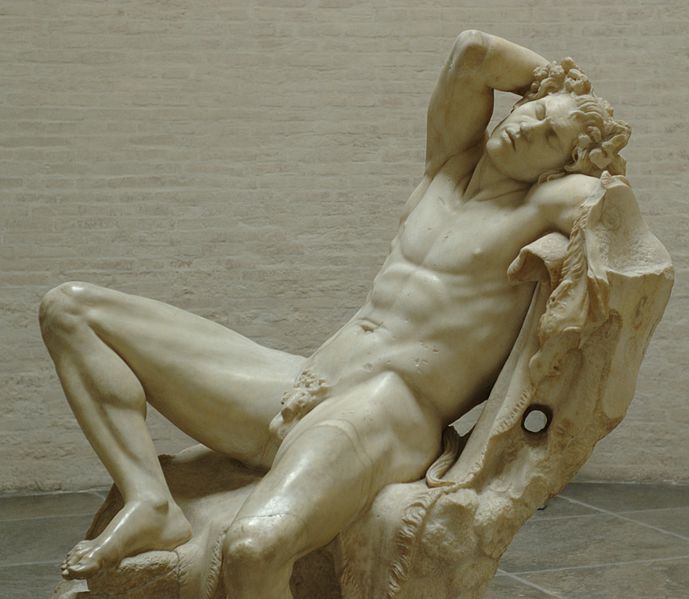
Le Faune Barberini (Glyptothek Munich)

Le Faune Barberini (Glyptothek Munich)

This version, carried forward from Nijinsky to Nijinska to Lifar, turns out to be a solo. Be gone the nymphs, me here, yo. So it’s the After That Afternoon, where I – Alvaro Rodriguez Piniera — lie about in my primitivo-naif rain forest décor and um, revisit that experience without even needing actual nymphs. Because, and that is what astonished me, a great artist can concentrate your mind into actually seeing what he sees. A split second hit where I started to feel inarticulately overwhelmed by the intensity of the mood he created alone out there. I thought, OK, sit up and quickly look around in order to make sure you are not insane. I saw: an entire audience, leaning forward, all sitting with mouths hanging open. I swear, it was a glimpse at a cave of bats hanging upside down! What an actor!

I’d always wondered what was so special about Nijinsky. Maybe here I finally caught a glimpse. Concentration, conviction, release with utter control. Where all lines and the smallest gestures confirmed a deeply-felt inner logic. Rodriguez Piniera made a guy in a spotted costume and gilded horned wig swooping around an abandoned scarf seem like the only way to go. A ballet that would always be modern. For what is otherworldly, if brought to life, can turn into an evident truth.

SUITE EN BLANC (Lifar/Lalo/well, yes, obviously no decor and arty costumes here)

“This is only his box. The sheep you asked for is inside.”

Everyone loves “Etudes.” But not enough people know this other ballet about ballet that held the stage in Paris before Harald Lander imported his masterpiece from Copenhagen. The best difference between these two roller-coasters which have no other story-line other than letting the audience in on just how high you can ride on technique? In Etudes you have a massively functioning corps de ballet and three stars. Yet all seem to be equally committed to one task: demonstrating how the struggle against one’s recalcitrant body leads to a larger kind of, ah that word again, inner perfection. In Lifar’s Suite en Blanc you have smaller groups and, by giving each one of them so much to do, he crafted each section into a constellation of stars each shedding its own light.

Nathan Fifield conducted the overture with such force and delicacy you could hear the stars and planets begin to twinkle as blown into place by the winds.

In swooping long tutus, Emilie Cerruti, Marie-Lys Navarro and Aline Bellardi, set the stage in the opening “Siesta”: softly romantic, powerfully in control, well-coordinated as a trio yet each individual never felt faceless (alas, I don’t know these dancers by heart yet, so I fear attributing attributes to the wrong name!)

Then Vanessa Feuillate wholeheartedly led Samuele Ninci and Ashley Whittle in a grand trio. All three played to the audience in a good way, with confident flair, utterly committed to the steps and without irony: let’s just hit this “invitation to the dance.” The audience, kind of still reeling after the “Faun,” responded. Delicate and precise, Mika Yoneyama then soothed us with her smoothly poised balances in the “Serenade.”

According to legend, one of the “baby ballerinas” of the Ballets Russes de Monte Carlo – I think it was Tatiana Riabouchinska – used to take men’s class as well. I always am reminded of that when I see the relentless “Pas de cinq,” where one girl challenges four boys in echapés and cabrioles and sheer energy. And can do all the « girly » things, too. The score gets terribly bombastic here and can, if listlessly played as is wont in Paris, drag the poor dancers down. Here dance and music bounced merrily along together. Sara Renda, despite a tutu, definitely proved to be one of the boys. With her four impeccable partners, they even made this all look easy and fun, which is absurd. And enchanting.

All bourées and asymmetrically-timed-and-positioned passés and careful flutterings, “La Cigarette” (in the long-lost first stage version of this flute-filled music from 1866, Rita Sangalli waved one around) should create the impression that the soloist floats and never comes off pointe. I found the solo a bit too strongly danced by Oksana Kucheruk, the crowd-pleasing pirouettes almost harsh in execution (the “I’m now going to let my face go blank and nail this step” variety). Etude-y. This may have been one little moment when I actually missed the way Paris’s dancers can merge precision with sometimes too much chic and nonchalance. Later on, in “La Flûte,” I had the same impression: Kucheruk is an impressive technician with natural lines who can indeed do almost everything…except go a little easier on herself. A bit like the rose with four thorns. I kept wanting to tell her: « you’re fine! Don’t force it, don’t keep the mirror in your mind, just enjoy the steps, will you?! »

But, in the meantime, Roman Mikhalev had used the grand Mazurka to grant me a little wish: what if the Poet in “Les Sylphides” could have broken out of that droopy melancholy solo? He’s in a mosh pit of girls, for god’s sake! He’d think big and jeté and turn and leap all over the place, while never losing his dignity. Nice, bold, manly, tasty. In the Adage, Stéphanie Roublot and Oleg Rogachev at first seemed beautifully in-synch, yet then something went cold. That was a pity, because the great advantage Suite en Blanc has over Etudes is that it’s not about just getting it to work in an empty studio. It’s about negotiating dancing all together. Most of the choreography is given over to partnering and interacting and sharing the stage.

Yes, that’s the major difference between Etudes and Suite en Blanc: the first focuses on challenging the deep part that lurks in dancers’ minds – you facing the mirror, and that annoying person just in front of you at the barre, whose every perfection is pissing you off…the stuff audiences don’t really understand — the second on how the excellence of each rare idiosyncratic talent contributes to forming a real community. More than a challenge, this ballet remains an homage to every one on stage. You each face us sitting out there in the dark, but are not alone. Suite en Blanc recognizes that we are all in this together: you dancers, us in the audience, even the musicians in the pit (who actually cared to look back at the stage at the end and applaud…hello, Paris?)

“What is a rite?” asked the little prince. /”Those also are actions too often neglected, “ said the fox. “They are what make one day different from other days, one hour from other hours.”

I found these different days in Bordeaux and Toulouse. My eyes still hear golden peals of laughter.

[Just in case: all citations, and many bit of inspiration, came from Antoine de Saint-Exupéry’s « The Little Prince » from 1943, in its translation by Katherine Woods].

4 Commentaires

Classé dans Blog-trotters (Ailleurs), France Soirs