Archives d’Auteur: Fenella

Avatar de Fenella

À propos de Fenella

Pour ne pas rester muette, car je n'ai pas les deux pieds dans le même sabot, i will write in English.

Toulouse: Roses Bloom Beyond Paris (2/3)

DAY ONE: THE BALLET DU CAPITOLE, TOULOUSE (evening of October 25)

Photo Patrice Nin / Théâtre du Capitole

Photo Patrice Nin / Théâtre du Capitole

LES MIRAGES (Lifar/Sauguet/Cassandre)

“Then you shall judge yourself,” the king answered. “That is the most difficult thing of all. […] If you succeed in judging yourself rightly, then you are indeed a man of true wisdom.”

Everyone who teaches a class on Existentialism should simply force the students to watch these two ballets – Les Mirages and Les Forains — and then tell them to hide all those hundreds of pages by Sartre under their beds along with their ripe underwear. Next assignment: go sit in a café and watch those passing by over a glass of the cheapest wine on the menu. Just what are all these people on the sidewalks running after? Love? Money? The moon and the stars? What do they think they will find in the end?

The story of Les Mirages is very much as if, say, a rather more ripe little prince had landed in a never-never-land filled with women, should have known better, and realized – a bit too late — that there’s no place like home. The fresh intensity of the Toulouse company’s interpretation kept me wondering – even if of course I knew – what would happen next.

In a smaller house, on a smaller stage, almost everything seemed magnified, larger than life: the music, the set, the costumes, the dancers.

The men of Toulouse are brawnier than those in Paris, and that physique brings us back to the 1940’s in a very positive way. More Jean Marais than Gérard Philipe, Avetik Karapetyan’s “Jeune Homme,” a faultless technician and obviously reassuring partner (five very distinct women at least, plus the random passerby!) brought that indefinable charisma that makes one of those “god I’m on the stage almost for the entire 45 minutes and I am playing a jerk and always turn to the right” roles seem like one of the best kinds of roles you could hope for. He gave an archetype a soul.

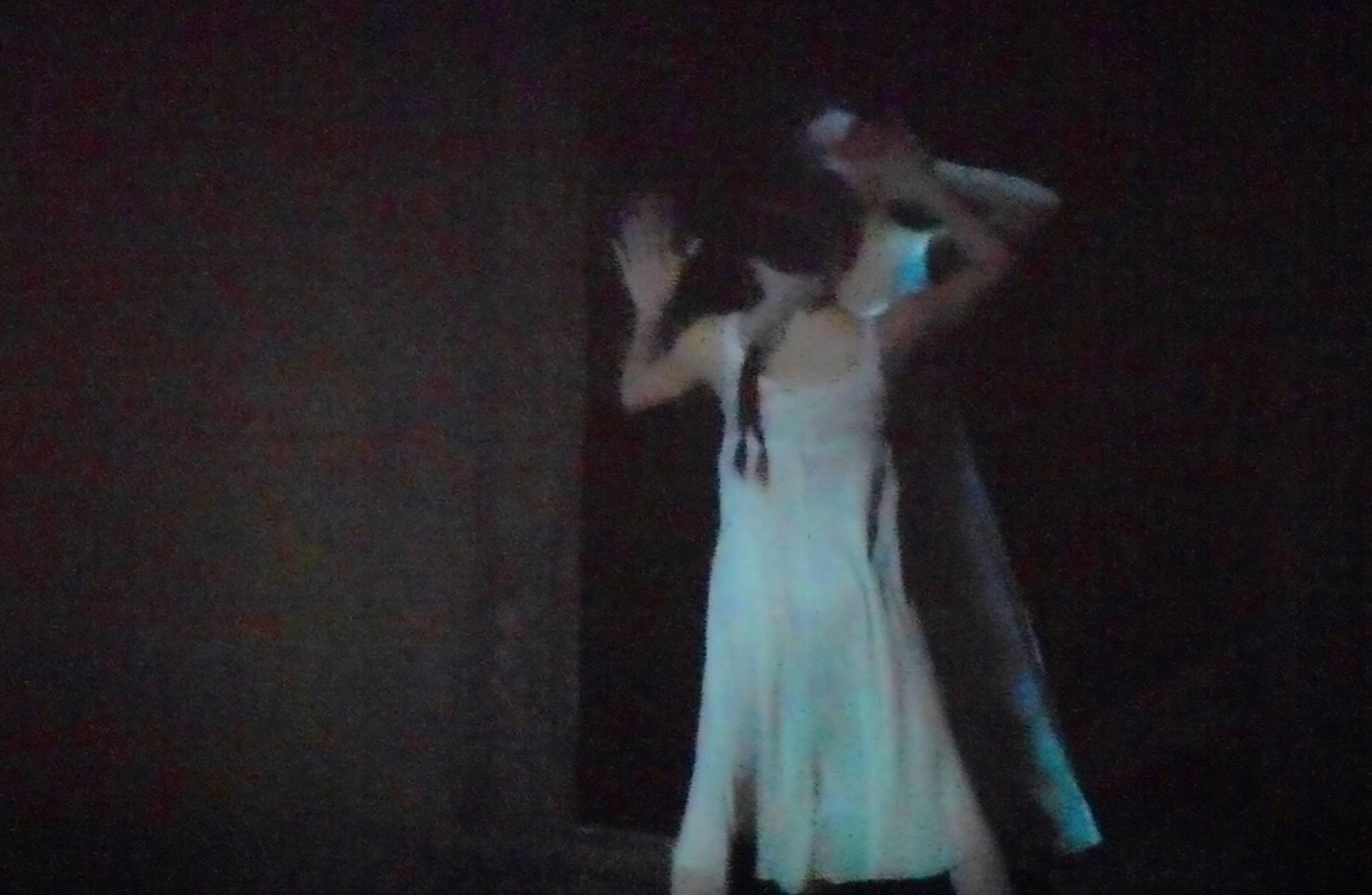
Les Mirages. Maria Gutierrez (l'ombre). Photographie Francette Levieux

Les Mirages. Maria Gutierrez (l’Ombre). Photographie Francette Levieux

Maria Gutierrez’s sharply-distilled, yet unsettlingly tender, L’Ombre – the clueless young man’s shadow, his shade, his subconscious, the truth about himself that he doesn’t want to face –was likened by Cléopold to a guardian angel. We both noticed the subtle way that she and Karapetyan seemed a microsecond off of the polished synchronization you get at the Paris Opera. And that opened our eyes. Suddenly the point of l’Ombre, to me, evoked Echo and her frustrations with a beloved Narcissus. She is unable to speak first yet ever condemned to always have the last word. More than saddened by her charge’s repeated follies – his chasing after Caroline Betancourt’s shifty bird of paradise, who moved so fast she blurred, or seeming to learn to breathe again while clasping Beatrice Carbone’s graciously swirling Art Deco curves to what he thinks is his heart – Gutierrez’s frustrated stabs at the ground with her toes, her wind-milling arms, her sudden still balances, all conspired to break my heart. I’ve never seen an Ombre so saddened by human folly. And the only way to do this is to turn off the Parisienne’s chic, to let go of irony. To despair, as one might have, in 1944.

*

*         *

LES FORAINS (R.Petit/Sauguet/Bérard)

“It is such a secret place, the land of tears.”

I have a soft spot for Les Forains [The Carneys]. That’s when I first spotted –evening after evening – Myriam Ould-Braham seeming to glow as one of the Siamese twins in Paris. Here I couldn’t focus my eyes exclusively on anyone, for the passion of everyone on stage, including that of the “spectators,” became overwhelming. Did you know that Piaf needed to record a new song based on the mood and music after seeing this very ballet?

I wonder what more Piaf would have given that song if Philippe Béran had been conducting and she had seen this company.

The Toulouse dancers, even when “just watching” with little to do, redefined the phrase “I belong to a company.” That group feeling became completely electrifying and amplified the impact of this terrible story about the loss of hope: a starving family circus troupe along with some minor talents it has adopted, put on a show and then try to pass around the hat. Day after day after day. Roland Petit’s ballet, which premiered in March 1945, recounts just one of those hungry and hopeless days. It makes you feel like an overfed voyeur content to look through a spyglass at human misery, and who brushes it off while looking for a taxi.  Alas, this is one story that will never go out of date.
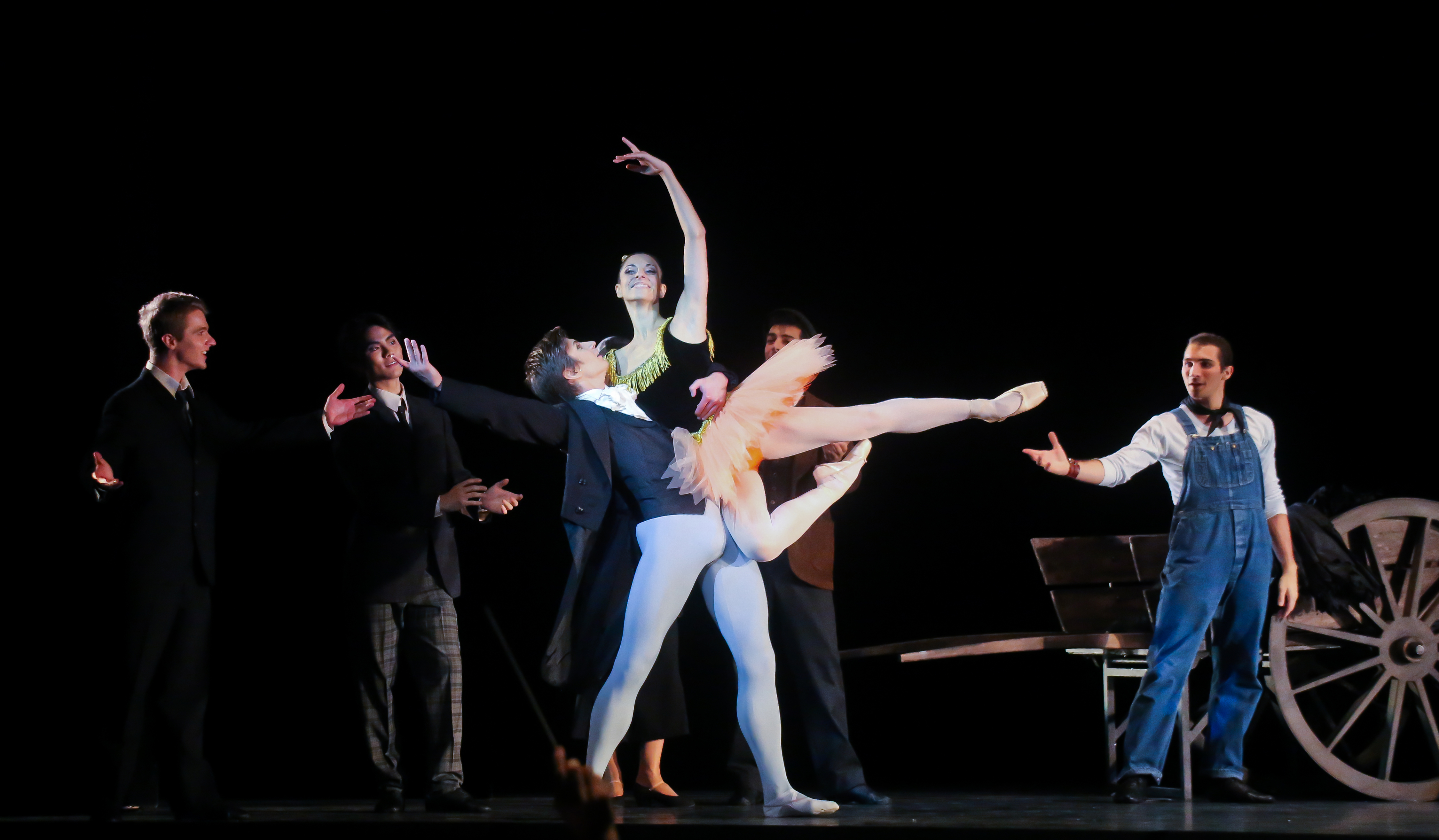
Les Forains.  Artyom Maksakov (le prestidigitateur) et Beatrice Carbone (la belle endormie). Photographie Francette Levieux.

Les Forains. Artyom Maksakov (le Prestidigitateur) et Beatrice Carbone (la Belle endormie). Photographie Francette Levieux.

Yet the ballet, like hope, can be delicious if danced by the likes of Artyom Maksakov (a generous and unusually youthful and hopeful Magician, heartbreaking in the subtle way he declined how his illusions of patriarchal strength was been chipped at and then shattered by an axe-like blow near the end – what an actor!); Alexander Akulov (not only a Clown blessed with ballon and élan but…what an actor! He almost convinced me that his character was called “The Narrator”); Beatrice Carbone (fearless as The Beauty Asleep, she seemed to galvanize the onstage onlookers with energy forged by many Kitris); and Virginie Baïet-Dartigalongue (as Loïe Fulller—who remembers Loie Fuller? — who literally set the stage the moment the weary beauty of her persona walked out on to it).

A rapt audience seemed to float out of the theater, their heads in the clouds still. Yet feet dragged, for this meant leaving Sauguet’s music and Toulouse’s dancers behind and returning to this mundane earth.  I yearned to doff my hat but, alas, it proved to be only a « boa constrictor from the outside » and needed time to digest these delicious treats.

[All citations are from Antoine de Saint-Exupéry’s « The Little Prince » from 1943, in its translation by Katherine Woods].

2 Commentaires

Classé dans Blog-trotters (Ailleurs), France Soirs

Roses Bloom Beyond Paris: A Tale of Music and Dance in Toulouse and Bordeaux (1/3)

ABOUT ORCHESTRAS AND THOSE WHO DO AND DO NOT UNDERSTAND WHAT THE FOX MEANT BY “TO BE TAMED.”

“May I sit down?” came now a timid inquiry from the little prince. “I order you to do so,” the king answered him… [all citations are from Antoine de Saint Exupéry, “The Little Prince,” translation by Katherine Woods, 1943.

I can still taste the music. Henri Sauguet’s deep and melodious melancholy for Les Mirages and Les Forains. He seemed to have dipped a finger into Satie’s cocktails yet have shaken off those drops of bitters. Honneger’s wild score for Icare went down like a Black Russian: “just what is in this tasty thing? Percussions only? I had no idea they could be so varied and so peppery and creamy.” Debussy? Sauternes, golden and daring to be swallowed whole. Lalo? Shots of vodka, invigorating and intoxicating. These ridiculous analogies? Due to the utter involvement and unblemished playing of Toulouse’s Orchestre National du Capitole and the Orchestre National Bordeaux Aquitaine.

Each group was led by an enormously committed conductor — Philippe Béran and Nathan Fifield, respectively— who actually watch and respond to what the dancers are doing. There is no shame in slowing down or accelerating, in picking up a nuance, while playing all the notes faultlessly, is there? After years of irritation with the sloppy rhythms and false notes served up by the Paris Opera’s orchestra whenever even some of its titular members deign to park their bottoms in the pit, here I could actually enjoy the dance — without wincing. More than that, I could savor the music completely dry. Conducted with force, yet sensitive to each flavorful layer of instrumentation, all the music for once really supported the dance. For two performances, I thought I was back at Carnegie Hall after too much champagne: when the music is so good you start to imagine little groups of dancing figures float across the proscenium.

But here I just needed to stare at the stage to make the music sound even better. My eyes could drink in the dancers of Toulouse and Bordeaux. While it’s too late for any Anglophones to catch this series of performances, the next time you come to France maybe you should seriously consider checking out what’s on in these cities located only a few hours from Paris. Don’t go unless the ballet or opera is on and let yourself be lifted up in the air by real, not recorded, music. Unlike the U.S., here we still have regional companies that present offbeat programs – no yearly, automatic, soul-deadening, demeaning, Nutcrackers in sight – even if Bordeaux and Paris have scheduled some for this December, that’s for the pleasure of playing around (in Paris, Nuts only shows up randomly every once in a while).

Or so I thought.

“We do not record flowers,” said the geographer. “Why is that? The flower is the most beautiful thing on my planet!” “We do not record them,” said the geographer, “because they are ephemeral.”/ “My rose […] perfumed all my planet. But I did not know how to take pleasure in all her grace.”

Alas, the hat passed around stage near the end of Les Forains turns out to be more timely than one would wish. So much great potential in regional theater turns out to be utterly underfunded due to political short-sightedness on the part of local and central government. These “geographers of nothing” seem to have become blind to why the ballet, from the era of Louis XIV until very recently had never been considered a luxury for the res publica, but a reservoir for national pride. Ballet was born in France! All these regional companies should not be facing the same existential struggle as American companies.

Have we learned nothing, then, since the 1940’s? These two companies – and others — need to be watered and protected, like the beautiful plants they are. Kader Belarbi and Charles Jude — despite the impatient and stingy hand of bureaucracy — choose ballets and dancers that do indeed prove that they both see from the heart.

Tomorrow and after tomorrow, I will tell you precisely how I spied not one perfect rose, but two.

Commentaires fermés sur Roses Bloom Beyond Paris: A Tale of Music and Dance in Toulouse and Bordeaux (1/3)

Classé dans Blog-trotters (Ailleurs), France Soirs, Humeurs d'abonnés

“Oh Frabjus Day! “* A Ballet treasure hunt awaits in Toulouse and Bordeaux.

Lifar Brecker

Serge Lifar posing for Arno Brecker. (Rohrbach)

During the weekend of October 25-26, the Balletonautes will visit both Bordeaux and Toulouse in the quest to reconfirm just how these regional companies in France have been re-awakened by the touch of two dancers whom the Paris Opera Ballet once cradled in its arms: Charles Jude and Kader Belarbi.

The programs will include:
By Roland Petit: Les Forains (in Toulouse)
By Serge Lifar: Les Mirages (in Toulouse); Suite en blanc; Icare; Le Faune -solo version- (in Bordeaux).

“Then the bowsprit got mixed with the rudder sometimes.”*

But, before I can even think about reviewing this renaissance beyond Paris, I find I must justify these directors’ choices of ballets. If a program includes Serge Lifar and Roland Petit – Jude and Belarbi’s forefathers –then some nasty old cobwebs that continue to stick in the craws of Anglo-Saxon critics must be addressed.

Prior to moving to France, I must admit that all I knew of Petit’s work basically consisted of Nureyev and Baryshnikov on film in “Le Jeune Homme et la Mort,” and all I knew of Lifar were photos of yet another guy wearing a hairnet in books about the Ballets Russes…not a live ballet in sight. Why?

Petit is easier to defend: if you dismiss him for being too obsessed with expressive yet highly-expressionistically-stylized narrative (woo!), then please take yet another look at his contemporaries such as Agnes de Mille and Antony Tudor, or at the vehicles created endlessly for Sergeyev and Dudinskaya in the 1950’s. They are all of the same era, they all find their way into the same confusion of post-war emotions and the need to act out. They are all one, and none of them should be relegated to the dustbin.

“For the Snark was a Boojum, you see” *

The case for Lifar proves harder to argue on generational/geographic terms.

After attending a promotional talk a while back for his book about artists who did anything to stay alive during the Occupation, I asked Alan Riding to talk to me a little bit more about Serge Lifar. He proved quite dismissive and quite curt: “oh, so you only care about the ballet!?” His bored sigh became audible. Next!

This kind of thing can get exhausting for me too. And I should have expected it. Arletty, Cocteau, Colette, oohCoco Chanel, many painters, even Drieu de la Rochelle (especially since the latter had the good sense to kill himself) are at least taken seriously as artists by those like Riding. But somehow Lifar, even if construed as an idiot-savant as dancers usually are, has never has been allowed to move out of limbo.

Sometimes I feel that ours is an art ostentatiously flattered while both dismissed and despised by these arbiters of taste. Dancers and choreographers are too often considered the stupidest people on the planet, yet the same outsiders continue to hold ballet to a standard way, way, above that granted to others.

I am on risky ground here, but when snarky critics continue to dismiss Lifar (because he kept the Paris Opera Ballet alive and warm and fed and focused on their art during the Occupation) also feel entitled to glorify Céline’s sordid rants as great art…that attitude makes me think we all need to think a bit more carefully about many things, art included…

“His intimate friends called him Candle-ends/And his enemies Toasted Cheese.”*

It gets worse. The race to the summit years before, immediately upon Diaghilev’s death, has not helped Lifar’s case either. Imagine the fistfight with Boris Kochno in 1929, as he and Lifar each pummeled each other front of Diaghilev’s corpse as laid out by the ever-practical Chanel.

Worser [sic] there is another – related – reason why there is no way to begin any discussion of Serge Lifar’s choreographic legacy if English is involved. Since the 1930’s, we have been feeding off of the great and long-hanging shadow of Mr. B’s virulent and never-ending revulsion for Serge Lifar. As if it was Lifar’s fault that he inspired Balanchine’s to create the strong and deeply masculine steps of Apollo and The Prodigal Son?

As the other candidate for director of the Paris Opera Ballet gig soon after Diaghilev’s death, Balanchine came undone, –as Ellis Island could have undone him as well: he slipped in to the US despite a history of tuberculosis — and the Paris prize went to Lifar. In my volume of “Balanchine’s Complete Stories of the Great Ballets, Revised and Enlarged Edition” from 1977, Lifar only gets mentioned in a kind of afterthought list as, “oh, by the way,” the guy who premiered some Mr. B’s most immortal male characters, no inspiration required. And not once does Lifar ever come to the fore as that prolific choreographer left behind in France, generous and protective of – and inspired by — the talents of his dancers, such as Yvette Chauviré or Michel Renault.

Balanchine’s rancor against the person who once inspired him the most remained as sharp as a knife unto death and perhaps informed his oft-cited utter dismissal of male dancers (in public statements, at least). Mr. B. still had to deal with men, and, oh, good lord. Man = if straight you are my competition for the pretty ballerinas who might inspire me; if gay I will pretend that you do not inspire me. Whatever. Man, I will give you glorious steps to dance but I will always claim they mean nothing, and then shout loud and proud that you are not “dance” because “dance is woman.”

Of course I adore most of Balanchine’s ballets. But there are days when playback of the Balanchine vulgate just exhausts me. So:

“What I tell you three times is true”*

The art déco steps and chiseled expressiveness that Lifar carved into them deserve a chance, as do Petit’s short stories, so much more subtle than you would assume. What a weekend awaits! Petit and Lifar via Jude and Belarbi : another generation of danseurs keeping ballet alive. Their combined lifetimes of work now breathe new life to a new generation of dancers. Dancers male and female, their kith and kind. I can’t wait to see how the dancers of both Bordeaux and Toulouse will astonish me, as they have before.

* All quotes from: Lewis Carroll, “The Hunting of the Snark”

Ballet du Capitole de Toulouse. Programme Lifar-Petit: Wednesday, October 22nd to Sunday, October 26th.
Ballet de l’Opéra de Bordeaux Programme “Icare… Hommage à Lifar”: Friday, October 24th to Sunday, November 2nd.

Commentaires fermés sur “Oh Frabjus Day! “* A Ballet treasure hunt awaits in Toulouse and Bordeaux.

Classé dans Blog-trotters (Ailleurs), Hier pour aujourd'hui, Humeurs d'abonnés

LESS IS MORE: Dances at a Gathering vs. Psyché (plot summary)

The choreographer Jerome Robbins, who died in 1998, considered the Paris Opera Ballet his second (third?) home.  He adored coming here to personally coach our dancers.  Only the New York City Ballet, his home base, has more of his ballets in its active repertory.

Creator of over 60 ballets and co-director – with George Balanchine – of the New York City Ballet, Robbins lived a triple life: commuting between Lincoln Center and Broadway and Hollywood. As the dance-maker, director, or “doctor” of many of the greatest musicals – such as On The Town, Peter Pan, Gypsy, Forum, Fiddler, and most famously, West Side Story — Robbins earned 5 Tony Awards and 2 Oscars.

That his musical, The King and I, is now playing at Paris’s Théâtre du Châtelet and his ballet “Dances at a Gathering” can be caught at the Palais Garnier, highlights this multilayered legacy. Whether his dancers wore 19th c. imperial Thai headdresses or wispy chiffon and pointe shoes, Robbins always sought ways for movement to seem a natural extension and expression of a deeper narrative.  An instinctive storyteller, even his most plot-less ballets betray glimmerings of plot.

Alexei Ratmansky, one year old when Robbins’s Dances premiered, grew up in the Soviet bloc in an atmosphere where the old-fashioned (such as the big 19th century narrative ballets at the Bolshoi) held on by its toenails.  During his youth, it had become possible to take peeks at bits of the glamour of the abstract plot-less-one-act and the decadent musicals of far-off America

Abstraction has long been justified by the joke that our vocabulary of leaps and spins does not quite include the words for “this is my mother-in-law.” But nowadays, the story ballet has come back into fashion.  Ratmansky’s challenge is to craft steps and combinations that will speak to you without a word being spoken. Especially as the story of Psyche revolves around her…mother-in-law.


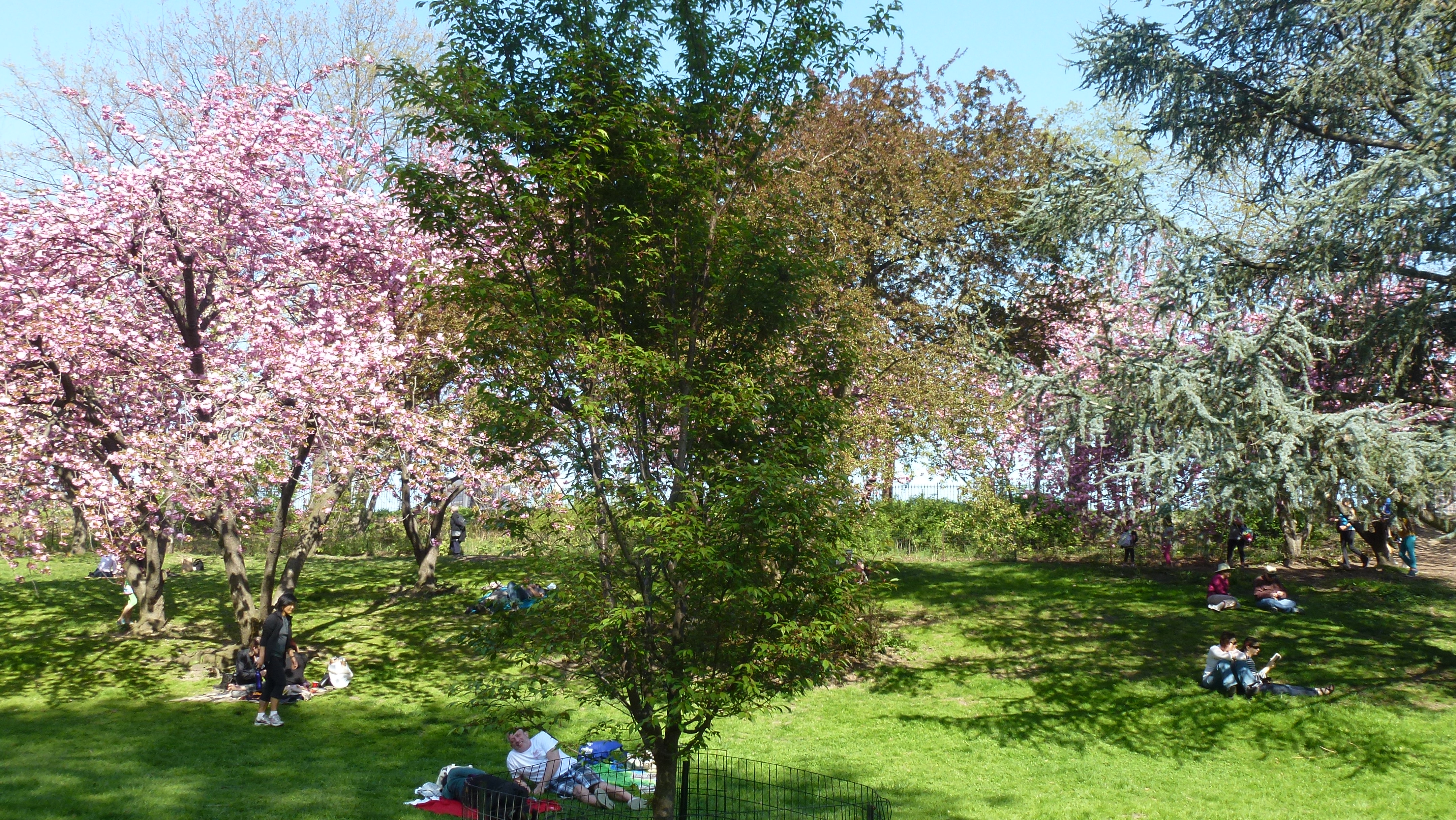
NYC, Central Park. A blue sky with shades of green and purple...

NYC, Central Park. A blue sky with shades of green and purple…

DANCES AT A GATHERING (1969)

Choreography by Jerome Robbins

Music by Frederick Chopin

There is an irony to be found in fact that the storyteller Robbins’s ballet masterpiece has no plot.  Circumstances, and a bit of stress fatigue, dictated its construction according to dancer lore.  Too respectful of the guru Balanchine’s authority – who nevertheless always assured that his co-director had access to rehearsal space at the New York State Theater – Robbins, feeling the urge to take on Chopin, never seemed to have insisted upon a normal rehearsal schedule. Instead he noodled around (to put it mildly: tried, discarded, reinserted, agonized, tortured both steps and bodies) with whatever dancers whenever they had a half an hour to spare. Each half-an-hour was used to carve out perhaps thirty seconds of steps to be reworded later…  The structure of “Dances” reflects its episodic – almost anarchic — birth.

Crafted by and for specific American dancers, this ballet in fact carries more than a hint of Slavic soul.  Of the seventeen sections, lilting mazurkas – a Polish dance in swift triple time  -dominate eight of them.  Little gestures such as a click of the heels, one arm akimbo while the other sweeps grandly up and out, a tilt of the head, all bring folk dance to mind.  One could find further irony in that while every bit of Chopin’s music tickles your feet and emotions, the dance pieces he inspires remain mysteriously both full and empty of story, including the very first abstract ballet ever, Fokine’s 1907 Chopiniana.

In the end, the story is that there is no story, as life really has none either: “In the room the women come and go, talking about Michelangelo.”  Think of this ballet as not merely something to watch, but as snippets of ongoing conversations caught on the sly…just let your eyes follow someone around this picnic on a late summer afternoon on Sheep’s Meadow in Central Park or on the banks of Chopin’s native Vistula. The boy in brown or green or violet; the girl in yellow or blue or mauve…pick one or two or three and amuse yourself by imagining which one you would want as a relative.

By the way, Robbins broke new ground by finally daring to reject the supremacy of  never-perfect orchestral accompaniment. He plonked a simple rehearsal piano on the apron of downstage right.  Basta! Until his piece – and that same year, Eliot Feld could have claimed to have gotten there first in his haunting Brahms-inspired sextet Intermezzo– ballet always meant puffy music.  Balanchine, bless his heart, certainly brought out the best in Stravinsky but – for Christ’s sake – do Gershwin’s songs really need to be pumped up by Hershey Kay?

Maybe.  For some odd reason, be it lack of cymbals or symbols, a portion of the audience always nods off during the understated moods in “Dances.”  Too soft, not dramatic enough.  It’s like the way Mozart snoozes some people out. In either case, I’ve yet to figure out why.  Unless…

There is a key moment late in the ballet when The Boy in Brown, watched by the others, kneels and stretches out his hand to softly caress the floor.  There lies the story, and the reason why dancers love this ballet more than earthlings: it’s about being home.  Regular families get together on Sundays in parks and playgrounds; the family of dancers gathers daily in the studio. Each performance together, then, is their version of Thanksgiving.

Chantilly

The Castle of Chantilly…or Cupid’s enchanted domain?

PSYCHE ( 2011)

Choreography by Alexis Ratmansky

Created for the Paris Opera Ballet

Music by César Franck (1890)

While “Dances” boasts of no plot, no orchestra, no sets, no fancy costumes, and all depends on the subtle flick of a dancer’s wrist…here you have got the whole nine yards.  Big loud music with chorus that keeps thundering along from climax to climax.  Whoop-de-doo sets, almost psychedelic in impact and certainly unnerving, by Karen Kilimnik. Adeline André’s flower-powered costumes will certainly give you something to talk about after the show.  Your discussion may center, however, upon whether the arrangement of steps helped or hindered the narrative.

Here follows a summary of Apuleius’s 2nd century telling of the story of Cupid and Psyche, with hints as to how it is staged tonight:

Once upon a time in ancient Greece, Venus – the goddess of love – grew very angry at a king (we never see him).  But was it his fault that the youngest of his three daughters, Psyche, had been blessed with such spectacular beauty that men came from far and wide just to stare at her?  Was it her fault that these men forgot all about keeping the fires lit in Venus’s temples? (hint: smoke rising).  Compared to Venus (in red), when it comes to vanity or bossing people around, Snow White’s stepmother was a pussycat.

She sends her son, Cupid, to put a stop to this annoying situation (this is about where the ballet starts)While his mission is to use his magic arrows to make Psyche fall in love with the ugliest creature on the planet, once Cupid sets eyes on her…guess what happens.  The problem, then, is how to get around mom.

Cupid concocts a plan.  First, he renders all men indifferent to Psyche’s looks.  Time passes and everybody – including her sisters – gets married.  The king, confused, seeks advice from Apollo and leaves horrified by the god’s instructions — which of course had been planted by Cupid.  The king must leave Psyche, dressed in mourning (black chiffon), on a mountaintop where she will be united to – or perhaps devoured by — a monster.

Obedient, fearful, bathed in tears, Psyche falls asleep while awaiting her fate.  But instead of a monster, four Zephyrs – the gentlest of winds, dressed in ripped shower-curtains – appear and waft her (now in sparkly pastel chiffon) away to a magical flower-filled meadow alongside a stream.  In the distance she can see a palace fit for a god, covered in gold and silver.  Soft and disembodied voices tell her to fear not and to await the arrival of her new mate at nightfall.  That would be Cupid.

In the dark, she cannot see her lover – and has been warned that she must never look upon him (blindfold) – but realizes that this cannot be a monster (during a pas-de-deux cleverly devised so that the dancers never look at each other, a real challenge as eye-contact provides a huge help in partnering).  And so the blissful days and nights pass, until Venus finally figures out what’s going on.

Uh, oh. Venus sends Psyche’s two sisters to plant seeds of doubt in her mind. (These are the two girls with fidgety movements dressed in violent blue and acid green topped with fright wigs).  Psyche, like Belle, hasn’t talked to a real person in ages and proves vulnerable to her sisters’ insinuations.

On their advice, Psyche prepares a lamp and a knife – should her bedmate indeed turn out to be a winged serpent with fangs– and waits for dark. Upon discovering Cupid’s shattering beauty, her hands begin to shake and a drop of hot oil lands on his shoulder.

A moment later he vanishes, having whispered that “where there is no trust, love cannot exist.”  Psyche, in despair, begins wandering through hill and dale.  It takes her a while to figure out that Cupid has run home to mommy.  The only solution is to kneel before her mother-in-law and humbly beg forgiveness.

Not so easy.  Claiming that Cupid hovers between life and death from, like, something that can be solved with a Band-Aid, Venus devises all kinds of impossible tasks Psyche must first perform as penance (hopefully failing or, better yet, dying in the process).

But all kinds of kindly creatures decide to help or at least do no harm (insects, sheep, dogs, eagles, plants).  Since the premiere almost three years ago, the costumes have been toned down.  The girl Flowers still look like flowers. But the Animals and Insects no longer wear the obvious, only the boys’ spastic gestures are left to clue you in as to what species (I kind of miss the loony giraffe costume).

As she does when depressed, Psyche falls asleep again. (Sent to hell by Venus in order to ask to borrow Persephone’s beauty secrets Psyche, figuring that she must be looking pretty worn-out by now, can’t resist peeking into the box which contains…sleep).

Finally cured, Cupid is ready to forgive Psyche but…only once Jupiter agrees to grant her immortality and Hermes carries the girl up to Mount Olympus (we see neither) will Venus relent (air kiss).

Thus love (Cupid/Eros) is eternally united with the soul (what the word “psyche” literally means).  By the way, Psyche’s emblem in art is the butterfly, which seems to be missing from the decor.

1 commentaire

Classé dans Retours de la Grande boutique

Orphée et Eurydice : a plot summary

P1070147An opera by Christoph Willibald Glück (1762)
Staged and choreographed by Pina Bausch (1975)
Sung in German, danced by the Paris Opera Ballet

Orpheus – a musician so gifted that the sound of his lyre and arc of his voice can make rivers change course, wild animals lie down to be petted, and rocks cry — dares to journey to the underworld in search of his beloved wife, Eurydice. This, one of the greatest love stories of ancient Roman mythology, provided the plot for not only the very first opera created in 1607 – Monteverdi’s Orfeo — but has inspired more than one hundred other operas or ballets.

Pina Bausch’s modern and expressive take on Glück’s richly emotional score solves the conundrum of how to return ballet to its rightful place in an operatic evening. Bausch took dance too seriously to provide mere divertissements. Here she blesses each singer with a danced double, as in Glück’s original version: bodies and voices interact and complete each other. This intricate coupling of song and movement creates a symbiosis that you could say resembles a great marriage. One that has, already, lasted much longer than the brief and tragic one of Orpheus and Eurydice…

PART ONE: (1 hour 20 minutes)

FIRST TABLEAU: Mourning
Her snowy wedding veil now a shroud, Eurydice had died from a serpent’s bite on her wedding day. In her motionless arms: red roses symbolizing her husband Orpheus’s passionate love. Orpheus, devastated by grief at the loss of his turtle-dove, refuses to be consoled by the nymphs and shepherds who mourn with him.

But Orpheus is the greatest singer on earth. Despite daring to speak of the cruelty of the gods, his cries of despair sound so beautiful that they soften the hearts of these very same gods. Love arrives with a message: Orpheus will be allowed into Hades. If his music can disarm the guardians of the gates of Eternity, then he might be able to do what no living being had ever done: bring his wife back from the realm of the dead.

But there is one condition. Should he succeed in wrenching his wife from the arms of death, Orpheus must not look at her – nor explain why — before they have returned to this earth.  Orpheus is suddenly worried for he has never lied, or been less than utterly honest, to Eurydice before.

SECOND TABLEAU: Violence
Orpheus enters a horrible dark and smoky cave by the river Styx, where the waters of woe pour into those of lamentation… and soon dissolve into the stream of oblivion. His wife just beyond reach, Orpheus must confront the three-headed guardian of the Underworld, the hound Cerberus (three male dancers in leather butcher’s aprons) and a swarm of Furies. You may be surprised that these screeching female avengers destined to torment sinners move about more like merely nervous and tired souls yearning for rest. That is because in Ovid’s vivid description, Orpheus proves the only mortal to make the implacable Furies not only relent, but weep. So if at first sight the Furies scream “no!” they do finally allow Orpheus to pass, swayed by how his beautiful music embodies the power of such loving devotion.

THIRD TABLEAU: Peace
Orpheus and Eurydice are reunited in the Elysian Fields, that exquisite and peaceful meadow in paradise where “blessed spirits” enjoy an eternity free from those violent human emotions that make us suffer so in mortal life. (The French term for this place is Les Champs-Elysées). Having already taken a drink from the river of forgetfulness and feeling rather blissed out, Eurydice is startled by how Orpheus seems both panicked and utterly cold at the same time. Did he come all this way only to turn away from her? Why, then, should she abandon this new « life? »

INTERMISSION (20 minutes)

PART TWO: (30 minutes)

FINAL TABLEAU: Death
As she is being led back to earth Eurydice, unable to understand why Orpheus stubbornly refuses look at her, can only imagine that it must be because he no longer loves her. In that case, she would rather be dead. Her despair grows, and Orpheus struggles to maintain his self-control.

This situation always makes me think of a very long car ride, where you are stuck in the back and wind up wanting to strangle the driver, there, in the front, with his back to you, who has been feeding you monosyllables for hours. Even if that means wrecking the car in the middle of Idaho. And I’m not the only one who feels this way. Now is the time for you to re-view Jean Cocteau’s dark-hearted film.

Alas, unable to stand it any longer, Orpheus suddenly turns to face Eurydice, to reassure and embrace her. At that very instant she falls dead, this time forever. Orpheus loses the will to live, even to move. In a poignant and emotionally raw final tableau, he allows death to take him too.

NOTE:

The opera’s libretto provides a happy end, where human frailty is forgiven and love conquers all. Bausch decided to cut Glück’s last two scenes. Her somber finale, with music from the lament we heard at the outset, is probably more suited to our pessimistic times, and rhymes well with the choreographer’s feral sensitivity to the complexity of life and love.  Her company in Wupperthal was/lives on as a coven of strong women who make big statements, most often in clad in those dresses that swish and swoop and make you move differently from normal – one way to signify the female in all her power.  Her men embrace extremes: clad in suits, or leather, or almost nothing at all.  They are either grindingly dominant or utterly fragile.  Bausch understood how, while we like to dream of love, too often we suffer from the urge to tear each other (and ourselves) apart. The Paris Opera Ballet is the only company outside Bausch’s own to have been deemed capable of doing justice to not just one but two of her masterpieces — the other being her pungent and loamy Rite of Spring, which will hopefully soon return to the repertoire.

4 Commentaires

Classé dans Hier pour aujourd'hui

Onegin: “Leave the ashes, what survives is gold.” *

P1050181ONEGUINE by John Cranko at the Palais Garnier in Paris
Tuesday, February 25: Amatriain, Paquette, Grinsztajn, Révillion
Wednesday, February 26: Albisson, Hoffalt, Barbeau, Révillion

This past week, anticipation of Isabelle Ciarvola’s farewell performance kind of sucked up the energy of many of us devoted spectators. But…

“The high that proved too high, the heroic for earth too hard,
The passion that left the ground to lose itself in the sky,
Are music sent up to God by the lover and the bard;
Enough that he heard it once: we shall hear it by-and-by.” [Robert Browning, Abt Vogler]

Other voices need to be heard too. And these two casts gave new music to us who live far beneath the sky, and new alchemies that spun distinct varieties of gold.

If Ciaravola used her body to transcribe long arcs of arias where you suddenly are convinced you hear the breeze sing along with her, then Alicia Armatriain (stepping in from Stuttgart for the injured Ludmila Pagliero) provided flickering and unexpectedly thunderous microclimates while Amandine Albisson embodied a luminous sky slowly darkening toward heavy rain. Each Tatiana, then, created her own kind of weather.

“Ah, but a man’s reach should exceed his grasp,
Or what’s a heaven for?” [Andrea del Sarto]

P1060930

Alicia Amatriain and Karl Paquette as seen by Cléopold on the 4th of March

Armatriain belongs to the reckless tribe of Alina Cojocaru and Marcia Haydée, each only interested in sucking out the emotional nectar deep inside the combination of steps and shapes demanded by their choreographer. Even at the risk of awkwardness, they trust us in the audience be their camera, their mirror, their oxygen, their adrenaline. Our guest Tatiana can do beyond 6 o’clock, but when she does 190 degrees sideways – almost flattening Lensky – the intent, the urgency of why she has pounced upon him, has everything to do with entering into the emotional pitch of the moment.

Armatriain dances and acts her role as if she were a thoroughbred filly, tense and hyper-reactive. So changeable that two bad movies about Van Gogh came to mind: scenes of where the genius slaps blobs of color onto canvas seemingly arbitrarily but then suddenly we see the sky fill with stars. But a superb horse, like a superb painter, is always slightly unhinged: will he fly across the steppes or smack into a wall? That’s how scary and unpredictable her jumps into and out of Onegin’s arms – the reckless way she pushed up off of his hands! — could feel.

Find the scene in Nils Tavernier’s film “Etoiles” where, just before a performance of Doux Mensonges, Wilfried Romoli tries to rein in Celine Talon’s “ick-eek-eek!” response to one of those trickily calibrated lifts where Jiri Kylian seems to slyly honor to his mentor, John Cranko. Somehow last Thursday the opposite happened, and thus Paquette could concentrate on carving out his own Onegin. Armatriain’s abandon visibly freed him up to react to, not anticipate, all she threw at him: “Well, if she’s not afraid I’ll drop her then I’m gonna have fun here too!”

Here alchemy happened and Karl Paquette finally got a chance to stop being stereotyped as “Mr. Nice Guy Reliable Partner” and let fly. His Onegin grew in confidence and became lithe and loose and even greedy. Do you remember the enormous grin that crossed your face when you leapt onto the upper saddle of a see-saw, hoping to knock the other grinning kid sitting down at the ground way up in the air? That’s what their partnering kept feeling like (I mean the word “felt”: I caught myself twitch in response, and realized the person in front of me did as well).

The Letter/Dream scene took on a special flavor, as if this were partly Onegin’s dream too. As if it illustrated an epiphany. I sensed perhaps I was simultaneously witnessing Onegin’s first reaction to reading her letter. A bright electric flash of joy – “could this be something I could feel?” I could imagine his pulse thickening at soon as he started perusing her missive, briefly alive, until the moment he folded it up again and sighed “what might have been.” This duet, conceived to illustrate an interior monologue, became a dialogue.

Joy and release within reach, the “Spring Waters” Soviet-style crotch lift – and other lifts – that Cranko so tenderly re- appropriated  here seemed to really come out of nowhere and everywhere. James Tuggle, a most sensitive conductor who actually watches the stage throughout, sometimes gently stretches out the musical line to give his couples time to get into lift-off position. This night he didn’t have to, and accelerated.

Less chilly, Paquette’s Onegin had an eye for the women from the start. He reminded me that Pushkin makes Onegin tease Lensky: “if I were a poet, I’d have picked this one instead.” A slightly avuncular tinge also signaled the patronizing (and so cruel in its own way) speech with which he will return Tatiana’s letter in the original text. So, when haunted by the ghosts of women past, you could understand what he had thought he had seen in each will o’ the wisp that passed through his arms. And all the regrets of so many lives not lived to the full.

“Escape me?
Never – Beloved!
While I am I, and you are you,
So long as the world contains us both,
Me the loving and you the loth,
While the one eludes, must the other pursue.” [Life in a Love]

If, in my opinion, Hervé Moreau’s Onegin of the 23rd surely headed out to drown in the Neva, Paquette’s of the 25th will probably drink himself to death while savoring every single morsel of his memories. Josua Hoffalt’s Onegin of the 26th, on the contrary, will just shut himself away in darkened rooms and slowly – and most determinately — let himself starve and fade away, staring angrily at his own reflection.

“Best be yourself, imperial, plain and true!” [Bishop Blougram’s Apology]

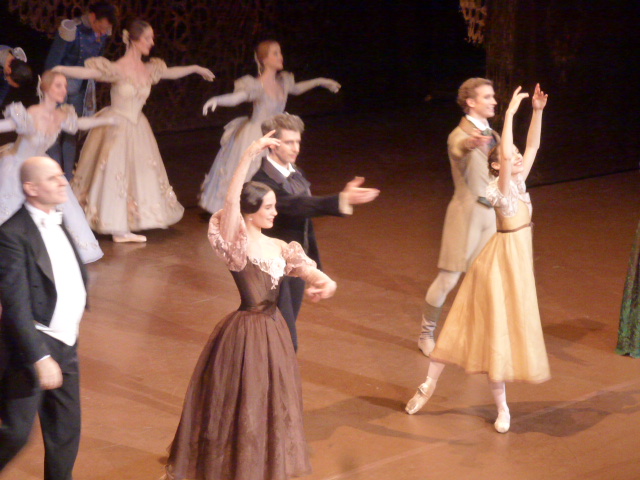
The conductor James Tuggle, Albisson, Hoffalt, Barbeau and Révillion on February 26, 2014

The conductor James Tuggle, Albisson, Hoffalt, Barbeau and Révillion on February 26, 2014

For last Wednesday Hoffalt’s Tatiana, Amadine Albisson, seemed as milky and addictive as curds and whey. Here all the lines were pure and cleanly shaped, all the steps full out, but never wild. She’s too young to channel Rachel or Callas the way Ciaravola now knows, but she’s mature enough to trust herself. Thus, her simple – but not simplistic – approach to the role reminded me more of Romy Schneider’s hope-filled (but in no way saccharine) Sissi than the still and sad-eyed Elisabeth she would later learn to evoke for Visconti. Men have told me their eyes were somehow drawn to the nape of Schneider’s neck, as I was to the way Albisson arched hers.

She was up against some partner: Hoffalt, irritable and nervy as if he were fleeing more than boring St. Petersburg society. As if he had already killed someone and needed time – and not more annoyances – to figure it out why he still needed to be alive. His pure and plucked-taught lines grew out of the energy of the music (and one day he will learn to bring this same commitment to those Petipa princes) and meshed with Albisson’s.

“My sun sets to rise again” [At the ‘Mermaid’]

On both nights Fabien Révillion’s varied and apt attack, his rhythmic and assured punctuation of perfectly executed and extenuated steps all free of hops and bobbles, made me wonder where this youth-filled poet had been all my life. Steps are only, after all, metaphors for words. Perhaps Lensky has delved too deeply into the German Romantics, but this one filled out his steps and let us watch him grow from a boy into a man overnight. A goofy grin and fleet-footed gayety gave way to a wrenching solo on the eve of the duel where he too let go of the expected. This Lensky punched at the air with all the force in his body, tried to slap at the sky, and seemed to want to yell at his younger self for bringing on the fate bearing down on his body. Where Heymann begged succor from the moon, Révillion’s outstretched arms cursed it. Arching backwards, he seemed to understand how foolish he had been to only smile for so many wasted years before daring to kiss either Eve Grinsztajn’s bewitching or Marion Barbeau’s touchingly forthright and sunny Olga. Révillion’s and Barbeau’s lines, sense of weight, and complementary look bode for an adorable partnership. I hope to see them paired again in a ballet with a happy ending.

“Lo, life again knocked laughing at the door!
The world goes on, goes ever, in and through,
And out again o’ the cloud.” [Balaustion’s Adventure]

*“Leave the ashes, what survives is gold.”  is taken from Robert Browning’s  « Rabbi ben Ezra. »


Commentaires fermés sur Onegin: “Leave the ashes, what survives is gold.” *

Classé dans Retours de la Grande boutique

Onegin: “Oh to love so, be so loved, yet so mistaken!” [Robert Browning, Epilogue to Asolando]

P1010032Onéguine at the Palais Garnier. At a Sunday matinee, February 23, 2014: Ciaravola, Moreau, Giezendanner, Heymann, Paquette.

I knew I would not be able to add to the comments of those who attended Ciaravola’s adieux this last Friday. So this will be about an earlier performance by the same cast, very different in its nuances because artists bring new colors to a character every time they step into the light.
Frankly, I didn’t want to talk about this penultimate performance either and procrastinated. Out of selfishness. I wanted to lock the memories away in a tiny, golden, silk-lined box that I, and only I, could peek into. I would inhale these varied and delicious fragrances during those dark moments when I’d forgotten that the technical demands of dance are only meant to enable dancers to embody poetry in motion, to distill song into drops of perfume, to free emotion from the bonds of words and technique itself. It’s been a long time since a performance made me remember all the ways it can feel like to be sixteen.

COUNTRYSIDE

“The hills, like giants at a hunting, lay/Chin upon hand, to see the game at play.” [Childe Roland to the Dark Tower Came]

Right away, the complex loving bond between Isabelle Ciaravola –Tatiana (boy, does she make “chin in hand, reading” come alive!) and her utterly guileless and radiant little sister (Charline Giezendanner-Olga) warmed the heart. With her torso always just ever so slightly inclined forward as in a 19th century lithograph, fleet and buoyant, Giezendanner seemed to be humming to herself the opera’s teasing and guileless “when I hear those songs, all I want to do is dance.”

“She looked at him, as one who awakes:/The past was a sleep, and her life began.” [The Statue and the Bust]

Both sisters let us experience this. Giezendanner folds naturally and sweetly into Mathias Heymann-Lensky’s open chest. Their duet didn’t look like a series of steps, but as if Olga had added “to dance…with you” to her song and the tenor’s “I love you” could be heard whispered in the background at the same time. Their lines, musical attack, their innate feeling for spin and then drift in balance and then to gently de-accelerate always brought them together. Heymann achieves one of the hardest, yet simplest, things: on your very first day of ballet class, the teacher tells you to always use your upper body in 1st to 5th “as if you were holding the sun inside your arms.” Most of us never get there. Heymann does that, and carries that over into partnering too.

“For I say, this is death, and the sole death,/When a man’s loss comes to him from his gain,/Darkness from light, from knowledge ignorance./ And lack of love from love made manifest.” [De Gustibus]

Hervé Moreau’s instantly provided a man truly depressed who saw all of life in dull grey and could feel nothing deeply, high nor low. He seemed to add another – much less cynical — albeit efficiently cold– layer of backstory to Pushkin’s already dense Chapter One. Something in the eyes, a soft and sinuous attack added to a mysterious aura, where something seemed frozen inside. He distilled the essence of exactly the kind of man so many women feel they need to “help.” He gave a glimmer (through a shoulder or a hand) that even if life he believed life sucked he didn’t too much mind being touched on the shoulder by this young girl.

Moreau here gave us that Parisian purity of subtle technique and épaulement that American critics deem cold because they seem to want all dancers, like waiters, step out onstage and say “Hi, my name is Bob and I will be serving you ten pirouettes tonight.” Well, he certainly served up a haunted solo, where he sang only for himself, not us, and especially not for Tatiana. I had a hard time taking my eyes off of Ciaravola just watching him dance. Her delicate little movements, not in the least intended to upstage – a hand on the heart moving up to the neck and down to the solar plexus; a sigh, widened eyes; an arm starting to reach out but checked — responded to each moment of his soliloquy as if trying to turn it into a conversation. Indeed I have the oddest feeling that I was tricked into seeing him through her eyes: he is unhappy because he doesn’t understand himself.

DREAM

“At the midnight in the silence of the sleep-time,/ When you set your fancies free.” [Epiglogue to Asolando]

This is embarrassing, but here goes. Watching the dream scene with these two, I felt as shocked and defenseless as Anton Ego the food critic in “Ratatouille”  when a bite of food zapped him back into his mother’s kitchen. That’s it! At sixteen (were those the days?) imagining being kissed on the nape of your neck and then leaping into a big lift was as far as your fantasy could stretch. John Cranko understood us.

Pure romanticism, completely seen from Tatiana’s viewpoint, with the orchestra – for once playing coherently for this series under James Tuggle’s responsive direction – stretching and pausing the music to match and suspend in thin air the dreamlike floating ethereal innocent electricity that connected Ciaravola to Moreau. Of course I know the steps require her to jump and help her partner, the skill he needs to make her seem to swoop and hit the ground precisely, but I could forget all that and all I could see was a young girl suspended in thin air, the way you find it normal fly in your dreams.

DUEL

“White shall not neutralize the black, nor good/Compensate bad in man, absolve him so:/Life’s business being just the terrible choice.” [The Ring and the Book].

Because we all know about his horrible injury, how much do I read into Heymann’s steps now? Each time I see him, I cannot determine whether he uses his body to express love of life or to sing his love of dance for they seem completely intertwined. Heymann danced more than full out, using Cranko’s up and down, forward and backward, arching and aching steps to articulate every thought that might occur to a man who knows he has willingly brought on his own demise and needs to use this one last chance to feel every part of his body from the top of his head to the tips of his fingers to the ends of his toes. He filled space the way Sergei Lemeshev’s voice did in 1937:  I found Giezendanner and Ciaravola nuanced their pleas to him – no mistake, despite the confusing schmattes, which of them was the loved one and which one the fond older sister — doubling his trouble.

ONEGIN AT GREMIN’S

“For life, with all its yields of joy and woe,/ And hope and fear, – believe the aged friend – /Is just a chance o’ the prize of learning love.” [De Gustibus]

Moreau, slightly gray-powdered and thankfully without the moustache, gave tensile strength and more than a touch of despair to the “ghosts of women past” scene. Indeed, he reminded me of how the choreography here feeds on Albrecht’s encounter with the wilis.

Karl Paquette’s Gremin, who had proved most present and observant at Mme. Larina’s country ball, has clearly figured out what happened, and certainly knows that even if his radiant wife “adores” him — a Ciaravola too obviously smiling and relaxing into these much less taxing but, oh, so more reliable arms — she doesn’t really love him “that way.” His melancholy and reserved prince had a bit of Siegfried lurking around the edges. Courtly, properly proud to present his wife, here Paquette, in the way he touched and manipulated his wife’s body, fully expressed a complicated melancholy – an inner life and story – that proved compelling. I’ve not often wished Gremin to have a solo, as in the opera, before. Sunday’s Gremin would have deserved one.

FINAL SCENA

“Love, we are in God’s hand. How strange now looks the life he makes us lead. / So free we seem, so fettered fast we are.” [Andrea del Sarto].

I could hear his letters, I could swear I heard her monologue. And for the first time in a very long time I began to wonder about how it all would end and actually started hoping for them to run off together à la Karenina. No two combinations were the same, every look, every fall, added more words. A dense thicket of call and response. I don’t quite know how Moreau managed to grab Ciaravola’s shoulders in so many varied ways, to kiss her neck both as gently and as ravenously as if his life depended on it. He communicated (especially in the way he progressively opened up his catches after the lifts) how his eyes and chest had been forced open by this dazzling creature.

Pushkin leaves the reader dangling: “you’ve heard enough about our hero, I will leave him and you be.” This Onegin obviously heads out to leap into the Neva, and this Tatiana knows that. But in the moment before his body hits the icy river, Onegin will experience the happiness that had eluded him so far: he will forever remember how Ciaravola melted for a few seconds into his needy heart.
So will we.

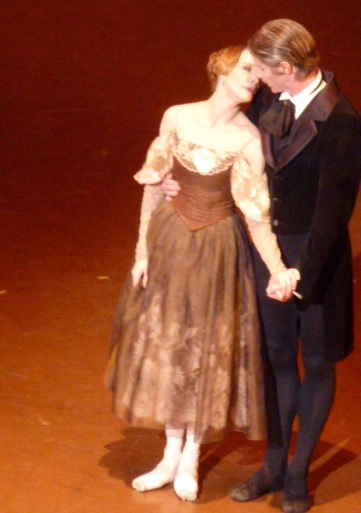
Isabelle Ciaravola and Hervé Moreau. [Farewell performance, February 28th]

Isabelle Ciaravola and Hervé Moreau. [Farewell performance, February 28th]

Commentaires fermés sur Onegin: “Oh to love so, be so loved, yet so mistaken!” [Robert Browning, Epilogue to Asolando]

Classé dans Retours de la Grande boutique

Onegin : Dirty Feet

Haydée's ShoeOnéguine, Monday, February 10th (Pagliero, Paquette, Grinsztajn).

Among the weird objects I will admit I own and cherish: one of Marcia Haydée’s ravaged pointe shoes.  Standard Freed’s, ballet size 4 ½, lined hastily with something akin to ripped Kleenex. Broken and dirty and small, it still reminds me of how each time I saw her on stage all of her came together, how she grew beyond her limits and used the body beyond that shoe to tell me a story.

Whether by calculation or instinct – but certainly to the delight of the choreographer — the creator of Cranko’s Tatiana always drew the audience into her orbit.  In any role, Haydée could seem almost demonic: fearless – especially when hurling herself heavily at partners – greedily absorbing and consuming emotions and then expulsing them out of every corner of an unconventional body. Everything she did emanated from a radiant core and this dancer never feared looking ugly or going too far if it served the narrative. Even if  you imagined her partners screaming “ice pack” as soon as they hit the wings, you rooted for her from the top of Family Circle at the Met because she somehow possessed a Callas-like shimmer that made all of us up there feel as if we were sitting only three feet away.

Haydée had a controversial dance equivalent of “vibrato.” Haydée could be scary. I am devastated that whoever owns the rights to the few recordings of her performances make most of them utterly inaccessible. (And equally enraged by all the other “Dead Choreographer Trust Babies” who systematically force erasures on UTube. The choreography keeps getting sold to companies, but why should that require washing away the footprints of prior and current generations of performers?)

Please believe me, I do not live in the world of “I was there, you were not.” Indeed, what keeps me going to the ballet is the hope of discovering new performers I can root for and new performances that will keep these old masterpieces alive and memorable.

But alas, on February 10th in Paris, I could only root for Eve Grinsztajn’s Olga. She alone seemed to have read the poem and listened to the opera. Lacking access to old video recordings I rely on my fading memories of Susanne Hanke: lustrous and poised, possessed of beautiful feet in the days before beautiful feet became standard issue, politely fighting back but gently amused by her wilder older sister.  Grinsztajn alone of this cast radiated a thirst for life, a desire to fill the air with her limbs and pearly feet and take at least a few emotional risks. This energy sadly seemed to have been drained from the other leads before the performance even began.  If it has taken me too long to write to you, it is because I came home dulled and enraged and loath to hurt the feelings of these dancers and their fans alike.

Ludmila Pagilero should have read more of what Pushkin says Tatiana read: Richardson with his sturdy damsels in distress, his villains more appealing than his heroes, his warm irony, but also his tacky exuberance.  His characters eat, they are sensual!  Pagliero’s performance broke my heart for all the wrong reasons.  For, when I finally broke down and used my binoculars from the last row atop the Palais Garnier during curtain calls, I could see that her face was filled with spent emotion.  Her face, yes, but her body had never once ripped loose. Instead her instrument had been precisely calibrated, each time doing Cranko’s triple repeats of steps exactly the same careful and studious way.  Thus nothing was ugly, but not ripe or rawly beautiful or expressively expansive either. Everything she did seemed small. We want our heroines to be…big.

I’ve found that Pagliero needs time to grow into a role onstage and fill it out.  She lets go of the classroom by the 4th time, usually. (This was her 2nd)  Unfortunately, I will not get to see her again. She’s out. Injured.  Indeed I delayed writing in anticipation of seeing her on the 25th, expecting an “aha” moment. Was she already fighting against pain on the 10th? Certainly that could entirely explain away an overly cautious attack, a reluctance to get her feet bruised by Cranko’s dangerous partnering landscape.  Thus I do I look forward to the next time she gets a chance to take a chance on Tatiana.

But perhaps Pagliero’s wan Tatiana could be also be ascribed to a major lack of chemistry with Karl Paquette’s Onegin?  He should have read more Byron… While the ballet makes the “hero” less likeable, when you read Pushkin’s original, you get how multi-layered and complicated the guy can be.  Onegin’s only real problem – even if well-read — is that he doesn’t listen to (or realize that he has) a heart when there is still time. Paquette – like Haydée, or any of Byron’s poems – can be a marvelous vector of emotion and most pleasing to spend time with, but only when he is at ease (as in this fall’s “La Dame aux camélias”).  Here he, like Pagliero, seemed too stiff from the get-go, uncomfortable in Onegin’s alien skin. Instead of getting into the story, I sat there wondering during each of this couple’s encounters “what if.”  What would Haydée’s crazy shoes have forced out of Paquette, or an encounter with the toss-around madness of Richard Cragun (or the suave and creepy confidence of Heinz Clauss) have released out of Pagliero?

If Egon Madsen – the Antony Dowell, all pure lines and tender tension, of Stuttgart back then – could have been in the audience this night, he would have picked Florian Magnenet up by the ear and hauled his sloppy Lensky back into the rehearsal room.  I am not sure which of the rehearsal directors imported from Germany actually worked with Magnenet, but I blame them all for allowing such a half-baked effort to be presented on stage to the dancer’s disadvantage.  Let’s get over the fact that he is relatively good-looking and tries to turn that fact “into “acting, Magnenet has lost his bearings. He doesn’t even know how to land from a jump or launch into an arabesque anymore without wobbling all over the place.  After his solo I wanted Onegin to shoot him.  Blessed with beautifully arched feet, apparently, even that fact has become invisible lately.  Why doesn’t he use them, and the rest of himself, to pull himself up and out of approximate performances?  He needs to shake himself up as both artist and dancer before it’s too late.

After an evening so utterly lacking in poetry, I could only think of Edward Lear’s “serve up in a clean dish, and throw the whole out of the window as fast as possible.”  These dancers should dare to get dirt on their shoes. And when they will, the story will come alive again and we will have the excuse we need to whip out the crinkled Kleenex in order to joyfully smear tear-ridden mascara all over our faces.  Ah yes, that’s it, advice from the uxorious Robert Browning: “No, when the fight begins within himself, /A man’s worth something.” [Bishop Blougram’s Apology].

2 Commentaires

Classé dans Humeurs d'abonnés, Retours de la Grande boutique

Three faces of Onegin: a plot summary

OneginAt the Palais Garnier in Paris from February 3 to March 5, 2014
Choreography by John Cranko (1967)
Music by Peter Ilyich Tchaikovsky (but not from his eponymous opera),
Orchestration by Karl-Heinz Stolze

The story is ageless: a young girl’s first love turns out to be a selfish and self-involved man who does not deserve to be loved by anyone at all. Onegin will realize the truth one day, too late for any possible happy end.

Critics at once deemed John Cranko’s decision to craft a danced version of this tale the equivalent of double-sacrilege. Alexander Puskin’s verse novel “Eugene Onegin,” (1831) is still venerated in Russia as the greatest exemplar of native language and style. Moreover, the great Tchaikovsky had adapted the tale into an opera in 1879. If at first the composer’s act of lèse-majesté made both Tolstoy and Turgenev sneer, his opera could now be considered the voice of a nation. Mutter or hum kuda, kuda, vi udalilis [Lensky’s cry of despair for golden days forever lost] upon landing, and the entire staff of the Novosibirsk airport will invite you out to dinner.

Given Pushkin’s gloriously insightful and disabused poem, Tchaikovsky’s deeply emotional lyricism…what more was left to say?

Ah, but John Cranko – South African by birth, English by dance training, and the person who make the Stuttgart Ballet in Germany world-renowned just before succumbing to  a heart attack in an airplane in 1973, age 46 – thought that translating these words and music into yet another medium could provide an incredible opportunity for his troupe of inventive dancer-actors to express themselves.

Denied permission to use any of the opera’s music, Cranko called upon the composer/orchestrator Kurt-Heinz Stolze to unearth all sorts of other lovely Tchaikovsky bits and pieces. In the process, they compiled a rich – and often less somber — score and a fully-rounded, sweeping, vocabulary of illustrative and inventive movement which both Pushkin and Tchaikovsky, I am certain, would have relished.

So, one day in the early 19th century, in a cozy country estate somewhere in Russia during the Romantic Era, the story begins….

ACT ONE: (35 minutes)

Scene 1: in the garden of a country manor

Tatiana, reading yet another Romantic novel in French, does not want to be disturbed. She’s an odd creature, not at all into the normal girly-girly things other women care about, unlike her mom 1) Madame Larina (Monsieur Larin is dead) 2) Olga, Tatiana’s sister, joyous and bubbly and silly — therefore most often cast as a blonde – or 3) the family’s faithful un-named nounou/nursemaid/baba. Tatiana’s birthday party will take place tomorrow, and she seems the least interested of all of them about what she will wear. You, irritated by the overly emphatic and tinkly music of the first scene, might share Tatiana’s dreamy remove.

The village girls, totally excited by the idea of a party, burst onstage. Sewing done, and a bygone romantic herself, Mom rekindles the folk legend that when you look into a mirror, the other face you see in the background IS your soul-mate. Lensky, a landowner and promising poet engaged to Olga, really likes this idea.

Tatiana, looking into that mirror half-heartedly and annoyed by being pulled away from her book, is startled to see the reflection of a tall, dark, and most handsome stranger, Eugene Onegin, just arrived from ultra-sophisticated Saint Petersburg with his friend Lensky. He’s the man of her dreams, who has just stepped out of a book.

From the start, however, Onegin clearly disdains Tatiana’s taste in romantic novels and quickly realizes that country-folk can prove just as dull as those who inhabit the salons of the big city. He cannot be other than polite to this little teenager who has glommed onto him, but he is boredboredbored by everything, by all of them, by life itself, and especially by all these happy locals who seem to have taken dance lessons from Zorba the Greek.

Scene 2: in Tatiana’s bedroom

Unable to sleep, Tatiana – who has learned from novels that men truly in love are too sensitive to take the first step –makes the kind of mistake that changes your life. Instead of asking her nursemaid for earthy advice, she begins to write a passionate letter to the first man she is convinced will cherish and protect the offer of her inexperienced heart and soul.

This is the “letter scene.” In Pushkin, the Tatiana actually drops rich classical Russian and writes her letter in French: the refined language of novels, of yearned-for sophistication. In Tchaikovsky’s opera, a glorious alone-on-stage aria re-translated into Russian semaphores Tatiana’s recognition of a kindred soul in Onegin. In a ballet, how? 10 minutes of watching a girl scratching quill and ink on paper in 3/4 time? 10 minutes of mime to the opera’s text? No. If twee local color had begun to get under your skin for the past twenty minutes, this is the moment when you will go, “Ohhh!” In the 19th century, the feelings of a hopelessly naive Tatiana could only find decent expression in words. Now, in dance, through the magic of mirrors, movement itself will bare her complicated – fearful and ecstatic — feelings.
Think of all those expressions we use: “I’m head over heels,” “he swept me off my feet,” “I could jump for joy.” Those are just phrases, processed by the right brain. That’s why this version of the story matters: the left-side of the brain takes over. No words, no reason, dance connects us between earth and all that heaven allows. Dance makes us rediscover the experience of pure and raw nonverbal emotion.

INTERMISSION (20 minutes)

ACT TWO: (25 minutes)

Scene 1: at Tatiana’s birthday party inside the manor house the next day

Everyone dressed up, visitors from the big city, Tatiana’s big day: what could go wrong? Everything.
Onegin unwittingly makes an ass of himself, the way you can only do when you believe you are so way cool you have no idea that you are just yet another pointless snob. He needlessly hurts the feelings of the local gentry, makes a big show of playing solitaire because that’s more entertaining than dancing with them. Bad enough.

Then Onegin makes two massive mistakes that will change his life. Imagining that he is so important in that great big world out there, he decides to “save” Tatiana from her illusions. He tears up her letter, so indiscreet and so dumb! and places the shards in her hand for burning. (In the ur-text, Onegin believes he acts out of kindness, harder to render in gesture alone, but the result of his words and actions -Tatiana’s pain – remains the same). That was in private. Tatiana, shattered, cannot resist the urge to make a fool of herself in the middle of the dance floor.

One person notices, and is pained by what he sees [but you will only catch this if the dancer in the role creates a rich persona right away]. He is Prince Gremin, a distant cousin of both, who has long admired Tatiana from afar. You get the feeling that Madame Larina had imagined this whole party around just such a match-making scheme.

Then, to drive the point home that he could have any girl in the world and that he is boredboredbored, Onegin — his second massive mistake — starts flirting with Tatiana’s sister. Olga reacts to all the rumpus in her usual girlish no-nonsense way. She cannot understand why her fiancé Lensky takes umbrage to his best friend showering attention upon her: “ But everyone knows you and I will be married for sure so just let me dance in the spotlight tonight! My darling boy, at least you chose a girl other guys actually find hot! Right?”

Prince Gremin finds this all most distasteful. Lensky finds this beyond outrageous…

Scene 2: at dawn, in a park not far from the country house

Lensky dances an aria where he reaches out — in long arabesques and deep bends — in which he seeks to take himself back to that golden past, to the fullness of life, to the one woman, to all the poetic words, he loves so much…and bids farewell to them all. For he, furious the night before, had challenged his best friend to a duel (Pushkin will be killed in a duel, too, in the pointless pursuit of saving his wife’s honor. Thus the novel’s text/the operatic aria,/this dance, each carry forward the same deeply ironic echo).

The two sisters burst into the clearing and hurl themselves upon both Onegin and Lensky, desperate to make them see reason. Listen to how the sisters’ music keeps going around in circles and cannot advance to another key, another melody. This noise reinforces how none of them can find a way out of this horrible dilemma. Only Onegin, starting to catch on to how absurd all of this is, flinches. But Lensky, bound by chivalric ideals, refuses to back down. Too full of pride, for once Onegin’s aim is true…

.
INTERMISSION (20 minutes)

ACT THREE: (30 minutes)

Scene 1: a grand ball in a Saint Petersburg palace many years later

Tatiana has married Prince Gremin, and their mutual affection forms a strong bond which all those invited to this soirée fully admire. Watch how Gremin – so uxorious he will not even need a solo to a splendid aria as in the opera — enfolds Tatiana in his arms, placing her delicately into view. Sigh along with her as she yields to this unexpectedly comforting form of mature love. This kind of love, she’d not been prepared for — or been taught to want — by all those Romantic novels back then…
A glittering, contented, and self-assured woman has replaced the awkwardly naïve country-bred teenager in braids. No one is more impressed than a hesitant Onegin, just returned from many years of travel as a kind of self-imposed exile.
In the empty ballroom, Onegin hallucinates that all the women he has seduced but never loved have come back to taunt him. Could Tatiana save him from himself after all?

Scene 2: in Tatiana’s private rooms in the palace

This time it’s Onegin who has written the passionate love letter and Tatiana who doesn’t know how to deal with it. Fidgeting with pages that seem to  burn her palms, she begs her husband (heading off on state business) to stay with her. While touched as usual, tender and tactful,  Gremin chooses duty over passion like a normal husband.
This time Onegin is not a hologram bursting out of a mirror, but a flesh and blood man who literally crawls on his hands and knees in amorous agony.  Older, wiser – he’s grown a mustache at least –seeking absolution and transcendence, Onegin imagines that she must take him back and save him from those long dark nights of the soul. He begs for the kind of love he finally understands to be real and true, even if the passion it arouses risks destroying them both.

So, if you were Tatiana, what would you do?

3 Commentaires

Classé dans Hier pour aujourd'hui, Ici Paris

Sleeping Beauty: Golden Hours on Angel Wings.

P1060221La Belle aux bois dormant by the Paris Opera Ballet: December 10th ,  21st (matinee), and 25th.

 O’ my luve’s like a red red rose:

Not at all: three casts have provided very different shades of that flower’s perfume.

PROLOGUE/CARABOSSE: Where sits our silky sullen dame,/Gathering her brows like gathering storm,/Nursing her wrath to keep it warm. [Robert Burns, “Tam o’Shanter”].

Every time I see the prologue, I can’t wait until the evilest fairy in balletdom bursts into view. Here each interpretation of Carabosse intrigued me.

On my first evening Nolwenn Daniel reminded me of the teacher who, when I met her again years later, seemed nothing like the witch who had so terrified me as a small child.  This made the role sadder: proper, strict, full of regret of having until now always played by the rules. Rather than channeling some inner diva, her sullen Carabosse seemed to beseech the court: “why do you hate me so much?”

Sabrina Mallem  banged her walking-stick loud enough to awaken even the grumpy Jean-Baptiste Lully. Anger arched through the nape of her neck.   Her Cruella must have been always driven to destroy the young and the beautiful.  When she set her minions upon the fairies, she seemed to be calling upon wolves to eat helpless puppies.  No melancholy here, pure gleaming wrath.

But, I must admit, Stéphanie Romberg gave me a witch the way I best like ‘em: haughty and full of fun inflections.  She played within the music, slowing down and accelerating her gestures at will, thus punctuating every morsel of mime.  She made “the words dripped with sarcasm” physically, silkily, palpable.

ACT I: AURORA DAWNS But to see her was to love her,/ Love but her, and love for ever. [Burns “Ae Fond Kiss”]

From the get-go, Ludmila Pagliero clearly had been dreaming of a Prince for a while now.  Perhaps Juliet’s nurse had already told her the facts of life, for she was ready, unafraid of her future as a wife. When her father presented her with the four Princes, and the way she responded to them, signaled “these guys are kind of cute! Ooh, but which one to choose?”  She attacked the Rose Adagio with flair and no fear of mistakes (she has the gift: when she “goes off,” she knows how to cover in a way most of the audience assumes are intended steps). This fearlessness translated into an unusual and refreshing take on the Second Act.  Indeed her entire interpretation worked back from Aurora’s exclamation when she is awakened: “I had a dream! Of a handsome prince! Who must be the man I love! And look! Here he is again!”  So Act Two turned into Aurora’s dream, not the Prince’s. She was checking out this umpteenth suitor and really liked what she saw.

Amandine Albisson’s more innocent Aurora seemed to exhale health and made me think she smelled of pure soap and fresh-mown grass. She incarnated the first breath of spring that knows not sorrow nor want nor winter nor desire.  She brought out the waltzing spaciousness of all the First Act music, and seemed to breathe her way through her balances and lush penchés.  The Second Act, all legato and lines, allowed her to suffuse the stage with an even more delicate and serene fragrance.  I prefer Albisson when she gets slowed down and can luxuriate in the moment and the movement.

My third cast, Myriam Ould-Braham, proved both the most experienced in the role (2004!) and the youngest at heart.  She’s managed to hold on to her fresh precision and natural expansiveness: she’s like Makarova, a tiny dancer for whom the stage always seems too small.  Her Aurora waves at her friends, adores her mother – the regal and warmly expressive Christine Peltzer — and probably not only still has a bedroom full of stuffed toys but probably live mice, hamsters, and a bunny rabbit.  She met her suitors in slight disbelief, like the young girl who suddenly feels a man’s arm about her waist at her first ball.

A small but telling detail. Each time – in many companies’ versions — I cringe when during the “Rose Adagio” Aurora, after handing her first set of roses to her mother, dumps the second clump somewhere downstage left kind of near someone’s feet. What kind of well-bred girl throws away gifts in the presence of the men who offer them?  Finally, Ould-Braham’s didn’t.  She handed them gently to mom again, but with less energy, as if she had begun to understand that her situation was serious, that this second time she got what the flowers meant but couldn’t quite pick one man quite yet.  Of course, then, this Aurora blossomed during her slow variation: she was thinking about what had just happened to her. And the way she responded to the sweet music gave us time to enjoy Ould-Braham’s natural finesse, delicate lines.

Another detail: the way each “died.”  Pagliero, utterly shocked and disbelieving, attempting to keep up the facade.  Albisson reacting as if the needle had been poisoned and striving desperately in big gulps to seek help (I look forward to a Giselle one day). Ould-Braham , whose tiny rushing steps expressed how deeply she couldn’t understand why anyone could want to hurt her. Each actress made this moment her own and I wouldn’t want to choose between them.

ACT TWO: Princes and lords are but the breath of kings, /’An honest man’s the noblest work of God” [Burns, “The Cotter’s Saturday Night”]

There’s the rub.  Princes. A bore. Not much to do except be handsome and noble and elegant and do the usual barrel turns…but is that true?  Nureyev’s version adds a bloody exhausting 8-minute solo for Desiré, where our prince keeps shifting intention, feet, direction, and energy, to one of Tchaikovsky’s most heartbreaking violin solos (originally written as an interlude, not meant to be danceable).  All tension and yearning, full of abrupt hesitations – this is where a dancer could establish a Wagnerian Siegfried-like character, bereft, in desperate need of a reason to live.  The choreography establishes that this prince…thinks. When a dancer commits to this solo, you understand why this generic prince could in fact be just the man worth waiting a hundred years for.

Pagliero’s suitor, Josua Hoffalt,  rushed through the solo with more impatience than melancholy.  Nominated  étoile a bit early, he still often seems too raw, and didn’t really seem to get the point of this pièce de résistance.  It’s up to you to bring a character alive, even if you think princes are all dimwits.  This lack of commitment translated into his dancing.  In particular, his forward energy kept getting blocked in his manèges: during one sequence in Act Three, his chainé turns into grand jetés seemed to stay rooted in place. He was no match for Pagliero’s splendid energy and aplomb.

Albisson and Florian Magnenet are matched because they are both tall, I guess, but they don’t fit together. Not only did they seem too polite and distant during the Wedding, from the first their lines and attack just didn’t align. Whereas Albisson uses her body full out all the time, Magnenet seems to fade in and out. His sleepy feet and loosely-controlled landings surprised me.  He’s handsome and well-built and he gave more energy and phrasing to the searching aspect of his big solo than Hoffalt, at least, but he really needs a coach to clean up the details. Talent does not suffice. In the ballet’s finale, the prince’s sisonnes should be at least as pretty and assured as that of Silver (Cyril Mitilan) and the Bluebird (Marc Moreau).

But, ah, Mathias Heymann.  Of the three, only he didn’t get a round of applause upon his entrance: he’s enough of a prince not to have to play the prince.  Then time stopped during his solo. He brought the line, the tension, the perfect soft landings, and clearly-delineated sweet agony inherent to the counter-intuitive changes of direction, that are there for the taking.

One of my favorite moments where Nureyev fits the action to the word occurs near the end of the dream scene. The corps de ballet, in interlaced groups of four, fold back into a long line that slices across the stage in a diagonal as the music gets more and more nervous. Suddenly, Desiré bursts into view and launches into a series of brisés/sauts de chat that fly across the ground, followed a split-second later by Aurora in travelling coupé-jetés.  What these steps should mean: our hero is promising to lead our heroine out of her limbo and she will follow him to the ends of the earth.  What it can look like: Aurora chases after her prey.  Manuel Legris knew how to make this moment count, and now with Heymann I felt a happy shiver go down my spine, as I delighted in Ould-Braham’s effervescence as she effortlessly followed his bravura lead.

ACT THREE: Go fetch to me a pint o’ wine,/An’ fill it in a silver tassle.

In Paris, we don’t get Little Red Riding Hood, alas. My favorite cast of “Gold and Silver:” Heloïse Bourdon and Pierre-Arthur Raveau, juicy and full, brought this oft dull interlude needed rigor and panache.

Despite having been promoted première danseuse, Valentine Colosante  — technically by-the-book, perfectly-proportioned yet too deliberate, a quality Anglos criticize the company for – never delighted my eye until this Florine.  Perhaps she needs a partner and François Alu’s high-flying yet earthy Bluebird finally brought out a kind of sweet personality in her dance. They both gave the audience a gloriously danced interlude.  Again, though, I wouldn’t give up having seen Charline Giezendanner (still only a soloist?!) shimmer next to Marc Moreau, or Eve Grinsztajn with Axel Ibot.  Grinsztajn, too often cast in the “sexy” roles (Manon in “La Dame aux Camelias” or the Street Dancer in “Don Q,”) reminded me of her lovely proportions, purity of line, and of the power of her unadorned classical technique.

THE CORPS DE BALLET: Green grow the rashes O;/The sweetest hours that e’er I spend/Are spent among the lasses O!

P1060340

The cast bows on December 25

And I tip my hat to Julianne Mathis, ever stuck in the corps but always buoyant and fine-tuned, who somehow still radiates joy in dancing.  I’ve always enjoyed following one dancer of the corps in his or her patterns – feels kind of like cheering on a football player – and Mathis seems to have been promoted into the incredibly vital yet thankless role of locomotive for the corps, a position Nathalie Aubin used to play to both my delight and sadness.  The corps de ballet makes enchanted kingdoms come to life.  Princes and princesses can’t live without them. Then gently scan your brother man, /Still gentler sister woman…

Commentaires fermés sur Sleeping Beauty: Golden Hours on Angel Wings.

Classé dans Retours de la Grande boutique