Archives de Catégorie: Humeurs d’abonnés

Nous avons un avis, et nous le partageons ! Avec humour si possible, avec humeur, s’il faut…

Balanchine in Paris & NYC : Can I offer you a glass of ballet?

NYCB, June 1 : Concerto Barocco, Tschaikovsky Pas de Deux, Fancy Free, Symphony in C

I was lucky enough to be in Paris a little over a week ago and had the opportunity to view some footage of the Paris Opera Ballet performing Symphony in C. Initially, I didn’t want to watch it. OK, actually the first time Cléopold tried to show it to me I think I ran away yelling about how I wanted to be surprised in New York (as I had done for Serenade). He suggested that, just maybe, studying and watching videos beforehand wouldn’t make the first performance less magical, but rather the opposite: knowing a little about what you’re seeing actually makes the performance way more fun and easier to understand. Go figure, he was right. As. Always.

What a treat! Watching the Paris Opera version made me excited to see it in New York, but what I noticed most, and actually one of the aspects that I continue to love about the Paris Opera in general, is how totally in control the dancers are. Every movement is deliberate and had a calmness or coolness about it. They never looked rushed or harried even though the piece is not what I would call serene, the music is quite fast, and the steps are very technically demanding.

This makes an excellent contrast to New York City Ballet, which I love for their energy and fire. Yes, every movement still has an intense level of precision and concentration (see: Whelan, Wendy), but the attitude behind the exact same steps is totally different. I wouldn’t call NYCB rushed, and they weren’t behind the music either, but every step felt fast and had sharpness. The dancers at NYCB have an attack that the Paris Opera does not use very often (exceptions: Forsythe, McGregor, etc). Please, please understand that I’m not saying that one is better than the other in any sense, just that they’re very different, and it’s fun to notice!

NYCB always dances with a high level of attack and energy because Balanchine wanted it that way. He even loved when people fell as it signified that they were really giving everything they had on the stage. On the other side of the pond, Paris Opera feels softer and has a lightness that I rarely see in New York. It’s like a velvety cabernet vs. a glass of champagne. Both are fantastic, but totally different.

Honestly, I could say the same thing about the companies’ respective homes. I live in New York, where everything is fast. In fact, everything happens NOW, and you’re probably late for something. “What are you waiting for, dear? Dance now! Do it now! You could get hit by a bus later!” Want to guess who said that? (It was Balanchine.) If there’s a piece that exemplifies the NYC speed, it would be Glass Pieces by Jerome Robbins (which they’re doing next spring. Oh yes, I’m excited already!). Paris, by contrast feels slower as a city. Yes, there were times when I was stressed and rushed there, but I’m trying to talk about the city’s atmosphere. How many people do you see power walking through a market? How many people run around with Starbucks cups because they need their caffeine fix right now? Some yes, but I would lay you money that they’re American students studying abroad. You feel the cities’ energy in the street, and you absolutely see it in their dancing. What a pleasure to be able to know and love both!

Next time: NYCB’s A Midsummer Night’s Dream.

Commentaires fermés sur Balanchine in Paris & NYC : Can I offer you a glass of ballet?

Classé dans Blog-trotters (Ailleurs), Humeurs d'abonnés, Voices of America

L’Histoire de Manon : le temps du bilan.

Les adieux de Clairemarie Osta ont marqué la fin des représentations de L’Histoire de Manon, ballet narratif de Kenneth MacMillan qu’on croirait fait pour Londres quand on l’y voit, et pour Paris quand on l’y admire. Le Royal Ballet y déploie son art de la pantomime, le ballet de l’Opéra de Paris lui insuffle un surcroît d’élégance. Et tous deux rendent justice au drame dansé, de l’émotion des premières étreintes à l’horreur du corps en loques.

Réminiscences et hallucinations

Les Balletonautes ont tenté de déclencher une ruée sur les librairies en revenant aux sources de l’histoire : le roman de l’abbé Prévost, qui a connu (et parfois subi) de nombreuses adaptations chorégraphiques  ou lyriques. James, qui a relu les aventures de Manon et des Grieux en pleurant, a aussi présenté les principaux personnages de l’intrigue, tandis que Cléopold a narré  la création du ballet d’Aumer en 1830. Notre intrépide ami y était-il déjà ? Il entretient le doute, et le sort le punit : une capricieuse machine à remonter le temps le projette de temps à autre dans un espace-temps indécis où, à l’ombre d’une loge à Garnier, il rencontre Poinsinet – le vrai fantôme de l’Opéra que nos lecteurs commencent à connaître. Ce dernier est imprévisible : il surgit au premier entracte de la première de la série, mais ne réapparaît qu’au second entracte de la dernière.

Pour se plonger dans un passé toujours actuel, il y a aussi  l’art du pas de deux chez MacMillan, décortiqué par Cléopold, et une vidéo de 1974, vénérable archive réunissant Antoinette Sibley et  David Wall.

Réjouissances et regrets  

Cinq couples étaient initialement programmés durant cette série ; au final, il n’y en a eu que trois et demi. Blessées, Agnès Letestu et Ludmila Pagliero n’ont pas dansé. Du coup, Isabelle Ciaravola a enchaîné les représentations, principalement avec Mathieu Ganio, et en fin de parcours avec Florian Magnenet.

Clairemarie Osta et Nicolas Le Riche, dont le partenariat est éprouvé, ont entamé et fermé la marche. La fraîcheur quasi métaphysique de la ballerine a enchanté James le soir de la première. Cléopold l’a vue moins innocente lors de la matinée des adieux.

Les prestations d’Isabelle Ciaravola et Mathieu Ganio convoquent le souvenir des créateurs du rôle – Antoinette Sibley et Anthony Dowell – et Fenella en profite pour philosopher sur les sortilèges de la beauté. Mlle Ciaravola adapte son jeu à son partenaire et épate aussi Cléopold quand elle danse avec un Florian Magnenet qui s’abandonne aux violences de la passion.

Nous n’avons pas eu l’occasion de voir Aurélie Dupont, Josua Hoffalt et Jérémie Bélingard. Mais les représentations auxquelles nous avons assisté nous ont convaincu, s’il en était encore besoin, de l’importance des seconds rôles. Fenella nous livre à ce propos de piquantes réflexions autour d’Audric Bézard, Stéphane Bullion, Aurélia Bellet et Alice Renavand.

Sans prétendre dresser un palmarès complet, quelques notations cursives. Alessio Carbone s’est montré un brillant Lescaut, aussi pervers que solaire. Nolwenn Daniel tire son épingle du jeu en maîtresse du frère corrupteur. Dans la série des G.M., Stéphane Phavorin – au premier chef – mais aussi Arnaud Dreyfus comme Éric Monin, rivalisent de morgue, de lascivité et d’expressivité. On a adoré haïr Aurélien Houette en geôlier. Tous les chefs des mendiants que l’on a vus – MM. Madin, Vigliotti, Alu – étaient grisants de légèreté.

N’oublions pas, enfin, que le sort a été bien cruel pour Christophe Duquenne. Nullement blessé, mais faute de partenaire, il a dû céder sa place en des Grieux. Ce rendez-vous manqué est sans doute un crève-cœur pour lui, et une déception pour ses admirateurs. Espérons qu’on donnera vite à ce danseur délié, enchanteur dans le Roméo de Noureev, de belles occasions de nous emballer.

Commentaires fermés sur L’Histoire de Manon : le temps du bilan.

Classé dans Humeurs d'abonnés, Retours de la Grande boutique

Manon: Afterthoughts about Second Bananas

L’Histoire de Manon

In French, the supporting role is called a spare knife – second couteau – and the dancers in these roles can sharpen the focus of the leading couple or even completely change the dramatic flow.  That’s why galas, where a relentless series of pas de deux take place in an emotional vacuum, bore me.  Spare knives carve out a much richer imaginary universe.  Bananas smell good.

Furthermore, what in opera often ends up as a simple tenor/baritone soprano/mezzo dichotomy can get nicely messed up in dance. You need years of retraining to move from Amneris’s shoes into Aida’s.  But nothing unsurmountingly physical prevents you from embodying Gamzatti one night and Nikiya the next.  Slap on costume and go out on stage.  Every second banana could be the next étoile.

Yet MacMillan’s Manon troubles the waters of this ideal.

By decreeing that Antony Dowell and David Wall alternate playing lover or brother, the troubling MacMillan surely added incestuous undertones to the sibling relationship.  [At least in La Bayadère Gamzatti does not turn out to be Solor’s sister].  Manon, torn between the two, must make us wonder whom she loves most deeply.

Mathieu Ganio’s perfect symbiosis with Ciaravola occasionally made me think of the word “twin.”         But then the pairing of Florian Magnenet/des Grieux and Audric Bezard/Lescaut brought twins to mind too, creating a different dynamic to which Ciaravola responded.  Not just because they are tall, dark and handsome (the Paris company harbors quite a few dishy men), but because both possess a similar stage presence.  They radiated youthful power and passion in equal measure, yet in a more down-to-earth manner.  A bit rough at the edges. The characters they embodied will never write their memoirs.  Ganio’s poet will.  These two belonged too much to this world, both too impulsive and inclined to live in the moment.

Audric Bézard’s Lescaut proved to be a really charmingly self-assured rascal.  You could root for him.  The way he grinned and ruffled the hair of Alistair Madin’s thieving Beggar King sent three messages out our way:  1)  cool how you’ve dunned Monsieur G.M.  2) I loved your variation that came after mine but we both know even your whirling dervishness can’t upstage me.  3) Hah, good for you!

Enter Ciaravola.  With a brother like this, could she pretend to be as other-wordly as on May 3rd?  No, only hopeful.  This brother made one imagine they’d already been orphaned for years and lived only for each other. He provided a substitute father and an appealing, if warped, mirror.  You could understand how he had used his charm and wits in order to insinuate himself into G.M.’s circle and why G.M. kind of trusted him.  Audric Bezard was everyone’s brother, loved and tolerated by all and sundry, despite his obvious desperation for easy money.

If Bezard wasn’t Prévost’s pimp, Stéphane Bullion, reacting to Ciaravola’s persona and forcing her to react to his, seemed to be one at the first performance I saw.  After the first act on May 3, quite a few people thought that Lescaut might be Manon’s domineering former lover. (I wander around evesdropping and chatting during intermissions).  They deemed Bullion’s characterization as that fierce:  possessively and jealously protective even as he sold her to the money-bags. Yet on May 13, facing Clairemarie Osta, a fraternal quality emerged in his Lescaut.

The contrasts became sharp in how Manon reacted when G.M. shot Lescaut.  In Bezard, Ciaravola lost a soul-mate; with Bullion, she only saw blood and real violence for the first time.  Osta keened over losing her brother, and used her fists the way he must have once taught her to do.

Not only do leads need second bananas, supporting actors need leads. And need each other. So now that Lescaut is dead, I’d like go back in time to talk about The Mistress, who could be Manon in the future or everything Manon is not.

Aurelia Bellet’s earthy and airy Mistress stood up to (and tried to make stand up) her giddy Bézard as we howled with laughter during the drunken pas in Act II.. These two made this off-balance parody of a MacMillan pas de deux seem just as death-defying as those of the heroes.  Cléopold referenced that early review where “if you are Antony Dowell, I must be Antoinette Sibley”…well, here we got:  “if we’ve landed up in Kenneth MacMillan, then we must be out of our minds.  You mean, we are supposed to do that? But upside down or just where, huh?”

Bellet’s Mistress could best be described as a “sweetie.”  Deeply even more unworldly and less clever then Manon, but infinitely more cheerful.  In it for having a good time, a hapless baby sister

Such momentary pleasures didn’t interest the character crafted  to the same steps by Alice Renavand.  Ice-cold when faced with Ciaravola yet firey-hot when trying to counter Osta, her Mistress reacted to one as rival and the other as potential sister-in-law.  At both performances, I enjoyed the majestically-timed accelerations and decelerations as she swept her legs up and around with elegantly-controlled aplomb.  That forceful swirling use of legs defined her character:  self-controlled, self-contained, self-sufficient.

Manon and Des Grieux collapse from exhaustion in Act III.  Each night while walking home I began to imagine an Act IV.  Renavand’s Mistress will certainly launch a putsch to take over Madame’s bordello at the Hôtel de Translyvanie and make Monsieur G.M suffer. Aurelia Bellet’s Mistress will shed hot tears over Lescaut for a long time but will end up living happily ever after with Monsieur G.M.

If second bananas can make you wonder about their fates, then they done good.

Commentaires fermés sur Manon: Afterthoughts about Second Bananas

Classé dans Humeurs d'abonnés, Retours de la Grande boutique

Retrouvailles aux adieux. (Nouvelle hallucination de Cléopold)

L’Histoire de Manon, matinée du 13 mai 2012 : Clairemarie Osta (adieux à la scène), Nicolas Le Riche, Stéphane Bullion, Alice Renavand.

Opéra Garnier, couloir des saisons vers la rotonde du glacier. Deuxième entracte…

[ ?] : « Je disais donc »

Cléopold : « AAAAAAGhhhhhhrrrr ! (suée froide). Poin – Poinsinet ! Mais d’où sortez-vous encore ? Ça ne va pas de surgir justement là, ce pauvre couloir des saisons et du zodiaque, abandonné par les bars depuis 20 ans. Même en plein jour il a l’air lugubre ! »

Poinsinet : « J’arrive par où je peux… Vous avez vu cette porte sur votre droite… Il y a ici un petit escalier …. »

Cl. (cachant son intérêt sous une apparente sévérité) : « C’est bon, c’est bon. Au fait, merci pour le lapin… Je vous ai attendu la dernière fois au deuxième entracte ! Les gens me regardaient de travers poireauter dans le couloir d’orchestre côté jardin ! »

P. (l’air matois) : « Ne sommes-nous pas au second entracte ? N’est-ce pas Clairemarie Osta et Nicolas Le Riche qui dansent ? Où est le problème ? »

Cl. (frisant nerveusement sa barbe blanche) : « Vous vous moquez de moi. C’était le 21 avril à la première, nous sommes le 13 mai, c’est la dernière et les adieux de Clairemarie Osta ! ».

P. : « Comme le temps passe vite ! Avouez quand même que c’est quelque chose, cette représentation ! Vous avez-vu, au premier acte ? Dans le chef des mendiants, le petit Alu dansait aussi bien qu’il avait l’air sale, c’est tout dire ! Quelle musicalité, quel sens de la scène !! C’est pour dire, même Bullion n’a pas cochonné sa première variation. Bon, on ne peut pas dire qu’il soit très à l’aise dans le maquignonnage… L’expressivité, ça n’est pas donné à tout le monde… But still, comme disent les Anglais. Et puis notre Phavorin, de toute façon, il en fait pour deux, voire pour trois dans GM. Vous avez vu ça, dans la scène de la chambre, ce « dirty old man », ces regards lascifs, ces mains avides. Brrrr ! Dire qu’au temps de sa splendeur technique il aurait pu être le plus ˝soupir˝ des Des Grieux ».

Cl. (succombant une fois encore au babillage spectral) : « Oui, oui… Exactement… Et puis cet acte chez Madame ! Avez-vous remarqué ? Clairemarie est moins « pure » que le soir de la première. Dans sa variation, elle ne refermait plus tant les épaules à la vue de Nicolas Le Riche, elle le charme discrètement. Le 21, on avait presque le sentiment que les deux ne s’étaient pas parlé depuis le départ de Manon pour la couche de GM. Ici, on sentait vraiment que des Grieux était l’amant de cœur caché dans le placard. Ça rendait encore plus noble son désespoir. Et puis pas mal du tout Bullion dans la scène de soulographie… Ça avait du chien. Pour le coup c’est Renavand que j’ai trouvé un peu à côté de la plaque… C’était enlevé mais…

Mais au fait… La scène chez Madame ! Vous m’aviez laissé sur ma faim la dernière fois. Alors à QUI vous fait-elle penser ? »

J.H. Fragonard, « Portrait de Melle Guimard », circa 1770, Musée du Louvre.

P. (riant) : « Vous avez de la mémoire…. Oui, bien… Où en étais-je …. Mais allons, Cléopold, vous n’avez même pas une petite idée ?? Mais à La Guimard bien sûr ! Saviez-vous que la place de l’Opéra est sise sur une partie des jardins de son somptueux hôtel particulier de la rue de la Chaussée d’Antin ? D’ailleurs, le bâtiment lui-même a été déboulonné pour construire la rue Meyerbeer. Tout un symbole (petit rire fat). Donc, figurez-vous qu’au temps de sa splendeur, lorsqu’elle était la maîtresse du maréchal de Soubise, elle s’est fait construire un petit chef-d’œuvre de maison par Ledoux. La façade était constituée d’une immense aula à caisson barrée d’un portique ionique. Le dessus du portique recevait une statue de Terpsichore. À l’intérieur ? Des peintures d’un très jeune David, mais surtout, un théâtre de 500 places ! La célèbre danseuse, l’une des premières à avoir viré du genre noble au demi-caractère, recevait trois fois par semaine : il y avait le jour pour la haute noblesse, le jour pour les artistes, les littérateurs et le jour … pour les plus grandes courtisanes de la capitale. Ces soirées-là se terminaient toujours en orgie. On dit qu’on y représentait pour l’occasion des pièces d’un osé… »

Hôtel de la Guimard, rue de la Chaussée d’Antin. Architecte Ledoux, 1781

Cl. (s’esclaffant) : « Il est clair que je ne verrai plus jamais de la même manière le lourd rideau rouge par lequel entrent et sortent les invités de Madame. Je comprends mieux le désespoir de des Grieux dans son solo si tout ce petit monde était en train de se rendre au théâtre de la Guimard.

D’ailleurs, c’était plutôt bien ce soir, en termes de jeu. Vous avez vu, Poincinet, comme mesdemoiselles Bellet et Mallem se crêpaient allégrement le chignon pour le sourire ravageur et les lignes souveraines d’Audric Bézard ? Et la petite Guérineau en prostituée travestie ; ce joli mélange entre un plié moelleux et une arabesque tendue comme un arc ?»

P. : « Et ça n’a pas toujours été le cas… Figurez-vous qu’il y a … ma fois presque 15 ans déjà, lors de la dernière reprise, je faisais semblant de manger à la cafétéria de l’Opéra… Feu la salle fumeur ! Quand je vois débouler plateau à la main… »

Cl. (avide de potins) : « QUI ? »

P. (raide comme la justice) : « Ah ne m’interrompez pas ou je m’en vais sur le champ ! »

Cl. : « Je me tais »

P. : « …Sylvie Guillem, elle-même ! Elle avise un groupe de garçons, ceux-là mêmes que j’avais vu la veille avec une autre danseuse dans le fameux passage des portés. Elle s’invite à leur table et leur dit en substance : – Bon les garçons, j’ai vu ce que vous faites. Il n’y a pas à dire vous êtes tous beaux, vous dansez tous bien … Personne ne contestera ça… Mais alors le jeu ! Mais vous n’êtes pas censés être beaux. Toi, tu es plutôt fétichiste, toi tu es narcissique. Racontez-vous une histoire les gars !

Comme c’était dit directement ! Le soir, à la représentation les gars étaient dé-chaî-nés. J’ai beaucoup ri… Melle Guillem, elle… Eh bien juste ce soir là elle était un peu trop cérébrale… Difficile d’être répétiteur et interprète dans la même journée. Ce n’est pas comme dans cette vidéo que vous avez certainement vue sur Youtube… »

Cl. (ébahi) : « Vous utilisez Youtube ? »

P. (haussant les épaules) : « Le temps n’a plus de prise sur moi, ça ne veut pas dire que je ne vis pas avec votre temps.

Bon, là, les porteurs de la Scala, ne brillent pas nécessairement par la personnalité… Mais elle ! Pensez qu’elle a sur cette vidéo… Mais non, je me tais. Sûr en tous cas qu’elle n’aurait pas excité la cruelle verve des caricaturistes anglais comme La Guimard lors de sa tournée d’adieux en 1789… Et pourtant, celle là, on la disait éternellement jeune grâce à son art du maquillage. Mais ce n’est pas tant le visage que la technique qui parle chez Melle Guillem… Et puis, ses partenaires de 1998… Je crois que la plupart d’entre eux ont atteint les rangs les plus convoités de la hiérarchie de la maison… »

C. : « Qui ? Qui ??? »

Poinsinet : « Tiens, Cléopold, voilà votre compère James qui s’approche. »

Cléopold : « Où ça ? »

Et quand je me suis retourné… Il était parti. James s’est encore moqué de moi, le bougre…

La Guimard en 1789. Caricature anglaise.

Restait le 3e acte… Mademoiselle Osta s’y est montrée encore une fois poignante. Bête fragile et effrayée sur le port de la nouvelle Orléans et enfin, dans la scène des marais, semblant tourner autour de Le Riche-des Grieux comme un papillon autour d’une lanterne, elle s’est brisée soudainement à son contact…

Quand le rideau s’est relevé, que la nuée de paillettes dorée est tombée des hauts du théâtre… Il m’a semblé que c’était des larmes de regret… Quitter la scène quand on est en pleine possession de ses moyens et qu’on a pour soi le merveilleux don de la juvénilité… Quel gâchis ! Au moins, Clairemarie n’aura-t-elle pas eu des adieux « à la Guimard ».

2 Commentaires

Classé dans Humeurs d'abonnés, Retours de la Grande boutique

Manon: « Beautiful girls »

L’Histoire de Manon on May 3, 2012

I was chatting with a charming young woman during intermission as we waited our turn at the bar.  The bartender gazed into her doe-like eyes and then seemed to need to read her smiling lips in order to understand that all she was asking for was a glass of white wine. He murmured “sept euros” (outrageous price) several times because he couldn’t see the money on the counter before him.  Then he turned to me, sloshed the rest of the bottle in a glass, pushed it over the counter and exclaimed cadeau, Madame, car c’est la fête ce soir!

Youth and beauty prove an intoxicating mix.

People behave differently towards beautiful girls.  They get stared at, fussed over, petted, and rarely hear the word “no.”   Beautiful girls begin to think that’s normal.  Beautiful girls have it easy. [This applies to beautiful boys, too.  Read Daniel Hamermesh’s recent “Beauty Pays.”  His research shows that in the US  men of equal qualifications are not equal:  over a lifetime, handsome men earn thirteen percent more than the least handsome].

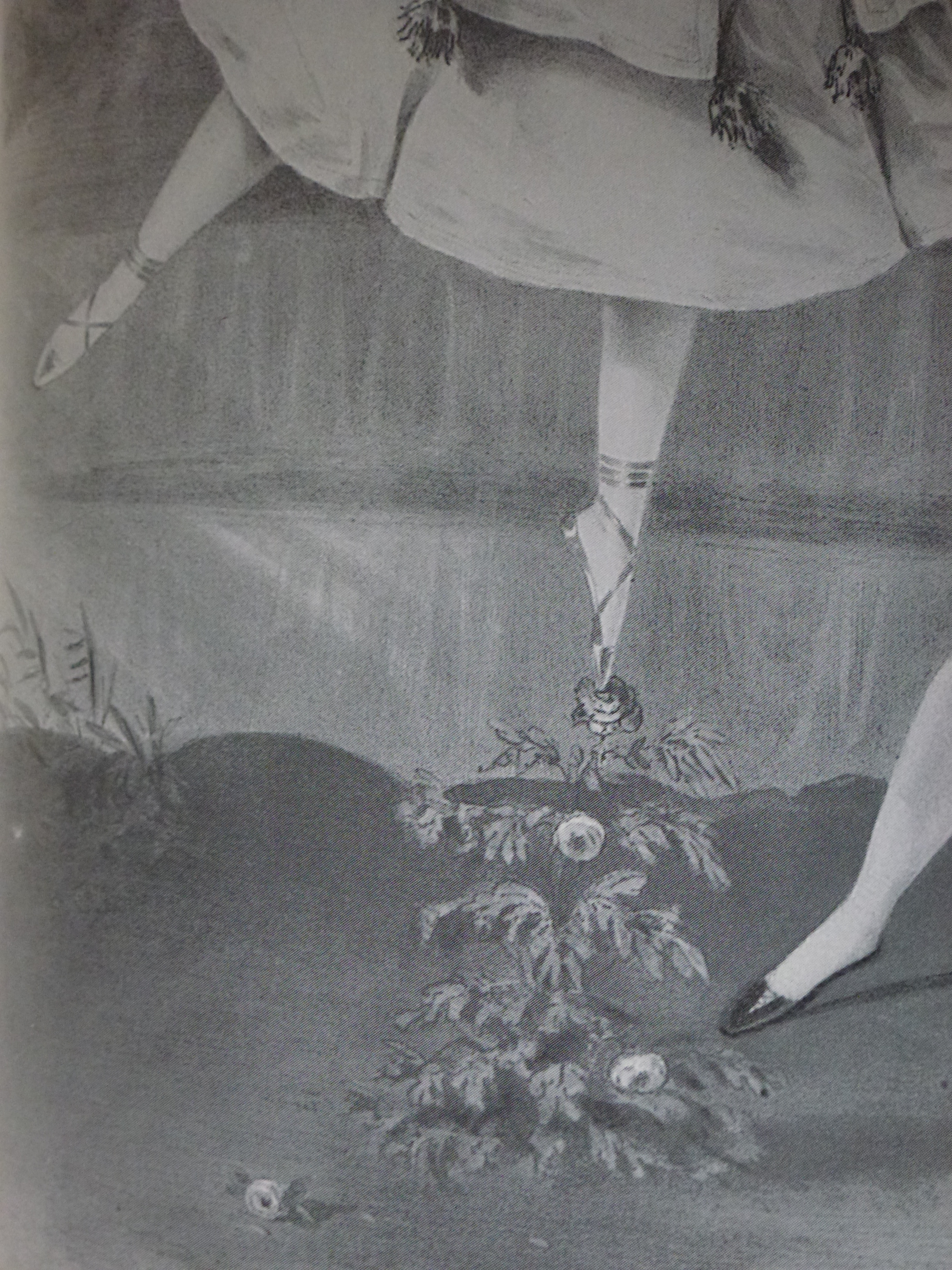
May 3rd’s Manon, Isabelle Ciaravola, is a beautiful woman. You can’t decide whether you want to lock the binoculars on the doe-like eyes in her heart-shaped face or on her tapering legs and perfectly-arched feet.  But more to the point, she is most intelligent in the way she uses that beauty to serve ballet.  You can banish the word “gymnast” when watching her legs move.  Yes, the arches would make any dancer scream with jealousy, but the way she dances through them even more.  She’s one of the few who make me regularly forget that she’s wearing pointe shoes.  As the  ballerinas in impossible Romantic lithographs (see Taglioni’s image on the left) you feel it just might be possible for her to pause, barefoot, on tippy-toe, atop a flower.  Her arms never stop furling and unfurling as she melts from one phrase into the next.  Her face glows, always alive and responsive, her eyes alight.

Ciaravola’s eyes are never brighter than when interacting with a partner.  In Mathieu Ganio she’s found her ideal counterpart.  He is just as beautiful for exactly the same reasons. When they work together their lines and alignment, their similar musicality, their  phrasing and theatrical instincts merge to make them seem like the two halves of one soul. The harmony appears so natural you actually wonder if they need to rehearse. Sibley and Dowell used to make me feel this way.

I’ve enjoyed  watching Ganio grow from the 19-year old baby étoile into a real man.  And this brings up a question.  Our culture appears to no longer simply fear growing old but even tries to avoid growing up while at the same time demanding more and more camera-ready “authenticity.” If Manon and Des Grieux are supposed to be teenagers, can any performers but teenagers be believed by a modern audience?

It’s a sad fact that actors and dancers will attest to: for most of your career your body and your interpretive skills develop, mature, or fade at wildly different rates. I am sooo tired of hearing the same old about whether a woman no longer age fifteen should be permitted to play Juliet or whatever.  But is youth all you need to project youthfulness?  Do you need to have acne, pigtails, and awkward manners?  Is being young tied to the calendar or is it a state of mind?  Ciaravola opted for the latter.

As she must know what it means to be beautiful, Ciaravola used it. Her Manon exhaled a kind of emotional virginity, a sense that life would always be fun because people are nicer to beautiful girls (and if people act weirdly around you, well that’s kind of funny too).  You could almost see the outlines of a cocoon sheltering the utter innocence of this pampered and oblivious child.  Ciaravola’s Manon, even as her love for Des Grieux continually grew and deepened along with her irresponsibility, seemed incapable of understanding that anything bad could ever happen to her.  As late as the second bedroom duet, her stubborn refusal to give up either her lover or all the pretty baubles made perfect sense.  Beautiful girls have a right to “have it all.”  This made Act III all the more heartbreaking. Manon lost her will to live when forced to face the way the world too often works: filled with ugly-hearted people who envy youth and beauty and seek to destroy it.  You must abandon that doe-eyed and childish innocent trust in others, which is perhaps the most beautiful thing of all, in order to survive in the adult world.

Commentaires fermés sur Manon: « Beautiful girls »

Classé dans Humeurs d'abonnés, Retours de la Grande boutique

Manon côté jardin (une hallucination de Cléopold)…

Gravure extraite des "Petits mystères de l'Opéra". 1844

L’autre soir, au premier entracte de la première de L’Histoire de Manon, je sortis de ma baignoire encaissée, et m’approchai de la porte de l’orchestre côté jardin. Dans le corridor pourpre qui conduit à la salle. Je fus effrayé par un caverneux « BONSOIR ! »

Cléopold : « Ahhhhrg ! … Ah mais c’est toi, Poinsinet, tu m’as fait peur, mais d’où sors tu ? Pas de l’orchestre tout de même ? »

Poinsinet (renfrogné) : «Et pourquoi pas ! Il fut un temps où je donnais rendez-vous à mes amis à côté de la stalle 85. C’était dans un autre théâtre, il est vrai.»

C (interloqué) : «C’est que tu es d’une humeur maussade ce soir… tu n’aimes pas l’interprétation d’Osta ? Je la trouve idéale !»

P : «Moi aussi, bien sûr… Très émouvant le premier pas de deux… Mais ne change pas de sujet… Il va falloir se justifier.

C : «??»

P : «Alors comme ça, on décrit la Manon d’Aumer « comme si on y avait été » et on ne cite pas ses sources… Ça manque d’élégance. TU aurais pu parler de MOI, tout de même, l’impérissable auteur « d’Ermelinde », chuté par une injuste cabale en 1767 et encore plus injustement condamné après ma mort à errer dans les couloirs de l’Opéra jusqu’à ce que j’accepte de la renier. Un malheur auquel tu dois de savoir tout ce que tu sais aujourd’hui sur la période 1830 à l’Opéra ! MOI , j’y étais!!… encore …  Et d’ailleurs j’y suis encore»[Regard vaguement halluciné].

C (barbe hirsute…) : «Bon d’accord, je n’ai pas cité mes sources mais si je l’avais fait, ce n’est pas toi que j’aurais cité. C’est Ivor Guest et son « Romantic Ballet in Paris » qui m’ont donné la substance de mon article…»

P (encore plus renfrogné) : «Ivor Guest… Hum !!… Encore un à qui j’ai tout appris et qui ne cite pas ses sources… Les Écrivaillons, les Historiens, les Musiciens… Tous des gâte-sauces ! C’est comme cet Albéric Second qui m’a ridiculisé dans « les petits mystères de l’Opéra »

C (cherchant désespérément à changer de sujet) :  « Ça évoque ton monde, cette Manon, non ? »

P : « Si on veut. Manon, c’est une histoire qui a été écrite avant que je ne sois né et la période décrite par Prévost – un homme délicieux ! – est très circonscrite. Savais-tu par exemple qu’on peut dater très précisément l’action de Manon Lescaut entre 1717 et 1721 ? »

C : « Non. Et comment ça ? »

P (un sourire fat) : « La Louisiane, mon cher ! La Louisiane… Figure-toi que la déportation là-bas des demoiselles de petite vertu n’a été appliquée qu’entre 1720 et 1721 !

Le théâtre de l’époque aurait bien convenu à l’esthétique déliquescente de Nicholas Georgiadis. On disait que le seul avantage de cette première salle du Palais royal – où Molière a joué, quand même ! -, c’était qu’elle était tellement mal éclairée qu’on ne pouvait pas voir la saleté des tentures !

À l’époque à laquelle MacMillan et Georgiadis ont situé l’action, cette période pré-révolutionnaire, on avait changé de salle. Mais dans laquelle se trouvait-on? Tout dépend. Ils ont été moins précis que Prévost dans la chronologie. La nouvelle salle du Palais royal (luxueuse celle-là !) n’a duré que jusqu’en 1781. Elle a brûlé, comme l’autre d’ailleurs.

Et puis, on avait aussi complètement changé de période chorégraphique. Noverre était passé par là. Plus de danseurs masqués et perruqués de noir ! Ce n’était presque plus Gaëtan (Vestris), c’était déjà Auguste (le fils !). C’était les débuts du ballet d’action, quoi. RIEN à voir avec ce qu’on voit ce soir, remarque… La Pantomime s’intercalait beaucoup plus avec les passages dansés. Même si les Français n’ont pas tout à fait succombé au dé – plo – rable goût des Italiens pour l’action mimée…

Tiens, cette scène chez « Madame » que nous allons voir à l’acte II, tu sais à qui elle me fait penser ?? »

C : « Euh non ? À qui ? »

DRRIIIIIIIING

P : « Plus tard mon cher, c’est la fin de l’entracte, il faut que je me faufile dans les coulisses… Rendez-vous au même endroit au deuxième ! »

To be continued…

Commentaires fermés sur Manon côté jardin (une hallucination de Cléopold)…

Classé dans Hier pour aujourd'hui, Humeurs d'abonnés

David Hallberg is Going to Make Me Homeless

The challenge: Go to the ballet approximately once per week while simultaneously never missing a ballet class (no Tuesdays or Thursdays) and working around travel plans. As a quick explanation for those of you in Paris who haven’t bought ballet tickets in New York, the process is slightly different. Here, instead of tickets coming out a few weeks before each production, every ticket for the entire season goes on sale at the same time. This results in poverty for about a month and internal battles about exactly how much ballet I can see.

What follows is a transcription of me fighting with myself over which tickets to buy. For reading purposes, the irrational side of my brain will be abbreviated to IB, and the (slightly) more reasonable side will be RB. I hope you’re entertained by my burgeoning schizophrenia.

The scene: Sitting at my work computer, currently with a single brain. The calendar for the NYCB season opens and my brain is immediately torn in half. The ballet battle begins.

Irrational Brain: Serenade and Firebird on the same night?! Buy every single ticket! NOW!

Rational Brain: Um, yes, that would be lovely, but don’t you want to see, you know, other things too? Also, I know you tend to get carried away here, but please remember you have to pay rent and buy food at some point.

IB: (sigh) Fine… two of them? Please? One includes Kammermusik No. 2 and the other has DGV: Danse a Grande Vitesse, neither of which you’ve seen so it’s totally justifiable, right?

RB: Done and done.

IB: Wait a second… by other things you don’t mean that I should go to the new Martins and Millepied night out of sheer obligation to the idea of “newness” do you?

RB: It would be a learning experience, and you need to push yourself more! Come on, what have those two choreographers ever done to make you actively avoid them?

IB: Ocean’s Kingdom and Black Swan respectively. Absolutely not. Veto declared. You can’t make me!

RB: Fine, be that way. What about Symphony in C? You’ve always wanted to see that, and June 1 has Concerto Barocco, Tschaikovsky Pas de Deux plus Fancy Free.

IB: Deal… What about A Midsummer Night’s Dream?

RB: Yes, but only one. You still have ABT and Paris Opera Ballet to buy.

IB: (sulks for a bit while looking up the ABT schedule and then…) Mother of everything sacred, David Hallberg is doing Apollo!

RB and IB simultaneously: Forget food, buy that ticket immediately!

RB: Hmm that night Osipova is doing Ratmansky’s new Firebird… that could be interesting. It would make a nice contrast to Balanchine’s. Let’s see… what else?

IB: Bayadere? That one’s beautiful!

RB: Correction, Nureyev’s is beautiful in Paris. You literally fell asleep last time you saw it at ABT. Also do you really want to see ABT’s corps de ballet as the Shades?

IB: Fine, but you don’t get to bring up the corps every time.

RB: If they could stand in a straight line I wouldn’t have to. Onegin?

IB: YES! With Julie Kent? Oh… she’s partnering Bolle.

RB: Hmm you know, that could be good. A man with this photo as his Twitter profile could probably pull off “pompous jerk” really well. Also, Kent makes everything magical, and you’ve never seen it.

IB: Done. Let’s see…obviously Steifel’s retirement in Corsaire. That’s just a given. What about Romeo and Juliet? Oh! Hallberg’s dancing… Why can’t he partner someone other than Osipova? Just for a change.

RB: Not everyone will partner Julie Kent. Get over it. Also, you thought Osipova was charming in Coppelia and actively wondered if she could pull off a young, dramatic role like Juliet; she could be fantastic! And you get to see Hallberg again, so stop complaining.

IB: Angel Corella is retiring! He’s dancing Swan Lake with Herrera… is that worth it?

RB: Yes, yes, it is. I wonder what ABT is going to do about its lack of male dancers? Oh, look! They’re giving Simkin a Swan Lake, and Hammoudi has one too! Too bad they’re on Wednesdays at 2:00. That could have been interesting.

IB: Ugh, can’t I just skip work those days? I want to see!

RB: No. Moving on. Paris Opera, what to see?

IB: Um, all of them, obviously. Is that seriously even a question?

RB: Yeah, that’s not really up for debate, is it? I think we’re done here!

IB: I think so! Alright, so it looks like we have:

May 2nd: NYCB Serenade, Tschaikovsky Pas de Deux, Kammermusik No. 2, Firebird

May 4th: NYCB Serenade, DGV: Danse a Grande Vitesse, Firebird

June 1: NYCB Concerto Barocco, Tschaikovsky Pas de Deux, Fancy Free, Symphony in C

June 6: NYCB A Midsummer Night’s Dream

June 8: ABT Onegin (Kent, Bolle)

June 11: ABT Apollo, Firebird, Thirteen Diversions (Hallberg, Osipova, Company)

June 18: ABT Romeo and Juliet (Hallberg, Osipova)

June 28: ABT Swan Lake (Corella, Hererra)

July 7: ABT Le Corsaire (Steifel, Murphy)

July 11: POB French Masters (Company)

July 18: POB Giselle (Gilbert, Hoffalt)

July 20: POB Orpheus and Eurydice (Gillot, Bullion)

Are we good? Does that cover it? Should I buy more? I feel like I should probably buy more.

RB: Did…did you just trick me into spending the rent and food money again? How do you do this EVERY season?!

IB: It’s a God-given talent. Or crippling financial addiction. Take your pick.

Weeks later…

Cleopold, being the wonderful person/editor that he is, suggested that it would benefit this little article to add links to the three ballet calendars I referenced (which I did). However, in adding said calendars, it was necessary to actually look at them, which led to the following….

RB: OK, just looking for the link, just going to highlight the link and put it in the article. Don’t even think about looking-

IB: There is a Cojocaru/Kobborg Romeo and Juliet on a non-ballet class day that you didn’t even consider last time! What is wrong with you?! That’s mandatory viewing, especially after Cleopold and Fenella loved it so much! How could you not want to see Cojocaru die smiling?

RB: No. You already spent all your ballet money! Don’t you click that link, don’t you dare-

IB: But look, Hallberg is doing Swan Lake! You know you have to see that!

RB: Yeah, with Semionova! Do you even remember how bored you were last year? You saw her running off stage after she killed herself!

IB: Don’t care! Hallberg. As. Siegfried.

RB: No no no no no no

IB: (buys tickets)

RB: …You do realize that now you’re not allowed to buy wine for the next two weeks.

IB: Worth it.

6 Commentaires

Classé dans Blog-trotters (Ailleurs), Humeurs d'abonnés, Voices of America

On Ballet and Pop Culture Part III: The Eleventh Commandment: Thou Shalt Not Bore The Audience

The ballet season after BS premiered, NYCB and ABT both pricked up their ears and decided it would be an opportune time to perform Swan Lake. They were right, and actually there were sold out performances. Obviously, this is a short-term solution. Natalie Portman is NYCB’s honorary spring gala chair this season and so far the reaction I’ve heard can be summed up as “eh.” This brings us to the big question: can ballet companies take this upswing in interest and translate it into new ballet converts before everyone stops caring? If so, how?

On March 22 The Royal Ballet did something absolutely brilliant: they live streamed their entire day of rehearsals. They also included interviews with dancers, musicians, the artistic director and costume/scenery archivists as well as archived rehearsal videos. The interviewers even asked questions from people watching from Facebook and Twitter. THAT is how you advertise. I didn’t care too terribly much about the Royal Ballet until that day. Sure I knew who Cojocaru and Kobborg were (again, guest stars), and Marianela Nunez, of course, but beyond that… not a thing. Now I consider myself a fan. I watched all day, and it was fascinating. Yes, I had to do work at this thing I call my “job” where I get “paid” so I can, you know, live, but the RB was in my ear all day long, even if I was forced to use the computer screen to do other things. I saw rehearsals for Alice in Wonderland, Polyphonia, a new Liam Scarlett ballet, Sweet Violets, as well as Pagoda and Romeo and Juliet. (Now I really want to play with swords.) After seeing the Alice rehearsal I immediately bought the DVD on Amazon and am so excited to watch it. As an aside, it’s been like two weeks. Where the heck is my DVD, Amazon?! The day concluded with an exclusive look at a rehearsal of Wayne McGregor’s new collaboration with musician Mark Ronson, Carbon Life, followed by a Q&A session. The lesson that should be taken away from all this? The program made me sincerely care about this company. And there it is: the key to my generation’s collective heart is, apparently, access. In a world of Facebook and Twitter, the idea that ballet is a world unto itself simply can’t fly anymore. On one hand, this makes me a bit sad. I love the mystical aspect of ballet, the idea that dancers are just so far removed from this world that they could never be touched by something as mundane as YouTube is beautiful, romantic and sad (Sylphide anyone?). But I have to say, Ashley Bouder posting her backstage Instagram pics on Facebook and laughing about her falls on Twitter makes me care more about her; it makes me want to buy tickets to see her, and more tellingly I have. Programs like this make ballet accessible to the unwashed, unlearned (aka uninitiated) masses. They make it far less scary, and they make what seemed to be a boring leisure activity reserved only for rich snobs, absolutely enthralling. THIS WORKS. I want to see almost everything they rehearsed, I want to follow them avidly, and I really hope they tour here so I can see them in person. I would even consider taking a side trip to London if I could get tickets.

That said, let’s talk about attempts to appeal to a new and younger audience that do not work. All of them can be summed up in a single word: pandering. Let’s begin with a general example. You’re a painter and you really want people to look at, appreciate and buy your paintings because hey, it’s art but you still need money to survive. Do you A) explain to people why you paint the way you do, what it means to you, and a bit about your technique or B) start to paint pictures of bunnies because, really, who doesn’t love bunnies? The answer is A, right? So why, why in God’s name would any company try to sell a ballet based on anything other than the quality of the ballet itself? I’m going to start with McGregor’s new piece, since I just finished watching that rehearsal. Now, since I haven’t seen it, I can’t say if it’s good or bad, it may even be great! However, most of the marketing surrounding Carbon Life has been about the costumes and music, so I feel pretty justified in saying that I do not care, at all, that the costumes were designed by Gareth Pugh. Sorry. I also don’t care that Mark Ronson did the music. Since they’ re trying so very hard to be young and cool by using a punk designer and popular music, the audience might initially be large and maybe even made up exclusively of 20 year olds; I don’t know what’s going to happen. What I do know is if the piece is bad overall, no ungodly fashion budget will save it. None. Because here’s the flip side to this social media thing: if something is bad, everyone will know in a matter of seconds. Personally, I don’t want to see this ballet. The choreography looked like everything McGregor has already done (and everything that Forsythe did before that).

Another great example of really obvious pandering is NYCB’s recent flop Ocean’s Kingdom. Music was by Sir Paul McCartney (they got a freakin’ Beatle!) with costumes by Stella McCartney. Choreography was by Peter Martins, of course, but somehow no one cared about that part. To very quickly sum up: the music was obvious, the costumes were cracked out, and the choreography was utterly forgettable. I wrote a review if you’re interested which you can see here, but really, all you have to do is watch this and you’ll have an idea (fair warning, I will use literally any excuse to show that clip because it makes me laugh so hard I cry… I am apparently 5 years old. However, it really does work here if you check out Daniel Ulbricht’s outfit ).

To be clear, I’m not against costumes, and I don’t think that every ballet should be danced in a black leotard and pink tights. If I thought for a second that I could get away with it, I would wear a tutu to go grocery shopping, or more accurately, just never take it off. I spent weeks looking for Sylvia’s dress for a special event (still looking, if you find it please message me. I will love you forever). When costumes (and music and setting) actually enhance the ballet and not distract from it, those extra details can make a production go from good to absolutely magical. Take the Paris Opera Ballet’s recent production of La Source: Jean Guillaume Bart’s choreography was riveting on its own, but when you add Christian Lacroix’s costumes and the set design… just wow. Every aspect of the ballet, choreography, music, costumes and scenery merged beautifully to create the finished product. You don’t even have to stick with tutus! Look at John Neumeier’s version of Sylvia: You can dress your nymphs in leather vests and helmets and put your goddess in a tuxedo; it gets the point across without being flashy and the dancers can move. Costumes are important and ideally help tell the story and set the mood, but they should never be the point. We have fashion shows for that.

So finally, here’s what I think needs to happen if we want to keep this ballet wave going: education. If we can show why ballet merits attention, I honestly think people will go and appreciate it, but once there’s an audience there has to be great ballet to watch. Essentially: explain why ballet is awesome and then prove it.

2 Commentaires

Classé dans Blog-trotters (Ailleurs), Humeurs d'abonnés, Voices of America

La Bayadère : le temps du bilan.

La saison des « Bayadères 2012 » à l’Opéra de Paris s’est achevée pour les Balletonautes et voici venu le temps des récapitulatifs et des bilans.

RECAPITULATIF

Cléopold nous a préparé à cette reprise en publiant une série d’articles sur l’histoire de l’œuvre du lointain XIXe siècle à l’arrivée du ballet au répertoire de l’Opéra en 1992. Il a tout d’abord abordé la production d’Ezio Frigerio et Franca Squarciapino et son adéquation avec l’orientalisme romantique du XIXe siècle. Il a ensuite évoqué les interprètes du rôle de Nikiya qui avaient travaillé avec le chorégraphe, de la création en 1877 à l’orée du XXe siècle. Enfin, il s’est penché sur l’arrivée de la Bayadère au répertoire de l’Opéra à travers ses réminiscences des saisons 1992-1993. Le trio des créateurs (Isabelle Guérin- Laurent Hilaire – Elisabeth Platel) se taille la part du lion, mais les autres interprètes de cette époque ne sont pas oubliés. Dans le même temps, Fenella nous a gratifié d’un très amusant « plot summary » (argument) pour qui ne connaissait pas encore l’histoire de la malheureuse danseuse sacrée.

Est venu ensuite le temps des compte-rendus de spectacles. La soirée d’ouverture, le 7 mars, a vu la nomination de Josua Hoffalt au titre d’étoile aux côtés d’Aurélie Dupont et de Dorothée Gilbert. Nous y étions. Cette même distribution aurait du re-danser le 22 pour une retransmission en direct sur les écrans de cinéma. Hélas, Dorothée Gilbert n’était pas de la partie. Elle a été remplacée au pied levé par Ludmila Pagliero, récompensée à son tour par le titre suprême. James était dans la salle… Prompt rétablissement à mademoiselle Gilbert que Cléopold avait eu la chance de voir encore le 19 mars en Gamzatti aux côtés d’Emilie Cozette et Florian Magnenet (remplaçant de Karl Paquette). Les Balletonautes auront vu enfin deux fois danser Myriam Ould-Braham, le soir de sa première, le 28 mars, puis le 11 avril. Cléopold a versé dans le lyrisme échevelé et James a vainement tenté de garder la tête froide pour rendre justice à son Solor (Magnenet) et à sa Gamzatti de dernière minute, la vaillante Charline Giezendanner.

BILAN?

Un mélange de grandes satisfactions mais aussi d’interrogations, voire de préoccupations. Une bonne nouvelle? Le corps de ballet brille encore de mille feux. La descente des Ombres à l’acte III, les Djampo de l’Acte I ou les demoiselles aux perroquets de l’acte des fiançailles sont réglées avec un mélange de rigueur et d’aisance souple qui fait plaisir à voir. Nous avons eu de truculents fakirs et d’élégants kshatriyas.

Un nuage? Plusieurs, et ce ne sont pas des cirrus…

  • Comment la direction de l’Opéra a-t-elle pu imaginer qu’une grosse machine telle que la Bayadère pourrait tenir avec trois distributions maison et la présence d’une invitée (Svetlana Zakharova)? Les blessures se sont enchaînées et ont bouleversé les répétitions. Les trios vus sur scène étaient donc souvent improvisés. Trop de solistes ont dû prendre le train en marche et l’ont payé d’un prix exorbitant (Mathilde Froustey, très attendue sur Gamzatti, a dû abandonner au moins deux de ses dates prévues après avoir remplacé Dorothée Gilbert). « Appartement » de Mats Ek nécessitait-il cette pluie d’étoiles qui a privé un pilier du répertoire de nombre de ses meilleurs solistes? « L’histoire de Manon » bénéficie de cinq distributions. Pourquoi Bayadère n’en avait-elle que trois?
  • La direction de la danse semble persister et signer dans son goût des danseuses solides et terriennes. Ludmila Pagliero, très à l’aise dans Paquita, semble moins à sa place dans un répertoire plus aérien. Héloïse Bourdon a écopé à vingt ans d’un rôle jadis très convoité parmi les solistes de la compagnie. Pourtant, ses prestations dans la première ombre au troisième acte ainsi que dans la danse indienne dégageaient une pénible impression de pesanteur. Cette pesanteur dont semblait enfin s’affranchir -après combien d’années d’étoilat?- Emilie Cozette, une autre promue de la direction Lefèvre.
  • Dernier point, et non des moindres, la question des tours en l’air chez les solistes masculins de la compagnie. Josua Hoffalt, Solor plein de charisme, a dû renoncer au fameux manège de doubles assemblés du troisième acte après plusieurs essais infructueux (y compris le soir de sa nomination) tandis que Florian Magnenet l’a vaillamment tenté lors des trois soirées où nous l’avons vu, sans jamais le dominer.

Il ne reste plus qu’à espérer qu’un vent de mousson viendra nettoyer le ciel de tous ces vilains nuages et restaurer dans toute sa splendeur « La Bayadère », loin de toute cette grisaille inopportune. Une reprise. Vite!

8 Commentaires

Classé dans Humeurs d'abonnés, Retours de la Grande boutique

On Ballet and Pop Culture Part II: Occupy the Ballet, We Are the 2.5% (No, really, please buy a ticket)

The spike we explored in the last post comes at a very convenient time for ballet companies. The US is still in a recession which means fewer people are willing to shell out the cash to spend an evening watching ballet and even less willing to donate hard earned money that could be going towards things like rent and food. Less money coming in means that ballet companies, which are overwhelmingly dependent upon donations from their audiences to function, are desperately trying to increase their fan base. To make matters even more difficult, they need to increase their fan base among the young. According to The National Endowment for the Arts’ Arts 2008 Audience Participation Report, “Performing arts attendees are increasingly older than the average U.S. adult.  Since 1982 [when the study began], young adult (18–24-year-old) attendance rates have declined significantly for jazz, classical music, ballet, and non-musical plays “(NEA 5).  To be specific, in 2008 only 2.5% of young adults attended the ballet (down 36% from 1982, when 3.5% of adults in that category attended. EEK!)

This report is from 2008; BS premiered in 2010 and was nominated for 5 Oscars and started the pop culture spike we’ve just talked about. Compare this to The Turning Point, which came out in 1977 and earned 11 Oscars nominations. The age of the average ballet patron in 1977? 33  (NEA 17). To be fair, that number is well within the median age of the American population at the time, so it’s not as if The Turning Point actually caused a huge upswing in ballet attendance; the patrons were already there. The movie was a reaction to ballet’s existing popularity, but what made people pay attention in the first place? Russians.

In 1961 Rudolph Nureyev defected from the Soviet Union and made the world start paying attention. His partnership with Margot Fonteyn is legendary, but I’m not going to go into Nureyev’s dance career (you know it, and if you don’t, here), this is just a very quick sum up of his presence in pop culture. When he wasn’t busy dancing, he was known to socialize with Gore Vidal, Freddie Mercury, Mick Jagger, Liza Minnelli and Andy Warhol among others. In 1971, Nureyev appeared on episode 213 of The Muppet Show. Up to this point, the show had struggled to attract celebrity guests but after the success of Swine Lake among other sketches the show’s popularity skyrocketed. He also starred in the 1972 documentary I Am a Dancer.  It’s fair to think of Nureyev as ballet’s reigning bad boy of the era. So at this point (early 70s), the public at large is pretty interested in ballet, making the atmosphere ripe for another ballet phenomenon. With impeccable timing, Mikhail Baryshnikov defected from the USSR on June 29, 1974 while on tour in Canada.  After a brief stint with The Royal Winnipeg Ballet, he moved to ABT and was a principal dancer there until 1978 when he hopped across the plaza to NYCB. Box office sales soared, and his performances were consistently sold out.  Public fascination with Baryshnikov is well documented. On May 19, 1975 he was on the cover of Time Magazine, which dubbed him “Ballet’s new idol.” He parlayed this success into movies with The Turning Point (1977), White Nights (1985), and Dancers (1987) among others. Audiences that had never cared about ballet before suddenly wanted to see the star, and all they had to do was spend $30 on a ballet ticket.

Hoping against hope that imported guest stars would continue to sell tickets when their own seem to flop, companies like American Ballet Theatre currently rely on a rotating panel of who’s who in the ballet world: Ivan Vasiliev and Natalia Osipova (Bolshoi, now both with the Mikhailovsky), Johan Kobborg and Alina Cojocaru (Royal), and Polina Semionova (Berlin) were all guest stars at ABT last year, and all of them are returning this season. While this does attract patrons and I certainly love the idea of sharing dancers and international collaboration (Kings of the Dance, YES!), the system does absolutely nothing to get new audience members into the theater, and it damages the company in the long run by not supporting and promoting its own company members. Unless companies like ABT want to become totally dependent on foreign imports, they need to start nurturing the talent at home.

So if all you need to create a ballet mania are ballet stars and movies, why didn’t we have a surge in the early 2000’s when Center Stage and Save The Last Dance came out? Well for one, Baryshnikov and Nureyev were already celebrities in the ballet world thanks to their very public defections from the USSR. The movies, articles and TV appearances added to their fame, which in turn added to ballet’s general popularity, but simply making a movie about ballet isn’t necessarily going jump start a specific dancer’s career. Look at Amanda Schull: poor Jody Sawyer is doing McDonald’s commercials now! Sasha Radetsky is still stuck as a soloist at ABT (a crime against ballet) and Ethan Steifel is mostly known because he just accepted the artistic director position at the Royal New Zealand Ballet, and those who don’t know that fact still think of him as Cooper Nielson. What those movies did cause is an upswing in dance movies like Save the Last Dance 2, Step Up, (and its three sequels) and, of course, a parody of all the ballet meets hip-hop movies, Dance Flick. The genre even got a mention on Family Guy (sorry for the terrible video quality on that one, but YouTube was not cooperating). So how could Black Swan avoid that trap and cause all this brouhaha? Well, Black Swan was critically acclaimed, had excellent actors, and a much hyped lesbian scene that convinced even guys who hated the very idea of a ballet movie to give it a chance. Center Stage, if we’re being honest, was a pretty cheesy movie (with some admittedly great one-liners).

Here’s why I think I’m right about all this: David Hallberg. If you watched that interview with Stephen Colbert that I posted earlier (and you really really should), then you know that Hallberg is the probably the biggest ballet star since Baryshnikov. He’s the first EVER westerner to be invited to join the Bolshoi, and having seen his performance as Rothbart in ABT’s Swan Lake, I can assure you that he is simply magnificent to behold. My jaw dropped. Literally. That combination of talent and work does exist in the US; all we need to do is support it. So really, please, go buy a ticket for the ballet this season and drag your friends along for the ride. You won’t be sorry!

Next time: Great, so now what do we do?

Commentaires fermés sur On Ballet and Pop Culture Part II: Occupy the Ballet, We Are the 2.5% (No, really, please buy a ticket)

Classé dans Blog-trotters (Ailleurs), Humeurs d'abonnés, Voices of America