Archives de Tag: Bluenn Batistoni

« Racines » at the Paris Opera : How to Cook Roots

George Balanchine’s Theme and Variations, Mthuthuzeli November’s Rhapsodies, Christopher Wheeldon’s Corybantic Games.

October 17th and 18th, 2025, at the Opéra Bastille in Paris.

This new season the triple bills are advertised under teaser catch-all titles that make no sense whatsoever. The one I’ve seen twice in a row is entitled “Racines” [aka “Roots”]. Now, as far as the Paris Opera Ballet goes, what do Balanchine, November (a newcomer), and Wheeldon have to do with our “roots?” Tchaikovsky, Gershwin, Bernstein? Well, if you are an American, the latter two just might work as far as your roots go.

I walked in — and alas left — the Opera Bastille both evenings still unable to find the answer.  Came home rooted around the refrigerator, in search of comfort and inspiration. I know this sounds like what am I about to write will be pretty gnarly, but please bear with me.

Once I’m done, I’m going to finally look at the essays in the program book and see if that adds some enlightenment.

*

 *                                  *
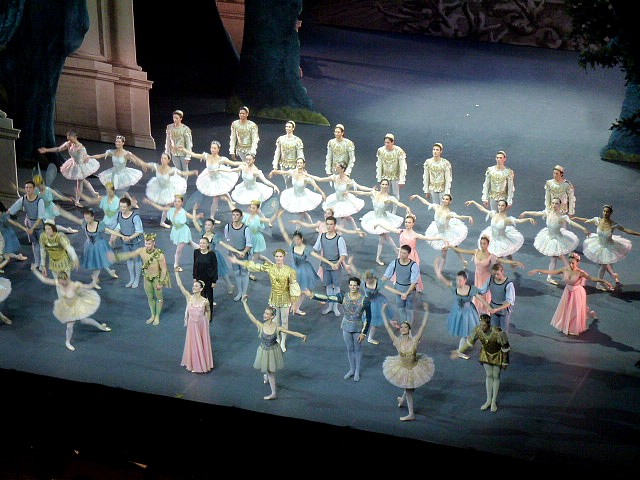
Theme & Variations.

Zucchini Blossoms/ George Balanchine’s Theme and Variations (1947)

Have you ever planted zucchini in your garden? It just never stops sneakily extending its roots in all directions. By the end of the season you just cannot even look at even one more piece of your neighbor’s redundant zucchini bread. That’s Sleeping Beauty, tasty, but two long runs of it last season turned out to be more than filling.

Zucchini blossoms offer a delicate synecdoche for all that raw bounty. They are, in a sense, all the flavor concentrated into one juicy fried mouthful. Maybe this is one way to define how Theme and Variations distills Sleeping Beauty: the essence is there, minus the endless fairies.

Unfortunately, there are as many opinions out there about THE “authentic” way to dance Balanchine technique as there are recipes that do, or do not, include nutmeg. Ben Huys of THE Trusts (both Balanchine and Robbins!) was the invited coach. This ballet, despite its surprising construction – the ballerina barely gets to breathe during the first half and then mostly polonaises around for the rest – always turns out to be very tasty.

So let’s just enjoy the show and take a look at the dancers.

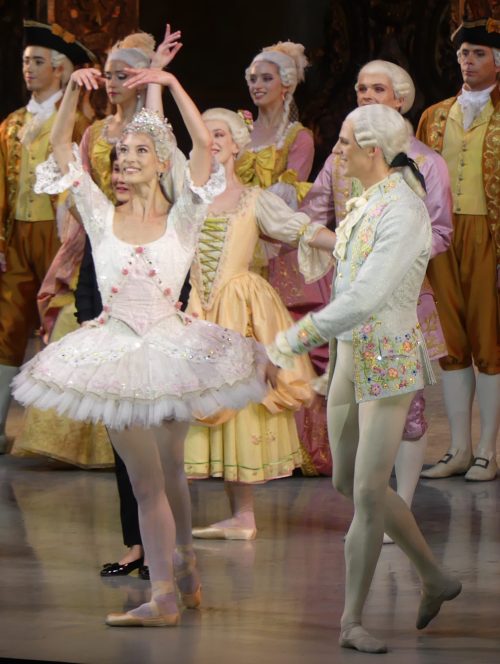
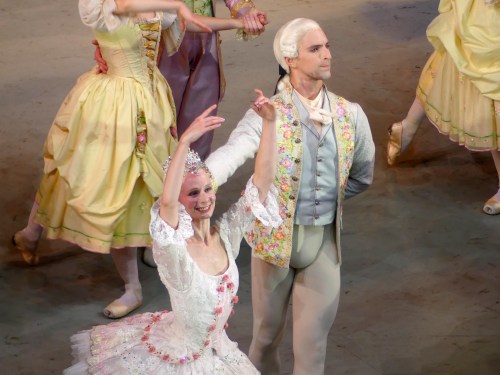
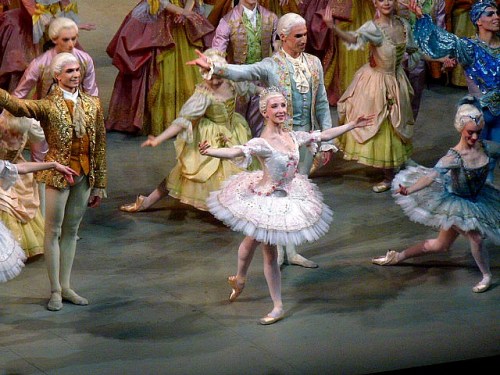
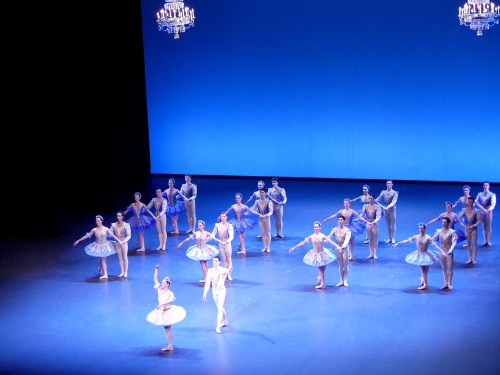
On October 17th, from the initial danced statement of the theme up to their deeply elegant réverances, both Bleuenn Battistoni and Thomas Docquir were still clearly inside their heads as Aurora and Désiré from last spring. And they continued to be that way, all the way through.  But, as the last time, there was just 1% missing. A dash of pepper. Battistoni reiterated the unemphatic grace of her first act Aurora: all about just the right uplift and épaulements and un-showy but oh-so centered rock-solid balances. But this performance could also use just one more pinch of spice.  Docquir, as he did last spring, concentrated on making his steps and jumps and batterie as scholastically perfect as possible. His performance wasn’t radiant. In princely roles, he seems to be fighting imposter syndrome. He rushed the music in partnering at times.

Honestly, this Theme was lovely, courtly, polished. The soft and precise landings into every pose at the end of a sequence literally pulled the audience in. I noticed that my neighbor kept leaning forward towards the stage each time, as if she had been swept up into 18th century courtesies, impelled to bow in return.
October 17th 2025. Bleuenn Battistoni & Thomas Docquir. Theme & Variations.

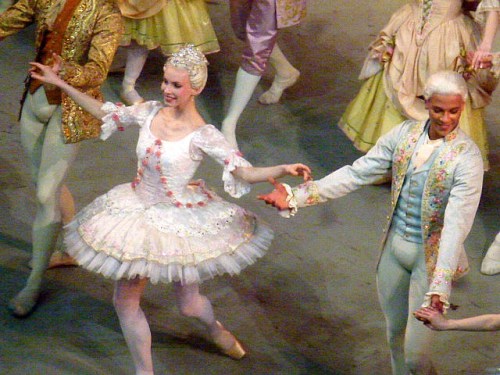
With Valentine Colasante and Paul Marque on October 18th, Theme felt looser and more fun. It was Beauty, but Act 3. Colasante luxuriated into the movements and teeny-weeny stretch-the-movement-out just enough beyond the axis to make a swish-swish seem new.  She danced big, fearlessly, and playfully dared to hover a microsecond too long. Both dancers caressed the air and the floor.  And there was something intriguing about the way Marque partnered: he seemed to catch her before the lifts, rather than on the way down, if that makes sense.

After the ballet, I thought about this very French concept of “la belle presentation.” Have you ever looked into a shop window in Paris where all the foodstuffs – from succulent to basic — are beautifully organized? Even bouquets of radishes are carefully placed in delicate patterns. Theme and Variations definitely suits our sense of l’art de vivre.

On both nights, I overheard complaints about the tiny corps on occasion not getting to their places and not lining up properly. Yes, yes, I did see it: one of the four girl soloists, and then especially when the male corps showed up. It’s not worth it to name names, as we have Giselle and a tour going on and are spread thin. Quite a few in the tutus and tights were newish to the stage. I find this critique particularly funny as Paris Opera Ballet is often accused of being too perfect from top to bottom.

As Balanchine would say, “who cares?”

*

 *                                  *

Rhapsodies. Magda Willi for Mthuthuzell November’s Rhapsodies.

Fennel and Endive /Mthuthuzeli November’s Rhapsodies (2024)

Who knows what to do with fennel or endives? Braise? Slice down in some direction and drench in lemon? No matter what, you have no answers. Maybe they just aren’t meant to be cooked.

Maybe Gershwin’s Rhapsody in Blue – by a composer who wrote pop music but wanted to be taken seriously – just isn’t meant to be used for a ballet?

Other choreographers have taken it on. In Paris, Odile Duboc did in 1999. It was insipid and has long gone into the dustbin.

Mthuthuzeli November’s take on the music has a lot more going for it. Or does it?

A clever set that leaves you puzzled, to start with.  The outlines of wooden door frames are highlighted by led lights. The frames are attached to each other and can be pulled out like accordions and wheeled around or reshaped into one square outline as clouds of dried ice float by. I thought of Olafur Eliasson’s “Inside the Horizon,” that unfolding series of slivered reflections at the Louis Vuitton Foundation. I began to recall the many times Jean Cocteau made characters walk through mirrors in his films. My seatmate – after we made a pact that we would both not put our noses into the program beforehand – concentrated hard and said she saw people trying to step away from their cellphones. A French friend had seen French windows.

So the set gets you from the get-go, even if your mind drifts back to how many choreographers have used moving sets to incite and inspire movement since the beginning of time…

And does the dance get your attention? It’s perfectly watchable, nicely thought out.

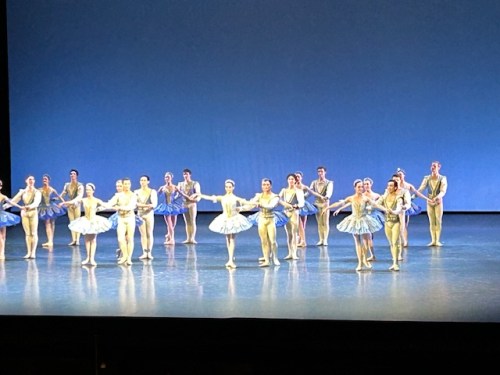
On the 17th in the lead couple Celia Drouy, sensual and rounded, was the charming girl next door. I’d love to see her in Dances at a Gathering. It was odd then, late in the piece, when she shoved away her partner, the cooly intense Axel Ibot. It seemed to come out of nowhere.

October 17th 2025. Rhapsodies.

The dance? Watchable and performed with energetic commitment by all. The cast was filled with skilled soloists who are only occasionally ever cast in big roles, such as Ibot (eye-catching here and equally focused the next night when he rejoined the corps) or Fabien Révillion (a delightful Colas long ago and a wrenching Lensky recently). I often watch for Isaac Lopes Gomes, cleanly and powerfully performing no matter what line he’s stuck in. Daniel Stokes. Juliette Hilaire. Charlotte Ranson…

Ah yes the dance. Forgot that one. Weight down but pulled up. A repeated group movement of squats in second thump forward while swaying side to side à la les drinking buddies in Prodigal Son. Open your arms to the sun and close them at varied speeds. Embracing the sky is common to almost all local world dances as well as yoga. Push and pull. As a young woman once said to me after she tried a baguette for the first time and did not want to seem ignorant: “I wasn’t amazed, but it was soft, it was crunchy, it was warm! It was soft and crunchy! Wasn’t it supposed to be soft and crunchy?”

On the 18th I think another layer got added to Rhapsodies. Letizia Galloni was laid back/avid, out-of-here/imperious, chiseled/pliant. She projected a mysterious anguish and tension which made you notice from the start that she was indeed pushing back at her partner, Yvon Demol. Even when Galloni yields, she holds something back.

Letizia Galloni is another one of those soloists whose career has switched on and off and on. Talented and eye-catching from the time she graduated the POB school, she scored La Fille Mal Gardée during the Millepied era about ten years ago. Then she faded into herself. Then disappeared. (At least here in a national company, you can go into hibernation without being fired).  But she popped up again last spring in Sleeping Beauty and offered the audience one of the loveliest Gold and Silvers I’ve seen in many a year: relaxed, imperious, generous, impeccable technically, with a sense of bounce and sweep that made us in the audience glad for her.

*

 *                                  *
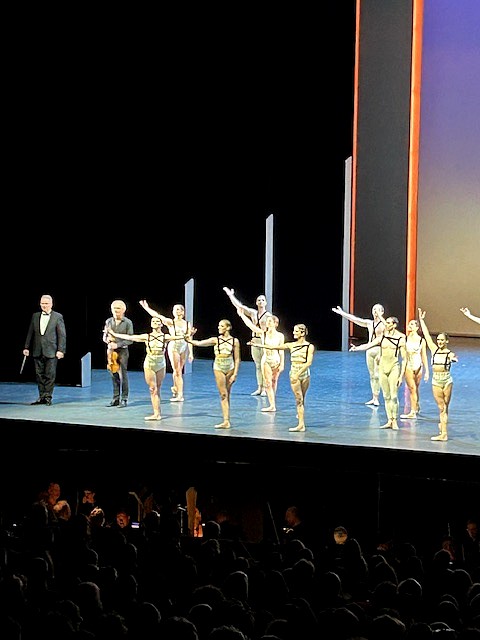
October 17th 2025. Corybantic Games.

Turnips/ Christopher Wheeldon’s Corybantic Games (2018)

Un “navet” aka turnip is the French way to say “that was a real dud.” I could have called this ballet a turkey, but we being very svelte and are only going to eat veggies today.

This thing, created for The Royal Ballet in 2018, has no structure (dramatic or balletic), no core, and dithers endlessly along. My seatmate on the 17th called it “soporific.” I thought of nastier words but simply nodded. I seriously considered skipping it on the 18th. Once was more than enough.

The pretty costumes are white with black ribbons crisscrossed across the torso that then dangle down from the shoulders. During the second night’s curtain calls, I tried to see if there was some sense to the danglers. Seems like the more of a soloist you are, the more ribbons.

The pretentious music is by Leonard Bernstein whenever he windily demands to be taken seriously. I’d call it Bride of Agon. The choreography, equally self-infatuated, proffers up innumerable quotes from just about every ballet that had an Antique World-y theme to the point that you could use it as a quiz: Note down the minute and the second where this choreographer directly cites Nijinsky, Nijinska, Robbins, Balanchine, Taylor. From Faun(s) to Apollo to Antique Elegies, this whole ballet felt like some snarky schoolboy’s inside joke. Flexed heels and upside-downsies and, as my seatmate noted, a lot of great final poses that turn out to be just a hook for more of the same. The Third Movement pas de deux ends with the guy hurling the girl up and into the wings (to be caught). Just where have I seen that one before?

It just goes on and on. I am too tired to describe it. Only a few days later I stare at my scribbled notes and all images of actual movement have faded. The steps from scene to scene – indeed within one — never get individuated. I’m looking at the cast list, filled with up-and-coming and cherished dancers and it’s painful. People tried to shine, gave it their all, but.

In the last scene, a soloist turns up (Valentina Colasante on the 17th and Roxane Stojanov on the 18th). Clearly, she is supposed to mean something, but what? Yes, I did know who the Corybantes were and that their earth mother is the fertility goddess Cybele (pretentious me) but what I didn’t see was one drop of wild ecstatic energy — not even once! — during these long minutes (37 minutes says the program, felt at least twenty minutes longer).

So now I’m looking at the program notes. Oh! Games is about Plato’s Symposium and polyamory! A less sexy or sensual ballet you will never find. No one connects. Ever. It turns out that in the fourth movement, if you look closely, the three couples are a straight, a male, and a lesbian one. Ooh! Did I look for boobies at all while three pairs of soloists in low light diddled around before settling into lovely enlaced poses on the downstage lip like teddy bears going to beddy? Seriously? As a female, I should note that women of any kind had no legal status or interest at all to Ancient Greek life or thought. Plato didn’t give a flying…hoot… about women, gay or straight. Why didn’t Wheeldon just make a dance about men being men who then tolerate a female diva who shows up for the grand finale? A fun fact is that Cybele’s male followers often castrated themselves at the apex of their delirium. Come to think about it, I don’t think that would make for a great ballet either.
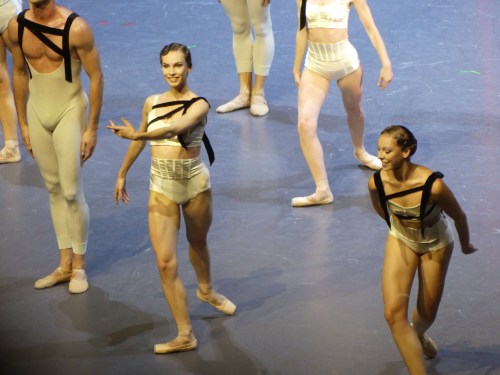
Bleuenn Battistoni & Roxane Stojanov, Corybantic Games.

As far as the title “Roots” goes, the program book insists that Wheeldon’s roots are in Greece. Seriously? He’s about as English as they come. As for Mthuthuzeli November,  the program talks less about his native origins and much more about his discovery of ballet. This program should have been entitled « Apples and Oranges with a Dried-Out Raisin on The Side. »

Could someone please pass the salt?


Commentaires fermés sur « Racines » at the Paris Opera : How to Cook Roots

Classé dans Retours de la Grande boutique

My Spring Season 2025 in Paris 2/2 : A Beauty Binge with Nymphs on the side.

In-Between The Beauties

Sylvia : ensemble.

Manuel Legris’s Sylvia, Palais Garnier, May 8th & 9th

Sandwiched in there, between Belles, we were treated to a short run of a revival/re-do of the ballet Sylvia, which had disappeared from the Paris repertoire.

I had never seen Darsonval’s 1979 version, alas. I will always regret how the Paris Opera then also deprogrammed the one I knew:  John Neumeier’s late 1990’s visually stunning version but esoteric re-interpretation of the story. It did take a while to figure out that Eros and Orion had been conflated into the same dancer by Neumeier,  yet the choreographer’s vivid sense stagecraft worked for me emotionally. All the better that Neumeier’s original naïve shepherd, Aminta/Manuel Legris himself, decided to try to piece together a new version that reached back to the ballet’s classic roots.

It was particularly odd to see most of the Sleeping Beauty casts now let loose/working overtime on this new production. While the dancers gave it their all, quite a few of the mythical beings were sabotaged by a production that included some very distracting costumes and wigs.

The Goddess Diana sports a basketweave ‘80’s Sheila Easton mohawk that would make any dancer look camp. In the role, a rather ferocious Roxane Stojanov held her head up high and ignored it, while the next evening a tepid Silvia Saint-Martin disappeared underneath the headgear to the point I had forgotten about her by the time she reappeared on stage near the conclusion. The interactions between Diana and Endymion make no sense whatsoever, particularly when you are at the top of the house and cannot see what is happening on the little raised platform at the back of the stage. Imagine trying to follow the plot when you can only see a bit of someone’s body wiggling, but without a head. Note to designers:  go sit up at the top of the house and do some simple geometric calculations of vectors, please.

To add to audience discomfort (hilarity?) with the staging at some point Eros, the God of Love, will abruptly rip open the raggedy cloak he’d been disguised in (don’t ask) in order to flash his now simply  gold-lamé-jockstrap-clad physique. On the 9th, Jack Gasztowtt managed to negotiate this awkward situation with dignity. On the 8th, having already gotten mega-entangled in his outerwear just prior to the reveal, Guillaume Diop didn’t. Seriously cringey.

There are many more confusing elements to this version, including the strong presence of characters simply identified as “A Faun” (Francesco Mura both nights) and “A Nymph” (a very liquid Inès MacIntosh on the 8thand a  floaty  Marine Ganio on the 9th).  But what’s with the Phrygian bonnets paired with Austrian dirndls? The Flames of Paris meet the Sound of Music on an Aegean cruise?

In Act 3, some characters seem to wear Covid masks. So please keep the choreography, but definitely junk these costumes!

Despite these oddities, dancers were having serious fun with it, as if they had been released from their solemn vow to Petipa while serving Beauty.

On the 8th of May, Germain Louvet’s fleet of foot and faithful shepherd Aminta charmed us. His solo directed towards Diana’s shrine touched in how grounded and focused it was. His Sylvia, Amandine Albisson, back after a long break, seemed more earthbound and more statuesque than I’d ever seen her, only really finding release from gravity when she had to throw herself into and out from a man’s arms.  But when Albisson does, gravity has no rules. Usually you use the term “partnering” to refer to the man, but I always have the feeling that she is more than their match. When I watch Albisson abandon all fear I often think back to Martha Swope’s famous photograph of Balanchine’s utterly confident cat Mourka as she flies in the air. When it’s Albisson, everything gravity-defying, up to and including a torch lift, feels liberatingly feline rather than showy or scary.

Here the hunter Orion is less from Ovid and more of a debauched pirate straight out of Le Corsaire. On the 8th, Marc Moreau at first moved with soft intention, clearly more of a suitor than a rapist where Sylvia was concerned. You felt kind of sorry for him. His switch to brutality made sense: being unloved is bad enough for a guy, being humiliated by a girl in front of his minions would make any gang leader lash out.

Marc Moreau (Orion), Amandine Albisson (Sylvia) and Germain Louvet (Aminta)

On the 9th, I had to rub my eyes. Bleuenn Battistoni – that too demure Beauty – provided the relaxed and flowing and poignant princess I had hoped to see way back in March. Nothing dutiful here. Already in the first tableau, without doing anything obviously catchy, her serene and more assertive feminine authority insured that the audience could immediately tell she was the real heroine – an eye-catching gazelle. Maybe Beauty is just too much of a monument for a young dancer? Inhibiting?  Ironically, at the end of the season, I would see Albisson let loose as Beauty. The tables will have turned.

I was drawn to Paul Marque’s melancholy and yearning shepherd Aminta. At a certain point, Sylvia will be prodded by Diana to shoot her suitor. Albisson did. Here Battistoni (and who in any case would obey Saint-Martin’s dry Diana?) clearly does by accident, which made the story juicier. Battistoni’s persona was vulnerable, you stopped looking at the “steps” even during the later Pizzicati solo, which she tossed off with teasing and pearly lightness. Everything I had hoped for in Battistoni’s Beauty showed up here.

Sylvia : Paul Marque et Bleuenn Battistoni

*

 *                                    *

The Belles Are Ringing

La Belle au Bois Dormant’s second series. Opera Bastille, June 27th,July 6th and 7th.

Guillaume Diop et Amandine Albisson (Désiré et Aurore le 7 juillet).

And then, boom, Albisson full out in Sleeping Beauty on July 7th.  As fleet of foot as I knew her to be, neither allegory nor myth but a real and embodied character. Whereas she had seemed a bit too regal as Sylvia, here came the nymph. Delicate and gracious in the way she accepted the compliments of all of her suitors, Albisson created a still space around her whence she then began to enchant her princes. She looked soundless.

Guillaume Diop, who had proven a bit green and unsettled earlier this series, woke up his feet, leaned into his Second Act solo as he hadn’t before – a thinking presence, as someone remarked to me – and then went on to be galvanized by his partner and freed by the music.

Perhaps Diop, like everyone else on the stage, was breathing a sigh of relief. For this second series of Beauties in June/July, the brilliant and reactive conductor Sora Elisabeth Lee replaced the insufferable Vello Pähn. During the entire first series in March and April, this Pähn conducted as slowly and gummily if he were asleep, or hated ballet, or just wanted to drag it out so the stagehands got overtime. With Sora Elisabeth Lee, here the music danced with the dancers and elated all of us. During the entire second series, Bluebirds were loftier, dryads were more fleet-footed. Puss and Boots had more punch and musical humor. Sora Elisabeth Lee gave the dancers what they needed: energy,  punchlines, real rhythm. This was Tchaikovsky.

So this second series was a dream.

On July 6th, Germain Louvet proved that he has grown into believing he can see himself as a prince. I say this because I was long perturbed by what he said as a young man in his autobiography (written before you should really be writing an autobiography).  An assertive prince, a bit tough and perfectly cool with his status as Act Two starts. And then he began unfurling his solo, telling his story to the heavens. His arms had purpose, his hands yearned. And when he saw his Beauty, Hannah O’Neill, it was an OMG moment.

As it had been destined to be. O’Neill’s coltish and gracious and sleek, sweetly composed and well-mannered maiden from Act One was now definitely a damsel in need of a knight in shining armor. She was his dream, no question. She began her Second Act solo as if she were literally pushing clinging ivy aside, her arms moving slowly and filling into spaces at the end of each phrase. No wonder that Louvet’s prince became increasingly nervous seconds later while trying to find his girl in among the sleepers. You could feel his tension. “Are they all dead? Was the Lilac fairy just fooling with me?” And, oh, Act Three. The way he presented his belle, the way they danced for each other.

Hannah O’Neill (Aurore) et Germain Louvet (Désiré)

But of all the Beauties, I will never forget Leonore Baulac’s carefree and technically spot-on interpretation, maybe because I just can’t find a way to describe this June 27th performance in words. Fabulous gargouillades? The way she made micro-second connections with all four of her suitors (and seemed to prefer the one in red)? The way everything was there but nothing was forced? The endless craft you need to create the illusion of non-stop spontaneity? The way Marc Moreau just suited her? Those supported penchées and lean backs in the Dream Scene as one of the most perfect distillations of call and response I have ever seen?

Both Baulac and Moreau sharply etched their movements but always made them light and rounded and gracious. Phrases were extended into the music and you could almost hear whispered words as they floated in the air. They parallelled each other in complicity and attack to the point that the first part of the final pas de deux already felt as invigorating as a coda.

Léonore Baulac et Marc Moreau (Aurore et Désiré).

You can never get enough of real beauty. Let’s hope 2025’s Paris fall season will be as rich in delight.

Commentaires fermés sur My Spring Season 2025 in Paris 2/2 : A Beauty Binge with Nymphs on the side.

Classé dans Retours de la Grande boutique

Better Late than Never. My Spring Season 2025 in Paris : A Beauty Binge: 1/2

Sleeping Beauty/La Belle au Bois Dormant. Paris, Opera Bastille.

March 11, 13, 22 and April 3rd, 2025.

Stagecraft

Sleeping Beauty made me fall in love with ballet but at the same time, each time I see it, I begin wonder just why at some point (I still cannot pinpoint when), this ballet starts taking too long. Something could be cut. But what, where, when? And why?

I’m still stuck pondering this question decades later, even as this ballet makes me feel like a bee just gob-smacked by all the pollen out there on stage, bemusedly happy to just sit and watch a swarm of dancers bumble around in all the colors of its endlessness.

March 13th and April 3rd. During first intermission, I met up with some young American dancers. To my dismay, they assumed that Bluenn Battistoni had just graduated from the Paris Opera Ballet school and was being given her first big chance. I tried to argue that the French style, like the French people, is modest and reserved, more about perfection rather than chutzpah. (The company has been eternally misunderstood by those many American critics who value flash). But I didn’t even manage to convince myself. Battistoni’s dancing is absolutely stunning and technically polished, but her stage presence was way too reserved – over-calm — this performance. I’m not saying she needs to sell out, just learn to catch the limelight a little more. She’s completely assured but not assertive enough. With the right coach I am sure Battistoni will move from inward-looking glow into eye-catchingly demure radiance.

Battistoni, on the second night, channeled a newly skippy feel to her hops and gargouillades. She was asserting herself more, aha, but remained soft-spoken.

Bleuenn Batistoni (Aurore) et Guillaume Diop (Désiré)

Inès McIntosh on March 11th was more extraverted but she, like Battistoni, would probably be better served right now by Balanchine’s clever abstraction of Sleeping Beauty’s formal magic: Theme and Variations. That is not to say that McIntosh didn’t offer a powerful mini-mad scene after her finger was pricked. McIntosh has undeniable presence, but she hasn’t yet grown into projecting that kind of distillation of womanliness offered by so many of the Auroras I’ve seen from Fonteyn on down.  In the Vision Scene, she just didn’t know how to project vulnerability and yearning.   At the end of the evening I left the theatre humming Don Q instead of SB.

Ines McIntosh. Aurore

March 22nd. Powerful yet demure radiance is exactly what Héloïse Bourdon embodies these days. She just glows. In her one shot this season as Princess Aurora, I was delighted by how she reminded me in her solos of where the choreography and music echo bits and pieces of her Fairy godmothers’ variations. The Prologue had come together to shape the personality of this princess. Bourdon’s hard-earned stagecraft (don’t get me started again on all the reasons she should have promoted ages ago) offers a gift to the audience. You don’t have to be a balletomane to feel that something big is happening, but if you are a balletomane you relish her mastery of both steps and nuance all the more. I was bewitched.

Bourdon Docquir March 22

On other nights I was reduced to sitting back and basking in the authority and easy confidence of the same Bourdon’s repeated brief stints as Sixth Fairy during the Prologue. This variation is normally given to THE Lilac Fairy, but alas Nureyev morphed Lilac into a separate and, when not mimed with authority, utterly insipid panto role. Why turn the juiciest solo into a random outing with no follow-through? Instead of a powerful ballerina/catalyst, THE fairy turns out to be a random junior dancer in a cut-out costume dominated by a big wig à la Lina Lamont from Singing in the Rain insipidly miming – with one cast exeption – “Oh Carabosse, you shouldn’t have come. No, no, no.”

Bourdon’s suitors in Act One clearly appreciated this well-bred Aurora in bloom.  “A rose? How kind of you.” She wasn’t “selling it” in a flashy way, nevertheless the people sitting near me literally screamed at the end of the adagio and a young man right behind me gasped in shock when she pricked her finger. Yeah, sure, vox populi. But I was equally enthralled by such gracefully and authoritatively danced intelligence. During the Vision scene, Bourdon’s control and release and way of finishing each phrase now evoked memories of the way she had danced at her birthday party. Each act had you plunge deeper and deeper into all the facets and colors that are buried in a diamond.

Of course, Bourdon has one great advantage over the other two Auroras I saw: on-stage experience in the ballet. The last time this ballet was given in Paris was over a decade ago, so neither Battistoni nor McIntosh have had the luxury to start out as a little fairy, get the music and production into their bones and muscle memory, watch and learn from the stars while in the wings or milling about dressed for a mazurka. Stagecraft takes years.

Part of my reticence about the Beauties could be blamed on the hard-working and well-meaning Prince Desirés of both Thomas Docquir and Guillaume Diop. As most of the company’s male principals had decided to hang out over at the Palais Garnier and devote themselves to performing in Mats Ek’s Appartment rather than be involved in this run, basically there were few men left.

Both, as if they were relief pitchers, were scheduled to partner at least two if not three ballerinas. Where is the rehearsal time then to craft intimacy in dance and drama with your partner? Where is the time to work on your own role?

As I noted to myself during Act Two: “McIntosh seems better on her own and fills the space when she is the dream.” Act Three: “Fish dives with Docquir not thrilling. Steps executed, zero connection, she seems like a doll instead of a woman. Isn’t this supposed to be a wedding?”

Perhaps Thomas Docquir (March 11th and March 22nd) has simmered too long in secondary roles, including endless iterations of Rothbart, to be “the one.”  He has clearly been working on refining his technique (solid from the start but now more polished, elastic, finessed, held up high) and elongating his lines. But, seriously, it is now time for Docquir to build up his self-confidence and stop avoiding the spotlight. When he came out on the stage in Act Two…both times few in the audience caught on that he was supposed to be the star.  His Vision scene solo was made for some nice lines, yet the longing was missing. He didn’t ever challenge McIntosh to do that one percent more and when I next saw him with Bourdon my always accentuate-the-positive seatmate made an interesting comment. “If even he can’t believe that he is a prince, then why should she believe him? [pause] Then why should I?”

Guillaume Diop (Désiré)

Guillaume Diop (March 13th and April 3rd) is so talented and cheerfully radiant – and known — that even if he’s sometimes just a bit too all over the place (not only Etoile but  in-demand fashion icon), the audience just takes to him before he even takes a second step. I saw him twice with Battistoni and clearly he learns fast and carries over new ideas from performance to performance. By the second performance I saw, the partnering between their had developed. Intense eye-contact led to easier connection.

He’s a very attentive partner – boy does he just know how to hold out his hand and whip his girl into pirouettes with concentrated nonchalance — and as a soloist he has impressive elevation and strength (those barrel turns). But he has got to keep working on refining his feet, still just a bit forgotten as they are too far away from his head, and he especially needed to re-ground his plié (I winced a few times on the 13th). While he knows how to stretch out of his balances, he’s begun to sit back on his standing leg and is not pulling up enough through his hip…a sign of being tired. He’s dancing too much and this worries me. Nevertheless, I am curious to how partnering a much more seasoned stage partner during the next run – Amandine Albisson — might galvanize him. Two young-uns is cute. Young talent rubbing up against stagecraft often results in more.

To be Continued…

2 Commentaires

Classé dans Retours de la Grande boutique

Mayerling : bilan tardif

Les Balletotos se sont cotisés pour voir trois distributions différentes du Mayerling de Sir Kenneth MacMillan. Tels des boas constrictors qui auraient mis du temps à digérer leur proie volumineuse, ils se résolvent enfin à vous en rendre compte. Fenella est enragée, Cléopold assommé et James… juste tombé sur la tête?

*

 *                                               *

JamesJames : représentation du 30 octobre 2024.

J’ai trouvé la recette pour passer une bonne soirée à coup sûr : voir le spectacle à travers les yeux de quelqu’un d’autre. J’ai longtemps hésité à revoir Mayerling, dont j’avais fait une overdose lors de son entrée au répertoire de l’Opéra de Paris. Pour cette année, une revoyure serait le maximum. J’ai même failli revendre ma place, mais une charmante amie qui avait pourtant une journée bien chargée a insisté pour découvrir l’œuvre, et je ne pouvais pas la laisser en plan. Et me voilà arpentant tous les couloirs et escaliers de Garnier – et il y en a de lépreux – pour narrer les nombreuses péripéties de chaque acte, détailler les interactions entre les personnages, donner des pistes pour reconnaître les perruques, tenter de rabouter tout cela à la géopolitique de l’Empire austro-hongrois, avant qu’il soit temps de nous faufiler en troisièmes loges.
Et là, miracle, la magie du spectacle opère. À chaque instant, je vérifie que les épisodes annoncés (« tu vas voir, dans la scène du bal, Rodolphe danse, non pas avec son épouse, mais avec la sœur de celle-ci ! ») sont compréhensibles, et du coup, suis attentif au moindre détail (tiens, je ne souvenais pas ce qui déclenche cette entorse à l’étiquette : sa mère, déjà, lui manifeste une horrible froideur). C’est comme si l’œil brillant de ma voisine contaminait mon regard. De blasé, me voilà neuf.
Oh, tout n’est pas parfait. Les quatre zigues qui harcèlent le prince pour lui faire embrasser la cause de la Hongrie manquent de rudesse et ne dansent pas toujours ensemble (ils seront plus à leur aise à l’auberge au deuxième acte ; il s’agit de damoiseaux Busserolles, Lopes Gomes, Marylanowski et Simon).

P1220748

Mathieu Ganio et Héloïse Bourdon. Répétition à l’amphithéâtre Olivier Messian. 12 octobre 2024.

Mais il y a Mathieu Ganio, dont on voit cette saison les derniers feux ; le danseur-acteur donne toute la palette de son art dans le rôle du prince Rodolphe. On voit à travers lui la morgue, la rage, les doutes, la névrose. À chaque pas de deux – et il y en a de nombreux – il adapte son style à sa partenaire et à la situation de cœur de son personnage : dragueur insolent avec la princesse Louise (Ambre Chiarcosso), il est las mais sensuel avec son ancien collage Marie Larisch (Naïs Duboscq), avant de se faire effrayant et glaçant de violence dédaigneuse avec son épouse Stéphanie (Inès McIntosh très touchante en fétu de paille). Approchant sa mère (Héloïse Bourdon, toute de grâce avec tout le monde et toute de glace avec lui), on le voir redevenir enfant. Au deuxième acte, lors de la scène de la taverne, il fait montre d’une élégance inentamée aussi bien pour son solo de caractère que lors du duo avec Mitzi Caspar (une Clara Mousseigne un poil trop élégante).

Alors que la névrose du prince progresse, Mary Vetsera prend son ascendant : Léonore Baulac incarne avec une crâne détermination le seul personnage qui dialogue d’égale à égal avec le prince ; le passage où elle inverse les rôles (Rodolphe avait terrorisé Stéphanie avec un pistolet, elle fait de même) scelle le pacte de mort qui occupera le dernier acte. Dans le rôle de Bratfisch, serviteur fidèle de Rodolphe, Jack Gasztowtt est presque trop grand et élégant, mais il habite avec précision sa partition, et avec sensibilité son rôle d’amuseur (2e acte) qu’on ne regarde plus (3e acte).

*

 *                                               *

cléopold2Cléopold : représentation du 5 novembre 2024.

Sans doute parce que je n’avais pas comme l’heureux James pour sa soirée une charmante voisine à mes côtés, je n’ai pas eu d’épiphanie face au mastodonte Mayerling. Le ballet apparait toujours avec ses mêmes gros défauts, sa myriade de personnages accessoires, notamment féminins, le tout encore aggravé par cette spécialité de l’Opéra de distribuer les rôles plus selon la hiérarchie de la compagnie que selon la maturité physique des interprètes. C’est ainsi que le 5 novembre, dans son pas de deux du « dos à dos » avec Rodolphe, Célia Drouy, par ailleurs fine interprète, a l’air d’être la petite sœur de son partenaire et non sa mère. Sylvia Saint-Martin tire son épingle du jeu en Marie Larisch. Sa pointe de sécheresse donne à l’intrigante comtesse une image vipérine qui s’accorde avec le premier pas de deux qu’elle a avec le prince héritier tout en enroulements-déroulements – notamment le double tour en l’air achevé en une attitude enserrant le partenaire- . Marine Ganio est quant à elle très touchante ; aussi bien dans son solo de jeune mariée où, malgré les signes contraires donnés pendant le bal, elle espère encore trouver dans le prince héritier un mari, que dans le pas de deux « monstre à deux têtes » de la chambre nuptiale.

P1220766

Marine Ganio (Sophie), Francesco Mura (Bratfisch) et (? ahhh La confusion des personnages multiples et vides)

On l’aura compris, on se raccroche au pas de deux comme un marin naufragé aux planches éparses du navire englouti. MacMillan reste un maître incontesté du genre. Et qu’importe si chacun des personnages féminins qu’il dépeint à part peut-être Mary Vetsera se voit refuser toute progression dramatique. Chacune d’entre elles reste l’allégorie d’un type de relation avec le prince héritier.

C’est pourquoi on ne voit guère en Mayerling qu’une tentative ratée de surenchérir sur le succès de Manon, créé quatre ans auparavant. La scène la plus emblématique de cet échec est à ce titre celle de la taverne qui tente de transposer, de manière pataude, l’acte « chez Madame » de Manon. En effet, on y trouve une myriade de prostituées qui se dandinent et se chamaillent. Un personnage masculin secondaire exécute une variation aussi bouffonne qu’acrobatique (Francesco Mura donne à ce numéro de Bratfisch une jolie bravura, entre relâché –les roulis d’épaules- et énergie coups de fouet des sauts). Un personnage secondaire féminin danse une variation sensuelle (Clara Mousseigne atteint les critères techniques du rôle sans parvenir à donner corps à sa Mizzi Caspar). Un quatuor de messieurs fait des grands jetés dans tous les sens (Les Hongrois de carton-pâte qui jusque-là ressemblaient plutôt à des polichinelles sortant de leur boite – MacMillan aurait mieux fait de ne pas aborder le volet politique si c’était pour le traiter de cette manière). La police vient enfin gâcher la fête.

Seulement voilà, dans Manon, la scène chez Madame vient faire avancer l’action : des Grieux, voit sa fiancée volage revenir à lui. Lescaut, qui favorise ce retour de flamme après avoir été la cause même du départ de l’héroïne, perd la vie. Manon est arrêtée et va être déportée en Louisiane. Dans Mayerling, la scène n’apporte pas grand-chose au développement de l’action. Que nous importe que Rodolphe propose le suicide à Mizzi Caspar quand la chorégraphie ne nous a suggéré aucune vraie intimité, même sensuelle, entre les deux personnages. Peut-être aurait-il dû proposer le marché à Bratfisch. Cela aurait, peut-être, donné une raison d’exister à ce personnage accessoire se résumant à ses deux variations.

Invariablement, cette scène inutile émousse suffisamment mon attention pour me trouver indifférent à un moment pivot du ballet, celui du salon de la Baronne Vetsera où, durant un tirage de cartes truqué, Marie Larisch finit de tourner la tête à la jeune écervelée Mary Vetsera – le rôle féminin principal- qui, depuis le début du ballet, ne faisait que passer.

Il faut donc attendre la moitié de la soirée pour rentrer dans le vif du sujet et c’est sans compter encore deux autres scènes parfaitement inutiles : la réception au palais de la Hofburg où on nous inflige tous les proches et illégitimes de la famille impériale (en amant de Sissi, Pablo Legasa est grossièrement sous employé) et la scène à la campagne  (beaucoup de décors et de figurations pour un coup de fusil).

C’est un peu comme si MacMillan, qui avait su condenser la Manon de l’abbé Prévost, n’avait pas su sélectionner les épisodes les plus significatifs qui ont conduit le prince au tombeau. Un ballet n’est pas un livre d’Histoire et multiplier les notes de bas de page ne fait assurément pas une bonne histoire.

P1220781

Hohyun Kang et Paul Marque (Mary et Rodolphe).

Mais venons-en –enfin !- aux personnages principaux. En Rodolphe, Paul Marque, assez compact physiquement, torturé et introverti, nous crée des frayeurs au début du ballet. Il cherche ses pieds lors de sa première variation (ses chevilles tremblent sur les pirouettes et même en échappés). Le pas de deux avec la sœur de Stéphanie (Luna Peigné) est un peu périlleux avec des décentrés ratés. On craint un peu pour la jeune danseuse. Cela s’améliore par la suite. Paul Marque joue très bien la maladresse et l’inconfort. Il semble déplacé au milieu de tous ces ors et ces fastes. Il est même touchant dans la scène de chasse, avalé qu’il est par son lourd manteau et sa toque. Il est aussi un morphinomane poignant mais convainc moins en Hamlet sur Danube, dans ses confrontations avec le crâne.

Pour le drame, on se repose alors sur Hohyun Kang qui, assez charmante et lumineuse dans ses premières scènes de presque figuration, se mue assez vite en liane à l’élasticité toxique. Sa Mary est un petit animal qui ronronne et griffe tout à tour. A l’acte 3, la scène de la mort, avec ses portés-synthèses de tous les autres pas de deux avec les autres interprètes féminines, est d’un effet monstrueux.

Mary-Hohyun accrédite l’idée d’un vrai sacrifice consenti. Elle semble rester complètement dans l’exaltation jubilatoire du suicide romantique. Je préfère la version où la jeune fille recule au dernier moment et est emportée par la folie de Rodolphe qu’elle a activement encouragée. Le choix présenté par Kang et Marque est cependant très valide.

Mais Dieu qu’il faut patienter pour en arriver là ; et que de fois on a cru sombrer dans les bras de Morphée avant ce dénouement.

P1220778

Hoyun Kang (Mary), Paul Marque (Rodolphe) et Silvia Saint-Martin (Marie Larisch).

*

 *                                               *

FenellaFenella : soirée du 13 novembre 2024

SHOOT! 

Mayerling by Sir Kenneth MacMillan, Paris Opera Ballet at the Palais Garnier, November 13th, 2024. 

Even if you put a gun to my head, I will never ever go see this ballet again. 

The potential dramatic arc keeps shooting itself in the foot as hordes of pointless people keep disturbing the crime scene. This cacophony of characters only serves to distract and, worse, confuse an audience unversed in the minutiae of minor late 19th century Central European history.  

During the early scene at a ball, once again I just kept trying to guess who’s who, as did the two women sitting in front of me who were leaning in and actively chatting to each other. “Archduchess Gisela,” seriously? Who?  Who cares? Who even cared back then? The character is a non-character, a company member who was just wasted playing a titular extra. (At least 18 roles have names in the cast list).

 So there. Now back to the topic at hand. What I saw. And it didn’t start well. 

Then, after having been absolutely gobsmaked by an Emperor Franz Joseph doing heavy squats in second when he was supposed to be leading a Viennese waltz with upright elegance, I started to sink down in my seat. I will not out the very young dancer who perpetrated this assault on the waltz as either he was not, or was seriously badly, coached. Clearly, more attention was paid to his wig and costume. If you are going to be so historically correct that you give specific names to minor characters…maybe you should pay attention to little details such as how a waltz is properly danced? 

P1220759

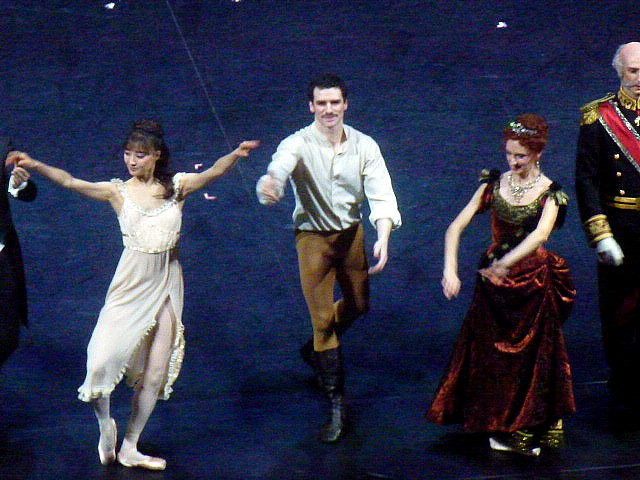
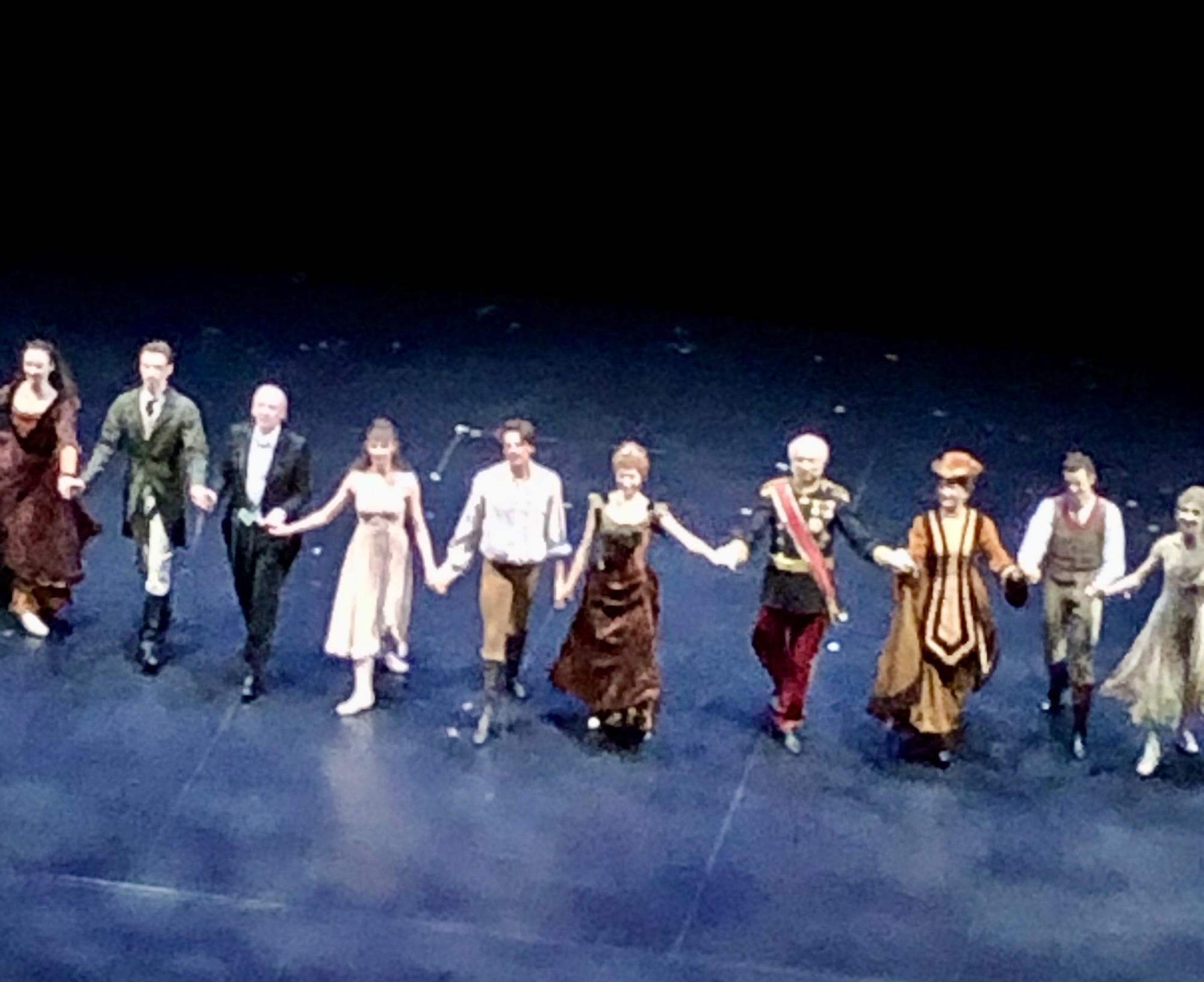
Curtain calls. The too many characters

Oh yes. The leads.  

Germain Louvet as Crown Prince Rudolph nailed it. He’s grown into his talent. He’s gone from being a youthfully pretty star into this manfully expressive artist, all without losing a sliver of his lines and elan. He’s really in the zone right now and, despite the fact that I think this ballet is a total waste, he made it work for us in the audience. From his first entrance as Rudolf, Louvet set out a complicated but readable persona: already anguished, brusque; very proper manners if required but clearly not a fool, not naive (and not as mad as others, such as his mother, assume he is).  

 As his mother, Empress Elizabeth, Camille Bon did impose a calm presence. You could tell she was his mother from scene to scene, no matter what the hat or hair. In their only intimate encounter, the one in her bedroom, there was no doubt that this woman hated to be touched by her son. The little kiss goodbye on the forehead never fails to pin down what kind of mother the dancer has shaped. Alas, later on, when Elizabeth dances pointlessly with a lover who suddenly pops up in the deserted ballroom, neither radiated charisma (not to mention desire). Why not just ERASE Sissi’s pointless boyfriend “Colonel Bay Middleton” Cast member #9? I wanted to remove him at gunpoint. No one in the audience has ever been able to tell who the hell he is supposed to be. 

As Rudolph’s battered bride, Countess Stephanie, Inès McIntosh proved naively helpless, but not hopeless and definitely not a ninny. You started to cheer for her: if only her new husband could tell that she’s just as melancholic as he is! Just not as crazy. And if only her new husband could see that her body does match his in lines and energy. Both Louvet and McIntosh have an unassuming way of lifting and extending their legs that makes the high lines seem natural. Neither of the two kicks or flings their legs about needlessly. Their extensions soar up softly and take time to soak in the music. They’d make a nice couple, given a chance.  

Heloïse Bourdon, whom I had once seen playing Rudolfs’s mother with cold fire, was unrecognizable (in the best way) here as Countess Larisch. Healthy, sane, pragmatic – you almost could imagine that the Habsburg Empire wouldn’t have fallen if she’d been Franz Joseph’s Pompadour rather than Rudolph’s enabler. Actually, her countess seemed more wry and disabused than enabling. Yes, a Pompadour: elegant, smart, knows someone will always hate her for where she comes from. 

img_9106

Mayerling. Curtain Call.

By first intermission, I was already thinking about the busy 1953 Warner Brother’s cartoon Duck Amuck, where Bugs Bunny progressively erases Daffy Duck. And now, please, for Act Two: 

CUT the tavern scene with Mizzi Caspar, which provides zero dramatic purpose or emotional payoff. I mean, this endless scene finally fizzles out when Mizzi — whom we have not seen before …and will never see again – gets taken home by another man who probably has a name in the program? He might be #10 or #11, who cares? Waving papers around (ooh, plot clue) is something to be saved for a close-up in a BBC miniseries.  

As Mizzi, however, Marine Ganio infused her persona with the voluptuous Viennese charm of what they call “Mädls:” « Girlies » with hearts of brass.  

Some can even manage, like Ganio, to be one of the boys when dancing to Liszt’s Devil’s Waltz with four pointless Hungarians.  [Don’t even ask me about the score. I want to burn it]. OK, maybe do not FULLY ERASE the tavern scene entirely but please:  just EDIT OUT these “Hungarian” Jack In The Boxes from the entire ballet. I was rather annoyed that James did not find them rough and rustic enough. Le Sigh, they are supposed to be noblemen aka elegantly sinuous whisperers, not tough guys. 

Louvet’s Rudoph was the happiest and least tormented when dancing with Marine Ganio’s Mizzi, even when he was pulling her in too manaically. Their yearning to stretch matched, their arms – even when in tight couronnes — matched. There was a story ready to be told here, but that would have been a different ballet. 

Please CUT the ennnndless scene of the Habsburg Fireworks and thereby CUT the out-of-place diva impersonating “Katharina Schratt”, Franz Joseph’s actress mistress, as she sings to boring effect to live piano accompaniment.  And CRUMPLE UP AND THROW OUT: The Hunt, oh god please. OK, Rudolph killing someone, by accident or on purpose,  is based on a true story. As the guy already is a drug and sex addict, syphilitic, and just plain nuts, does this excuse to make a prop gun go pop…add anything to the narrative?  

Most of all: CUT CUT CUT Bratfisch, the loyal coachman, OR at least please give him enough to do to make him identifiable! As is, he is a 5th  Jack In The Box, but a lonely one who dances alone. As this character is 8th out of 18 in the playbill you might not notice that he was the first guy you saw on the snowy stage of Act One Scene One. Antoine Kirscher, eh? Didn’t he also get cast as the naughty coachman (aka the guy with a horsewhip) in Neumeier’s La Dame aux camellias? Here Kirscher couldn’t quite make as much of a sassy statement in the endless tavern scene, hampered by the fact you had no idea who he was supposed to be. Now seriously dated Groucho Marx references don’t help the younger ones in the audience.  Nor could you tell that the sad guy in the last scene in the churchyard was someone you’d seen before. Even with two solos, it’s a non-role and no dancer, none, has been given enough to chew on to really make it work.  

Oh, and by the way, one of the many pretty girls who’d been popping in and out for at least an act and a half then turns out to be the starring female role: Mary Vetsera, the last of Rudoph’s mistresses, the only one who turns out willing to die with/for him. Bluenn Battistoni. Clearly not naïve: she’s a girl of our time who has seen too much perversion on the internet that she thinks  doing  “x”(spellcheck just censored me) on a first date is normal. Battistoni’s Mary was clearly not a drama queen with death wish either. Just a girl…and perhaps Louvet’s Rudolph was a bit too careful with his ballerina during the final flippy- flappy too-much is not enough MacMillan partnering.   

Honestly, by the time the action got around to Mary, at some point after the tavern or  the hunt, I must have been weirdly smiling: I was now thinking about that 1952 cartoon “Rabbit Seasoning” where Bugs asks his nemesis whether Elmer Fudd should shoot him now or shoot him later. If this ballet ever shows up in the Paris Opéra repertory again, I swear I shall scream, like Daffy Duck, “I demand that you shoot me now!

Commentaires fermés sur Mayerling : bilan tardif

Classé dans Humeurs d'abonnés, Retours de la Grande boutique

“Some enchanted evening/you may see …” (My spring season at the Paris Opera)

Just who wouldn’t want to be wandering about dressed in fluffy chiffon and suddenly encounter a gorgeous man in a forest glade under the moonlight? Um, today, that seems creepy. But not in the 19th century, when you would certainly meet a gentleman on one enchanted evening…« Who can explain it, who can tell you why? Fools give you reasons, wise men never try. »

Notes about the classics that were scheduled for this spring and summer season — La Bayadère, Midsummer Night’s Dream, Giselle — on call from April through July.

*

 *                                     *

P1180305

After the confinement, filmed rehearsals, and then two live runs in succession, DOES ANYONE STILL WANT TO HEAR ABOUT LA BAYADERE? But maybe you are still Dreaming or Giselling, too?

Here are my notes.

Bayaderes

« Some enchanted evening, you may see a stranger across a crowded room. And somehow you know, you know even then, That somehow you’ll see her again and again. »

April 21

In La Bayadère, if Ould-Braham’s Nikiya was as soft and naïve and childlike as Giselle. Bleuenn Batistoni’s  Gamzatti proved as hard and sleek as a modern-day Bathilde: an oligarch’s brat. [Albeit most of those kinds of women do not lift up their core and fill out the music]. Their interactions were as clear and bright and graphic as in a silent movie (in the good sense).

OB’s mind is racing from the start, telling a story to herself and us, desperate to know how this chapter ends. Partnering with the ardent Francesco Mura was so effortless, so “there in the zone.” He’s one of those who can speak even when his back is turned to you and live when he is off to the side, out of the spotlight. Mura is aflame and in character all the time.

OB snake scene, iridescent, relives their story from a deep place  plays with the music and fills out the slow tempi. Only has eyes for Mura and keeps reaching, reaching, her arms outlining the shape of their dances at the temple (just like Giselle. She’s not Nikiya but a  Gikiya).

Indeed, Batistoni’s turn at Gamzatti in the second act became an even tougher bitch with a yacht, as cold-blooded as Bathilde can sometimes be:  a Bamzatti. There was no hope left for Ould-Braham and Francesco Mura in this cruel world of rich fat cats, and they both knew it.

April 3

Park  as Nikiya and later as Giselle will channel the same dynamic: sweet girl: finallly infusing some life into her arms in Act 1, then becoming stiff as a board when it gets to the White Act, where she exhibits control but not a drop of the former life of her character. I am a zombie now. Dry, clinical, and never builds up to any fortissimo in the music. A bit too brisk and crisp and efficient a person to incarnate someone once called Nikiya. Could the audience tell it was the same dancer when we got to Act 3?

Good at leaps into her partner’s arms, but then seems to be a dead weight in lifts. When will Park wake up?

Paul Marque broke through a wall this season and finds new freedom in acting through his body. In Act Three: febrile, as “nervosa” as an Italian racecar. Across the acts, he completes a fervent dramatic arc than is anchored in Act 1.

Bourdon’s Gamzatti very contained. The conducting was always too slow for her. Dancing dutifully. Where is her spark?

*

 *                                     *

P1180391

Midsummer Night Dreams

« Some enchanted evening, someone may be laughing, You may hear her laughing across a crowded room. And night after night, as strange as it seems, The sound of her laughter will sing in your dreams. »

June 30

Very baroque-era vivid conducting.

Aurelien Gay as Puck: feather light.

Pagliero’s Titania is clearly a queen, calm and scary. But also a woman, pliant and delightful.

Jeremy Loup-Quer as Oberon has heft and presence. Dances nicely. Smooth, but his solos are kind of like watching class combinations. (Balanchine’s choreography for the role is just that, basically)

First Butterfly Sylvia Saint-Martin displayed no authority and did the steps dutifully.

Paris Opera Ballet School kiddie corps has bounce and go and delicate precision, bravo.

Bezard/Demetrius in a wig worthy of a Trocks parody. Whyyyy? Particularly off-putting in the last act wedding scene. Who would want to marry a guy disguised as Mireille Matthieu?

Bourdon/Hyppolita unmusical fouettés. I miss her warmth and panache. Gone.

Act 2 Divertissement Pas where the couple appears out of nowhere in the “story.” (see plot summary). The way Louvet extends out and gently grasps Ould-Braham’s hand feels as if he wants to hold on to the music. Both pay heed and homage to the courtly aspect of the Mendelssohn score. That delicacy that was prized by audiences after the end of the Ancien Régime can be timeless. Here the ballerina was really an abstract concept: a fully embodied idea, an ideal woman, a bit of perfect porcelain to be gently cupped into warm hands. I like Ould-Braham and Louvet’s new partnership.  They give to each other.

July 12

Laura Hequet as Helena gestures from without not from within, as is now usual the rare times she takes the stage. It’s painful to watch, as if her vision ends in the studio. Does she coach Park?

Those who catch your eye:

Hannah O’Neill as Hermia and Célia Drouy as Hyppolita. The first is radiant, the second  oh so plush! Hope Drouy will not spend her career typecast as Cupid in Don Q.

In the Act II  Divertissment, this time with Heloise Bourdon, Louvet is much less reverential and more into gallant and playful give and take. These two had complimentary energy. Here Louvet was more boyish than gentlemanly. I like how he really responds to his actresses these days.

Here the pas de deux had a 20th century energy: teenagers rather than allegories. Teenagers who just want to keep on dancing all night long.

NB Heloise Bourdon was surprisingly stiff at first, as if she hadn’t wanted to be elected prom queen, then slowly softened her way of moving. But this was never to be the legato unspooling that some dancers have naturally. I was counting along to the steps more than I like to. Bourdon is sometimes too direct in attack and maybe also simply a bit discouraged these days. She’s been  “always the bridesmaid but never the bride” — AKA not promoted to Etoile — for waaay too long now.  A promotion would let her break out and shine as she once used to.

My mind wandered. Why did the brilliant and over-venerated costume designer Karinska assign the same wreath/crown of flowers (specifically Polish in brightness) to both Bottom in Act I and then to the Act II  Female Allegory of Love? In order to cut costs by recycling a headdress ? Some kind of inside joke made for Mr. B? Or was this joke invented by Christian Lacroix?

*

 *                                     *

img_2046

Giselles

« Some enchanted evening, when you find your true love, When you hear her call across a crowded room, Then fly to her side and make her your own, Or all through your life you may dream all alone.. »

 July 6

 Sae Eun Park/Paul Marque

 Sae Eun Park throws all the petals of the daisy already, does not lower the “he loves me” onto her skirt. There goes one of the main elements of the mad scene.

Her authoritative variations get explosions of applause due to obvious technical facility , plus that gentle smile and calm demeanor that are always on display.

What can Paul Marque’s Albrecht do when faced with all this insipid niciness? I’ve been a bad boy? He does try during the mad scene, shows real regret.

Ninon Raux’s Berthe:  gentle and dignified and not disdainful.

Park’s mad scene was admired by those around me at the top of the house. Many neophites. They admired from afar but not one of those I surveyed at the end of Act I said they had cried when her character died. Same thing at the end of the ballet while we reconnected and loitered around on the front steps of the Palais Garnier.  I asked again. No tears. Only admiration. That’s odd.

On the upside, the Paris Opera has a real thing with bourrées (piétinées), Each night, Myrtha and Giselle gave a plethora of what seemed almost like skateboard or surfing slides. They skimmed over a liquid ground with buttery feet whether forward, backward, or to the side. I think a new standard was set.

In her variations, Hannah O’Neill’s Myrtha gave us a will o’ the wisp of lightly churning jétés. She darted about like the elusive light of a firefly. Alas, where I was sitting behind a cornice meant a blocked view of downstage left, so I missed all of this Wili Queen’s acting for the rest of Act II.

Daniel Stokes’s Hilarion was not desperate enough.

Despite the soaring sweep of the cello, I don’t feel the music in Park-Marque’s Giselle-Albrecht’s pas de deux.  Not enough flow. Marque cared, but Park so careful. No abandon. No connection. The outline of precise steps.

July 11

 Alice Renavand/Mathieu Ganio

Act I

Battistoni/Magliono peasant pas: Turns into attitude, curve of the neck, BB swooshes and swirls into her attitudes and hops. As if this all weren’t deliberate or planned but something quite normal. AM’s dance felt earthbound.

Renavand fresh, plush, youthful, beautiful, and effortlessly mastering the technique (i.e. you felt the technique was all there,  but didn’t start to analyse it). I like to think that Carlotta Grisi exhaled this same kind of naturalness.

ACT II

The detail that may have been too much for Renavand’s body to stand five times in a row: instead of quick relevé passes they were breathtakingly high sissones/mini-gargoullades…as if she was trying to dance as hard as Albrecht in order to save him (Mathieu Ganio,, in top form and  manly and protective and smitten from start to stop with his Giselle. Just like all the rest of us)

Roxane Stojanov’s Myrtha? Powerful. Knows when a musical combination has its punch-line, knows how to be still yet attract the eye. She continues to be one to watch.

July 16

 Myriam Ould-Braham/Germain Louvet

Act I :

A gentle and sad and elegant Florent Melac/Hilarion, clearly in utter admiration of the local beauty. Just a nice guy without much of a back story with Giselle but a guy who dreams about what might have been.

Ould-Braham a bit rebellious in her interactions with mum. This strong-minded choice of Albrecht above all will carry into the Second Act. Myrtha will be a kind of hectoring female authority figure. A new kind of mother. So the stage is set.

Peasant pas had the same lightness as the lead couple. As if the village were filled with sprites and fairies.

Peasant pas: finally a guy with a charisma and clean tours en l’air:  who is this guy with the lovely deep plié? Axel Magliano from the 11th!  This just goes to show you, never give up on a dancer. Like all of us, we can have a day when we are either on or off. Only machines produce perfect copies at every performance.

Bluenn Battistoni light and balanced and effortless. She’s not a machine, just lively and fearless. That spark hasn’t been beaten out of her by management. yet.

O-B’s mad scene: she’s angry-sad, not abstracted, not mad. She challenges Albrecht with continued eye contact.

Both their hearts are broken.

Act II:

This Hilarion, Florent Melac, weighs his steps and thoughts to the rhythm of the church bells. Never really listened to a Hilarion’s mind  before.

Valentine Colasante is one powerful woman. And her Myrtha’s impatience with men kind of inspires me.

O-B and Germain Louvet both so very human. O-B’s “tears” mime so limpid and clear.

GL: all he wants is to catch and hold her one more time. And she also yearns to be caught and cherished.  All of their dance is about trying to hold on to their deep connection. This is no zombie Giselle. When the church bells sang the song of dawn, both of their eyes widened in awe and wonder and yearning at the same time. Both of their eyes arms reached out in perfect harmony and together traced the outline of that horizon to the east where the sun began to rise. It was the end, and they clearly both wanted to go back to the beginning of their story.

*

 *                                     *

What would you do, if you could change the past?

« Once you have found her, never let her go. Once you have found her, never let her go. »

The quotations are from the Rogers and Hammerstein Broadway musical called
« South Pacific » from 1949.

2 Commentaires

Classé dans Retours de la Grande boutique