Archives d’Auteur: Fenella

Avatar de Fenella

À propos de Fenella

Pour ne pas rester muette, car je n'ai pas les deux pieds dans le même sabot, i will write in English.

Le Parc. Paris. Plot summary.

La Carte du Tendre. Illustration pour la « Clélie » de Madeleine de Scudéry (1654)

Choreography: Angelin Preljocaj (1994, created for the Paris Opera Ballet)

Music: Mozart and Goran Vejvoda.
At the Palais Garnier.

You are in Paris now, a perilous yet exhilarating place. Surely, you expect to find romance. Maybe in a park, under the shade of a tree? But what do you really want? Love or sex? Reason or emotion? Are they mutually exclusive? A meeting of the minds or…And just how much of yourself are you willing to surrender? These are ageless questions.
Fascinated by the great early novels of 17th and 18th century French literature, Angelin Preljocaj tried to see whether such a verbal genre could survive translation into the language of movement. Les Liaisons dangereuses, La Princesse de Clèves, Mlle de Scudéry’s Clélia, and the plays of Marivaux, all charted the treacherous journey which might connect your heart through your brain to the rest of your body. At the time, artists even drew maps of this untamed wilderness: relationships depicted as a landscape littered with land mines. When trapped between the dangerous Sea of Passion and the Lake of Indifference, are trust and tenderness even possible? Do lovers ever truly know or understand each other?

While the ballet is danced in one blow – 1:40 minutes and no intermission – conceptually, the ballet is set up into three sections:

PART ONE:

Each section begins with a weird, stiffly-moving, coven of Gardeners. Are they fate? Are they the rigid rules of society? Wearing welder’s glasses and butcher’s aprons, are they hiding from the light of day or does this indicate that love is blind, scalding, fatal? Their music will sound like a train wreck or the repetitive grind of a factory assembly line: are we ever in control of such events? In a harsh and stiff way, they map out the very gestures and movements that will follow. Notice that the “garden” is carved out of steel and wood beams. This “park,” this “landscape of love,” will have sharp and painful edges.
Suspicion/Flirtation. The company assembles around a game (is it only a game?) of one-upmanship and musical chairs. He checks out the available women (en travesti, a wink at Marivaux) while She feigns indifference. But He has noticed Her. Despite the ordered surface, the disorienting game of seduction has begun.
The first meeting/Temptations (Pas de deux/duet #1). He is ardent, She apprehensive; but both quickly realize that they are in synch. The two of them “talk” but hesitate to touch…until she faints. They struggle to remain true to – and break out of – polite society’s rules.

PART TWO:

Gardeners again.
Delicious bait. The women, having discarded some clothing, cheerfully anticipate being loved some more. She, in a bright red gown, is curious but apprehensive.
Desire. Four men arrive on hands and knees as if desperate. He is one of them, yet soon happily finds another woman to flirt with. Those men who don’t get so lucky dance out their frustrations.
The second meeting/Resisting (Pas de deux #2). The gardeners bring Her to a grove in the park. As hard as He tries to impress her, She resists. While he seems to be offering his body and soul, she fears the consequences. Perhaps she could surrender only her body but not her soul ?

PART THREE:

She is trapped in a nightmare, manipulated by the ice-cold gardeners.
Regrets. Late at night, the women lament lost (or dead) lovers/loves.
Passion. He, aflame with desire, goads the other men on.
Weakness. A second too late, some of the men realize just how much women can/will depend upon them. While seduction may on occasion result in a man acquiring a “ball and chain,” for all women all the possible results – including childbirth or death thereby —  leave a deeper mark on their bodies.
The Third Meeting/ Surrender (Pas de deux #3) In French, the title is “abandon.” As  They dance, the steps they once did side by side merge into one. This is truly one of the most magnificent statements about love — that flying kiss! — but do any of us really believe that love can last forever?
EPILOGUE: As the sky blackens (the storm approaches?) the gardeners have the last word.
10 Commentaires

Classé dans Hier pour aujourd'hui

Ballet in Red, White, and Black. The National Ballet of China visits the Théâtre du Châtelet, Paris.

Photo IPHONESwan Lake, September 26
The Red Detachment of Women, October 1

Remember that the most beautiful things in the world are the most useless; peacocks and lilies, for instance.  [John Ruskin, “The Stones of Venice”]

Many would add ballet to Ruskin’s example. As an artifact of “aristocratic times,” while beautiful, has this art form outlived its usefulness?

Yet “aristos” means not only “most excellent” but also most…”useful.”  The ancient god Aristaeus watched over the shepherds, bee-keepers, cheese-makers, olive-growers, herb-gatherers, and sent the soft Elysian winds to waft over them and us as well.

With its double bill, this dual purpose is exactly what the National Ballet of China set out to prove during its two-week stay.  Urgent, honest, disarming, these dancers tried to convince the audience that even the modern chestnut that is The Red Detachment deserved viewing.

I fear that with all the brouhaha over the season opener of a series of La Dame aux camellias at the Palais Garnier…some of us may have forgotten that a lovely company with utterly appealing dancers was appearing only a few metro stops away.

Fine art is that in which the hand, the head, and heart of man go together [Ruskin, “The Two Paths”]

Cao Shuci (Odette/Odile) and Ma Xiaodong (Siegfried), two of the youngest principals in the company, certainly go together perfectly. Cao Shuci frightened me at first.  So thin and fragile (the young man sitting on my right muttered, “she’s thin as a stick!”), so broken, she projected the aura of a kitten that had been abused. Ma Xiaodong is not only blessed with the kind of lush plié that results in plush jumps, his partnering is warm, attentive, and nuanced:  at first his Siegfried seemed to fear to break his drooping lily of an Odette but soon realized to his delight that she was a most supple flower.

Odile brought out the peacock in both their souls.  Cao has marvelous eyes (downcast, sidelong, bold stare, as she wills) and a marvelous command of effect:  even if it’s choreographically the same step, she gives each pose a different energy, each time turning each arabesque into a different-looking one.  By the end of the evening, my neighbor [“that was her, too?”] sighed, “Oh, no, she’s perfect. I’m in love.”

Be sure that you go to the author to get at his meaning, not to find yours [“Sesame and Lilies”]

When I espied Ma Xiaodong among the vaguely folkloric quintet of boys during The Red Detachment, I felt grateful for an anchor. He reminded me of a lost world.

What on earth can an American in Paris (or the pampered gala group in the orchestra seats) today make of the “brighten the presence” stares directed at the audience, the constant beat and repeat of clenched and raised fists and brisk nods of the head, the flag-waving, and – worst of all — the stereotyped characters?  Just in case you didn’t get it, one of the Evil Landlord’s minions actually picks his nose. [No supertitle translation of the words on banners waved, of blackboard texts pointed to, or of song lyrics was probably a blessing. The recorded music, after conductor Zhang Yi’s tempestuous reading of the Swan Lake score, was not].

I just cannot embrace this ballet.  I get its meaning and historical import (bring ballet to the people, save ballet from attacks by party philistines by any means, any means, possible), but for all the masterfully danced enchainements and acrobatics (including an audience-pleasing citation of the serial grand-jétés from Harald Lander’s 1948 Etudes) I kept wondering: bring what ballet to which “people?” Had I been forced to dance this thing for an entire career, where almost every combination seems to be danced to the right, I would have shot myself and not the evil landlord.

Weirdly, swans and princes and fairies or even firebirds prove easier to identify with.  Yet Zhang Jian brought utter conviction to her role as the rebel-in-training, Wu Qionghua, as if she could flatten the enemy simply by arching her back, arching her eyebrows, and dancing beyond full out all the time (even so, she gave off hints of her inner Swan, incapable of gracelessness).  But her role – and that of her comrades, including Zhou Zhaohui’s emphatically brave and emphatically handsome Commander – pointedly leaves little room for much nuance or individual interpretation.

An evening of danced archetypes turns out to be most exhausting. I left the theater sagging under the weight of history. I had so wanted to get into the (collective) authors’ meaning, not mine. But – as with Spartacus or Les Miz – as hard as the performers try, I just cannot suspend belief the way I always can when confronted by a couple of swans wearing make-up.  As the victorious unit advanced en masse towards us, weapons in hand, I felt…nothing.

When we build, let us think that we build for ever [“The Seven Lamps of Architecture”]

Commentaires fermés sur Ballet in Red, White, and Black. The National Ballet of China visits the Théâtre du Châtelet, Paris.

Classé dans Ici Paris

China’s glorious red detachment of women (Plot Summary)

RDoWYou’ve seen the poster umpteen times in the Paris metro by now:  the Swan Queen and a uniformed Passionaria facing off, their respective hindlegs raised up and delicately curved (a pose inspired by Giambologna’s Renaissance bronze of Hermes…the figure’s attitude was then adopted by Louis XIV’s dancing court at Versailles as the epitome of an elegantly poised position).

But the young woman on the right-hand side of the poster, the one wearing the rebel cap, stares at the world of ballet with steely eyes.  From her, and Madame Mao’s, point of view swans and ballerinas – from Leda to Odette/Odile – have always been silly geese, an easy metaphor for eligible/available/pliable young women. Why are artists perpetually fixated upon our bourgeois obsession with love? Why can’t we reshape dance to serve the revolution? Why can’t dance – even in toe shoes — be about brotherhood instead?

This ballet IS a face-off.  Collectively constructed and composed in Mao’s China of 1964, the Red Detachment of Women is supposed to provide answers to these questions.  It challenges the conventional way we have structured and told stories again and again and again in epics, cinema, poems, novels, opera, ballet – all media, indeed — since the beginning of time.  This ballet means to enlighten us to the fact that class issues, not personal romantic distractions, are what really matter in life.  How long has it been since you read a book or watched a movie that didn’t talk about love?

Unfortunately, this particular ballet is now about as “mod” as the Beatles. But we should take a look before we lade it onto the trash-heap of totalitarian-era kitsch. This period-piece documents an attempt by brilliant dancers trained in the classical tradition to keep the “decadent” art they loved alive during an era when the powers that be had deemed ballet pointless and worthy of extinction.

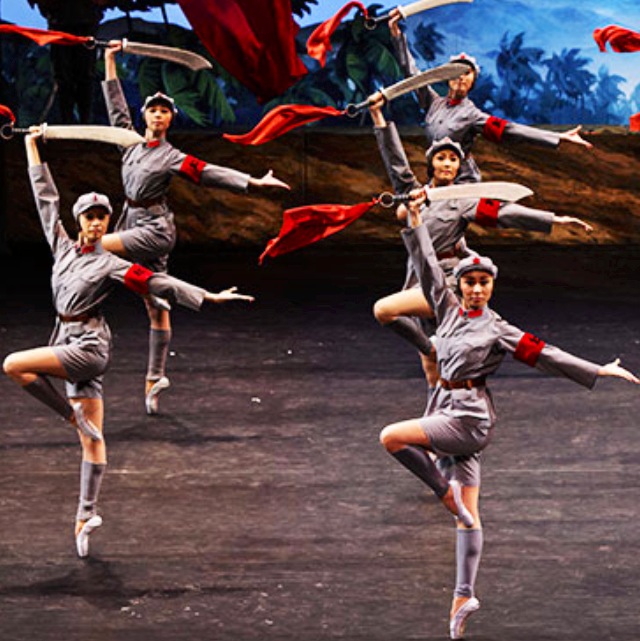
In the 1960’s and 1970’s, Swan Lake and the rest disappeared from the national repertoire in China, and only a handful of radical ballets, including this one, got to be performed unto exhaustion.  But this ballet (and it certainly is one) has evolved into a nostalgic totem for an older generation for a rather poignant reason.  The uniform of the Red Detachment – hot pants, bare legs, bobby-socks thrust into pointe shoes – while certainly intended as macha, provided a rare moment of regime-sanctioned cheesecake in most serious times.  Sous les pavés, la plage!


The action takes place during the Chinese Civil War.  Everyone in the audience knows that the People’s Republic of China is about to prevail. Beware, evil landlords everywhere, especially on the first of the month…


PROLOGUE, night:

Our reluctant heroine/Wu Qionghua, tied to a pillar, struggles furiously to free herself.  A poor peasant girl, she has been singled out by the Evil Landlord/Nan Batian as one juicy and strong enough to be sold into slavery at a good price.

When the Evil Landlord’s Henchman/Lao Si tries to ready her for market…she escapes.

SCENE ONE, later that night:

She doesn’t get that far into the forest and the Evil Landlord Nan’s henchmen knock her out.  When the skies open and a violent storm erupts, the Evil Landlord and his minions flee, convinced the girl is dead.

Two innocent-looking men cross the stage.  But they are RED ARMY WARRIORS in disguise.  Hong Changqing/the Officer and Xiao Pang/the Messenger stumble upon the shattered Wu Qionghua.  She mimes/tells them about her miserable life.  They can only offer one solution:  to join in their crusade.

SCENE TWO, morning, a few days later:

The people and the rebel soldiers rejoice: a women’s revolutionary cell – the Red Detachment – has been created.  Their stylized training exercises remind us that ballet requires as much rigorous discipline as any “masculine” endeavor.  [The original cast actually underwent weeks of military training in order to lose their “SwanLake-y” softness).

Wu Qionghua arrives and denounces the crimes of her evil landlord.  Hong verifies her account.  As newly appointed commissar of her unit, Hong welcomes our fervent heroine to the “Detachment” and gives her a gun.

SCENE THREE, nightfall, at the Evil Landlord’s estate:

Hong, disguised as a rich merchant, has crashed Nan Batian’s birthday festivities.  Nothing could possibly go wrong.  At the sound of a gunshot at midnight, the women’s brigade will strike and annihilate the landlord and all his kind.

But Wu, unfortunately, totally messes up.  When she stumbles upon her former tormentor she cannot resist this chance to try out her new gun.  Not only does she miss her mark and thus allow the evil landlord to flee, but by letting her gun go off she has prematurely given the signal to attack.

While evil has not been wiped off of the face of the earth tonight, at least the rebels manage to seize the landlord’s hoard of grain. They redistribute it immediately to the poor.

Hong critiques Wu Qionghua for her ridiculously emotional behavior, unworthy of the warrior she must strive to become.

SCENE FOUR, dawn at the rebel camp:

Hong lectures the female division about the importance of discipline, of self-control, a lesson our ever less reluctant heroine takes to heart.  She now understands that she must fight not against HER landlord, but against ALL landlords.  She must leave her ego, her past, and her pains aside. Only then can she become an effective instrument of “the people.”

She has transformed herself into Hong’s best comrade-in-arms. This, then, is what true love is about: community. 

As one big happy family, the peasants and the Red Army Soldiers, share their joy.

When the Evil Landlord’s minions attack a recently liberated zone, the entire village heeds the call to arms and heads off to fight for everyone’s freedom.

SCENE FIVE, in the mountains:

The Red Army tries to squeeze the enemy and cut off its supply lines.  Hong, trying to protect his unit, is wounded and captured.

SCENE SIX, dawn, at the landlord’s estate:

Hong dies, heroically.

But so does the Evil Landlord (much less heroically).

Blue skies chase the clouds away.

Qionghua takes over for Hong and humbly agrees to become Party Commissar.

Peasants and soldiers and audience now must join in singing “The March to Victory.”

Commentaires fermés sur China’s glorious red detachment of women (Plot Summary)

Classé dans Hier pour aujourd'hui

La Sylphide: A phantom of delight

 “Surprised by joy – impatient as the wind/I turned to share the transport.” (Wordsworth, “To Sleep”)

P1050181La Sylphide at the Palais Garnier on closing night.

Just getting to see just one of Amandine Albisson’s first Sylphides [bless your pointy little head, director of sales at the Opéra de Paris, for NEVER letting us know who will dance when tickets go on sale] occurred by chance.  A Balleto d’or for “best led game of bait and switch” should go to management for trying to prevent the core audience from seeing the casts they wish to see.

Though nothing can bring back the hour/Of splendour in the grass, or glory in the flower.” [“Ode, Intimations of Immortality.”]

P1050222On almost all these nights of the Paris Opéra’s run of La Sylphide, I have had the privilege (nuanced with regret, for he could still dance James) of enjoying the splendid stage presence, timing, and almost inhuman musicality of Stéphane Phavorin’s inexorable Madge.  He’s always been a one-man-band (what the French call more aptly un homme-orchestre), ever able to create glorious music out of the crap which the completely undisciplined Paris Opera orchestra constantly throws out into the auditorium, seeming to think nobody will notice. [Note to the orchestra: we don’t just hear your flubs. Those in the front box seats get to admire your sophomoric antics as well].  The entire quacking wind section should be retired, not this verray parfit gentil knight.

Phavorin is only dancer I’ve ever witnessed who to managed turn the role of Paris into a most elegant and dignified model of masculinity – rather than the embarrassed post-it of a man you always get.  I do not understand why he retires — obviously in great shape — stuck in character roles, having never been given a stab at Romeo.  During his adorably diffident curtain calls on the night of his forced retirement [age 42.5 according to law], Phavorin seemed as encumbered by his bouquet (bringing them on proves a rarity on the Paris stage) as an unwilling bridesmaid.  He kept trying to hand them off to Albisson, perhaps hoping that she will never get her wings clipped like so many others have.

“A lovely apparition, sent/To be a moment’s ornament/ […]I saw her upon nearer view,/A spirit, yet a woman too! […]And now I see with eye serene/The very pulse of the machine;/A being breathing thoughtful breath,/A traveler between life and death”  [ “She Was A Phantom of Delight.”]

P1050231Amandine Albisson, my Sylphide on the closing night of the season, is one of the few dancers at the Paris Opera who seems to be on the way to having a normal career. So far. She’s steadily been given roles, freed to catch the light and our attention. Her regal yet lithe and emotionally fragile Venus proves the only thing (besides the appalling sets and costumes) I remember about Ratmansky’s forgettable “Psyché” last year. [Scheduled to be paired with “Dances at a Gathering” next year.  Don’t get me started on the management’s choices for mixed bills].  Juicy and tart in Roland Petit, too, especially as the vicious gypsy in “Le Loup.”

Skinny as any other dancer, she projects an unusually plush physical centeredness.  A tallish one, she can sometimes seem a bit languorous.  For these very reasons some disliked her calm aplomb in the recent revival of Forsythe’s “In the Middle, Somewhat Elevated.”  While I’ve enjoyed these qualities each time I’ve seen her dance I had started to worry that she getting ready to be typecast unimaginatively as “always a Myrtha but never a Giselle.”   Certainly, she has proven she can do queen or goddess.  Princess? Not a far stretch.  And now…

On July 15th, Albisson still chomped at the bit at first like a young racehorse, anticipating the music.  But once she settled down, she harnessed her qualities and tweaked them: yes, a woman who dances, yet sprightly too. Neither cloyingly feminine nor overtly carnal, her Sylphide – while definitely female and seductive – emanated the oddest aura of…old soul.  I’ve never seen a Sylphide have such pity infuse the looks cast at her Effie: “poor child, you are very pretty for a humanoid. But you really don’t have the slightest chance, my dear.”

“I have felt/A presence that disturbs me with the joy/Of elevated thoughts ;a sense sublime/Of something far more deeply interfused,/Whose dwelling is he light of setting suns […]and dwelling is in the mind of man.” [from “Tinturn Abbey.”]

Imagine the imperious yet vulnerable Maria Casarès using her velvety voice to lure Orphée away from his life/wife and to his death in Cocteau’s film.  Albisson seemed to galvanize Florian Magnenet’s James.  Never have I seen a James fuss so much about his engagement ring, and never has that ring made more sense as an anchor, a lifeboat, a magnet.  Magnenet/James wasn’t an impetuous lad like Chaillet, nor a Byronic  and dreamy poet like Heymann.  His James could have been narrated by Alexandre Dumas, Jr.  This hot-blooded Scot has just returned to his native village after quite a disappointing time in the big city.  He’s vowed to give up fast women and big ambitions. He’s hoping Effie can save him from all his addictions.  But it quickly becomes clear to us that even without Albisson’s witchcraft, soon Magnenet/James would be cheating on his virtuous and virginal wife in any case.

I could just hear Wordsworth natter on:

O’er rough and smooth she trips along,/And never looks behind;/And sings a solitary song/That whistles in the wind.” [“Lucy Gray”]

Now, honestly, how could any man resist the allure of the yet-unbroken spirit of a ballerina like Albisson?

3 Commentaires

Classé dans Humeurs d'abonnés, Retours de la Grande boutique

As Diaghilev may have said: “ASTONISH ME!”

diaghilev CocteauA triple-bill : “Béjart / Nijinski / Robbins / Cherkaoui-Jalet” and the others (Igor, Claude, Maurice) begins May 2nd at the Palais Garnier in Paris.  

Probably the most famous words spoken in dance (and probably the most apocryphal – mà, si no è vero è molto ben trovato), the impresario Serge Diaghilev’s roar quoted above can also be interpreted as “I want the best of everything.”  In 1908, this Russian aesthete began flooding Paris and beyond with the best musicians, the best dancers, the best designers, all obsessed by ceaselessly exploring the now and the new.  Until his death in 1929, Diaghilev’s Ballets Russes company continued this obstinate pursuit of the cutting edge: rich evenings of one-act ballets harnessing season after season the best talents of his time (some of them in embryo, as in a neophyte Coco Chanel for costumes):  Balanchine, Nijinsky and his sister Nijinska, Massine, Lifar/ Picasso, Braque, Matisse, Goncharova/ Stravinsky, Prokofiev, Debussy, Ravel…

Here the Paris Opera Ballet pays tribute in a manner Diaghilev might have endorsed: one revival, two re-mixes, and something so utterly new that the current management hopes it will make you jump out of your seat.

L’OISEAU DE FEU (FIREBIRD

Choreography:  Maurice Béjart (1970)

Music:  Igor Stravinsky (1910)

The original choreography for this ballet as set by Michel Fokine in 1910 continues to be produced in companies around the world.  Inspired by Russian fairytales, the classic version tells a linear story:  a rather dim prince encounters a big red bird wearing a tutu and toe shoes.  To the prince’s astonishment this one, unlike most ballet heroines, is not hanging around waiting to be loved or rescued, she wants to be rid of him.  She buys her freedom with a feather that will bring her back if called, promising to help him if need be.  And he will need it, once he encounters an evil sorcerer who seems to patronize the same beauty parlor as Edward Scissorhands.  In the end, the prince will end up freeing a passel of knights who had been uncomfortably turned into stone and a multitude of enchanted princesses for them to marry.

Maurice Béjart kept the redness of the “firebird’s” costume, but little else of the story when he remade it.  Or did he?  For the essence of the story remains the same:  we yearn for freedom, for liberation, at any price.

Here the bird –the free spirit, the catalyst — is danced by a man. For Béjart, totally ‘60’s in his instincts, a “firebird” could only mean a “phoenix:” a creature willing to be consumed and destroyed if that brings us a greater good.  Unlike the bird of 1910, this one will try to fire up the masses, rather than simply shake up a spoiled and naive princeling.

Honestly, I find the 1910 version, rooted in ancient Russian myth, eternally satisfying in the way it responds to and is rooted in the music. This 1970’s “partisan” version – inspired by emotions burning deeply right then due to the Vietnam War – can seem somewhat dated.  On the other hand, while it remains rather easy to locate women sporting tutus and feathers, being able to gape at a buff guy dancing his head off in tight vintage red spandex remains a relatively rare, and a most pleasant, experience.

 L’APRES-MIDI D’UN FAUNE (AFTERNOON OF A FAUN)

Choreography:  Vaslav Nijinsky (1912)

Music: Claude Debussy

Ode to a Grecian Urn goes somewhat 3-D.  Dance stiff and stylized in profile with bent knees and legs in parallel (as unnatural and uncomfortable for ballet dancers as skiing).

In this re-creation of the original choreography, a half-man/half-animal meets some females with anacreontic hair.  Not quite sure what to do with his feelings and the signals these women seem to send, the Faun ends up frightening them away. Like men in most bars today, he just doesn’t get it.

Left alone to figure out just what to do with the scarf one of the nymphs dropped when she fled, the Faun’s final gesture will still, 101 years later, astonish – even offend — some in the audience.

L’APRES-MIDI D’UN FAUNE (AFTERNOON OF A FAUN)

Choreography:  Jerome Robbins (1953)

Music: Claude Debussy

The same music again, but completely different…or maybe not. Consider how a ballet dancer his/her self could seem to be the most exotic and mysterious figure out there for many of us flat-footed ones.  They are fauns, fauna.  Outside the studio, they glide yet walk like ducks, hold their heads as if they had antlers balanced atop, take dragonfly leaps over puddles in a delicate manner frogs would envy, do weird catlike stretches in airplanes…but inside the studio, freed from our gaze, they become human again.

Jerome Robbins (choreographer of Gypsy, West Side Story, Dances at a Gathering) created a ménage-a-trois to the same score as Nijnsky:  only here the almost lovers turn out to be 1) a boy 2) a girl 3) the studio mirror.  We, the audience, get to play the “mirror.”   If the 1910 version made you gasp, think about how here you get seduced into becoming peeping toms.

BOLERO

Choreography: Sidi Larbi Cherkaoui/Damien Jalet( 2013)

Sets (and probably explosive ideas): Marina Abramovic

Music: Maurice Ravel (1928)

Invented in 18th century Spain, the “bolero” is a slow dance where two simple melodies are repeated again and again over a stuttering triple rhythm (one, a-a-a, and three, and one…). The Franco-Basque composer Maurice Ravel’s version differs from its model in that it builds to a cathartic orchestral crescendo.  Think Andalucia meets Phillip Glass.

In a medium difficult to write down and for long rarely deemed worth filming, Bronislava Nijinska’s original choreography – for the pickup company of a former Diaghilev diva who dared to set up a rival company, Ida Rubinstein — died with those who had experienced its few performances in 1928. Apparently her creation didn’t astonish the audience enough.

In Maurice Béjart’s 1961 version – the one most performed since — he appropriated part of Nijinska’s original story: a man/woman dancing alone on a table in a tavern.  But Béjart added how he/she slowly arouses his/her spectators on-stage and out-front to a rather melodic orgasm. His version remains enormously popular, if always rather embarrassing to witness.

As the première of a new conceptualization of this same music will take place May 2nd, I cannot tell you more than the pedigrees of the three commissioned to astonish us:

Cherkaoui/Jalet, both born in 1976, have collaborated for years on performance pieces, all over the world.  Cherkaoui started dance late – but is a very hip grasshopper — Jalet started his drama and ethnographic music studies earlier.  Both grew into and from the wild Belgian modern dance scene, which continues to sprout all over. Both men love exploring the limits of music and dance and stagecraft: from Björk to flamenco, from Florence and the Machine to Shaolin monks, from the potential physically and mentally disabled performers can bring to life to the banality of our everyday gestures.  These two share a quest to explore and explode categories of identity.

Adjoining them to the Grande Dame of Terrifying Performance Art – Marina Abramovic – makes me a bit nervous. Dare I say she explores and explodes too much in protest against our flat lives? Even if her most recent piece, which played at the MOMA in New York, seemed mild (only sharing a moment of silence per person during 736 hours with hordes who lined up for the emotionally exhausting experience), she has built a reputation since the 1970’s as someone inspired by quite extreme quests: almost burning to death, passing out from lack of oxygen, taking pills in order to have seizures or catatonia in front of an audience, letting it bleed…

Because they have pushed their bodies to the limit since childhood, self-induced pain brings nothing exciting and new to dancers. All that I hope is that this creative trio agrees that their cast has already been tortured enough. On the other hand, since I couldn’t attend the last time a ballet provoked a riot by furious spectators – the Diaghilev-provoked Rite of Spring one hundred years ago – I’d be tickled to actually be present at one…

Commentaires fermés sur As Diaghilev may have said: “ASTONISH ME!”

Classé dans Hier pour aujourd'hui, Humeurs d'abonnés, Retours de la Grande boutique

Roland Petit bill : “Float like a butterfly, sting like a bee”

P1010032While the big news of the evening of March 27th, has of course become Eleonora Abbagnato’s late-career elevation to the rank of étoile/prima ballerina during the final curtain calls, I’d like to start by mentioning other dancers, those young talents and strong soloists who gave masterful performances earlier in this evening devoted to Roland Petit’s ballets.

Dancers, athletes, choreographers.  The self-proclaimed greatest boxer Muhamed Ali once said “Champions aren’t made in the gyms.  Champions are made from something they have deep inside of them: a desire, a dream, a vision.”

Many criticize Petit as merely a “dance maker.” Or even worse, a vulgarian. However I like the fact that, by being somewhat obvious at times, his desire, his dream, his vision, was to make the audience feel smart and included. His are ballets to be engaged with directly, without afterwards feeling forced  — because you feel stupid and confused — to purchase and read an expensive program with all its extensive rhetorical flourishes.  What his works will always need – and don’t all ballets? – is to continue to be fed by the imaginations of great dancers, younger and older. They can give any package of steps and gestures new life and, by melting into the music, provide the “oomph” that make ballet continue to come alive again night after night.

It’s a lack of faith that makes people afraid of meeting challenges, and I believe in myself.” (M.Ali)

Le Rendez-vous distills, somewhat awkwardly, the perfume of post-liberation Paris.  That somehow magical moment of Juliette Greco, of Sartre, of Montand and smoke-filled dance halls. While “of the moment” in 1945, it’s now up to the performers to make this dusty relic sing to us.

Alexandre Gasse, a youthful demi-soloist, got his chance to embody the archetypical “young man about to be eaten alive during sex by a praying mantis” (Petit’s ballets can unfortunately, I must admit, too often resort to the virgin/whore and man vs. female bloodsucker dichotomy pushed to center stage during the Romantic Era but which wears thin these days).

Most of the ballet actually revolves around his gentle relationship with a crippled beggar – to set up that he’s a nice guy — only in the last scene does he have to deal with the femme fatale in high heels (crippling for her).  Throughout, Gasse floated like a butterfly, landing after all kinds of double-tours softly onto one knee.  His performance was free, emotionally fresh, danced with flair and thoughtfullness, his chest and back open and ready to take on almost any challenge.

I’d begun to hope that he’d just go off with the beggar and, as they say in the  French variation on “happily ever after:  “et ils eurent beaucoup d’enfants.” But then another young soloist arrived for her date with the audience, Amandine Albisson.

Albisson, in her Louise Brooks wig, at first made me think of Arielle Dombasle during her recent Crazy Horse phase.  But she only resembled a frozen monument to pulchritude at first glance.   Albisson has already demonstrated – in Psyché or in In the Middle, for example –  that she is endowed with a fearless stage persona and spotlight-attracting cool. Even if she hasn’t yet quite mastered the scarily humorous and sensual way that Ciaravola and Cyd Charisse unfurl their gams in extensions, her dance already has its own weight and authority.  For two seasons now, she’s been testing her wings.  I hope she won’t try to imitate Ciaravola or Guillem  and continues to believe in herself.

“George can’t hit was his hands cant see/Now you see me, now you don’t/George thinks he will, but I know he won’t.” [M. Ali]

Le Loup is a cruel parable of mistaken identities and identity confusion.  Sabrina Mallem, in the supporting role of the gypsy, grasped the chance to have the time of her life: she created a character ferocious and cruel by using sharply stabbing feet,  no, chiseled, no, it wasn’t about the feet, the legs, the arms, at all in fact.  It was about the full-bodied, blood-rich, completely disarming sensuality she managed to express at every swerve of every part of her superbly-controlled body.  Mallem radiated life like a great boxer high on adrenaline. She’s hit that “sweet spot” where honed technique and learned stagecraft make even a mere soloist a great performer.

And so to Carmen, a highlight during an evening of highlights.  Where Abbagnato seemed to be telling us and them:

If you ever dream of beating me…you better wake up and apologize.” [yes, Ali again]

Petit structured a couture gown around his beloved Zizi Jeanmaire with this ballet, designed to highlight all of her multiple attributes… in 1949. And ever since, the specter of its two creators has haunted each ballerina who dares try to tame this ballet while trapped in yet another black wig.

Most fall into two categories: those Carmens who overdo the bent-index-finger biting “ergo me sexy” category, and the others who overdo the “ I gotta pretend I be ze flamenco queen “ category.  In each case, they all forget that the original French text, even music, is filled with bitter irony and a raised eyebrow.

Petit’s Carmen does not need to be overcooked.  She needs to hum, not scream.   She’s the only fully human character in the whole piece.  The rest certainly move about, but they – especially the men — are in essence cardboard cutouts.

Abbagnato’s Carmen fluttered like a butterfly and brawled like a bee. She sandpapered away all the clear edges one would expect, and spared us any “olé, olé” hispanitude. More than that, she gave a dragonfly aspect to the character.  Never at rest, always buzzing, ever alert to threat, proud of her delicately nervy wings.  Indeed, she was probably unphotographable this night, for she rarely paused to pose for a six o’clock standard snapshot. She was too busy dancing.  And by really dancing, not just steps but ideas, she kept making the interstices in between the usual photo-ops come alive.

I found myself completely absorbed by the final duel between this elusive heroine and her Don José: for once it seemed as if this Carmen suddenly had decided that there was no way the choreographer would let her down and not let her go free. Her movement reflected less the shivering angry  pride of Zizi Jeanmaire when confronted by Don José’s knife, but a kind of shock  at this man’s betrayal. By wielding a knife, he was cheating and breaking the rules of the game. Dragonflies, butterflies, bees never expect to face a pesticide.

So when Abbagnato launched herself at her lover’s knife with the fervor of the character she’d sculpted in 40 minutes flat… the entire house heard another patron near me “lose it.”  A loud gasp of “Mais ça alors!” [American translation: “Jesus H. Christ.”]  That’s the kind of comment yelled out at a boxing match where the one you root for gets hammered.

While some of you may find Petit awfully corny, I like the fact that he always tried to make the dances where dancers could convince even one member of the audience thinks this dream, this vision….is real.  And never want to wake up.

Commentaires fermés sur Roland Petit bill : “Float like a butterfly, sting like a bee”

Classé dans Retours de la Grande boutique

The Nureyev “Gala” in Paris: I was there, but Nureyev definitely wasn’t.

P1010033What a stunningly lukewarm tribute to a glorious past. If, quite often, some piece turned out to be cleverly — even beautifully — danced, what the evening consistently denied the audience was a sense of how Nureyev had touched the lives of the dancers in this company.

The evening began with a 4-minute slide-show of photos set to Swan Lake’s polonaise. And then, as they say in Italy, è basta. No films of rehearsals, no other reminders during the evening, no tributes at the end, no nothing.

Craning my neck around from my seat even before the evening started, I had been delighted to spot many who once served to inspire Nureyev’s obsessively revisited stagings of remembered worlds of choreography during his tenure in Paris. All of these retired but far-from-dead dancers continue to speak eloquently and openly at other venues about how Nureyev’s passion for dancing inspired their own. Yet not a single one had been drafted to pass along to us this night what they knew of Nureyev, to say a few words, (even on video) before each piece. How I wish that at least they had all been invited onstage at the very end to take a group révérence.

Nureyev’s inventiveness as a choreographer remained equally unacknowledged due to the choice of excerpts.

Why present so many warhorse standards that only shed dim light on what Nureyev had once wrought? We just went through 24 “Don Quichotte’s” two months ago: so did we really have to revisit the entire pas de deux which is the least “Nureyev-y” part of the production, to then only be offered a taste — the entrada and adagio — of the Black Swan pas de deux which he’d idiosyncratically expanded into a pas de trois with that unusual solo for Rothbart/himself?

After Raymonda’s “clapping variation” my mind drifted to how many dancers in the audience had been directly involved in the enormous adventure of “Raymonda.” Nureyev had filled out the life of this ballet by bringing each character to the fore. He transformed the small mime-y roles of Henriette and Clémence, of Bernard and Béranger, into fully and deftly danced ones. Where was the pas de six? Where was the great big waltz for a full corps of boys and girls? And where did they hide that beautiful and exotic and manly creation, Abderahm, with his – for its time — devastating synthesis of classic and modern impulses?

Most of all, I wondered what had happened to the male corps de ballet which Nureyev was purported to have re-energized? It must have been dancing outside the house during those first four minutes of slides when the orchestra had attacked the polonaise and then gone home. Our one moment with more than a four men at a time — Don Q’s fandango — while certainly inventive and stylish, doesn’t really bring any of the technical and expressive abilities of the male corps to the forefront.

An “homage” to Nureyev where men hardly dance at all? Is that possible? In peevish response, I will not mention a single ballerina in this summary.

Almost all of the leading men got stuck being wallpaper. We caught glimpses of: Hervé Moreau, Benjamin Pech, Mathieu Ganio, Stéphane Phavorin, Audric Bézard, Vincent Chaillet, Yann Saiz : all relegated to supporting females  in pirouettes or penchées, The men got to do their moves as if the pre-Nureyev, no, the pre–Nijinsky ukaze against male dancers daring to be other than moving-men was still in force. As in: we do our best, but nobody wants to look at us anyway.

Duquenne tried, stretching out the energy of his arabesques as Nureyev would have liked in the Nutcracker Snow Scene. Magnenet brought energy and delight to “Cendrillon.” Le Riche shrugged off this atmosphere  and charmed his way into Juliet’s heart during the balcony scene from « Roméo ». Each time: a female partner. What about Nureyev’s  many duets and trios for guys?

The only masculine solo saved the evening for me. Nureyev would have relished the way Matthias Heymann returned to the stage after a major injury. Nureyev had always loved beautiful movement full-out, had loved honesty in the moment, had used his eye to pick out those dancers who come fully alive on stage, who need and want to have us out there in the dark. Heymann’s ecstatic resurrection as Byron’s/Nureyev’s ill-begotten “Manfred” provided a rare moment of grace.  Perhaps the only true homage all night.

The evening ended with bits of the last act of “La Bayadère,” including the languorous descent of 32 ballerinas, lovely, albeit no longer an unusual feat for most companies. Why not the devilishly complex fugue for the boys and girls from the first act of his “Swan Lake?” Or the many other moments from Nureyev’s “Bayadère” when male dancers do take part? Or, or… (As Solor, Stéphane Bullion mostly provided wallpaper too).

Perhaps that is why none of Nureyev’s dancers took to the stage at the end of the evening. This provincial gala had had nothing to do with what Nureyev had taught them – and us – about ballet.

1 commentaire

Classé dans Humeurs d'abonnés, Retours de la Grande boutique

KAGUYAHIME: three faces of the moon (and the sun)

AgnèsKagyahimeAlice Renavand and Hervé Moreau:

 “There came a wind like a bugle;/It quivered through the grass […] How much can come/And much can go/And yet abide the world!” [Emily Dickinson,“There came a wind”]

Ah, what an innocent moon princess, wide-eyed little mermaid, who gave us dance that proved as soothing as a warm bowl of milk.  Renavand’s Kaguyahime on February 7 linked her every movement into the next into the next and the next with the smoothest control and ease.

Her baby-goddess made me think of…a kitten, a filly, a puppy.  One who went out to play, got fascinated by a bit of string, trotted after a butterfly – the entire audience returned her grin when she got hoisted onto those boxes by the villagers – and then found herself lost and too far away from home, naïvely incapable of understanding why a pack of surly hounds started picking on her.

Her encounter with Hervé Moreau’s Mikado [Emperor] really proved the highlight of the evening.  Just looking at him — utterly still but overly alert on his throne then slicing sinuously through those theatrically billowing golden waves of fabric — I could have sworn I heard the supple baritone gravitas of the actor Jeremy Irons’s voice.  Renavand’s juvenile moonkitten found herself face to face with a fully-grown lion.  None of the other Mikados made me so feel the burden of great power and its constraints:  his spine seemed endlessly strong, elongated, yet a stillness in his core indicated that maintaining dignity at all costs took precedence over any hope for true love. When rejected at the end, he didn’t flicker an eyelash. He re-stretched his spine and then, with the grace befitting a son of the Sun, prowled in slow-motion down into the drummers pit with such with silken elegance that none of us could take our eyes off of him.

Agnès Letestu and Vincent Chaillet:

“Our journey had advanced;/ Our feet were almost come/To that odd fork in Being’s road, /Eternity by term.” [Emily Dickinson, “Our journey had advanced”]

When I first got to Paris, some of my random seatmates could grumble about Letestu. Gorgeous, yes, but so self-contained. One of the few nominated as étoile after Nureyev had stuffed that level with spectacular personalities (leaving  most of the next generation to vegetate as “premières danseuses”) she must have felt enormous pressure.  Too many of her interpretations were “in the head” – Giselle’s completely internalized mad scene as inspired by Dustin Hoffmann in “Rainman” springs to mind – but I always thought that if she’s that smart and that conscientious and that potentially delicious, then if one day she lets go of all that and just lets herself be onstage, it will happen. That has now been the case for these last glorious years. Think of the way she sunk her teeth into “Diamonds” by letting herself enjoy the mastery of movement and space she had always possessed, utterly stunning Jean-Guillaume Bart. Remember her magnificently gleeful and relaxed Siren recently in “The Prodigal Son.”

Is that why I found the moon on February 8 closest to being an absolute goddess, the live embodiment of a star.  Such women, like the self-contained Garbo, paid dearly for the freedom to just be themselves.  Letestu has let go of all the tiny voices and knives around her, but perhaps used the memory of all that to shape her poignant persona in this role. Her Kaguyahime also resembles Kylían himself: a deeply melancholy and intelligent man, quite disabused about life and others, yet generous, thoughtful, and full of a desire to connect with the audience.  Like Kylian, and the gods, Letestu held out a hand to us from the moment she stepped onto that platform and began to perform her first measured and tentative steps.  She radiated trust in herself…and trust in our capacity to follow her on her journey.

Vincent Chaillet’s manly Mikado could not hope to hold onto such a philosopher-queen. He was (quite!) appealing, but this incarnation of the moon recognized the power of her own innate sadness.  She made us feel that she had always known that daylight would be too bright for her to endure for long.

Renavand’s final steps homewards made me sad for the adventure she felt forced to abandon. She had no choice.  Letestu’s made me glad: all evening, she had made each of her choices with integrity and lucid honesty. And she had said all she wanted to say. When Gillot finally turned her back on us, the feeling became bittersweet.

Marie-Agnès Gillot with Alexis Renaud:

“Parting is all we know of heaven, / And all we need of hell.” [Emily Dickinson, “Parting”]  

Her interpretation benefitted most from the change of venue to the more cozy and intimate venue of the Palais Garnier.

She’s a complicated dancer.  Ballet is crueler than the modeling world and, as a woman of height, thin but with the gorgeous shoulder-blades of a swimmer, I am certain she’s had this fact drilled into her:  you can be cast as a queen (Swan or Wili) but abandon hope for ingénue or princess.  When in fact she’s allowed to play soft and feminine roles, she can astonish us:  her first act Paquita on one night about ten years ago should have served as the model to others of how to dance fleet of foot and light of heart.  Her petit allegro made you forget that it’s quite hard for big dancers to move fast.  She made herself weightless.

Back at the Bastille, Gillot’s performance of Kaguyahime two years ago suffered from a need to project into that big barn of a house. This brought out a necessarily ingrained discomfort about being “too big.”  So her interpretation back then struck me as a bit marmoreal, monumental, too dour.  She put none of the finesse and delicacy that she possesses to use.

When she appeared on stage on February 14th, my eye (from the top of the Garnier) found itself drawn to…her hands, suddenly tapered and filled with a febrile energy that seemed to shine out from the tips of her fingers.  (I hadn’t seen that from much closer two years ago).  These little/big hands began to tell a story:  “at home, I have the loooongest fingers, but here I stretch and stretch and they still feel so stubby. What’s going on?”  This alien from the moon vividly expressed disconnect:  her movements constantly exhibited darting moments of tension, as if she kept wanting to find the way back to moving the way she used to when she had been happy and free up in the sky.  Of all our three moons, she most illustrated how walking on earth — being bound by gravity, assaulted by our filthy and exhausting air — challenged her.  Not at all that she couldn’t do the steps or looked like a big lump – the “floor-barre” solo in Act II left no doubt as to each ballerina’s masterful, even superhuman, muscular control – but even near the end she continued exploring how to shape each movement against the tethers of the earth and that engaged my sympathy.

Pairing her with Alexis Renaud’s Emperor – diffident, less assertive than the others – inverted the dynamic of Renavand/Moreau.  Renaud needed the aid of those two henchmen to subdue her, and he knew it.  But by being softer, he allowed Gillot to become the only one of our moons to really hesitate about returning to the sky.  Each time she turned back towards us at the end, you could feel her dilemma:  “maybe I’m wrong, maybe happiness really does exist in your world?”

Commentaires fermés sur KAGUYAHIME: three faces of the moon (and the sun)

Classé dans Retours de la Grande boutique

Small steps/Onegin in London, bis.

P1000939When little kids think about dancing, they imagine either prancing around or doing that tippy-toe tiny run which Americans call a “bourrée” and the French call “piétinées” (literally = little stabbing steps you use to crush something.)  Tipping around on your toes while not shuddering your entire body ain’t, to put it lightly, easy. Dancers with boobs hate this step. Even without boobs, you feel the largest you’ve ever been doing this most simple little thing. It’s just not natural and the mirror concurs: you’ve never looked more tense and gelatinous in your entire life. It’s the simplest, but the most damnably difficult series of small steps on earth.

Then Alina Cojocaru, as Tatiana, began to bourrée around the stage, one hand hung limply about mid-chest, disconnected from the rest of the buttery palpitations of her feet. Limp at first, yet her hand vibrated in and out due to the aftershocks of the troubling feet below.  I finally understood the point of this step. It’s not about prancing. It’s the means by which you can semaphore just how hard your own heart is beating. Most often when you get to do it on stage (Swan Lake comes to mind) the bourrée means to tell the audience you hesitate about something, most often love.  Cojocaru’s thoughtlessly palpitating little hand kept bumping against her heart.

Having seen her many times, including her Paris Giselle, I still could not tell you about the shape of her arch.  The Olympic rating of her feet [probably gorgeous] is not the point.  The way she uses her feet is.

Shattered by Onegin’s [Jason Reilly’s] rejection in Act II, Cojocaru then focused me on her neck and eyes.  The way she seemed to nestle hesitantly yet trustingly into Bennet Garside/Gremin’s ardent but prudent arms and return his gentle gaze let the audience know that there might be an interesting Act III to come.  Too often, I’ve found that I’ve forgotten that the leftover guy who dances around with her from Act II is the same dancer who becomes her husband in Act III.  The Gremins need to somehow come alive just at the moment that their Tatianas endure public humiliation…this role tends to be undercooked.   Here it came out just right.

In the evening, Thomas Whitehead’s Gremin proved a most White Russian aristocrat.  I’ve often been perplexed by how that role should be played.  Here you are, covered in medals, a prize coveted by matchmakers, yet the girl of your dreams has somehow managed to fall publicly and stupidly in love with someone else much less worthy.  But you can’t play for boorish aristocrat, for then Tatiana must be really crazy not do do an Anna Karenina.  This supporting role demands delicate balance.  Tenderness or masculine pride seem to offer themselves as the best options.  Gartside opted for tender, Whitehead went for pride.

And that worked in each case. They were up against very different women, Cojocaru’s Tatiana couldn’t stand the suspense and looked at the last page of the book she was reading in order to calm down, while Sarah Lamb’s Tatiana let her book happen to her.  Her bourrées were cleaner, more literal. She wasn’t a sprite who needed to be tamed, she was already a woman, as Cleopold has pointed out.  But a woman, as she tippy-toed around aroused by love her hands dangling poised and softly curled, who had already lost her way and probably would never find the strength to go after what she was looking for.

Purists – White Russians raised on Pushkin, other picky eaters – would have died during this evening performance.  OK, so Lamb is as blonde as they come, and so what?  As if Tchaikovsky’s opera hadn’t already added to and cut all kinds of stuff from the original poem.  Why fault this ballet for not cleaving to the (which one?) original?  Ballet was never meant to illustrate but to create new images…

Instead of wearing a ridiculous wig, Lamb concentrated on creating a rich character out of flesh and bone.  This one never will get over the romance novels that her dashing Onegin (Valeri Hristov) deems so jejune. That is why her piétinées/bourrés seemed smoother, more widely spaced, more confident.  She knew that she had found her romantic hero and would never change her mind.  Precisely because she was so touchingly naïve and confident in her Act 1 Dream Scene, remaining somehow so while shocked by Lensky’s murder, Lamb’s final act proved heartbreaking. In a very different way.  Cojocaru’s Tatiana let us know that the tragedy from here on after would be Onegin’s and she had already begun to grieve for him.  By first dancing calmly and kindly – Englishly? – with her boring husband, then suddenly re-awakened to sensuality – and, oh, the possibilities — with Onegin, Lamb let us know that losing him will become the obsession that will shape of the rest of her bitterly unhappy life.  Cojocaru’s Tatiana will find joy in other things, be they babies or sunsets or sitting by the fireplace.  Nothing in the rest of Sarah Lamb’s Tatiana’s life will ever satisfy her.

One day, Cojocaru’s T. will tell her husband the whole story (Gartside makes you feel she probably already has).  Lamb’s T. will take this secret with her to the grave, for it’s all she has, the only thing in her life that ever had meaning.

The bourrée is a weird step, for you can either move forwards, backwards, sideways, or remain stuck in the same place.  Few other steps can express all the possible responses you could take to all of life’s choices.  It’s up to you how you dance it.

Ce diaporama nécessite JavaScript.

Commentaires fermés sur Small steps/Onegin in London, bis.

Classé dans Blog-trotters (Ailleurs), Ici Londres!

An unbiased plot summary of KAGUYAHIME

“Fair as the moon, clear as the sun, and terrible as an army with banners.” (The Song of Solomon)

Kaguyahime, NDTI 1991, Photo Roger-Viollet

Kaguyahime, NDTI 1991, Photo Roger-Viollet

The word “surreal” nestles between “surprise” and “surrender” in most dictionaries.

1) “Having the intense irrational reality of a dream;”

2) “to strike with wonder or amazement esp. because unexpected (as noun)/ an attack made without warning (verb);”

3) “the action of yielding one’s person…into the power of another” (Websters’s Dictionary)

 All prove unexpectedly useful when trying to think about what happened in, and your reactions to, this most unusual and practically indescribable ballet.

Maki Ishii’s score gives us the live collaboration of Western percussionists with Japanese experts of Kodo and Gagaku. Jirí Kylián, inspired by the music, uses one of the first recorded stories in Japanese literature, The Tale of the Bamboo Cutter, to frame the action on stage.  Yet there is nothing “Japanese-y” about the staging, the choreography, the over-all message. This piece embodies a universal lament:  since the beginning of time men continue to blame women for arousing their own testosterone-driven impulses to commit violence.

ACT I  [40 minutes]

She, Kaguyahime the goddess of the moon, slowly prepares to descend to earth.  There she intends to walk carefully through its bamboo forests. Some part of her hesitates to encounter the earth’s fearsome aliens: us humans, but curiosity consumes her. She tests the ground with her feet gently – for her as weird a sensation as walking on the moon for us.

The music will illustrate this contrast between the celestial and the earthy throughout. The hypnotic rustle of the Gagaku winds, made of bamboo, belong to Kaguyahime’s world.  Harmonious and refined, Gagaku has provided the exquisite soundtrack to imperial court ceremonies for over a thousand years.  Buoyant and vigorous, Kodo drums are the sound of village festivities, they celebrate us in all our primal human power. Indeed, this is one piece where you may be excused for leaning forward to look into the orchestra pit:  the magnificent drummers seem to be dancing themselves.

Men in white, the “suitors” from the village, steal in and push around boxes (the symbolism escapes me). Each vies for her attention by dancing a solo of increasing intensity. Soon it becomes clear that they all wish to seduce her.  The last one actually manages to touch her, but cannot hold on to her. She manages to keep eluding his grasp.

The ground cleaves open to create a living sea of red colors.  The women of this village take over the stage and dance in a wild and jumpy way, pulling the men back into their orbit. Boxes are pushed around, opened and shut (the symbolism escapes me).  Kaguyahime finds herself literally hoisted onto a pedestal. But do they wish to celebrate or isolate her?

When conflict begins, we should not be surprised.  Those in black are the Mikado’s (Emperor’s) minions  — call them knights or nobles or…just…more… men.  This is not class struggle, however, for they fight about only one thing:  a woman.

The goddess of the moon is bewildered and sad. Why such a mess?  How could this be her fault?

O! Withered is the garland of the war,/The soldier’s pole is fallen; young boys and girls/Are level now with men; the odds is gone,/And there is nothing left remarkable/Beneath the visiting moon.” [Shakespeare, Antony and Cleopatra, Act IV]

Intermission [20 minutes]

ACT II  [30 minutes]

            Very violent drumming. One musician almost bashes in the face of a drum shaped like “the man on the moon.” The noise could even remind you of helicopters, the sound associated with combat. A local dispute has escalated into a major war where even women join the battle. Trapped by the competitive violence her beauty has evoked, Kaguyahime – as hapless as Helen of Troy – lets herself be pulled to and fro by a boy, a couple…

The gentle moon goddess tries to cover her ears, to hide, increasingly fearful of what she has wrought merely by having shown her shimmering self to us.

The stage is invaded by a billowing golden curtain. Our goddess finds herself engulfed in the manipulative and more than intoxicating embrace of the Emperor.  At first he seems quite the boor, stomping in with his two henchmen, but something about him fascinates her. She gets pushed and pulled in a tortured quartet and then abruptly finds herself alone. Perhaps, her solo suggests, the emperor – of all these men – has touched her heart? Could he possibly be more than a mere man? Perhaps slightly divine?

More wild drumming than you could ever imagine.  The army returns. The moon goddess suffers being beset by shields, mirrors, blocks: has the Emperor arranged all this new confusion?  He wants her.  And she wants him too, as becomes clear in a tense and too short duet(I lament how little stage-time Kylián allots the Emperor).

But this proves a most intelligent goddess.  Frightened by the awful covetousness of humans, their endless capacity for jealousy and their easy willingness to kill each other over all unimportant things, Kaguyahime decides to leave this planet.

She summons the brightest light. After the Emperor leaves her be –  descending as calmly as a sunset — she ascends regretfully back to her home in the sky, so very sorry that we have all disappointed her dreams of life amongst us.

With how sad Steps, O Moon, thou climb’st the skies!/ How silently, and with how wan a face!/ What! May it be that even in heavenly place/ That busy archer his sharp arrows tries? [Sir Philip Sidney, “Astrophel and Stella.”]

6 Commentaires

Classé dans Hier pour aujourd'hui