Archives d’Auteur: Fenella

Avatar de Fenella

À propos de Fenella

Pour ne pas rester muette, car je n'ai pas les deux pieds dans le même sabot, i will write in English.

My Nights at the POB (2024 Spring / Summer collection)

A classical ballet, just like a classic book you’ve reread many – many ! – times, almost never fails to delight you again when you rediscover it. Here are some of my most recent ones at the Paris Opera ballet.

Hannah O’Neill and Germain Louvet: a most pleasant discovery

P1200303Don Quichotte on March 27th

For a while now, I’d been unconvinced by the pairing of Hannah O’Neill with Hugo Marchand. His large presence overwhelmed her and their lines and musicality did not match. He made her look small and quite pallid, which is odd considering that the smaller Gilbert never did. Maybe it’s because Gilbert is clearly a fighter while O’Neill’s persona is more demure?

But who else could she dance with? Germain Louvet? Pairing them in Don Q on March 27th proved splendid: their lines and timing and reflexes completely in synch. They even giddily broke the line of their wrists exactly when the music went “tada.”

But Don Q is a comedy.

Up until now, for me, Germain Louvet only lacked one thing as an artist: gravitas. It was impossible to find fault with his open-hearted technique, but somehow I always got the feeling that he wasn’t quite convinced when he played a prince. Some part of him remained too much a stylish young democrat of our times.

His acting could reminded me of how you tried to keep a straight face when you got cast as Romeo at an all-girl’s high school.  You tried really, really hard, but it just wasn’t you.

P1200201

Germain Louvet (Basilio) et Hannah O’Neill (Kitri).

*                                        *
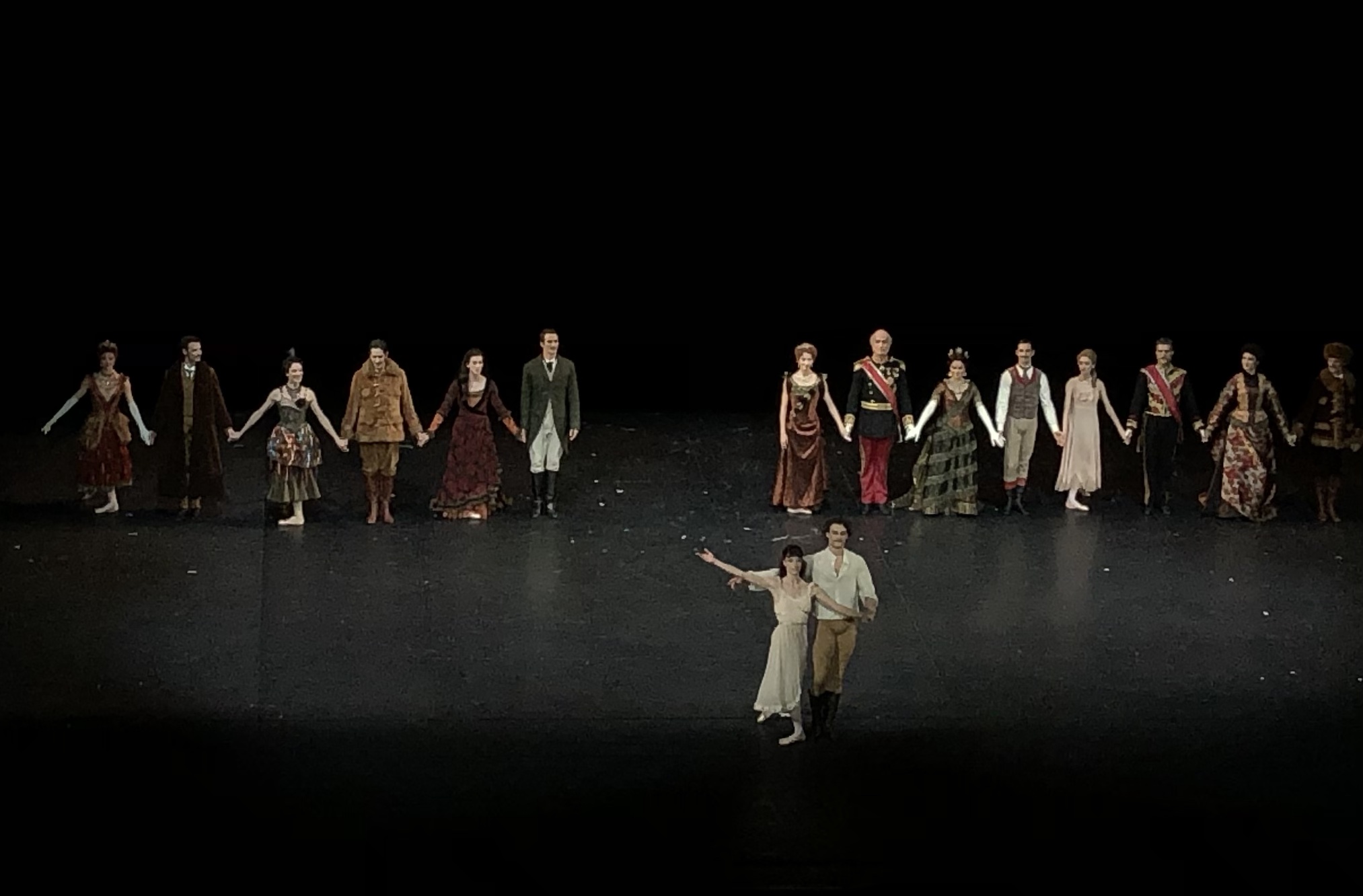
P1200348

Giselle. Saluts

Giselle on May 28th

Then something happened when Louvet stepped out on the stage on May 28th. Here was a man whose self-assurance seemed worldlier, tougher, critical distance gone. Within seconds in his pantomime with Wilfried, Louvet “was” that Old-World well-mannered man used to being obeyed and getting what he wants at any restaurant. I was convinced.

And it all came together when Hannah O’Neill answered his knock-knock.  A healthy, normal girl with no secrets who has clearly been warned about men but who has decided – on some level to this Albrecht’s surprise – that he is a good man.

Everything about O’Neill’s Giselle, from her first solo onwards, breathed restraint and modesty. She was the kind of girl who speaks so softly you cannot help but lean in to her.  Louvet’s Albrecht clearly felt this.

Once again, every little danced detail matched. But more than that, these two were literally inside the same mental space. Both of them reacted strongly to Berthe’s narrative:  O’Neill spellbound and Louvet taking that cautionary tale personally, as if Giselle’s mother had just put a hex on him. Later, when Giselle shows him her big new diamond pendant, Louvet managed the degrees of that multileveled reaction of “I must not tell her she has a scorpion crawling on her chest just yet.” And none of this felt like he was trying to steal the spotlight. He was really in the moment, as was she.

Antonio Conforti’s Hilarion had also been believable all along, his mild state of panic at the growing romance evolving into fear for her life. (His Second Act panic will be equally believable). When Conforti had rushed in as if shot out of a cannon to put a stop to the romance, you could see how Giselle knew that he was no monster. This nice Giselle’s inability to disbelieve anyone made her mad scene all the more poignant. No chewing of the scenery, her scene’s discreet details once again made us want to lean in and listen.  Giselle’s body and mind breaking down at the same time was reflected in the way O’Neill increasingly lost control, even the use, of her arms. She took me directly back to one awful day when I was crying so hard I couldn’t breathe and walked straight into a wall. Utter stunned silence in the auditorium.

Louvet’s differently shaped shock fit the character he had developed. You could absolutely believe in the astonishment of this well-bred man who had never even put one foot wrong at a reception, much less been accused of murder.

Woman, Please let me explain
I never meant to cause you sorrow or pain
So let me tell you again and again and again

I love you, yeah-yeah
Now and forever*

In Act II, you had no need of binoculars to know that the regal Roxane Stojanov  was the only possible Queen of the Wilis. Her dance filled the stage. Those tiny little bourrées travelled far and as if pulled by a string. She seemed to be movingNOTmoving. Her reaction at the end of the act to the church bells chiming dawn — a slow turn of the head in haughty disbelief — made it clear that this Queen’s anger at one man, all men, would never die. Clearly, she will be back in the forest glade tomorrow night, ready for more.

I was touched by the way Louvet’s Albrecht was not only mournful but frightened from the start. It’s too easy to walk out on the stage and say “just kill me already.” It’s another thing to walk out on the stage and say “I’ve never been so completly confused in my entire life.”

Woman, I can hardly express
My mixed emotions at my thoughtlessness
After all, I’m forever in your debt…*

P1220482

Hannah O’Neill et Germain Louvet (curtain call)

*                                        *
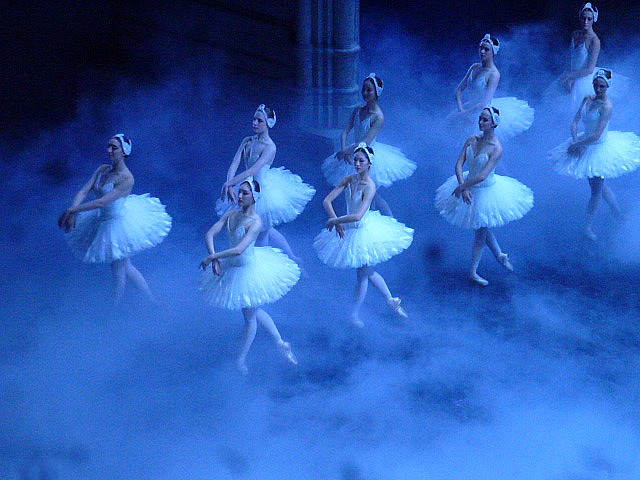
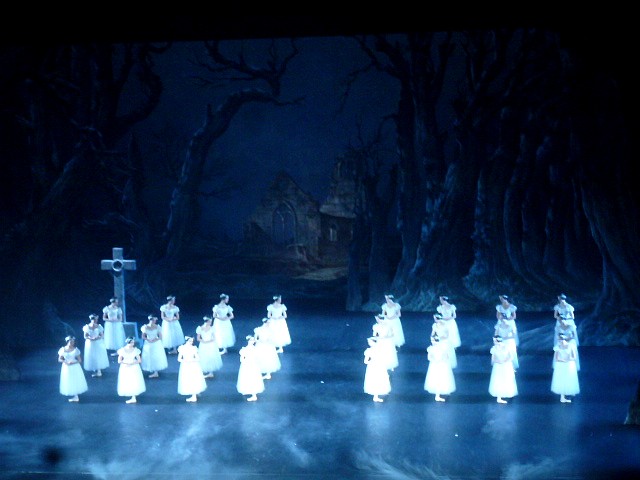
P1220593Le Lac des cygnes on June 27th

O’Neill’s unusual interpretation of Odette – under-swanned and unmannered – reminded me of Julia Roberts saying ,” “I’m just a girl standing in front of a boy asking him to love her.” No diva here. O’Neill’s swan/princess had not only been captured but promoted queen against her will. All she wants is to be seen as a normal girl. I think this take on the role might have put out some in the audience nourished by that awful horror movie’s over the top clichés. Once again I fell for the rich nuances in this ballerina’s demure and understated authority.

And here was Germain Louvet again! Elegant, well-mannered, gracious, and absolutely un-melancholy. His prince was not self-involved, yet regal with a kind of natural elegance that set him apart. I’ve met people like that.

Louvet’s at ease Siegfried just wants to dance around with his friends and has never thought much about the future.  Often the Queen Mother scene just seems like an intertitle in a silent movie: basic information needed to make a plot point. The acting can be light, as in Paris the dancers cast as queen mothers are mostly ten to fifteen years younger than their sons. Young Margaux Gaudy-Talazac, however, had believable authority and presence.  I cannot put my finger on exactly what she and Louvet did and when, but what developed was clearly the Freudian vision Nureyev had had for this ballet in the first place. “Why do you want me to go find a woman? I’m just fine here with you, mommy.” This Siegfried’s rejection of the Act Three princesses was preordained no matter what. What a pity, then, that Thomas Docquir’s flavourless Wolfgang and stiff Rothbart gave all the others little to work against.

Back to no matter what… But what if a woman unlike all other women actually exists? Hey, what if even dozens of them are lurking out there just outside the windows? Louvet’s tiny gesture, stopping to stroke a tutu as if to check it were for real as he progressed in through the hedgerow of swan maidens, made these thoughts come to life.

O’Neill and Louvet’s courtly encounters were like the water: no added ingredients, pure and liquid. O’Neill kept her hands simple – the way you actually do when you swim– and Louvet gently tried to get in close enough to take a sip but she kept slipping away from him. As he gently and with increasing confidence pushed down her arms into an embrace, you could sense that she couldn’t help but evaporate.

Their lines and timing matched once again. But I wondered if some in the audience didn’t find this delicately feminine and recognizably human Odette too low energy, not flappy enough? But she’s a figment of HIS imagination after all! This Siegfried was in no need of a hysteric and obviously desired someone calm, not fierce. [This brings me back to what doesn’t work in Marchand/O’Neill. He may appreciate her in the studio, but on stage he needs a dancer who resists him].

As Act Three took off, I found myself bemused by when I do focus, and when I don’t focus, on how this production’s Siegfried is dressed in bridal white. Louvet’s character was indeed both as annoyed and then as anguished as an adolescent. No other betrayed Siegfried in a long time has buried his face in his mother’s skirts with such fervor.

Nota Bene: All nights, in the czardas, the legs go too high. The energy goes up when it should push forward. This ancient Hungarian dance is not a cancan.

As Odile, O’Neill once again went for the subtle route. Her chimera played at re-enacting being as evanescent as water, now punctuated with little flicks of the wrist. Louvet reacted in the moment. “She’s acting strangely. Maybe I just didn’t have time last night to see this more swinging side to her?”

In Act Four, O’Neill’s Odette was no longer under a spell, just a girl who wants to be loved. No other Siegfried in a long time has dashed in with more speed and determination. As they wound and unwound against each other in their final pas de deux of doom I wondered whether I’d ever seen Louvet’s always lovely partnering be this protective. The only word for his partnering and persona: maternal.

It wasn’t a flashy performance, but I was moved to the core.

And woman
Hold me close to your heart
However distant, don’t keep us apart
After all, it is written in the stars*

*John Lennon, “Woman.” (1980)


P1220592

Le Lac des cygnes. Hannah O’Neill (Odette/Odile) et Germain Louvet (Siegfried).

*

 *                                       *

Sae-Eun Park : I found her and then lost her again

Gisele May 17 Sae-Eun Park and Germain Louvet

P1220423During Giselle, what I’ve been looking for finally happened. Before my eyes Sae-Un Park evolved from being a dutiful baby ballerina into a mature artist. And her partner, Germain Louvet (again!) whom I’d often found to be a bit “lite” as far as drama with another goes, came to play a real part in this awakening.

But this was not the same Albrecht, to boot. From his first entrance and throughout his dialogues with Wilfried, words from an oldie began to dance around at the back of my brain:

Well, she was just seventeen
You know what I mean
And the way she looked
Was way beyond compare
So how could I dance with another
Ooh, when I saw her standing there?*

I almost didn’t recognize Park. All the former technical mastery was still in place but it suddenly began to breathe and flow in a manner I had not seen before. She came alive. All her movement extended through a newfound energy that reached beyond from toes and fingertips and unblocked her already delicate lines. Her pantomime, her character, became vivid rather than textbook. I’ve been waiting for Park to surprise herself (and us) and here she demonstrated a new kind of abandon, of inflection, of fullness of body.

Well, she looked at me
And I, I could see
That before too long
I’d fall in love with her
She wouldn’t dance with another
Ooh, when I saw her standing there*

Throughout the ballet, Louvet and Park danced for each other and not for themselves (which had been a weakness for both to grow out of, I think). Park’s acting came from deep inside. From inside out for once, not demonstrated from without. During her mad scene, I simply put my notebook down.

Act 2 got off to a… start. Sylvia Saint-Martin clearly worked on controlling all the technical detail but danced as harshly as is her wont for now. The disconnect between her arabesque, torso, and abrupt arms, the way she rushes the music, the way her jumps travel but don’t really go anywhere…everything about her dance and stage presence just feels aggressive and demonstrative from start to stop. She finally put some biglyness into her last manège, but it was too late for me.

Well, my heart went « boom »
When I crossed that room
And I held her hand in mine

Oh we danced through the night
And we held each other tight*

There was a different kind of emotional violence to Germain Louvet’s first entrance, reacting to THIS Giselle. Along with the flowers, he carried a clear connection to the person from Act One onto the stage. You don’t always get the feeling that Giselle and Albrecht actually see each other from the backs of their heads, and here it happened. Both rivalled each other in equally feathery and tremulous beats. Their steps kept echoing each other’s. Park’s Giselle was readably trying to hold on to her memories, and moved her artistry beyond technique.  This newfound intensity for her was what I’d long hoped for. I am still impressed by how visible she made Giselle’s internal struggle as the dark forces increasingly took control of her being and forced her to fade.

I left the theatre humming as if the thrum of a cello and the delicate lift of the harp were tapping on my shoulder.

Now I’ll never dance with another, Ooh.*

*The Beatles, “How Could I Dance With Another?” (1963)
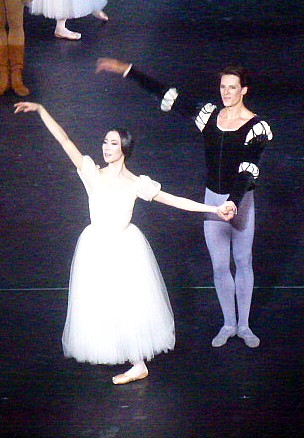
P1200388

Sae-Eun Park (Giselle) et Germain Louvet (Albrecht)

*                                        *

Swan Lake, Sae-Un Park with Paul Marque on June 28th

P1220597However, this performance saw the ballerina go back into comfort mode.

In Act 1 Pablo Legasa, as the tutor Wolfgang aka Rothbart, instantly asserted his authority over Siegfried and the audience understood in a way that it hadn’t with  Docquir whose presence didn’t still does not cross the footlights . Legasa’s tutor gleefully set up the about-to be-important crossbow as he slid it into Marque’s hands, just as he would later use that cape better than Batman. Most Rothbarts manipulate the Loïe Fuller outfit like a frenemy, at best.

The little dramatic nuances matter. Whereas Louvet’s Siegfried hadn’t really wanted to rock the boat much during Act 1 — so to be fair Docquir didn’t have that much to do — tonight Legasa repeatedly denied Paul Marque, whose Siegfried is more of a regular guy, any escape or release without express permission.

Paul Marque doesn’t possess the naturally elongated lines of Germain Louvet, but that isn’t a problem for me. Marque’s vibe feels more 19th century: dancing at its best: a restrained yet elevated 90 degrees back then was the equivalent of 180 now and every step he makes is as clearly outlined as if it popped out of an engraving. The way he worked up towards making the last arabesque in his solo arch and yearn gave us all we wanted as to insight into the internal trauma of the character.

In Act 2, Sae-Eun Park finally arrived to the delight of her fans.  She gave a very traditional and accomplished classic rendering of Odette, replete with big open back, swanny boneless wings/arms, took her time with the music and became a beautiful abstract object in Siegfried’s arms. Her solo was perfectly executed. Could I ask for anything more? Maybe?

You have to make it work for you. O’Neill remained a woman, a princess trapped in some kind of clammy wetsuit and gummy gloves that covered her fingers. Park outlined and gave a by the book performance of the expected never having been a human swan. But at least now she dances from the inside out and her arms do fully engage in dialogue with her back.

I loved the way this Siegfried reacted to all the swans. “What? You mean there’s more of them?” Marque, as in Act One, then chiselled a beautifully uplifted variation that felt true to Nureyev’s vision in the way a synthesized centeredness (thesis) encounters and surmounts a myriad of unexpected changes in direction (antithesis). Very Hegelian, was Marque’s synthesis.  Bravo, he made philosophical meanderings come alive with his body.

These lovers are lulled into the idea that escape is possible and will happen soon.

In Act 3, Legasa continues to lead the narrative. He is clearly whispering instructions into Odile’s earbud while also utilizing his cape and hands as if they were remote control.. For once Rothbart’s solo did not seem like a gratuitous interruptionsreplete with awkward landings. The pas de deux can in fact be a real pas de trois if that third wheel unspools his steps and stops and brings out the underlying waltzy rhythm of the music. Legassa tossed off those double tours with flippant ease and evil father-figure panache. Nureyev would have loved it.

Park’s Odile? Marque recognized his Odette instantly. Park did everything right but only seemed to come into her own in her solo (from where I was sitting). Even if her extended leg went up high and she spinned like a top, at the end of the pas de the audience didn’t roar.

“When Siegfried discovered he has both betrayed and been betrayed, Louvet, like a little boy, he wrapped his arms desperately tight around his mother.” Why did I write that in my notebook at the exact moment when I was watching Paul Marque in the same pantomime? I don’t quite remember, but I think it was because “mama” wasn’t what anything was about for him.

In the last Act, while Legasa acted up a storm, Marque remained nice and manly. The night before, Germain Louvet had really put all his energy into seeking Odette and fighting back against the forces of darkness. He really ran after what he wanted. Marque is maybe just not as wild by nature. Or maybe he just stayed in tune with Park? In Act 4, Park did fluttery. Lovely fluttery arms and tippy-toes that stayed on the music and worked for the audience. I observed but didn’t feel involved.

For me, only Pablo Legasa made me shiver during this Park/Marque Swan Lake. I found myself wondering what Park would have done IF a more passionate dancer like Legasa – as Louvet had been recently for her Giselle – had challenged her more. Now that I think back, Marque, too, had hit a high dramatic level when recently paired with Ould-Braham in Giselle. Maybe it’s time to end “ParkMarque.”  I like them both more and more, just not together.

P1220546

Le Lac des cygnes. Sae-Eun Park (Odette/Odile) et Paul Marque (Siegfried).

*

 *                                       *

Héloïse Bourdon: The Treasure that’s been hiding in plain sight.

You may say I’m a dreamer
But I’m not the only one*

P1220572Swan Lake, Héloïse Bourdon and Jerémy-Loup Quer, on July 12th

Then on July 12th, something long anticipated didn’t happen. Again. As she had way back then on December 26th, 2022, Heloïse Bourdon gave yet another stellar performance as Odette/Odile in Le Lac des Cygnes. At the end, as the audience roared, so many of us expected the director to come out and finally promote Bourdon to étoile (star principal). Instead all we all got do was shuffle out quietly and once again go home to wash off what was left of our mascara.

If anyone managed to find the perfect balance between woman and swan this season, it was Bourdon.  Even in the prologue, this princess showed us that she felt that danger prickling down the back of her neck just as an animal does.

As the curtain rises after this interlude, Jeremy-Loup Quer’s Siegfried puts his nightmare aside and is feeling just fine with his friends. He will later prove rather impervious to his mother’s admonitions and more boyishly cheered by her gift of the crossbow. Then, there was the moment where he looked intently at his baby throne only to turn his back on it in order to stare out of once of the the upstage window slits.

This Siegfried’s melancholic solo was infused by a kind of soft urgency, where the stops and starts really expressed a heart and mind unable to figure out which way to go. Touchingly, Bourdon would echo exactly this confused feeling in her solo in the Second Act, bringing to life the idea that Odette is both a product of Siegfried’s imagination and indeed a kindred soul.

As Wolfgang the Tutor, Enzo Saugar had made his entrance like a panther, a strong and dark-eyed presence with threateningly big hands. I instantly remembered his first splash on the stage as a very distinctive young dancer in Neumeier’s Songs of a Wayfarer at the Nureyev gala last year .  Alas, as of now, Saugar continues think those eyes and those splayed fingers suffice. This works at first glance, but goes nowhere in terms of developing a coherent evening-long narrative. He just wasn’t reactive. He was performing for himself.

So thank goodness for Heloïse Bourdon. As Odette, she uses her fingers and wrists mightily as well, but with variety and thought. Hers was a woman and swan in equal and tortured measure. When she encounters Siegfried, he is clearly instantly delighted and she is clearly a woman trapped in a weird body who hestitanly wonders whether he could actually be her saviour.

Whereas Louvet’s Siegfried had seemed to say when the bevy of swans had filled the stage, “What? The world has always been full of swans?! This is like so unbelievable,” Quer seemed to be saying, as with the Princesses later: “Pleasure to meet you, but for me there is only one swan and I’ve already found her.”

 I’d have to agree. Bourdon glowed from within without any fuss, and this was magnified by the unusual way she used her arms. Some dancers don’t connect their arms to their backs, which I hate. When dancers make their arms flow out from their backs this gives their movements that necessary juice. But here Bourdon’s arms had a specific energy that I’ve rarely seen. It flowed and contracted inward in waves from her fingers first and then pulled all the way back into her spine. I was convinced. That’s actually how you do feel and react when you are injured.

Throughout the evening, whether her swan was white or black, these two danced for each other, including not leaving the stage after a solo and staying focused for their partner from a downstage corner.  Whether in Act Two or Four, each time Rothbart tried to rip her out of Siegfried’s arms via his spell, this couple really fought to hold onto each other.  You could understand this prince’s bewilderment at a familiar/unfamiliar catch-me-if you-can Odile. (Perfectly executed, unbelievably chiselled extensions, fouettés, etcetera, blah blah, just promote her already).

Like Giselle, this Odette knew her hold on life was fading as the end of the last act approached. The energy now reversed and seemed to be pumping out from her back through her arms and dripping out of her hands and beyond her control. This Siegfried, like an Albrecht, like someone in a lifeboat, kept begging his beloved to hold fast.

The Paris Opera’s management may be blind, but the audience certainly wasn’t. I saw a lot of red eyes around me as we left the theatre in silence. Oh what the hell. As long as Heloïse Bourdon continues to get at least one chance to dance a leading role per run I can dream, can’t I?  Next time, how about giving her a Giselle for once?

Imagine there’s no heaven
It’s easy if you try
No hell below us
Above us, only sky*

*John Lennon, “Imagine” (1971).

P1220639

Le Lac des cygnes. Héloïse Bourdon (Odette/Odile) et Jeremy-Loup Quer (Siegfried).
1 commentaire

Classé dans Retours de la Grande boutique

Pina Bausch at the Paris Opera: Bleu Blau Blues

IMG_8596As we trod in a daze down the stairs of the Palais Garnier after an uninterruped 1 hour and 50 minutes, the elegant Italian who had been sitting next to me apologized for having repeatedly kept checking the time on her bright phone in the dark. Ten minutes in, she’d already felt as if she was being personally tortured. Her day had already been long and painful enough. Then a delightful older Parisian lady I know bounced over and declared emphatically that she had been practically lifted out of her seat and insisted she we would go out for a drink to celebrate such a galvanizing theatrical experience. A usually luminous young woman we three know seemed out of breath: energized, confused, and alarmed. Before she carefully slipped away from us, Maria whispered that her thoughts — About men? About women?  About anything? — had just been turned completely upside down by this, the first time she had ever seen a ballet by
… Pina Bausch.

That something invented in the 1970’s by a woman could still either torment or vivify the women of today means that this ballet has not lost its relevance.

You could drive a person crazy
You could drive a person mad
First you make a person hazy
So a person could be had!

The hook in Pina Bausch’s Blaubart/Barbe-Bleue is that of how soundscape and space and movement and emotion cannot be disconnected.  We witness the endless, yet intermittent, manipulation of an onstage reel-to-reel tape wound and rewound by a very powerful — but very confused — everyman. At the push of a button, the machine burped out tiny slivers of Bartok’s original opera. And then another push of the button killed it off. Then repeated, repeatedly.

Therefore: beware, this ballet is a long haul, and might just drive you crazy. If you edited out the incessant repetitions of Bartok phrases and Bausch phrasings, the whole evening could have been ding-dong bell and over and let’s go out for that much-needed drink in fifteen minutes flat. This is definitely not a “date-night” ballet. Or maybe it is?  At least as a warning sign?

You’re crazy
You’re a lovely person
You’re a moving
Deeply maladjusted
Never to be trusted
Crazy person yourself

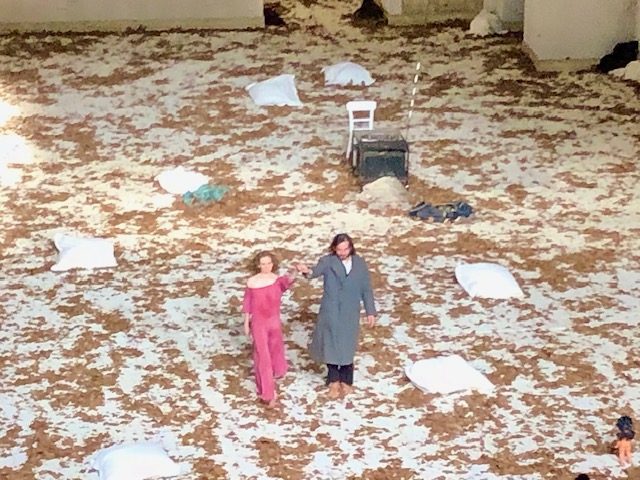
 From the start, Bluebeard is in some kind of combat of egos with a woman in a flesh pink dress. She’s not taking this abuse lying down (well, actually often she is, when she’d not plastered against a wall or slithering off a chair).

Slinky dresses, out-there loud femininity always mattered to Bausch, as did deconstructing men from XL jackets down to their smalls and uninhibited display of tiny biceps. Deconstruction of any and all stereotypes had always been this choreographer’s thing. Bausch relates to my generation’s  view of male/female relationships: OK, let’s just admit that we the same but different, that we are all are messed up, that we are all brilliantly confused? Is a middle ground even possible?

A person that
Titillates a person and then leaves her flat
Is crazy
He’s a troubled person
He’s a truly crazy person himself

IMG_8639

Léonore Baulac et Tareku Coste

I was completely taken in by Bluebeard’s and Judith’s passionately intense symbiotic disharmony. The interiority and unstoppable feral energy of their repeated actions bound us to their toxic relationship.

At the start, SHE is the one pulling and manipulating his seemingly dead-weight body, yet HE is the one that keeps insisting upon collapsing upon her over and over and again and again. As we near the end, it takes HIM an excruciatingly long time to drag HER limp body, lying heavily inert upon his stomach –  as awkward and heavy as dead bodies truly are –  backwards and to and fro and to and fro and to across the stage. Their all-out performances were more than hypnotic, they were witchcraft. Against your will, you sank — increasingly defenceless and desperate for air — under their spell. 

Takeru Koste as Bluebeard channeled a long career built out of honing his craft in little actor/dancer parts into this one great big theatrical presence. This was clearly the role of a lifetime. Léonore Baulac gave us all the colors of Judith.  She can be one of the most reactive dancers when she is galvanised by a partner’s body and eyes.  

I think Koste and Baulac’s determined commitment to making their combat of the sexes wear us down took twisted control of everyone in the audience (even the reluctant lady). I can honestly say that the choreography works in the sense that I felt rubbed raw by the incessant re-re-re-re-enactment of the claustrophobia that an obsessive relationship creates.

Spoiler alert: if you’d seen Baulac’s Juliet when the Capulets force her into her wedding dress, you will relate to her face when Koste’s Bluebeard carefully and slowly and literally smothers her body in layer upon layer of his other dead wives’ dresses, leaving her almost unable to move. Almost. She resists fate for one more time. And I cannot get the image out of my head of this Judith rushing to and fro in one last burst of exhausted febrility. Larded in fabric, Baulac scuttled about upon her tiny footpads. She was like a mouse that still tried to run away after its head had already been partly chomped off. That’s when my heart, already heavy, broke. Along with hers.

Then you leave a person dangling sadly
Outside your door
Which could only make a person gladly
Want you even more

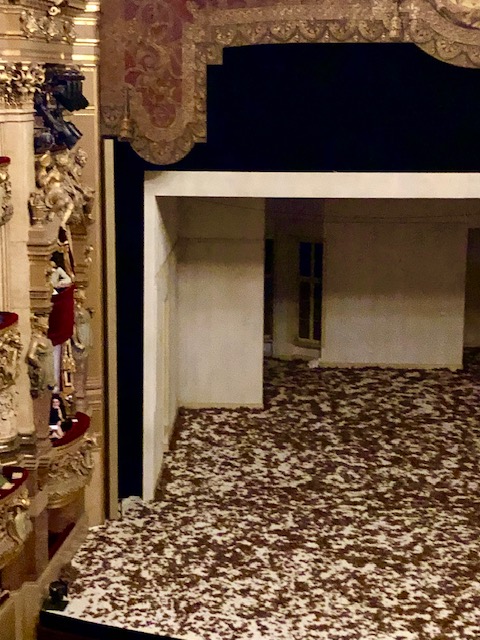
 The thing with Bausch that I think many of us always wired into was the fact that she pitied men and women in equal measure. We are always pushing and pulling at each other with extreme pitiless energy, always arguing. Here the twenty demi-soloists (the slaughtered wives and the previous incarnations of Blue?) were more than perfect and utterly out there as they theatrically fell, or crashed into or artfully dangled from the walls. I guess I need to mention the stage covered with a forest of dead leaves to swish and the occasional dead pillow.

What is wrong?
Where’s the loose connection?
How long, O Lord, how long?

As we left the theatre, my three girlfriends finally asked me: “well?”  I don’t think anyone was ready for a comment on the recorded music – of all things — not the dance. Clearly, the music is sliced up just the way each of Bluebeard’s wives had been. But one aspect of the music above all would have been my complaint way back in 1977, too. I hate the heavy German translations of “obscure” languages. The vowels and consonants and sonorous lines go poof. None of my three friends reacted to my plaint, until I said, “what would you think of someone dancing to something inspired by Rigoletto, Carmen, or Onegin if sung in German?” Pause the reel, please. I must confess that I have been listening to Bartók since I was a child and so I’m a bit of a purist.

Knock-knock! Is anybody there?

Knock-knock! It really isn’t fair.

Perhaps Bluebeard the dancer was really playing around with a real console onstage in 1977? Trying to get any kind of recorded music to work way back then, even just in the rehearsal room, must have indeed been an additional challenge, and now it still is but in a different way. I recently saw a reel-to-reel console in a museum of technology! Why are we so good at advancing technology but so lousy at ending feminicide?

Not only the German bothered me, but the deliberately bad quality of the sound bothered me. Of course, that was Bausch’s point:  in most cases, our lives are just as bad as tinny musical phrases repeated over and over again unto toxicity. The words we spit at each other mean nothing. The real melody is always just out of reach.

You impersonate a person better
Than a zombie should

IMG_8626

Quotes (out of order) from Stephen Sondheim’s Company.

Commentaires fermés sur Pina Bausch at the Paris Opera: Bleu Blau Blues

Classé dans Retours de la Grande boutique

La Sylphide in Toulouse : pick your team !

SYL2-7250

La Sylphide. Ballet du Capitole de Toulouse. Tiphaine Prevost. Photographie David Herrero

In Toulouse, one cast danced from the outside in, the other from the inside out. One was clean and sufficed for a Saturday night out, but the second cast on a Sunday matinée took us on a journey.

I’ve become so accustomed to the Paris  Opéra’s Taglioni/Lacotte Schneitzhoeffer score that I was refreshed by the way Lovenskiold’s music begins in a proto-Verdian fashion. A quick explosion of tutti brass and drums instantly gives way to the plangent tone of a solo cello and then crescendos begin again.

As dandelion puffballs waft across a scrim during the overture, we see the back-story: while walking along the heath, the little boy James exasperates his girl companion. Effie cannot see the delightful ageless fairy beckoning to him. The boy’s fate is sealed: he will always be chasing after what he cannot catch.

But that’s his choice. Are you, or will you be, Team Syphide or Team Effie, up in the air or feet planted on the ground?

To my surprise, be it Bournonville or Lacotte,, sometimes I find myself  rooting for Effie, the all too human girl. During both performances last weekend in Toulouse, I found myself solidly Team Effie, for very different reasons.

SYL2-7272

La Sylphide. Alexandra Surodeeva. Photographie, David Herrero.

Saturday, October 21

It’s really a matter of taste, but I have never been fond of the modern Russian classical ballet style. It’s too “top model.” There the point is to get from one camera-ready pose to the next rather than exploring danced-through phrases. A case in point: I cringed each time Alexandra Surodeeva  launched clearly and deliberately from flat-footed arabesque to, hop!, full-pointe. No full-footed juicy relevés initiated by plié and the toes, just a haul-up using the hamstrings and the butt muscles. The extended leg gets stuck up in the air like a salute. The snapshot will be gorgeous as Surodeeva has beautiful lines. Her fluffy ronds de jambe and batterie just after yet another pose then left me cold.  Her rather earthbound leaps in hard shoes led to noisy landings (in a pose). So for me, this Sylphide just didn’t happen. Surodeeva was just too much of a technically strong dancer, too healthy, too embodied. Her arms, both stiff and flappy, seemed more Balanchine than Bournonville. Each double pirouette turned out rather wobbly and approximate, which seemed odd for such a polished technician.

Instead, Nancy Osbaldeston’s feminine and elfin Effie won me over. Why was she not cast in the principal role?  She’s delicate and dancey, soft on the ground and fleet of foot, and her phrasing, and the way she shapes her steps… lets you hear the music. Just lovely.

On this Saturday, Alexandre De Oliviera Ferreira’s goofy and bouncy Gurn – his beautifully expansive explosion of a solo lifted the house — matched with Rouslan Savdenov’s equally unromantic James. Poor Effie, what a choice! Alas, Savdenov, who can reach out and stretch in the direction of his movements in the soli, sculpting beautiful shapes out of thin air, was just not believable as a dreamer. Indeed, he played the role from the outside. “I will now pretend to see a vision in white, I will now pretend to get mad, now I will now smile big, now my face will go blank as I manage the manège.” I felt sorry for him. He was like a light bulb with the switch awry. But he was dancing by himself, I guess.

Simon Catonnet’s Madge was strong and funny and crisp, but  — surprisingly for this gifted character dancer – his pantomime as the witch was emphatic without being effective and clear. A bit Sturm und Drang. Once the overture gets out of the way, the score becomes positively Rossinian in the way all the downbeats call for their match in mime. Catonnet’s Madge, beautifully limber down to her fingertips, seemed to be listening to her own music.

SYL2-7065

La Sylphide. Ballet du Capitole de Toulouse. Simon Catonnet (Madge) et Alexandre De Oliveira Ferreira (Gurn). Photographie David Herrero.

What made everything work at both performances was the really, really, together corps that often included soloists from the other day. The company is light and noiseless and together and without any stiff gestures or poses. The really charming Scottish reel in Act One brought the house down both times. The plethora of fairies filling the stage in perfect unison in Act Two brought sighs from the audience.

In Act Two, Savedanov’s James continued his aggressive pursuit of the sylph, who did those abrupt relevés again.  When Surodeeva-Syphide’s wings fell off, I was shocked for the wrong reason. I had never noticed that she had borne wings in the first place.

SYL3-1014

La Sylphide. Kayo Nakazato. Photographie David Herrero.

Sunday , October 22

Due to an injury, the third cast  Sylphide ended up dancing with the first cast James. As the fairy and human never partner but only touch each other once, this is do-able. But what about the mime, the connection? Will they pull off the drama, inhabit space so much together you imagine they actually have been touching throughout?

The answer became yes.

Kayo Nakazato’s Sylphide, as of the opening tableau, was pliant and in the music.  In the first scene, here you had feet rolling without a need to hop up, a body in movement between poses, a smooth and silky presence. She danced it all out soundlessly. Her smooth and un-posed movements and the supple and alive nape of the neck let that almost feline aspect of all fairies come out. “Catch me if you can! Pet me if you can! In the meantime, I will just perch up on a shelf, watching you, as I settle down my fluffy self. I know you want me.” Legs never higher up than needed, beautiful cupped-in and un-showy delicate lines. In Act Two, she caught a butterfly! I had seen simply two hands clap the night before, uncertain what that had meant. When she would die, in a final arc just like a butterfly pierced by a pin, the audience held its breath.

Her James, Ramiro Gómez Samón, was really talking to himself and to his vision throughout. He gazed at the women he was torn between and then tried to look into his heart. His smile was melancholy, distant. He even managed to remind us (through light mime) that he had been the little boy in the prologue. He was bigger than Savdenov, rounder with a softer plié.  In this role where you are supposed to be as fanciful as nut who chases after butterflies, Gómez Samón’s James was clearly more at ease with all the choreographic changes of direction and changes of heart. That this Sylphide looked into his eyes really helped.

SYL1-2227

La Sylphide. Ramiro Gomez Samón (James). Photographie David Herrero.

Kléber Rebello’s  Gurn proved to be an actor and dancer more “French” than yesterday’s, more subtle. “Oh, of course, I always loved you. And by the way, why exactly are we in this mess in the first place? Don’t forget – no stress — I’m here for you.”  But also, just who wouldn’t want to marry Rebello’s Gurn after his first act solo? What placement, uplifted ballon, épaulement, pliés that go somewhere! Seriously, girlfriend, this one is boyfriend material.

Rebello was definitely the more dignified spurned suitor. He eagerly responded to every mood of Tiphaine Prévost’s anxious and alive Effie, so clearly worried about her fiancé’s sanity from the start. He even managed to make gentle uplift out of the fact that the only girl available to dance the reel with him was a little one. Whereas De Oliviera Ferreira’s Gurn dutifully disappeared into the second row with his partner, Rebello’s Gurn kept presenting the girl to her advantage. A real gentleman.

Kudos go to Tiphaine Prévost’s Effie, too, who made her role as The Girl Next Door both beautiful and believable up to the end. Her bride on that walking diagonal at the finale had accepted a “marriage of reason” that will probably turn out well, but she was clearly not happy to be back in that accursed forest again.  Nor was the mother, Solène Monnnereau for both performances, who elegantly and subtly reacted in kind to each of her successive daughter’s moods.

SYL1-2248

La Sylphide. Ballet du Capitole. Tiphaine Prévost (Effie) et Ramiro Gomez Samón (James). Photographie David Herrero.

And what a witch! Jérémy Leydier’s scary and grumpier Madge seemed to almost snake out of the fireplace in Act One. His timing and force made me think of a gnarly wisteria carefully planning to take all the time it needed to rip apart an iron grille…his masterful mime made James’s doom all that more inevitable and preordained.  Maybe I’m Team Madge? Like mom, she’s an inventive cook and only wants to keep you from marrying Mr. Wrong.

SYL1-2313

La Sylphide. Jérémy Leydier (Madge). Photographie David Herrero.

Commentaires fermés sur La Sylphide in Toulouse : pick your team !

Classé dans Blog-trotters (Ailleurs), France Soirs

MacMillan’s Manon at the Paris Opera: Dammit.

img_7407

Histoire de Manon Lescaut. Aquarelle de Maggy Monier. Editeur Nilsson, La Bibliothèque précieuse. 1930’s

Dammit, the evening of July 5th started out splendidly. The first image — that spotlit sight of an utterly lone and still man in cape and tricorn — made my neighbour gasp in surprise.

As Lescaut, Francesco Mura is elastic and poised, reaches out, seems to have no dark side.

The beggars and their chief make their parody clear, but none of the beggar chiefs I saw had the panache of Hugo Vigliotti, on June 24th, who seems to have inherited Simon Valastro’s title of “best lion king of the second bananas.”

Ludmila Pagliero’s Manon enters curious about everything and everybody, reactive to all the new sensations around her.

In their first encounter, Marc Moreau’s Des Grieux has nice inflections that respond to Pagliero’s feminine grace. The mood was that of children’s games, where everything – including using the see-saw – is natural and uncomplicated. As if they were on a playground swing, the sweep and flow built up. Remember when you’d swing so hard you were nearly horizontal to the top… and only then would you jump off? That’s how their lifts and curls felt throughout the ballet, dangerously free. Pagliero’s abandon, and utter trust that she will be caught, was gorgeous. She just took off, certain she could fly on her own.

My neighbour let out a breath and said “intermission already?!”

But alas this same neighbour left after Act Two. “I’m sorry, I couldn’t stop worrying about work due tomorrow.” During Act Two, I too admit my mind had begun to wander.

At fault?  Silvia Saint-Martin as Lescaut’s mistress. In Act One already, she was like one of those underage girls who watch some video of Roland Petit’s femmes fatales over and over again, thinking sexuality and sensuality are the same, and then imitates a Carmencita from the outside. She never added another layer, a nuance. If it weren’t for her costume, you couldn’t have told that she was supposed to be more interesting than the corps de ballet.

She gave us an engineer’s outline, not a character. Mura therefore had nothing to work with during Act Two, so he underplayed and their interactions did not provide even one hint of comic relief. The only moment the audience laughed was when she kicked him, but we should have been chuckling from the start.

So there was a gaping big hole in Act Two.

Meanwhile, Pagliero continued to develop her character in what had become a theatrical vacuum. A bit distressed by her brother’s boozy breath. Sad and cold in her solo for Monsieur G.M., definitely not “loud and proud” about being a top-notch sex worker. She’s also frightened by Moreau/Des Grieux’s pushiness. “This necklace is all that I have.” “This bracelet is non-negotiable.”

She’d worked hard for her money.

After the black hole of Act Two, I just couldn’t get back into the mood. I sat there during the last act thinking, “wow, those flips are incredible.” Dammit.

*

 *                                     *

img_3913

Histoire de Manon Lescaut. Aquarelle de Maggy Monier. Editeur Nilsson, La Bibliothèque précieuse. 1930’s

Zut alors! La soirée du 5 juillet avait pourtant superbement commencé. La première image d’un homme en cape et tricorne inondé dans sa solitude par une douche de lumière avait fait haleter de surprise ma voisine.

En Lescaut, Mura est à la fois élastique et posé ; il projette. Il semble n’avoir pas de côté sombre.

Les mendiants et leur chef rendent claire leur parodie, mais aucun des chefs mendiants n’a eu autant de panache qu’Hugo Vigliotti, le 24 juin, qui semble avoir hérité du titre de plus Grand Roi Lion des seconds couteaux jadis détenu par Simon Valastro.

Ludmila Pagliero entre, curieuse de tout et de tous, réceptive à toutes les nouvelles sensations autour d’elle.

Durant la première rencontre, Marc Moreau a de jolies inflexions qui répondent aux grâces féminines de Pagliero. L’humeur était aux jeux d’enfants où tout, même jouer à la bascule, est naturel et sans complication. Comme s’ils étaient sur une balançoire, leur flux et reflux gagnait en intensité. Vous souvenez-vous, quand vous vous balanciez très fort, vous vous retrouviez parfois en l’air à l’horizontale, et à ce point seulement vous lâchiez prise ? C’est à cela que les portés et entrelacements des deux danseurs faisaient penser pendant tout le ballet ; dangereusement libres. L’abandon de Pagliero et sa certitude qu’elle sera rattrapée étaient magnifiques. Elle prenait son essor, certaine qu’elle pourrait voler par ses propres moyens.

Ma jeune voisine, le souffle coupé, laissa échapper : « C’est déjà l’entracte ? ».

Hélas, cette même voisine est partie après l’acte 2 : « Désolée, j’ai du travail pour demain et je n’arrête pas d’y penser ». Et je dois aussi avouer que pendant l’acte 2, j’avais commencé à perdre ma concentration.

La faute à qui ? Silvia Saint Martin en maîtresse de Lescaut. Déjà durant l’acte 1, elle est comme une jeunette qui a regardé en boucle quelques vidéos de femmes fatales de Roland Petit, confond sexualité et sensualité, et du coup, imite la Carmencita de manière extérieure. Jamais elle n’a ajouté une couche supplémentaire, une nuance. À l’acte 2, n’était son costume, vous n’auriez pu deviner que la danseuse était censée être plus intéressante que le reste du corps de ballet. Elle nous a délivré un plan détaillé, jamais un développement. Du coup, Mura, qui n’avait peut-être rien sur quoi s’appuyer, s’est mis en retrait et leurs interactions n’ont donc offert aucun répit comique. Le seul moment où le public a ri est quand Saint-Martin a renversé son partenaire cul par-dessus tête, mais nous aurions dû pouffer dès le début.

Il y avait donc un trou béant à l’acte deux.

Et pendant ce temps, Pagliero continuait à développer son personnage dans ce qui était devenu un grand vide : quelque peu affligée par l’haleine alcoolisée de son frère, triste et froide pendant son solo pour monsieur G.M ., absolument pas haute et fière d’être une travailleuse du sexe de haut-vol. Elle se montre également effrayée par l’outrecuidance de Moreau/Des Grieux : « ce collier est tout ce que j’ai ! », « le bracelet n’est pas négociable ! ». Elle a travaillé dur pour les obtenir…

Mais après le trou noir de l’acte 2, je n’ai pu me remettre dedans. Je me suis retrouvée assise là, pendant le dernier acte, en train de penser « ouah, ces grands doubles tours en l’air sont incroyables ».

Zut alors!

Libre traduction : Cléopold

Commentaires fermés sur MacMillan’s Manon at the Paris Opera: Dammit.

Classé dans Retours de la Grande boutique

Fille incomprise : un argument pour Manon

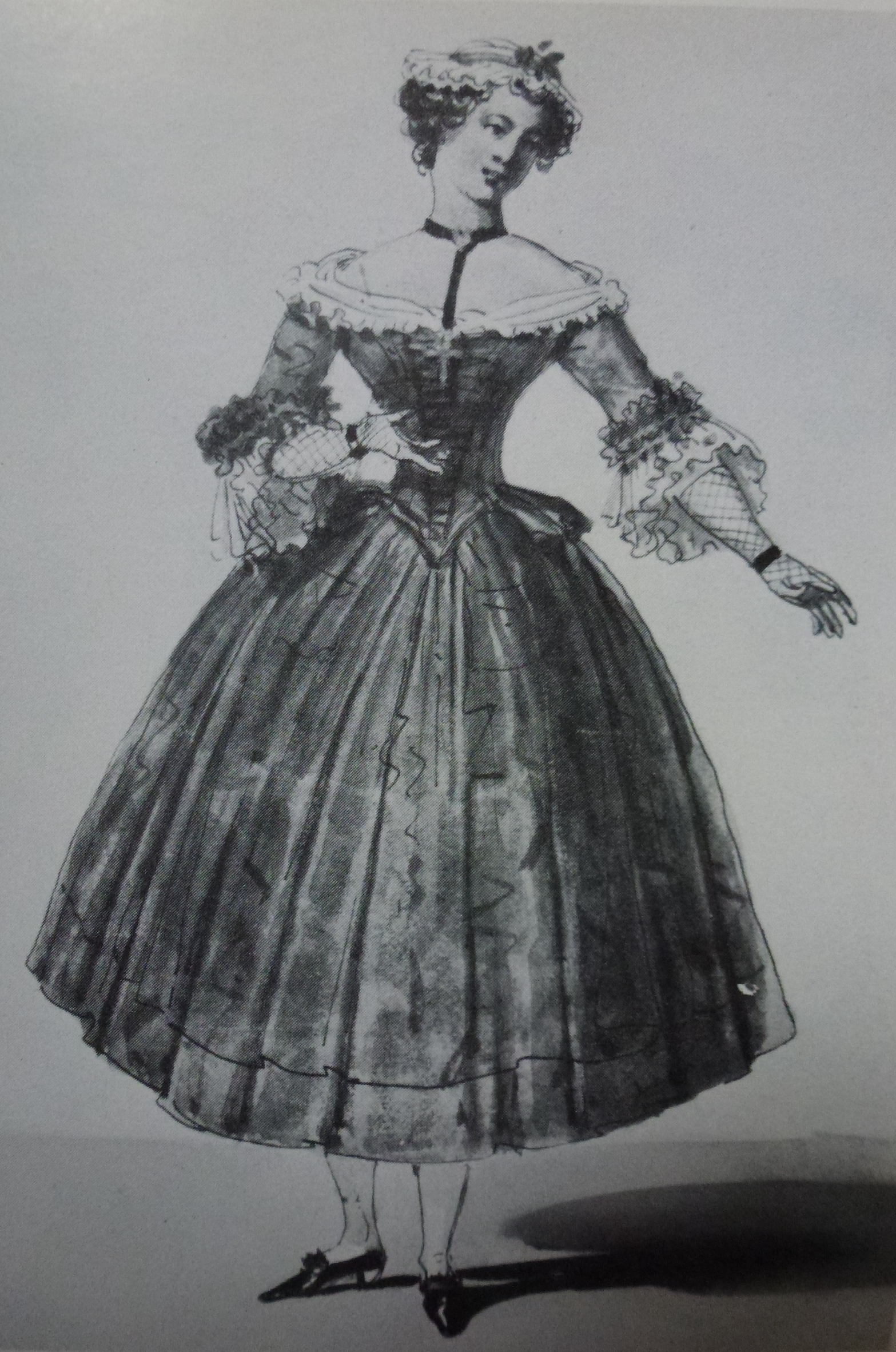
Pauline Montessu dans Manon, 1830

Pauline Montessu dans Manon, 1830

À l’instar d’autres classiques français comme Les Noces de Figaro ou Les Liaisons dangereuses, cette histoire met en lumière les questions de genre et de classe durant l’Ancien régime.

Ouh ça semble rasoir ! Reformulons : ce ballet à propos de toutes sortes d’interactions sociales ou sexuelles sera dansé par des personnes incroyablement souples portant d’étourdissants costumes d’époque. Et ça, ça n’est jamais barbant.

Le roman de l’abbé Prevost, 1731, continue de laisser les lecteurs perplexes. Son héroïne de la lie aux nues et des nues à la lie est-elle immorale ou amorale ? Une vicieuse croqueuse de diamants prétendant l’innocence ou une innocente désemparée corrompue par les hommes et précipitée dans le vice ? À moins que la proactive Manon ne représente l’horizon très anti-Cendrillon des jeunes filles bien informées d’aujourd’hui?

S’il existe quelque chose comme la « nature féminine », les hommes – du politicien libidineux au zélote exalté – essayent encore de la déchiffrer.

Vous connaissez peut-être les plus célèbres adaptations de ce conte, les opéras de Jules Massenet (1885) et de Puccini (1894). Sir Kenneth MacMillan les connaissait assurément en 1974. Amoureux de cette histoire, sous la pression d’une échéance au Royal Ballet de Londres, il se sentait paralysé par ces deux somptueuses partitions. Comment éviter de faire mimer aux danseurs des arias bien connues ? La solution:  utiliser de la musique de Massenet, quantité de passages savoureux mais pas une note extraite de l’opéra !

ACTE UN (43 minutes)

Scène 1 : un relais de poste non loin de Paris

La première personne que nous découvrons sous une douche de lumière est le corrompu et vénal frère de Manon, Lescaut. Aussi à l’aise avec la racaille qu’avec l’aristocratie émoustillée, il essaye tout d’abord de placer sa maîtresse auprès du riche Monsieur G.M. avant de s’esclaffer quand ses amis mendiants soutirent la montre de cet imbécile prétentieux.

Au milieu de cette assemblée décadente débarque un timide et séduisant étudiant, tellement perdu dans la lecture de son livre qu’il est insensible à toute l’agitation qui l’entoure. Son nom est Des Grieux.

La diligence arrive finalement et Manon avec. Alors qu’elle est encore en train d’essayer de se débarrasser du vieillard qui avait tenté de la séduire durant le voyage, elle se retrouve confrontée à son frère qui essaye de la placer auprès du lubrique G.M. Il n’est pas étonnant que ses parents l’expédient au couvent, les hommes ne semblent pouvoir garder les mains dans leurs poches en sa présence. Est-ce de sa faute ?

Sur une musique très délicate, Manon essaye de s’accrocher à sa liberté, ou tout au moins à son libre arbitre dans le choix de l’un des hommes dégoûtants que son frère encourage dans leurs ardeurs. Pendant ce temps, la maîtresse de Lescaut découvre à foison ses bas. Elle ne verrait aucun inconvénient à postuler pour les miettes.

Mais voici que les yeux de Manon rencontrent ceux de Des Grieux, le seul et unique homme qu’elle désirera jamais. Après tous ces vieux grimaçants et trébuchants, voilà enfin un homme qui sait danser !

À la fin de cette scène, nous sommes gratifiés du premier des glorieux pas de deux que les amoureux de la danse associent à MacMillan : jusqu’à quel point les corps peuvent être portés aux limites du push-me-pull-you? Dans ce ballet, l’enjeu de chacun de ces duos sera de savoir jusqu’à quel point vous pouvez aller sans vous casser une cheville ou un poignet ou tomber la tête la première tout en transmettant une pure émotion. Et chacun de ces duos se terminera avec l’exquise façon qu’à MacMillan d’inventer d’infinies manières pour les amants de redescendre des hauteurs en balayant le sol – tellement délicieusement – avec leurs corps.
Le barbon revient pour constater que Manon s’est enfuie avec son porte-monnaie et sa voiture. Monsieur GM offre encore davantage d’argent à Lescaut pour qu’il retrouve et lui livre cette tentante et fringante créature.

Scène deux : dans l’humble mansarde de Des Grieux. [au moins ce n’est pas une ennuyeuse propriété campagnarde] Des Grieux essaye d’écrire une lettre à son paternel sur l’air du « c’est un ange, stp envoie-moi un peu plus d’argent ». Il est de bonne famille mais n’a pas encore la main sur son héritage.

Amoureuse mais néanmoins lassée de le regarder écrire, Manon entreprend de le distraire – c’est un euphémisme- (ici, consultez l’article de Cléopold sur ce pas de deux qu’il analyse seconde par seconde).

Lorsque Des Grieux s’extirpe finalement de cette étreinte pour aller poster sa lettre, Lescaut entre furtivement en compagnie de Monsieur G.M. qui tente Manon avec toutes sortes de promesses, de joyaux et même une cape doublée de fourrure. Rien auquel une jeune fille puisse décemment résister. Bon, d’accord, le mec à l’air d’avoir développé un bizarre fétichisme des pieds, mais toute ballerine qui se respecte a été vaccinée contre ce genre de cliché depuis une éternité.

Lescaut reste en arrière afin de juguler les légitimes angoisses d’un Des Grieux horrifié et d’essayer de lui faire entendre raison : « Laissons-là dépouiller ce richard ! Nous pourrions tous être riches ! »

ENTRACTE (20 minutes)

ACTE DEUX (46 minutes)

Scène un : Une soirée élégante chez une dame fort louche.

Nous l’avions déjà vue durant la première scène trainant aux côtés de Monsieur G.M. Mais ce n’était pas une dame… ou sa femme. « Madame » est ce qu’on appelle une maquerelle. Ces femmes avec des éventails durant la même scène n’étaient pas des dames mais ses « filles ».

Chez Madame, les épées doivent être laissées à l’entrée ; mais on peut être tenté par toutes sortes de métaphores.

Tirant à sa suite un Des Grieux boudeur et peu disposé à le suivre, arrive Lescaut bien éméché qui entraîne dans son jeu – cul par-dessus tête – son inconditionnellement optimiste maîtresse.

Manon entre sensationnellement parée. Elle est portée en l’air, à la Marilyn Monroe, par un groupe de clients énamourés devant Monsieur G.M., exsudant une fierté malsaine.

La vanité un peu stupide de Manon n’est tout d’abord pas le moins du monde érodée par les regards languissants de Des Grieux. Lorsqu’il parvient enfin à s’isoler avec elle, elle lui dit clairement que si elle l’aime lui, il n’en est pas de même de sa pauvreté.

Elle lui indique quoi faire : tondre G.M. en trichant aux cartes… Des Grieux est mimi, mais il sabote le travail. Les épées sont tirées des fourreaux. À la faveur de cette confusion, les amants s’échappent de nouveau.

Scène deux : de retour dans la mansarde.

Les amants, c’est devenu une habitude, dansent dans tous les recoins de la chambre.

Mais voilà que Manon se rend compte qu’elle a « oublié » de rendre ses bijoux…

Mauvaise idée. G.M. sait où se trouve le nid d’amour et fait irruption escorté par la police et trainant à sa suite un Lescaut menotté et sanguinolent. Il fait arrêter Manon pour vol et prostitution. Pour la première fois de sa vie, l’héroïne doit faire face à l’abjecte cruauté vengeresse à laquelle certains hommes sont particulièrement enclins.

ENTRACTE (20 minutes)

ACTE TROIS (25 minutes)

Scène un : arrivée à la Nouvelle Orléans

Une cargaison d’infortunées prostituées a été déportée à la Nouvelle Orléans. L’amour de Des Grieux ne connaît aucune limite. Il a réussi à embarquer sur le bateau en prétendant être le mari de Manon et paraît même curieusement content en dépit des circonstances.

Même brisée psychologiquement et le crâne tondu, Manon attire malgré elle une attention inhabituelle.

Scène deux : le bureau du geôlier

En voilà une particulièrement dégoûtante. Le geôlier lui donnera des privilèges si elle … Et il la force à le faire. Des Grieux assouvit le désir du public médusé en tuant ce prétentieux pervers.

Scène trois : perdus dans le bayou

En fuite et sans but, le couple s’obstine à s’aimer dans des directions opposées. Des Grieux espère encore, tandis qu’hantée par ses souvenirs, Manon, qui n’est pas faite pour ce genre de vie, meurt d’épuisement dans les bras de son amant désespéré. Elle a été complètement consumée par la force des attentes des autres hommes.

Commentaires fermés sur Fille incomprise : un argument pour Manon

Classé dans Retours de la Grande boutique

Maurice Béjart at the Paris Opera : « Let Me Entertain You »

Maurice Béjart, Paris Opera Ballet. April 28th, 2023.

L’article en anglais est traduit en français plus bas …

P1190130

Maurice Béjart’s ballets have a Broadway soul: generous, florid,  and loud. So catchy, you feel you could almost hum a few bars of the steps.

Decades later, Béjart’s gimmicks still “have it” for an audience, even when it probably sees them coming from miles away. Just one example: spot-lit and center stage, you lunge towards the house/ right arm thrust directly forward/palm up/eyes focussed straight into the audience/ in order to either plead to or challenge the darkness. It showed up in each one of this night’s three ballets.

Firebird/L’Oiseau de feu …

”Do something special, anything that’s special!”

Everyone kept demonstrating the steps too heavily: now I plié to leap, now I plié to turn, now I…

Francesco Mura didn’t lead the narrative. If he hadn’t been in red, you wouldn’t have known he was the one inspiring the troops in this theoretically “revolutionary” ballet. For a while I wondered if he were holding back in order to unleash charismatic power later and thus pump up the drama.  Not.  While Mura’s soft and un-bombastic approach (despite rather tight-backed arabesques) did grow on me a bit, I couldn’t find the firebird.

In fact, it seemed that the trio of girl passionarias were in charge.  Caroline Robert, Aubane Philbert, and Pauline Verdusen, caught the light and commanded our attention at every twist and turn.

I could sense that those sitting around me had not the faintest idea as to who Gregory Dominiak’s Phoenix was supposed to be, either.

The audience wasn’t restless. Just clueless.

Songs of a Wayfarer/Le Chant du compagnon errant…

“I had a dream, a wonderful dream.”

Most in this role of “the young man who must look death in the face” dive right away into the realm of twenty minutes of anguish. Here we started with an almost weightless Antoine Kirscher and I wondered where he was going to go with this nice and naïve persona.

But then he, like the audience, got a shock when Enzo Saugar (who he? A yesss to whoever cast him) showed up and revealed the stage presence of someone born to be in the spotlight. Better yet, this kid knows how to share the stage. Here, dancing with his death, Kirscher has never seemed so alive. His partner shook him up, challenged him, made him dance bigger and better. Unexpected emotional crescendos happened. I, and I think Kirscher too, forgot about how pretty his feet are.

Bolero…

“I’m beginning to like doing this. I like that. I hope you did because I’m going to do it again. However – my mother’s advice, which I always take, is to make them beg for more, and then – don’t give it to them.”

Bolero, about 16-17 minutes of emphatically-demonstrated aerobic striptease, often just wears me down. By the time we reach the sweat-drenched climax, I’ve often got a melody from a different burlesque thrumming in my head: “You can pull all the stops out/ Till they call the cops out, […]/ Grind your behind till you’re dead…”

Here, Hugo Marchand proved he had nothing to prove. Calm, controlled, riveting, he patterned the downbeat, light and agile and untouchable. There was stillness to the way he moved. I sat there thinking: how fabulous that he’s pretending this ballet is not a gimmick.

Those little thrusting movements, which can seem quite vulgar, here illustrated Duncan’s theory about the solar plexus: an honest – almost innocent — grounding of the body.  My thoughts flashed to when Sondheim’s Gypsy Rose Lee — very, very slowly — removes a glove with finesse instead of baring it all.

The male corps responded to Marchand’s cool aplomb and worked it with ease. On cloud nine, the audience hummed as it wafted down the steps of the Opera Bastille in a bemused daze, begging for more.

In Béjart’s world, ”Either you have it, or you’ve had it.”

All quotes are from the 1959 Broadway musical Gypsy. Stephen Sondheim, lyrics.

*

 *                                         *

« Let Me Entertain You ».

Libre traduction Cléopold

Les ballets de Béjart ont toujours eu une âme Broadway : généreux, flamboyants, tapageurs. Tellement entraînants qu’on a l’impression qu’on pourrait en fredonner les pas.

Des décennies plus tard, les « trucs en plume » de Béjart sont toujours un hit pour le public, même lorsqu’on les sent venir à des kilomètres. -Un exemple ? Éclairé au projecteur, en plein centre de la scène, vous vous mettez en fente en direction de la salle, le bras et la paume droite tendus vers l’avant, les yeux plongés dans le public comme pour une supplication ou un défi à l’obscurité.- On retrouve ces ingrédients dans chacun des trois ballets de cette soirée.

L’Oiseau de feu

« Do something special, anything special ! »

Chacun avait tendance à détailler lourdement les pas : « et maintenant je plie pour sauter », « et maintenant je plie pour tourner », « et maintenant… »

Francesco Mura ne dominait pas la narration. S’il n’avait pas été en rouge, on n’aurait pu deviner qu’il était l’inspirateur de cette troupe dans ce ballet théoriquement « révolutionnaire ». Un moment, je me suis demandé s’il ne se retenait pas afin de déchainer son pouvoir charismatique plus tard dans l’optique de renforcer le drame. Mais non. Même si l’approche douce et non grandiloquente de Mura a fini par me toucher (en dépit d’une arabesque un peu raide), je n’ai jamais vu un oiseau de feu.

En fait, il m’a semblé que le trio féminin de passionarias avait pris les commandes. Caroline Robert, Aubane Philbert et Pauline Verdusen, prenaient la lumière et attiraient notre attention sur chaque tour et chaque torsion.

Je pouvais sentir aussi que tous ceux qui étaient assis autour de moi n’avaient pas la moindre idée de ce qu’était le Phénix de Gregory Dominiak.

Le public n’était pas impatienté mais vaguement médusé.

Le Chant du compagnon errant

« I had a dream, a wonderful dream »

Dans ce rôle du « jeune homme qui doit regarder la mort en face », la plupart des interprètes plongent d’emblée dans un monde de vingt minutes d’angoisse. Ici, tout a débuté avec un Antoine Kirscher presque sans poids et je me suis demandé où le danseur allait pouvoir aller avec cette douce et naïve personnalité.

Mais alors le danseur, de même que le public, a reçu un choc quand Enzo Saugar (qui ça ? Bravo en tous cas à la personne qui l’a distribué) est apparu, révélant une personnalité faite pour se retrouver sous le feu des projecteurs. Mieux encore, ce gamin sait déjà comment partager la scène. Ici, dansant avec sa propre mort, Kirscher n’a jamais autant semblé en vie. Son partenaire l’a bousculé, l’a poussé dans ses retranchements, le faisant danser plus grand et plus vrai. Sont arrivés d’inattendus crescendo émotionnels. J’en ai oublié, et sans doute Kirscher aussi, combien ses pieds sont jolis.

Bolero

« I’m beginning to like doing this. I like that. I hope you did because I’m going to do it again. However, my mother’s advice, which I always take, is to make them beg for more, and then – don’t give it to them”

Boléro, 16 à 17 minutes de striptease aérobic emphatiquement démontré, me lasse bien souvent. Alors qu’on atteint le climax inondé de sueur, j’ai souvent la mélodie d’un numéro burlesque qui me trotte dans la tête « You can pull all the stops out, /Till they call cops out, […]/ Grind your behing till you’re dead… »

Mais ici, Hugo Marchand a prouvé qu’il n’avait rien à prouver. Calme, sur le contrôle, passionnant, il façonnait le rythme, agile, léger et inatteignable. Il y avait une forme d’immuabilité dans son mouvement. Je restais là assise, pensant : c’est fabuleux, il fait comme si ce ballet n’était pas un truc en plumes.

Ces petites oscillations pelviennes, qui peuvent paraître assez vulgaires, illustraient ici la théorie Duncanienne du plexus solaire : un honnête, presque innocent, ancrage au sol du corps. Retournant soudain à la Gypsy de Stephen Sondheim, j’ai pu voir Gypsy Rose Lee, retirer très très lentement un gant au lieu de se mettre crument à poil.

Les hommes du corps de ballet se sont mis à l’unisson de l’aplomb contrôlé de Marchand et s’y sont aisément coulés. Au septième ciel, les spectateurs semblaient littéralement flotter tandis qu’ils descendaient les marches de l’Opéra Bastille, l’air hébété. Ils en redemandaient.

Dans le monde de Béjart « Either you have it, or you’ve had it ».

Toutes les citations viennent de la comédie musicale Gypsy (1959) avec les paroles de Stephen Sondheim.

2 Commentaires

Classé dans Retours de la Grande boutique

Balanchine in Paris.  “Alas…it’s a bore.”

Ballet Imperial/Who Cares? Paris Opera Ballet, February 10, 2023.

I had a great time during intermission, which bodes ill for what will follow.

This double-bill ballet evening supposedly counterpoints “masterpieces” from contrasting moments in time — 1941 and 1971. Yet the two pieces, new to the Paris repertoire, were danced almost interchangeably in terms of rhythm, attack, and, indeed, inventiveness. After an exhausting series of Swan Lakes during December and January, how on earth did the once perfect but a now obviously under-rehearsed corps manage to be consistently out of line almost throughout these two little “easy” American ballets? I did everything possible not to groan aloud.

« Look at all the captivating fascinating things there are to do”

“Name two”

“Look at all the pleasures

All the myriad of treasures we have got.”

“Like What?”*

Sometimes these days, Balanchine ballets can seem like dusted off museum pieces that refuse to come to life. But as Balanchine knew, anything can come alive if the music is right. Ah music. All music has an emotional (albeit not necessarily narrative) arc. Perhaps part of my “meh” reaction to this double-bill might be laid at the doorstep of the Orchestre de l’Opéra national de Paris under Mikhail Agrest’s restrained baton: schoolroom tidy for the Tchaikovsky piano concerto, then utterly lacking a drop of razzamatazz for the Gershwin.

Ballet Imperial, aka Tchaikovsky Piano Concerto #2 in the US

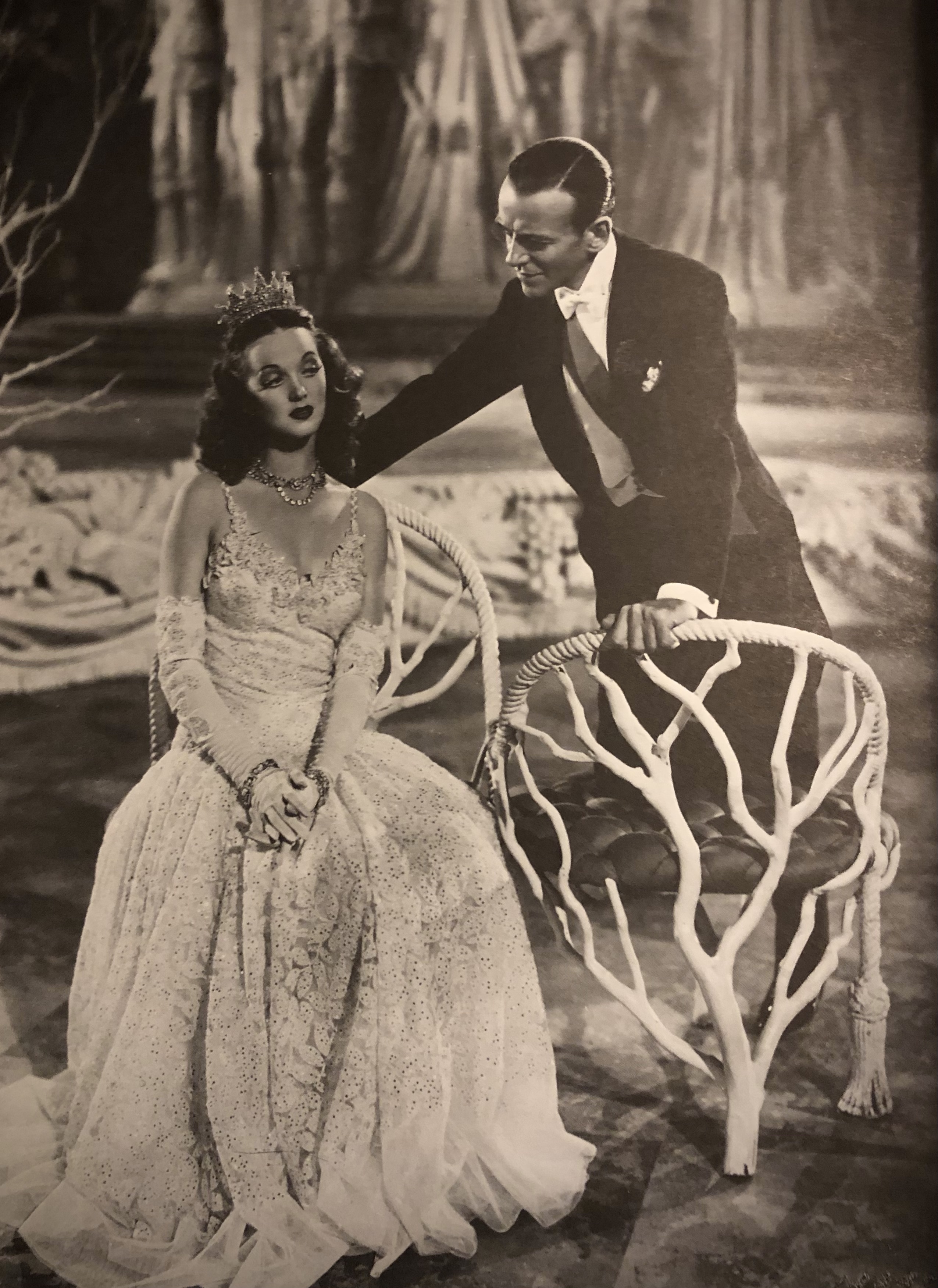
img_6803

Fred Astaire and Lucille Bremer. « This heart of mine ». Ziegfield Follies. 1946.

You can see every tree almost saying “Look at me!”

“What color are the trees? “ “Green!”

“What color were they last year?” “ “Green!”

“And next year?” “Green!”

“It’s a bore.”*

No concerto – even if you re-re-name it Number Two for NYCB after having gotten rid of the sets and costumes for that original thing first entitled “Ballet Imperial” – is ever about “I show up, play fancy, and then go home.” Alas, that was the feeling that dominated both in the pit and on stage on Friday night.

With the exception of the always just-right and delicious Marine Ganio  [who can lay claim to the title of most overworked and underrated dancer in the company], the other minor soloists proved cautious, self-conscious, or just plain stiff (special mention to Silvia Saint Martin).

Oh and yes, there she was. Ludmila Pagliero was all pulled up: a pliant partner, a soloist lit from within, with nowhere to go during so much of the dull and predictable choreography.

But Paul Marque came to the rescue and caressed his ballerina in masterful gently-landed lifts [even that super-awkward one in attitude front where she falls back and then hops on pointe with bended knee. It’s always been an ugly one]. Marque was marvellous in returning his partner to the ground as if she were as light as an autumn leaf. You could sense that he had his own narrative thing going on and bravo to him.Marque did his responsive best as the token male who represents one finger in the cat’s cradle/labyrinth of females-with-connected-hands movement. Just how many times did Balanchine do this “signature move” in his works?  I would have preferred that the Paris Opera Ballet offer “Theme and Variations,” which uses the same themes and patterns but which has a spine. That ballet would have given the blossoming Paul Marque more of a chance to shine.

This thing called Ballet Imperial went on and on and nowhere. Some fouettés were offered up at some point. Woo-hoo?

*

 *                                                     *

Who  Cares?

img_6801

Fred Astaire & Eleanor Powel « Begin the Beguine ». Broadway Melody of 1940.

“Don’t you marvel at the power of the mighty Eiffel Tower?”

“How many stories? “ “Ninety!”

“How many yesterday?” “Ninety!”

“How many tomorrow?” Ninety!”

“It’s a bore.”*

A backcloth with a vaguely New Yorker-style cover illustration of skyscrapers is now a dated cliché. But at least it was less hard on the eyes than that dull cyclorama, predictably blue and bland since early television recordings. (And which had been deemed sufficient for the previous ballet).

In 1971, this ballet claimed to pay homage to beloved Gershwin musicals of the past. And for a generation or two afterwards, often an audience member would hum along.

Clearly no youngster in this audience had ever heard of Gene Kelly or Fred Astaire [both still alive and venerated in 1971] or…George Gershwin. So did the under age fifty audience pay attention? Kinda.

OK there is nothing a conductor can ever do about the Balanchine’s beloved and somehow sublimely tacky orchestrator, Hershey Kay. Except maybe, give up and give in to that old “ba-da-boom” of Broadway melodies. Here George Gershwin’s jazzy swoop just bumbled along in the orchestra pit. If dancers have no air under their feet, they cannot fly.

The first part is a medley/mash up of relatable tunes, created to give kids in the corps about 15 seconds of fame. Their moments are totally fleeting, kind of as pointless as confetti. After the corps has sufficiently increased the running time  [which included some haplessly missed marks], Mr B. begins to unleash the mini-soloists. A loud “yes” goes out to the swoop and charm of Seohoo Yun and to the natural swing and flow of Roxane Stojanov .

Then all these other people show up. [Apparently, this has always been a ballet in two parts. To me it was always just shapeless].

“But think of girls!”

“It’s either yes or no

And if it’s no or if it’s yes

It simply couldn’t matter less.

It’s a bore.”*

 As to “the” Fred and Ginger/Gene and Cyd avatars… I preferred Léonore Baulac and Germain Louvet later, alone in their solos, rather than together. Don’t get me wrong, there is nothing wrong in what they do as a pair, lovely lines. They clearly like each other, dance to each other. But as far as a couple goes, you never sensed that shiver of desire. Alas this description applied to whomever the cheerful and charming Louvet ended up dancing with.  It’s weird, he’s a generous and well-meaning partner and fun to watch but here he just didn’t connect to anyone. Watching Louvet was like watching Eleanor Powell, an asteroid, a comet, doing her own marvellous things. Who remembers who her partners/satellites were? Who were Louvet’s? (F.Y.I. Baulac/Colasante/O’Neill).

Hannah O’Neill, on her own in “I’ll Build a Stairway to Paradise,” rode on whatever inflections she could glean from the lackluster conducting with poise and discretion.  Léonore Baulac’s solo “Fascinatin’ Rhythm” had snap but could have been bigger, in the sense of more openness out of the hip. Valentine Colasante’s “My One and Only” was luscious and beautifully outlined, but read as oddly unmusical, so unusual for her. (N.B.: leaden orchestra’s fault).  In his solo then, Germain Louvet, finally liberated from the females [and I am sure he doesn’t think about it this way, but is he just better when he dances unhindered?] proved very smooth, silkily, and jaunty. Nevertheless, he lacked that mysterious “something else” a Gene Kelly, or a Georges Guétary, or a Louis Jourdan, brought to their musicals back in the day.

I did not even try to score a ticket for another cast. Worse than that, I had come home from the theatre, written the above, printed it out, and put it in a drawer. Who’d care?

“Look at Paris in the spring when each solitary thing is more beautiful than ever before.”

“It’s a bore.”*

Quotes from *Lerner and Loewe, “Gigi.” Look up either the Broadway version from 1951 or the MGM version by Vincente Minelli from 1958.

Commentaires fermés sur Balanchine in Paris.  “Alas…it’s a bore.”

Classé dans Humeurs d'abonnés, Retours de la Grande boutique

Michaël Denard (1944-2023) : The Art of Sharing.

Denard Giselle prière

Michaël Denard. Giselle Acte 2. Paris. Photographie Mickaël Lemoine

In 1971, an unknown guy from the distant Paris Opera Ballet breezed into an ABT  City Center run,  “just like that,” and not only astonished us but stole our hearts.

All of us in New York: gay or straight, young or old, orchestra seaters or top of the house fanatics at City Center became equally and completely besottedly in love with the gorgeously cheekboned, dashingly blond, and beautifully-proportioned guest artist Michaël Denard. Guest artists at ABT were both the norm and an exception. So why was this one so special?

For many of us, love at first sight centered itself down around his ankles, elegantly arched, controlled, and connected to pliant feet pointed without effort.  We didn’t have that many male dancers so fleet of foot and arched of line in the American dance world back in the day.  Even Nureyev, the then absolute idol, had to make up for a lot of his limitations with sheer grit…Remember how Nureyev used to curve over and stab his five toes into the floor at the end of a variation, hoping that we’d focus on his assertive upper-body flourish instead? Denard didn’t seem to need to do any flourishes and the way all the parts of his dance radiated “this is all natural and not a challenge” was a revelation.

But then it got better when you looked up from down there at the rest of him. His arabesque, the way he’d push off those feet into easy jumps, his sweet and relaxed gentlemanly demeanour and natural épaulement. Denard remains one of those rare dancers who had nothing to prove to themselves, no insecurities.  No stress.

Denard Lac agenouillé Rothbart

Michaël Denard. Le Lac des cygnes. Bourmeister. Paris. Photographie Mickaël Lemoine.

But, as his career would prove, his work was never just all about him. During these early days in the 1970’s when he was starting to develop his legendary partnership with Ghislaine Thesmar in France, Denard had been imported to finally give an American ballerina at ABT, Cynthia Gregory, a “tall-enough” partner and thus a chance to shine.  Her 5’7” in those days, so normal nowadays, had been used against her for years but her talent was obviously ready to explode. Gregory had had it pounded into her that she was too big to dance any of the Romantic parts, and now here came this dishy and stretched cavalier from a far off land. Each season through 1975 – so short a time — we could not wait until the annual arrival of Gregory’s best prince and partner. Paquita, Swan Lake, a joyous and witty Coppelia, one-acts, and most of all, Giselle.  Each time, Denard made Gregory look so easy to love and move through the space of the stage. He made her seem so normal sized, absolutely as light as a will o’ the whisp, gorgeously feminine, at her best. How I wish their Giselle had been filmed!

An innate gift for partnering – be it with a ballerina, a corps, a choreographer, a student — may have been Denard’s life-long secret: mastery of craft combined with the most generous and un-egotistical spirit. Any dancers can spin or split. But not that many know how to share.

Michaël Denard (1944-2023) : une étoile en partage

Denard Giselle Lys

Michaël Denard. Giselle final. Paris. Photographie Mickaël Lemoine

En 1971, un gars venu du lointain Opéra de Paris arriva comme une brise durant une saison d’ABT à City Center, « comme ça », et non seulement nous étonna mais encore s’empara de nos cœurs.

Tous à New York, gay ou straight, jeunes ou vieux, fauteuils d’orchestre ou fanatiques des hauts de City Center tombèrent également et complètement fou-amoureux de ce superbe invité aux pommettes hautes, insolemment blond et merveilleusement proportionné, Mickaël Denard. Les « guests » à ABT étaient pourtant à la fois la règle et l’exception. Alors qu’avait celui-ci de si spécial ?

Pour beaucoup d’entre nous, l’amour au premier regard se centrait particulièrement dans la zone au-dessous de ses chevilles, joliment cambrées, contrôlées, et connectées à de souples pieds qui pointaient sans effort. À cette époque, nous n’avions pas dans le monde de la danse américaine tant de danseurs si agiles et à la ligne si arquée. Même Noureev, alors idole absolue, devait compenser ses limites avec du cran. Vous souvenez-vous comme Noureev se rassemblait par-dessus ses cinq doigts de pieds plantés dans le sol à la fin d’une variation dans l’espoir qu’on se focalise sur son haut du corps confiant ?  Denard ne semblait pas avoir besoin de quelconque fioriture et la façon dont sa danse irradiait le « c’est naturel ; ce n’est pas un défi » était une révélation.

Mais dans un sens, cela devenait encore meilleur quand vous regardiez au-dessus de ses chevilles et le considériez dans son entièreté : son arabesque, la façon dont il repoussait le sol dans ses sauts légers, son attitude douce et  chevaleresque, ses épaulements naturels enfin. Denard était de ces rares danseurs qui n’avaient rien à prouver à eux-mêmes ; aucune insécurité ; pas de stress.

Mais, comme le reste de sa carrière l’a prouvé, son travail ne se résumait jamais à lui seul. Dans ces années du début des années 70, alors qu’il commençait à développer son partenariat légendaire avec Ghislaine Thesmar en France, Denard avait été « importé » pour donner finalement à une ballerine américaine d’ABT, Cynthia Gregory, un partenaire suffisamment grand et, de ce fait, une chance de briller. Dans ce temps-là, les 1 mètre 70 de cette dernière, si dans la norme aujourd’hui, lui avaient porté préjudice, mais son talent était prêt à exploser. On avait martelé à Gregory l’idée qu’elle était trop grande pour danser les rôles romantiques, et voilà qu’il arrivait, ce cavalier savoureux à ligne étirée venu d’une contrée lointaine. Chaque saison, jusqu’en 1975 – une période si courte – nous ne pouvions nous tenir d’impatience en attendant la venue du meilleur prince et partenaire de Gregory. Paquita, Le Lac des cygnes, un joyeux et primesautier Coppélia, des ballets courts et, par-dessus tout, Giselle. Chaque fois, Denard rendait Gregory si facile à aimer et à mouvoir sur l’espace de la scène. Il lui donnait tellement une taille normale, une légèreté  de feu-follet, une superbe féminité. Que j’aurais aimé que leur Giselle soit filmée.

Un goût inné du partenariat – que ce soit avec une ballerine, le corps de ballet, un chorégraphe, un ou une élève – a dû être le secret de la vie de Denard : une maîtrise de la technique combinée au plus généreux, au moins égotiste des esprits. N’importe quel danseur peut pirouetter ou jeter. Mais ils ne sont pas si nombreux ceux qui sont capable de partager.

Libre traduction, Cléopold

Commentaires fermés sur Michaël Denard (1944-2023) : The Art of Sharing.

Classé dans Hier pour aujourd'hui, Retours de la Grande boutique, Vénérables archives, Voices of America

Mayerling in Paris : deadly…

img_6284

Mayerling. Hugo Marchand and Dorothée Gilbert as Rudolf and Marie.

As Joseph II of Austria once purportedly said, even a Mozart can produce something with “too many notes.”

After descending the grand staircase at the Palais Garnier, I stopped at one of the pulpits to buy the illustrated program. Before I could say “bonsoir,” the clearly exhausted usher, without looking up, launched into the bilingual mantra she had obviously been repeating all evening: “there is a plot summary in it! Cast list! Y’a un synopsis dedans, of course!”

That’s not a good sign for a story ballet. Especially one based on history that has become a film and television and touristic cliché: the Decline of the Austro-Hungarian Empire.

But if we are in SissiLand, as one visitor to the Palace of Schönbrunn once called Vienna, exactly which one of these equally young women on stage is the Empress Sissi? Despite Scene One, my young neighbour and seatmate admitted during intermission that he had no idea that the tense and sad pas de deux with Rudolf in Scene Two had been with his mother. “Maybe she should have stayed inside the same costume from Scene One? “

My neighbour made a nostalgic reference to how Ophuls’s film of Schnitzler’s La Ronde, set in the same Viennese fin de siècle twilight as this, still makes who is who so easy to follow nearly a hundred years later. Then he began to enumerate silent movies that aren’t that hard to understand, either. “Do they ever use inter-titles in ballet?” he suggested, full of hope.

As to this scene, it turns out that consulting the illustrated program afterwards – the one with a Plot summary! Cast list! – won’t help in any case. “SA peine” [a feminine noun in French despite the object] was translated as “HER grief.” Instead of clarifying that Rudolf was reaching out to his mother with HIS grief, he had been somehow upset for her.  Which was not the case at all. Confusing.

After that scene with “her” grief, we discovered the anti-hero in a different bedroom playing with guns and skulls and yet another young woman. Who she?

You get the picture, it takes an age to figure out who is who, sort of, as there are just too, too, many anxious women and men in fancy wigs buzzing around.  Actually, the wigs help: the redhead, the blonde, the one with bangs.  But do wigs mean anything dramatically? I wonder how many in the audience inhaled and sat back and then sat up straight: “oh damn now who is this new woman with long loose dark hair” during Act Three Scene Two? Ha! fooled ya, it’s Sissi’s New Look.

Let’s not even mention my neighbour’s confusion concerning “those four guys who hang out and seem quite loyal to Rudolf, but seem a bit threatening.” “They are Hungarians who want their country to leave the Empire.” “Really? Wow. I never would have guessed that.” It doesn’t help that they do parallel turn-ins à la Russe and in the cast list are not even given one of that plethora of given-names that only a historian could identify (Count Hoyos? Are you serious?) Upon reflection, my neighbour thought that announcing them as “These four mystery men who lurk on the stage and then on the apron have been added to cover the noise and tedium of scene changes” would have been clearer.

I could go on and on about the “hunh?” factor concerning the narrative: imperial boyfriends and girlfriends galore. Then there is Bratfisch, oh god. (Marc Moreau was both funny and touching and danced with zest, but nobody in the audience had a clue as to why he kept popping up in the narrative in the first place). FYI Bratfish is not an old boy-friend, he is the designated Imperial Coachman Loyal To Rudolf Until Death Do Us Part.

Of course I’ve seen this ballet before. But every single time it takes me ages to finally concentrate on the dancers dancing and acting out about something because I’m just too distracted by trying to channel the Almanach de Gotha. I usually fight hard to get to see every cast for a ballet. I only had a ticket for this one. But should another pop up, I will probably say, “not in this lifetime.” Or better yet: “over my dead body.”

*

 *                                 *

So, now, as to the leads: Hugo Marchard’s Rudolf is a brusque and sardonic Laurence Olivier-y Hamlet, utterly confused and repulsed by his compulsive need for women’s approval.  Dorothée Gilbert’s Mary Vetsera is more Nureyev’s Clara: she has seen too much of adult life, and tries to mimic it. She has had a theoretical understanding of love, gleaned from overheard gossip provided by the, many, many, women whooshing around her. Her role makes it clear that long before the Internet naive young women were already being groomed by their environment to pleasingly submit to dominant males. I can’t say this pair clicked as “gilbertmarchand” at first, but by the end they convinced me of their “folie à deux.”

I am looking forward to seeing them in Manon”s last pas de deux this summer instead. Perhaps that illustrated program in English translation will contain no more oxymorons such as: “The tragedy reached its tragic conclusion.” And have you ever heard of a “twin suicide?” I’ve heard of the Twin Towers, but as far as I know, few twins were on stage. What was demonstrated at the end of the ballet by the leads was a “murder-suicide.”

Hannah O’Neill, identified as Countess Marie Larisch in the program, grew on me and my seatmate and the audience. She’s the one in the blue dress at first, reddish wig, etc…but with glinting eyes and a unique elegance that went beyond all that — so easy to partner, like Dorothée Gilbert, that every trick seems effortless. O’Neill’s Larisch was the character my seatmate “got” almost at once as an old flame/friend/pimp à la Pompadour. He rooted for her, a discarded girlfriend (out of those too many discarded girlfriends who dominated space on the stage).

As poor Princess Stephanie, the ugly duckling Belgian devout political pawn married off to an Austrian sex maniac, Silvia Saint-Martin came off more as spoiled and stiff rather than frightened or anguished. As Rudolf’s woe-begotten bride remains in costumed variations of white and cream, my neighbour DID understand later on that a woman standing stiffly downstage-left in Act Two was the same character who had been flung about and humiliated at the end of Act One…But then he said, ”but who is she supposed to be in the first place, exactly? She never reacts to anything.”

Mitzi Caspar, what a great role and what waste at the same time. This character appears onstage in Act Two for One Scene that’s all and then hangs around somewhere backstage in costume for an hour and a half waiting for the final curtain calls. Valentine Colasante’s prostitute  — joyful and easy-going and gorgeously all there — finished every whirl with unfussy, light, and impressive suspension. With her long neck and relaxed tilts of the head, she was lit from within. Her dance with Marchand’s Rudolf felt trusting and warmly in synch. They even gave us the illusion that the heavily re-orchestrated Liszt had lifted up its head too for a while. That’s so cool: dancers making the music sound better.

Let it be said: the cast on stage was not helped by the languidly-conducted Liszt score that dragged us down. The orchestra provided zero swing or swoop, especially in the last act. My neighbor noted that a lot of the musicians were awfully young. “Is that normal for a Grand Opera?” “No.” Poor dancers, poor us.

As stunning and challenging as MacMillan’s passionate acrobatic pas de deux can be for dancers, this thing called Mayerling ends up delivering an exercise in narrative tedium.

img_2648

The Family-Crypt of the Habsburgs in Vienna.

2 Commentaires

Classé dans Humeurs d'abonnés, Retours de la Grande boutique

Le Temps d’Aimer la Danse 2022 (5) : « A Carnival of the Animals »

Le Temps d’aimer festival in Biarritz

Saturday-Sunday, September 10-11

When you will go to Biarritz’s fall dance festival next September, you will be trying to run from place to place as fast as a thoroughbred. Be prepared: You will spend your time running around the town and its ‘burbs like a headless chicken unless you hire a limo, and even with a blessed limo you can’t be in two places at the same time.

For an article in French by Cléopold on the same shows, click here.

LE TEMPS D'AIMER 2022 - COMPAGNIE DIFE KAKO - CERCLE EGAL DEMI-CERCLE AU CARRE

CERCLE EGAL DEMI-CERCLE AU CARRE par la COMPAGNIE DIFE KAKO, chorégraphe CHANTAL LOIAL, Photographie de Stéphane Bellocq.

*

 *                           *

OXEN

img_2323

Proyecto Larrua. « Idi Begi »

Saturday, September 10

14h on the esplanade Théâtre du Casino Municipal

Proyecto Larrua: Idi Begi

The entire piece seems to be taking place in slowed-down motion inside your head. Have you ever milked a cow? Felt the warm, silent, yet titanic weight of that flank as you rested your head against it? Those ten minutes feel completely out of time, just as this piece did.

Idi Begi means “ox eye.” Idi probak” means “pull bull,” a competition between farmers. A lot of Basque games – and this is Basque country — seem to be about skilful shows of force. I’d have called this perfectly formed 15 minute piece, one of the winners of the Artepean choreographer’s competition: “Agon.”

To the thunderous and then plaintive sounds of what seem to be pots and pans or maybe cowbells, a bent over and already worn duo with heavy hanging heads trot slowly as they submit to a dominator with a long stick.

Yet the downtrodden mood doesn’t feel violent or frightening, but uncertain and volatile instead. A stylized power struggle, played out through the weight and push and pull these three dancers give to their movements. The dominated tread along and slowly and painfully, yet as bodies intertwine you start to lose the sense of who is on top. Images of paintings of powerful peasants and beasts, the heavy and symbiotic lives they led together, flashed through my mind.

*

 *                           *

HORSES AND ROOSTERS AND BEES

LE TEMPS D'AIMER 2022 - COMPAGNIE DIFE KAKO - CERCLE EGAL DEMI-CERCLE AU CARRE

CERCLE EGAL DEMI-CERCLE AU CARRE. COMPAGNIE DIFE KAKO, chorégraphe CHANTAL LOIAL., Photographie de Stéphane Bellocq.

Saturday, September 10, 9 p.m.

Théâtre du Casino Municipal

Companie Difé Kako

“Cercle égal demi-cercle au carré” [A circle equals a semi-circle squared]

In this increasingly mean and ugly world – where we talk at and not to each other, particularly when the issues at stake include colonialism, racism, and ageism — civilized discourse, friendly interchange, has become as rare as hens’ teeth.  At this performance you witnessed the best kind of cross-pollination as a joyous swarm of colourful bees and dignified butterflies fluttered and stomped around each other in good and infectious cheer.

Welcome to Difé Kako [Things Will Get Hot] a joyously inclusive company of musician dancers of all colors (including pink) and all ages (from young adult to senior). And I mean inclusive: from the get-go the seated audience buzzed, tickled by the fact that after the performance they were invited to another venue where they could meet and dance with the entire company.

At first you are a bit bewildered by what is successively projected on the backdrop: squares (okay that’s part of the title), then ocean waves, then a tan rider galloping on a horse, then odd dated black and white footage of expressionless white men perfecting dressage. It all takes a while to sink in. But when a “caller” shouts out to her dancing “cavaliers” [one of the many words in Creole that you can easily figure out] you start to get it. Aha, not only ballet but the patterns of most old social dances took their inspiration from horses [the term “balletto” was originally coined during the Renaissance to describe intricate horseback parades]. To put it another way: in a past life you were probably either a slave or serf, but when you appropriate these European dances you, too, are as glorious as a knight in shining armor.

The dance varied back and forth in waves. The swooping and dignified quadrilles of the elders were mesmerizing. A quadrille with a caller…a square dance? Of course, that’s how it translates. Yet the first term evokes Marie-Antoinette while the second is Americanized. These church ladies’ casually dextrous use of their fans and the sloping angles of their necks took me straight back to the elegance of the ancien regime, too cool for barn-raisings. One particularly elegant man with jaunty tipped hat and a whisper of a smile wiggled in the lightest and the least emphatic of increments. You could see the energy reserved deep down below the surface, and that he was readied to dance all night. He stole my heart.

Alternatively –and even when the whole company fills the stage — the youth stomps and bops, play with every way to move from Ministry of Silly Walks stalks to hip swivels and wiggles, to two-steps or to gallops around the stage. They even tease each other by imitating the pecks only chickens use to check each other out.

Several members of the younger troupe of dancers meanwhile flowed back and forth from the dance floor to the bandstand house right where they’d join the percussionists and pick up a base, or a sailor’s concertina, or a wood/metal block or with maracas or fiddle. Song and words floated atop the air.

At one point, the ecstatic dance stops as the youths turn to stare at the screen and watch themselves dancing to the sound of a flute on a volcanic hillside in the Antilles.

Absolutely nothing matched, but everything in this patchwork (down to the chequered fabrics that somehow hung on to belts) seemed to be all the right ingredients you’d need for a savory stew. There are are words for “just throw it all it the pot and it will end up delicious” in every single language, after all.

It was marvellous to watch the audience stream out at the end, so much more buoyant than when it fussily trooped in. Now we were ready and willing to engage in conversation, and did. If you open your mind and heart to others you will live and learn. It’s never too late.

*

 *                           *

SHEEP, DOGS, AND HOOMANS

TA22-Kukai©stephane_Bellocq-1

Kukai Dantza. « Eta orain zer? » Photographie ©stephane Bellocq

Sunday, September 11, 9 p.m.

Atabal (not exactly in the center of Biarritz)

Kukai Dantza  “Et oran zer?”

Atabal, like the other suburb of Anglet where I had found “Tumulus” the day before, is kind of in the middle of nowhere outside the resort town of Biarritz. These new venues are quasi-impossible to get to on public transportation on a Sunday. Indeed the space used for this performance seemed to be nothing more than an industrial zone hangar, despite the raised stage area.

You panic about arriving late, worried about the “open seating” plan, then realize that both audience and performers are upright and scattered all over the place. Where is the vantage point where you could sit semi-comfortably on the floor or even lean exhausted by the day you’d just had against a wall? Nowhere. [About an hour in, this turned out to be clearly painful for a valiant elderly gent with a cane who I couldn’t take my eyes off of to the point of worrying about him rather than the dancers. He was a real trooper and survived].

“Eta oran zer”/”And what comes next?” or even “Now what?” turns out to be a roiling group of ten dancers and a plethora of ambulating musicians and their conductor who all couldn’t care less where the stage happens to be traditionally located. You are supposedly part of the performance, swivelling around to follow one dancer or the other from one spot to a palm-held illuminated spot, then unwittingly get encircled and swept into the center like sheep, then pushed back out to the edges of the dance floor.

During the hour and more than a half of Et Oran Zer, these dancers/border collies –gently, but with pre-planned determination and startlingly cold hands —  forced the audience to be squared, circled, and divided.

You might catch and enjoy some energetic Basque references. A girl keeps repeating a Basque flurry of beaten jumps in whiplash fashion (the entrechat-six, among other steps, were integrated into Louis XIV’s new – the world’s first– vocabulary of ballet). Tours en l’air, also of Basque origin, proliferate. And then these hints of an ancient culture translated themselves into delicious hip-hops, crumps and slides. I was particularly taken by the scary intensity of the dancer who looks just like Keith Haring, sans the glasses.

Unlike last night with Difé Kako, however, tonight I didn’t feel included. Just getting pushed about, hither and yon, for no clear reason. And, alas, way too early into the thing we got pushed out of the centre and got to stand around in a circle and watch. Forty-five minutes of just standing around, clearly disinvited to the dance, became endless. Might as well provide seats, then, in the first place.

TA22-Kukai©stephane_Bellocq-4

Kukai Dantza. « Eta orain zer? » Photographie ©stephane Bellocq

At several turns during this festival, you could run into troupes of Basque dancers, sometimes already bouncing on the plaza as you walked out of a venue. Each time, amateurs young and old would join the professionals and demonstrate an ingrained mastery of complex steps and patterns and exchanges. Unlike so many places where “folk dance is like so yesterday,” — Hungary included — here in the southwest of France these peasant dances remain a strong vector of identity, a part of everyday life. I envy how hopping up to the plate in your espadrilles has never stopped being an easy and normal thing that anchors you to a sense of communal and intergenerational identity. Look up some Basque dances and try them out in front of your mirror: it takes a will of steel to learn these deliciously complex steps and patterns. You gotta be born into it.

As for the music, I was instantly amused as I walked into the performance space only to catch tiny threads of  “L’Arlesienne.” Bizet’s eponymous heroine is a mirage whom you will never see. And that seemed like a cool metaphor. But then the music moved on to a catchy melodic hodgepodge of folk-ish instruments like fiddle and flute and ambulating cello, a real score. Alas, the inventive live de-ambulating orchestra’s mesmerizing sound finally faded into in to the predictable beats of a recorded soundtrack about twenty minutes before the end.

Shatteringly loud house techno took over. I pulled back like a terrified mouse and crouched in a corner behind the amps, hoping to spare my ears. In any case, the audience had long been reduced to the usual status of immobile passive onlookers, gaping at dancers whirling in the centered spotlight. I peeked out and watched through the legs of the crowd of static onlookers. Not one amateur Basque dancer’s leg stepped out to join in.

When I walked out of that hangar, I was more panicked about finding the next bus back to town than hushed in reverie. After what I had just experienced, honestly, I felt as deflated and exhausted as a lab rat.

Commentaires fermés sur Le Temps d’Aimer la Danse 2022 (5) : « A Carnival of the Animals »

Classé dans Blog-trotters (Ailleurs), France Soirs