Archives d’Auteur: Fenella

Avatar de Fenella

À propos de Fenella

Pour ne pas rester muette, car je n'ai pas les deux pieds dans le même sabot, i will write in English.

When flights of angels sing. Forsythe and Brown for the Paris Opera Ballet.

photo (1)Tuesday, December 11

Has he attained the seventh degree of concentration? (G.B. Shaw, Heartbreak House, Act 1)

On Tuesday night, I think the Paris Opera’s dancers did.

I start with the second piece, O Zlozony/O Composite physically composed by Trisha Brown. As I expected, those around me alternated between slumping back in their seats and keening forward. The audience dances a connect/disconnect on their part too! Quite often, those sitting react more to the music than to the dance. But this once, I leant forward all the way through because of the way the music was danced to.

I somehow had felt left out in the cold by the first cast I saw on Dec. 6: Aurelie Dupont, Nicolas LeRiche, and Jéremie Bélingard. Perhaps this trio intended to create a mood which could only emphasize my winter? But as I sat there in the warm dark of the Palais Garnier my only thought proved to be about how I would soon have to head out again into a cold and solitary early winter’s night. The trio looked as pretty and as icy and as disconnected as snowflakes. I could swear I saw snow abstractly represented on the backdrop.

But on Tuesday night suddenly van Gogh’s Starry Night seemed to have enveloped the back of the stage as another almost-new cast orbited in response to a sheltering sky and lifted me up and away from this cold world. Straight-faced – as modern/contemporary demands — but not deadpan. Lost in their own thoughts, this trio melted the snow without having thrown any obvious flames in that direction. Suddenly, I didn’t give a flying fuck about the soundtrack’s irritating and repetitive “brrrd.”

1) Aurélien Houette’s subtly menacing brawn added a wryly poetic mystery to the weird aura that Milosz’s poem already fully embraces. He played against the piece’s potentially glacial prettiness. He embodied a man, a man who moves as he wishes, a man of slowly burning fires. A man with issues and suppressed stories to tell.
2) Jeremie Bélingard, who seemed somehow an outsider filled with an unnecessary fire or hope for warmth when dancing with Dupont and LeRiche here found his place. I know, I know, narrative has been out of fashion in modern dance since, like, forever. So Bélingard keeps his marvelously expressive face quite still, as the task requires. Yet the way he moved and physically reacted to both of his willing partners implied that he certainly had invented his own internal monologue. One which both partners – equally concentrated on their own ideas – somehow understood this time around. His every step seemed to stem from some deep logic, a driving force. He wanted to say something to his partners, to us. And the audience heard him.
3) Muriel Zusperreguy made herself as weightless as a feather in these two men’s calibrated arms. Her unselfconscious femininity has already pleased me many times. The way she allowed the trio to turn her into a graceful yet unpredictable Calder mobile made me think “Aha, New York.” She, too (and how do you do that through a relevé?) let us out front know that she might just have found what she’d spent a lifetime looking for: someone(s) she can trust with her life.

This time, instead of random snowflakes, I found myself fascinated by the stately revolutions of three planets: Houette’s Mars, Bélingard’s Mercury, and Zusperreguy’s…Venus.

Goddesses as well could be found in the Forsythe pieces:  Amandine Albisson — whose superbly proud and juicy Venus had made last season’s Ratmansky Psyché watchable — Sabine Mallem and Marie-Agnes Gillot pulled the audience into their orbit by offering up their wide and true port de bras which made them all resemble proud eagles in flight.  Particularly Eleonora Abbagnato (too rarely seen in Paris as of late) seduced the audience with her rallentando swishes of arms fore and aft in Woundwork. When in focus, Abbagnato always proves as energetic and poignant as anyone’s choreography encourages dancers to dare to be.

Perhaps because Zusperreguy, Houette, Bélingard had reminded me to look and listen and trust my feelings I suddenly, thirteen years after the premiere of Pas./Parts, realized why it has always made me feel at home. During Tuesday’s performance, the music, and the dances, and especially the dancers, sent me back to New York during the long summers of years long gone by. A walk on the West Side in the 1970’s would have taken you to streets overcrowded by kids playing jacks or hopscotch or fighting the way only thirteen-year olds know how to mess up. Watching Pas./Parts, I started to hear not only bubble-gum popping, but to realize that I was hearing snippets of all those kinds of music that once had blared from open tenement windows – yes, the cha-cha, but also a celestial albeit random mix of boogie-woogie, polkas, rock, bits of classical…This ballet, even if from 1999, turns every dancer on stage into a potential John Travolta. The entire cast that night, through its youthful and reckless energy, asked us to play jacks with them. I loved them all, but particularly appreciated the live-wire energy of the very young Emilie Hasboun. Like every one the school produces, of course she has spectacularly assured technique. But not all of them seem to attract the eye, to refract the light, and to glow like a starry night. She does.

For me, all the dancers this evening illustrated two lines from a poem so rarely considered nowadays (perhaps because, um, it’s a bit overheated) Longfellow’s Evangeline: Silently one by one, in the infinite meadows of heaven /Blossomed the lovely stars, the forget-me-nots of angels.

Commentaires fermés sur When flights of angels sing. Forsythe and Brown for the Paris Opera Ballet.

Classé dans Retours de la Grande boutique

To pointe or not to pointe… Is that the question?

WWF

What a piece of work is a man! […] how infinite in faculty! in form, in moving, how express and admirable! in action how like an angel! in apprehension how like a god! (Hamlet, Act II, scene 2)

These four pieces were created on the bodies of dancers in the Paris Opera Ballet yet are these “ballets?” Does ballet mean: women wearing toe shoes? Fluffy tutus? Men in tights? Perennial productions of The Nutcracker? Are these four « modern » either, though? The term proves equally slippery, and as rich with clichés. Does modern mean anything anymore when we still automatically call Picasso’s work “modern” and he has been dead since 1973?

Invented in the US and Germany about a 100 years ago, modern dance defined itself against the sissified genre of ballet: rejecting any footwear and seeking a more natural way of moving, these pioneers developed a grounded, earthy, expressive form. Then in the 1960’s, a new generation of “post-modernists” went as far as one could go to eliminate, if not movement, then “dance” from their dances.

The term used much today, “Contemporary,” means reacting to and interacting with current trends in society and art. As in: what “modern” used to mean. [This month’s Dance Magazine interrogation of current choreographers on this subject inspired my musings).

The “modern contemporary ballets” we witness tonight try to defy categorization. By indirections find directions out, as Shakespeare counsels us (Hamlet Act II, scene 1).

By now almost all dance makers have learned to appreciate the way classically-trained ballet dancers understand the use of the body and its weight and its center and its energy. And they love to take chances. If anyone can look good – both ethereal and earthy — while intentionally falling off their shoes, the Paris Opera’s dancers can.

In The Middle, Somewhat Elevated (1987)

Choreography by William Forsythe; Music by Thom Willems. (28 minutes)

The mysterious title refers to just where Forsythe blithely told the Opéra’s management to put those golden cherries (so that’s what’s dangling up there!) when told he had no budget for a set.

But the music will probably bother you more than the title. The composer constructed a “Theme and Variations” out of the sound of a locomotive crashing into a train, along with electronic distortions of his own voice. 25 years on, the opening chord still…no, I won’t tell you, just sneak a look at your neighbor when the lights first blast on…I own a copy of the recording, and play it when I need something violent to get me out of a bad mood. Smashing things – or at least bouncing around full force– can prove quite cathartic, if you stick with it.

Forsythe likes the idea that any part of the body – from your big toe to your little finger — can provide the intitial impulse for a violent cascade of movement to follow. He knows that tension, distortions, weird changes in speed, all challenges can lead us to dance in ways we never thought of before. This ballet (it has girls in toe shoes, guys in tights, no?) breaks movement down in order to let the dancers exult in demonstrating how they have chosen reconstruct it.

The laws of gravity need not apply. You can start from any point or any “pointe,” in order to test the limits of your strength and balance.

For me this ballet illustrates a portion of Hamlet that I’ve always found both perfect and absurd: … there’s a special providence in the fall of a sparrow. If it be now, ‘tis not to come; if it be not to come, it will be now; if it be not now, yet it will come: the readiness is all. (Act V, scene 2).

The dancers are ready.

PAUSE ONLY

O Zlozony/O Composite (2004)

Choreography byTrisha Brown;Music by Laurie Anderson.(25 minutes)

Trisha Brown belongs to an earlier generation (born in 1936 vs. Forsythe’s 1949), yet her imagination fed Forsythe’s just as her own continues to grow and evolve. A founder of the post-modern and minimalist wave one could encounter downtown at Manhattan’s Judson Church during the ‘60’s, her early works often used the music of complete silence.

With the still inventive and chic violinist Laurie Anderson (do a search of ‘O Superman’ from 1981), Brown chanced upon a poem by Czeslaw Milosz. Anderson recorded a Polish actress reading this ode to a bird and began to tweak it in her own way. Each musical section is exactly two minutes long. Brown, always willing to attempt a new way of looking at things, broke this poem down in her own manner too: a trio set against a starlit sky, against which they evolve, revolve, return, float, and come to rest.

The opening section illustrates (distills? cracks open?) the image of a branch still swinging from the heavy weight of a bird that rocked back and forth over great seas of air.

You may get distracted when the composer gets to the poet’s bird sounds: “pta, pteron, fvgls, brd.” Or by trying to figure out how dancers supposedly (according to the program) are shaping letters – including inexistent ones – of the alphabet as they go along.

The woman in this triangle sometimes wears pointe shoes. Could that mean something? I find myself again in Hamlet: see yonder cloud that’s almost in shape of a camel? (Act 3, scene 2) i.e. just let it go…and try not to think too much.

Tonight you will either die of boredom or experience a kind of out of body experience if you surrender to the dancers’ intense concentration and quiet commitment to revolving within outer dimensions of space and sound.

INTERMISSION (20 minutes)

Woundwork 1 (1999)

Choreography by William Forsythe; Music by Thom Willems. (15 minutes)

Wound as in “winding,” not “harming.” For two couples.

Growing up on Long Island in the 1960’s, Forsythe thought that dance meant the twist (and he was high school dervish) and music meant rock and roll. He discovered classical ballet in college, along with the Derrida, Foucault, Barthes…

The music stems from the recording of three clarinets, deconstructed and unraveled.

The piece could be called “roll and reroll.” Or “ twist and detwist.” While at first the two duets seem not to belong to the same place, the more you look the more you realize that one couple’s to- and-fro gets echoed, and mixed up, by the other’s.

Perhaps Hamlet fits these dancers too: though I am native here/and to the manner born – it is a custom/ more honored in the breach than the observance. (Act 1, Scene 4). By breaking some genteel rules of ballet, Forsythe frees the Parisian dancers to stylishly outdo themselves. If you are to the manner trained, is « too elegant »even possible?

PAUSE ONLY

Pas./Parts (1999)

Choreography by William Forsythe; Music by Thom Willems. (35 minutes)

One of the touchstones of modern French literature, Raymond Queneau’s Exercises de style, comprises 99 retellings – in 99 different literary styles – of the same dull anecdote about standing around waiting for a bus. After a while, the absurdity starts to cheer you up.

Here we only experience 20 sequences (parts) put out by 15 dancers who each latch onto micro-segments of a dance phrase (a step, a pas, let’s say “the letter ‘E’”) as they dance into and around each other. After a while, even Hamlet would have started to smile. You won’t believe your ears when Willems’s music devolves into a deliciously perverse version of the cha-cha.

There’s a divinity that shapes our ends/Rough-hew them how we will. (Act V, scene 2).

Commentaires fermés sur To pointe or not to pointe… Is that the question?

Classé dans Hier pour aujourd'hui, Humeurs d'abonnés

A not too biased plot summary of Don Quixote/Quichotte

NB : voir en dessous pour la traduction française.

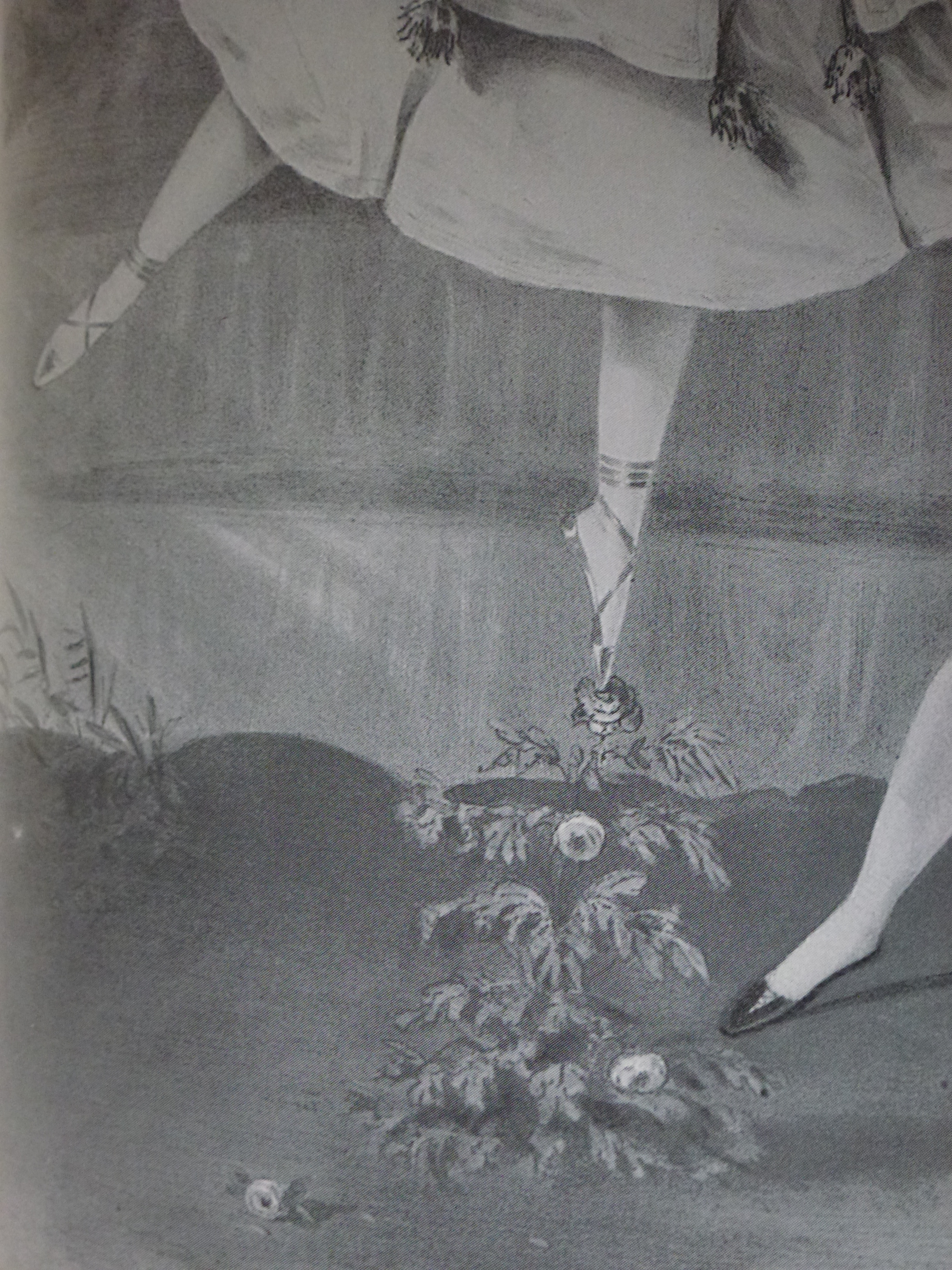
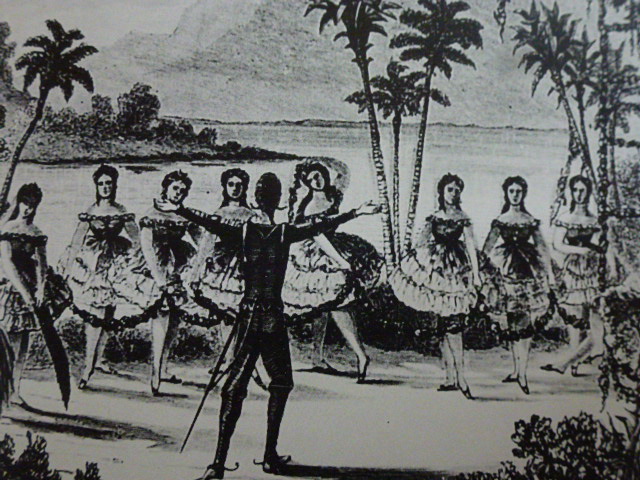
La scène des Dryades, Saint Petersbourg. Gravure russe.

A minor episode from the second volume of Miguel Cervantes’s novel Don Quixote de la Mancha – “Gamache’s Wedding” – is spun out into a comic evening-length ballet. While the mime playing the Don keeps crossing the stage in his single-minded pursuit of courtly love, the real heroes are two thwarted but resourceful young lovers. This is a ballet of many colors: exuberant stylized folk dances (Spanish and gypsy) contrast with the classical purity of the poetic “dream scene;” and slapstick gives way to an explosion of spectacular pyrotechnic dancing in the final “wedding scene.”

As Cleopold points out, even the choreographer of record re-tooled his original within two years and then again…and this ballet has been added onto and fussed over by each generation and every company ever since. For Paris, Rudolf Nureyev scanned and chewed over every version he could find in search of, for lack of a better word, the truth. He sought to create a dramatically-correct structure that would allow the dancers to feel less silly. By instilling some kind of additional logic into the plot and action (details, really) and adding yet more dance, he reshaped this ballet chestnut into an even more satisfying soufflé.

PROLOGUE: IN DON QUIXOTE’S ROOMS

The mimed prologue brings us into the world of Don Quixote, an impoverished gentleman obsessed with the days of chivalry. We see the exasperation of his starving entourage: his servants and the rotund monk Sancho Panza. While this fat man of God tries to hold onto the chicken he has just stolen, the Don prepares to go out and right the world’s wrongs.

ACT I: A SQUARE IN BARCELONA

The high-spirited and strong-willed Kitri, the innkeeper’s daughter, leaps into view. She is soon joined by the man she loves: the dashing Basilio, a barber. Her father, Lorenzo, interrupts them. He refuses to let his gorgeous daughter marry such an impecunious suitor. Lorenzo has a much better catch in mind: the idiotic Gamache, a foppish aristocrat.

The sexy Street Dancer, joined by the toreador Espada and his matadors — and then by Kitri’s two girlfriends — all entertain the crowd with dances until the Don arrives astride his mangy horse. The earthy antics of Sancho Panza (which consist mostly of looking up under the womenfolk’s skirts) distract the crowd. When Don Quixote espies Kitri, he mistakes her for the sweet and inexistant “Dulcinea,” his imaginary ladylove. Kitri humors the elderly knight and joins him in an old-fashioned minuet.

When Sancho Panza’s unsuccessful attempt to steal a fish creates a disturbance, Kitri and Basilio run away together.

ACT II

SCENE 1: A GYPSY CAMP IN THE SHADOW OF A WINDMILL

Finally all alone in the middle of nowhere, Kitri and Basilio come to realize just how serious their flirtatious love affair has become. When set upon by gypsies, the couple appeals for help. Kitri’s gold earrings play a cameo role. By the time Lorenzo, Gamache, the Don, etc., catch up with them, the young lovers have become unrecognizable in borrowed gypsy garb. Kitri is particularly brazen, jiggling her shoulders and rattling her new fake jewelry right under the noses of her pursuers. The guests are next treated to a puppet show, which tells the story of…young lovers on the run. The Don, always one more step away from the real world, first tries to rescue the puppets but then espies a giant monster: the famous windmill. Challenging it to a joust, the Don rushes to the attack. Even the orchestra goes oooh! The windmill wins.

ACT II

SCENE 2: A FOREST GLADE (THE DON’S DREAM)

We now share the vision that appears to a terribly wounded Don Quixote. He hallucinates that Dulcinea/Kitri leads him to a magic land: the kingdom of the dryads (mythical wood nymphs). Here Kitri, Cupid, the Queen of the Dryads, and a bevy of identically dressed ballerinas all dance only for him. The knight’s idea of heaven turns out to be a pure and abstract classical ballet: a realm of soft colors and music, beautiful tutus, complex geometric patterns, gentle and harmonious movements, which provide the setting for extremely technically difficult solos for each ballerina.

ACT III

SCENE 1: A TAVERN

The bullfighter Espada and his friends are rejoined by Kitri and Basilio, still in their exotic disguise. Lorenzo, et al., also catch up with them. Kitri’s father is adamant that his daughter must marry Gamache – the stupid suitor from act 1 — but Basilio has one more trick up his sleeve. “Distraught,” Basilio “stabs” himself and lies “dying” center stage. Kitri begs the Don (miraculously recovered from the windmill’s conk on his head) to help the course of true love. Her father finds himself forced at swordpoint to bless their union. This, of course. means that Basilio may miraculously recover from his wound. The Don and Gamache decide to finally have it out. (When the guys are “on,” this bit can turn into the Minister of Silly Walks meets Mr. Bean).

ACT III

SCENE 2: THE WEDDING PARTY

No extensive miming of wedding vows here, merely a joyful party where Kitri and Basilio express their relief, like any newlyweds, at finally being united.

We get to see these two burst into a brilliant grand pas de deux, a rite of ballet which follows a template as codified as any ceremony. A bouncy entrance for both. A sudden burst of private emotions brings them together to dance in slow harmony. Then the hero will jump for joy. Then the heroine will begin to trill [When she whips out her fan, start – discreetly – to rub your head and pat your stomach along to the music, to demonstrate just how much you are in sync to this subtle demonstration of technical mastery]. Then they will both try to outdo each other in the final coda but finish having decided that fabulous partnering is in fact the secret to a great marriage.

All on stage join together to celebrate. The guest of honor, Don Quixote, decides to take his leave and sets out in quest of new adventures. I bet that, after today’s events, he will only find boredom.

Un épisode mineur du second volume du Don Quichotte de la Mancha de Miguel Cervantes -les noces de Gamache- est monté en épingle jusqu’à devenir un ballet comique en deux actes. Tandis que le mime qui joue le Don ne cesse de traverser la scène en quête d’amour courtois, les vrais héros sont deux amants certes contrariés mais jamais à court d’idées. Voila un ballet aux multiples couleurs : d’exubérantes danses de caractère stylisées (espagnoles et gitanes) contrastent avec la classique pureté de la scène du rêve ; et la grosse farce fait place à une explosion spectaculaire de pyrotechnie dansée dans la scène nuptiale finale.

Comme Cléopold l’a fait remarquer, le chorégraphe d’origine a lui-même revisité son original deux ans après la création et encore après … et son ballet a été revu et tarabiscoté par les générations suivantes. Pour Paris, Rudolf Noureev a passé en revue et digéré toutes les versions à disposition, à la recherche, en l’absence d’un vocable plus approprié, de la « vérité ». Il aspirait à créer une structure dramatique correcte qui permettrait aux danseurs de ne pas se sentir insipides. En instillant un peu de logique supplémentaire dans le livret et dans l’action (quelques détails seulement), et en ajoutant encore un peu plus de danse, il a accommodé ces restes de ballet pour en faire un consistant plat de résistance.

PROLOGUE : DANS LA CHAMBRE DE DON QUICHOTTE

Le prologue mimé nous transporte dans le monde de Don Quichotte, un gentilhomme fauché obsédé par l’époque de la chevalerie. On sent l’exaspération de son entourage affamé : ses serviteurs et le rondouillard moine Sancho Panza. Tandis que l’aimable gyrovague essaye de rester en possession du poulet qu’il vient juste de chiper, le Don se prépare à sortir afin de redresser les torts qui pullulent en ce monde.

ACTE I : UNE PLACE DE BARCELONE

La vivace et têtue Kitri, la fille de l’aubergiste, nous saute littéralement aux yeux. Elle est bientôt rejointe par l’homme qu’elle aime : le beau Basilio, barbier de son état. Son père, Lorenzo, les contrarie. Il refuse de laisser sa superbe fille épouser ce prétendant impécunieux. Lorenzo a un bien meilleur candidat en tête : le ridicule Gamache, un aristocrate suranné.

La pulpeuse danseuse de rue, rejointe par Espada le toréador, ses compagnons matadors ainsi que par les deux amies de Kitri divertissent la foule de leurs danses jusqu’à ce que Don Quichotte arrive à califourchon sur va vieille rosse. Les badineries rustiques de Sancho (qui consistent en gros à regarder sous les jupes des filles) distraient la foule. C’est alors que Don Quichotte s’avise de la présence de Kitri qu’il confond avec la douce et imaginaire « Dulcinée », la dame de ses rêves. Kitri divertit le vieux gentilhomme et danse avec lui un désuet menuet.

à la faveur du trouble causé par la tentative manquée de Sancho pour voler un poisson, Kitri et Basilio prennent la poudre d’escampette.

ACTE II

SCENE 1 : UN CAMP GITAN A L’OMBRE D’UN MOULIN A VENT

Enfin seuls au milieu de nulle part, Kitri et Basilio réalisent soudain combien leur bluette est devenu une affaire sérieuse. Capturé par des gitans le couple leur demande de l’aide. C’est une boucle d’oreille en or de Kitri qui décide de leur sort. Quand Lorenzo, Gamache, le Don etc. les rejoignent, les jeunes amants sont devenus méconnaissables, dissimulés sous des oripeaux gitans. Kitri se montre particulièrement effrontée, agitant ses épaules et faisant sonner ses nouveaux bijoux de pacotille juste sous le nez de ses poursuivants. Les invités se voient ensuite donner un spectacle de marionnettes qui conte l’histoire de … deux jeunes amants en fuite. Don Quichotte, jamais vraiment les deux pieds sur terre, essaye d’abord de voler au secours des marionnettes puis aperçoit un monstre géant : le fameux moulin. Le provoquant en combat singulier, il fonce tête baissée. Même l’orchestre fait « Hiiiiiiii » ! C’est le moulin qui gagne.

ACTE II

SCENE 2 : UNE CLAIRIERE (LE RÊVE DE DON QUICHOTTE)

Nous assistons maintenant à la vision qui apparait à Don Quichotte, cruellement blessé. Dans son hallucination, Dulcinée/Kitri le conduit dans une contrée magique : le royaume des dryades (de mythiques nymphes des bois). Là, Kitri, Cupidon et la Reine des dryades, ainsi qu’une cohorte de ballerines habillées de manière identique dansent toutes pour lui. L’idée que se fait le chevalier du Paradis prend la forme d’un pur moment de danse classique abstraite : un domaine de couleurs et de musique suaves, de beaux tutus, de figures géométriques complexes, d’élégants et harmonieux mouvements, écrin approprié pour les très techniques solos de chacune des ballerines.

ACTE III

SCENE 1 : UNE TAVERNE

Le Torero Espada et ses amis sont rejoints par Kitri et Basilio toujours dans leur déguisement exotique. Lorenzo & Cie les rattrapent finalement. Le père de Kitri est inflexible dans sa résolution de marier sa fille à Gamache -le stupide prétendant du premier acte- mais Basilio a plus d’un tour dans son sac. « Dérangé », celui-ci se« poignarde » et gît, « mourant » en plein milieu du plateau. Kitri supplie Don Quichotte (miraculeusement rétabli de son mouliné sur la caboche) d’aider la cause de l’amour vrai. Le père se trouve bientôt forcé de donner son consentement à la pointe de l’épée. Cela donne le signal à Basilio pour guérir miraculeusement de sa blessure. Don Quichotte et Gamache décident finalement d’en découdre (quand les gars sont bien dedans, la scène peut ressembler à la fille adultérine des Monty Python et de Mister Bean).

ACTE III

SCENE 2 : LES NOCES

Pas de grande scène de mime pour ce mariage mais avant tout une joyeuse réception où Kitri et Basilio expriment leur soulagement, comme tous jeunes mariés, d’être enfin unis. On verra ces deux-là se lancer dans un brillant pas de deux, un rituel balletique qui suit une routine aussi réglée qu’une cérémonie. Une entrée bondissante pour les deux suivie d’une soudaine effusion les unissant dans une danse de calme harmonie (adage). Puis, le héros saute de joie (variation I). Puis l’héroïne se met à roucouler (variation II) [Quand elle commencera à agiter son éventail, entreprenez de -discrètement- vous frotter la tête et l’estomac en même temps, avec panache, pour montrer toute votre sympathie à cette discrète démonstration de maîtrise technique]. Enfin, ils essaieront chacun de se surpasser l’un l’autre dans la coda, tout ça pour finir par convenir qu’un fabuleux partenariat est le secret de tout bon mariage. Tous se joignent à eux pour célébrer la noce.

L’invité d’honneur, Don Quichotte, décide alors de s’éclipser pour aller vers de nouvelles aventures. Je pense qu’après les évènements de cette folle journée, il ne pourra que se raser.

Libre traduction de Cléopold

2 Commentaires

Classé dans Hier pour aujourd'hui

Very Biased Plot Summary BALANCHINE GOES TO PARIS: IN F(REE) MAJOR

What does an abstract ballet have in common with one that tells an old-fashioned story?

The fact is, all ballets are always built upon the same basic vocabulary of steps. Yet all ballets serve to honor the gorgeous technique that dancers – both artists and athletes — never stop developing. They challenge themselves in order to challenge us.

Ballet could be used to define infinity. Starting from a few positions, ballet frees us to shape infinite combinations. Think about this: only 26 letters combine to create the English language. But just how many ways can you mix them up into just how many words? The OED recently accepted its millionth. And just how many ways can you tease those words into new sentences?

Our audience doesn’t need 3-D glasses. For here they whoosh before us, exaggerating the sensations of being alive, literally carving space out of space: these marvelous dancers, defying anything we could possibly imagine on our own.

George Balanchine’s (1904-1983) vocabulary certainly proved infinite [425 ballets] After fleeing the turmoil of revolutionary Russia, he danced and created works for Serge Diaghilev’s legendary troupe of exiles, Les Ballets Russes. Dispirited by losing his chance to direct the Paris Opéra Ballet, Balanchine left for the United States in the early 1930’s. There he would create a school in order to create his own company. Both continue to perpetuate his legacy. But more than that, he changed the way we think about ballet.

PRODIGAL SON (1929)

Music by Serge Prokofiev

After the Russian Revolution and civil war, Balanchine found himself stranded in Paris. He soon was adopted by the Ballets Russes, whose impresario, Serge Diaghilev, paired the budding choreographer with equally talented musicians such as the crochety composer Serge Prokofiev.

Here we have a chapter from the Gospel of St. Luke stripped down and fluffed up – literally and figuratively – older brother who stays home cut, sexy siren added.

So there’s this cute young guy, fed up with his droopy father – that beard! those ponderous gestures! – and his droopily conventional sisters. He decides to demand his inheritance and go out to experience the world. He vaults over the fence that keeps him from being free in a marvelously airborne moment. (Today he would leap onto a cheap airline destination Barcelona…or Madrid).

In a bar, he meets a bunch of weird guys with shaved heads (what’s so 1929? Go out drinking tonight and take a good look around you). A mysterious woman (aren’t we all) chats him up. She blows hot and cold, wields quite the hat and can do amazing things with her long red velvet cloak. Ooh. This must be heaven.

So is that all that will happen to young college students on their junior year abroad at a bar in some exotic location? Noooo. The following: after getting drunk and seduced they might just wind up stripped and naked and left for poop while their fairweather friends sail away.

What will save such young men, even if literally broken down? That anthem from the Wizard of Oz: “there’s no place like home, there’s no place like…” actually does work, as it turns out. Hitting rock bottom frees you to finally figure out who you really are.

Deeming this kind of linear and figurative structure too cheesy, Balanchine would avoid easy narrative for the rest of his long life. After putting this ballet into the closet for twenty years, Balanchine reluctantly revived it only when the explosive powers of a male dancer inspired his respect: men like Jerome Robbins or Edward Villella. Damian Woetzel kept the flame alive, many of the Paris dancers do too.

SERENADE (1934)

Music by P.I. Tchaikovsky (Serenade in C major for String Orchestra)

Women, like sunflowers, find their faces drawn towards a strong light that bathes them from stage right. Then they remember who they really are, concentrate, and snap into first position. First position is where dance, and a dancer’s life, begins.

Trained at the Maryinsky School in Saint Petersburg, Balanchine was costumed as a tiny cupid in The Sleeping Beauty the first time he set foot on stage. Smitten by the sounds and movement, throughout his career Balanchine never failed to mention his debt to that ballet’s choreographer, Marius Petipa, and his adoration of the composer Tchaikovsky.

This elegiac piece distills the essence of what we think about when we think about ballet, that glorious genre created in France: elegant and mysterious sylphlike creatures clad in long and fluffy tutus who dance by the light of the silvery moon. There is no story – what Balanchine once safely in the U.S. – began to deem, and reject as, “extraneous narrative.”

One of the first ballets Balanchine created in America, Serenade owes many details to the fact that he had to work on a deadline (the premiere would be given at the estate of a financier – and potential donor – in the New York suburb of White Plains). He faced using all the 28 dancers registered at his school. Only seven showed up today? A section for seven. A girl falls down? A girl will fall down. A girl’s hair spills out of her chignon? Guess what. Most of all, music guides the movement. More than that: it frees them to move.

There is a role which dancers have taken to calling “The Dark Angel.” But why? Like the rest of the ballet, the reasons the dancers move to the music seem mysterious and random. If one ballet exists that could be described by Arletty’s legendary cinematic sigh, “atmosphère, atmosphère,” this is the one. In L’Hôtel du Nord her voice betrayed quite the hint of exasperation. Not here. Every person I know who has ever taken a single ballet class becomes enslaved by the beauty of the steps, dying to dance while at the same time choking down a few tears for no logical reason.

Be patient, you non-dancers. Suddenly, at some odd moment, you will fall in love with dancing.

AGON (1957)

Music by Igor Stravinsky

As far as those who grew up in those regions once at the forefront of ballet knew – the one Diaghilev and Balanchine left behind, that part of the world Stalinism turned into a laboratory for the sentimental treacle and ‘6 o’clock’ robotism we now call the “Russian style”– ballet remains defined by semaphored emotions, gymnastic values or, at the very least, encased in elaborate ethnically and historically-correct sparkly nylon tutus.

But Balanchine had moved on a very long time ago.

After fleeing Eastern Europe, my mother, in the winter of 1957, experienced something even more shocking than anything she had ever lived through up until that evening: attending a ballet in New York where men and women danced “practically naked” [leotards and tights] “where you could not avoid being forced to look at their –what is the polite word? ah, yes — crouches” [a LOT of splits in all kinds of horizontal and vertical and 3-D directions].

More disconcerting to her: the ballet fit into no preconceived category. “Almost naked, yes, yet nothing to do with strip tease,” she would always ponder. “The dancers were so grim and serious, as if they were in combat.” She never quite got over the shock, but also never quite forgot how that evening made her begin to understand what freedom could feel like: living full-out, uninhibited, unashamed, playing around with force and speed.

My disarmed and diffident mother was not so far off the mark, for Lincoln Kirstein – Balanchine’s amanuensis – speaks of this ballet in these terms: “the innovation lay in its naked strength, bare authority, and self-discipline in constructs of stressed extrreme movement […] it was an existential metaphor for tension and anxiety.” [Balanchine’s Complete Stories of the Great Ballets].

The ballet, perhaps I should say THE ballet, is Agon.

No frills, no flowers,no moonlight serenades, no distractions. “Agon” literally means: struggle, competition, suffering. Olympics, marathons, each morning’s ballet class, or actually really doing those sit-ups you intended to do after crawling out of bed. That everyday fight between you and the mirror.

Stravinsky’s spiky score plays on and distorts – the way only someone who composed The Rite of Spring could – early Baroque dance forms. Not that it matters. Unless you are a musicologist, I dare you to recognize the 17th century rhythmic references to those rigidly codified dances which the court of Louis XIV transformed into the very first ballets ever performed.

“A choreographer cannot invent rhythms, he can only reflect them in movement.” [BCSGB] quoth Balanchine. But there is more to this piece than that. During an interview on television Balanchine once addressed what could be the potentially boring part of any plotless ballet: “What is abstract? Boy meets girl. This is not abstract.”

Something about this ballet speaks to the attraction of equals. Men and women meet and interact as only trained dancers can do: at the highest pitch. Tell me you’ve never ever felt the tiniest urge to outdo your partner on the dance floor.

Spinoza – please indulge me in an exceptional moment of philosophical pretension – spoke about how true freedom could only be achieved by completely conquering our passions. Dance provides just such a way: by controlling their bodies, dancers free themselves from time and gravity. They simply embody passion abstracted, calmed, teased and tamed. Watching them do the impossible, we join them in tasting what it feels like to be completely free.

Commentaires fermés sur Very Biased Plot Summary BALANCHINE GOES TO PARIS: IN F(REE) MAJOR

Classé dans Hier pour aujourd'hui, Retours de la Grande boutique

Esprit de corps

It gladdens my heart that friends in New  York– one still quite new to ballet, the other a veteran of watching modern dance –  have discovered Giselle for the first time with the Paris Opera Ballet.  By definition, that meant that they would discover the work of the corps.

1) “Giselle” was breathtaking[…] the corps de ballet honestly shined the most. Some of their dancing left people around me gasping. Hopping on one flat foot and then going straight up to pointe without losing balance, brava!”

2) “my friend Kathy and I are floating after tonight’s performance of « Giselle » The NYTimes review [MacAuley, you don’t need a link] does not do it justice.  We particularly loved the second act – the corps was absolutely incredible! I had never seen « Giselle » live but Kathy has seen it multiple times and thought this corps was extraordinary and by far the best she has seen in any ballet.  We were not alone as the ovations were incredible – six curtain calls I think.”

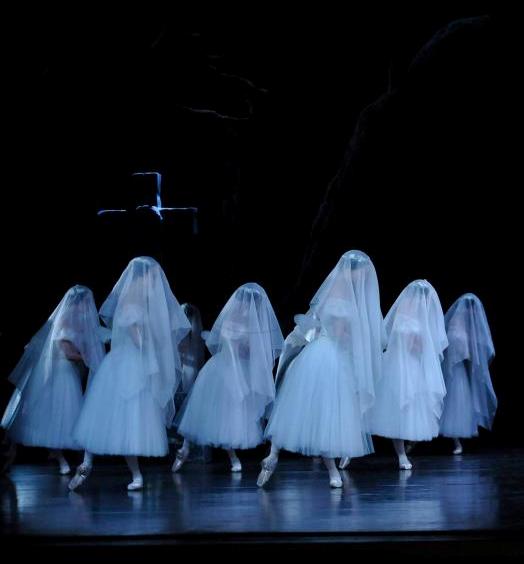
The Paris Opera Ballet’s corps knows just how to float, and make the audience float with them. Sometimes one individual will attract your eye –Ciaravola and Gilbert, not too long ago, could hypnotize my binoculars – but never break the spell.

Even so, I had been leery of the POB’s choice to bring Giselle to the States.  That well-known Benois set that wobbles at every knock, those over-fluffy long tutus for the second act…and, good lord, New York gets to see Giselle almost as much as the Nutcracker!  Bo-or-ing.

I should have remembered that I owe my own love of ballet to the corps in, guess what?

My adorable godfather had treated me to my first ballet: Nutcracker, what else?  I hated it so much – only the“Snowflakes” made the evening tolerable — I cried when my parents stuck me two years later into a school that included ballet in the curriculum…While  I worked and worked at all of this painful and unnatural crap I kept thinking “blech, if I’m to end up in Nutcracker, what’s the point in all this?”

Then my glamorous friend Andrea  ( two year’s older! Quite a coup for a skinny and mournful mite) dragged me to see my second ballet ever: Giselle with ABT  (that company which later got lost along the way).

Whenever I find myself ending up with aching and dully-bruised knees – that means often, I’m clumsy — I think of that first Giselle.  I can still remember being both in pain and in heaven the end of that night.  Perched up on seats in the very last row, house right, at City Center – Andrea on the aisle, me one off.  My ears having begun to explode in response to the startlingly fresh yet structured music hammered up to us by the orchestra during the overture, I began to lean so far forward in this last seat up there that I kept repeatedly falling over onto my knees while the sound of the seat I should have sat on continually annoyed those around me by clapping shut.  I clonked down over and over again, despite Andrea hissing at me that I was making a fool of myself during each solo, duet, the mad scene. By Act II, giving up on the seat altogether, I basically remained in my position of prayer once the corps began to cross the stage.  Andrea started leaning forward…

I still get to tease her about her much too subtle fall-off-the-seat technique : when I tell her that once again in Paris I found myself slipping dangerously forward from my top-of-the-house seat during the second act of Giselle.

Therefore, I’ve been deeply concerned by the average two to four-year turnover in the ABT corps for years now.  It shows on stage.  It used to be a company of soloists who weren’t bothered by being part of the group for they knew they had a chance to one day get promoted.  That’s been lost:  you get stars plus background noise, not a family. I love the way Ailey and POB hold on to their dancers.  L’esprit de corps only works if each individual feels valuable. Neumeier does this in Hamburg, London’s Royal Ballet under Monica Mason found that feeling again, and Manuel Legris has started to give his corps in Vienna that same élan.

While, of course, the stars appeal to me, those who all sublimate their egos and urge to take over space in order to create a unified and living work of art for the audience to share with them remain my heros.  The corps? My definition of performance artists.

Commentaires fermés sur Esprit de corps

Classé dans Humeurs d'abonnés, Retours de la Grande boutique

Manon: Afterthoughts about Second Bananas

L’Histoire de Manon

In French, the supporting role is called a spare knife – second couteau – and the dancers in these roles can sharpen the focus of the leading couple or even completely change the dramatic flow.  That’s why galas, where a relentless series of pas de deux take place in an emotional vacuum, bore me.  Spare knives carve out a much richer imaginary universe.  Bananas smell good.

Furthermore, what in opera often ends up as a simple tenor/baritone soprano/mezzo dichotomy can get nicely messed up in dance. You need years of retraining to move from Amneris’s shoes into Aida’s.  But nothing unsurmountingly physical prevents you from embodying Gamzatti one night and Nikiya the next.  Slap on costume and go out on stage.  Every second banana could be the next étoile.

Yet MacMillan’s Manon troubles the waters of this ideal.

By decreeing that Antony Dowell and David Wall alternate playing lover or brother, the troubling MacMillan surely added incestuous undertones to the sibling relationship.  [At least in La Bayadère Gamzatti does not turn out to be Solor’s sister].  Manon, torn between the two, must make us wonder whom she loves most deeply.

Mathieu Ganio’s perfect symbiosis with Ciaravola occasionally made me think of the word “twin.”         But then the pairing of Florian Magnenet/des Grieux and Audric Bezard/Lescaut brought twins to mind too, creating a different dynamic to which Ciaravola responded.  Not just because they are tall, dark and handsome (the Paris company harbors quite a few dishy men), but because both possess a similar stage presence.  They radiated youthful power and passion in equal measure, yet in a more down-to-earth manner.  A bit rough at the edges. The characters they embodied will never write their memoirs.  Ganio’s poet will.  These two belonged too much to this world, both too impulsive and inclined to live in the moment.

Audric Bézard’s Lescaut proved to be a really charmingly self-assured rascal.  You could root for him.  The way he grinned and ruffled the hair of Alistair Madin’s thieving Beggar King sent three messages out our way:  1)  cool how you’ve dunned Monsieur G.M.  2) I loved your variation that came after mine but we both know even your whirling dervishness can’t upstage me.  3) Hah, good for you!

Enter Ciaravola.  With a brother like this, could she pretend to be as other-wordly as on May 3rd?  No, only hopeful.  This brother made one imagine they’d already been orphaned for years and lived only for each other. He provided a substitute father and an appealing, if warped, mirror.  You could understand how he had used his charm and wits in order to insinuate himself into G.M.’s circle and why G.M. kind of trusted him.  Audric Bezard was everyone’s brother, loved and tolerated by all and sundry, despite his obvious desperation for easy money.

If Bezard wasn’t Prévost’s pimp, Stéphane Bullion, reacting to Ciaravola’s persona and forcing her to react to his, seemed to be one at the first performance I saw.  After the first act on May 3, quite a few people thought that Lescaut might be Manon’s domineering former lover. (I wander around evesdropping and chatting during intermissions).  They deemed Bullion’s characterization as that fierce:  possessively and jealously protective even as he sold her to the money-bags. Yet on May 13, facing Clairemarie Osta, a fraternal quality emerged in his Lescaut.

The contrasts became sharp in how Manon reacted when G.M. shot Lescaut.  In Bezard, Ciaravola lost a soul-mate; with Bullion, she only saw blood and real violence for the first time.  Osta keened over losing her brother, and used her fists the way he must have once taught her to do.

Not only do leads need second bananas, supporting actors need leads. And need each other. So now that Lescaut is dead, I’d like go back in time to talk about The Mistress, who could be Manon in the future or everything Manon is not.

Aurelia Bellet’s earthy and airy Mistress stood up to (and tried to make stand up) her giddy Bézard as we howled with laughter during the drunken pas in Act II.. These two made this off-balance parody of a MacMillan pas de deux seem just as death-defying as those of the heroes.  Cléopold referenced that early review where “if you are Antony Dowell, I must be Antoinette Sibley”…well, here we got:  “if we’ve landed up in Kenneth MacMillan, then we must be out of our minds.  You mean, we are supposed to do that? But upside down or just where, huh?”

Bellet’s Mistress could best be described as a “sweetie.”  Deeply even more unworldly and less clever then Manon, but infinitely more cheerful.  In it for having a good time, a hapless baby sister

Such momentary pleasures didn’t interest the character crafted  to the same steps by Alice Renavand.  Ice-cold when faced with Ciaravola yet firey-hot when trying to counter Osta, her Mistress reacted to one as rival and the other as potential sister-in-law.  At both performances, I enjoyed the majestically-timed accelerations and decelerations as she swept her legs up and around with elegantly-controlled aplomb.  That forceful swirling use of legs defined her character:  self-controlled, self-contained, self-sufficient.

Manon and Des Grieux collapse from exhaustion in Act III.  Each night while walking home I began to imagine an Act IV.  Renavand’s Mistress will certainly launch a putsch to take over Madame’s bordello at the Hôtel de Translyvanie and make Monsieur G.M suffer. Aurelia Bellet’s Mistress will shed hot tears over Lescaut for a long time but will end up living happily ever after with Monsieur G.M.

If second bananas can make you wonder about their fates, then they done good.

Commentaires fermés sur Manon: Afterthoughts about Second Bananas

Classé dans Humeurs d'abonnés, Retours de la Grande boutique

Manon: « Beautiful girls »

L’Histoire de Manon on May 3, 2012

I was chatting with a charming young woman during intermission as we waited our turn at the bar.  The bartender gazed into her doe-like eyes and then seemed to need to read her smiling lips in order to understand that all she was asking for was a glass of white wine. He murmured “sept euros” (outrageous price) several times because he couldn’t see the money on the counter before him.  Then he turned to me, sloshed the rest of the bottle in a glass, pushed it over the counter and exclaimed cadeau, Madame, car c’est la fête ce soir!

Youth and beauty prove an intoxicating mix.

People behave differently towards beautiful girls.  They get stared at, fussed over, petted, and rarely hear the word “no.”   Beautiful girls begin to think that’s normal.  Beautiful girls have it easy. [This applies to beautiful boys, too.  Read Daniel Hamermesh’s recent “Beauty Pays.”  His research shows that in the US  men of equal qualifications are not equal:  over a lifetime, handsome men earn thirteen percent more than the least handsome].

May 3rd’s Manon, Isabelle Ciaravola, is a beautiful woman. You can’t decide whether you want to lock the binoculars on the doe-like eyes in her heart-shaped face or on her tapering legs and perfectly-arched feet.  But more to the point, she is most intelligent in the way she uses that beauty to serve ballet.  You can banish the word “gymnast” when watching her legs move.  Yes, the arches would make any dancer scream with jealousy, but the way she dances through them even more.  She’s one of the few who make me regularly forget that she’s wearing pointe shoes.  As the  ballerinas in impossible Romantic lithographs (see Taglioni’s image on the left) you feel it just might be possible for her to pause, barefoot, on tippy-toe, atop a flower.  Her arms never stop furling and unfurling as she melts from one phrase into the next.  Her face glows, always alive and responsive, her eyes alight.

Ciaravola’s eyes are never brighter than when interacting with a partner.  In Mathieu Ganio she’s found her ideal counterpart.  He is just as beautiful for exactly the same reasons. When they work together their lines and alignment, their similar musicality, their  phrasing and theatrical instincts merge to make them seem like the two halves of one soul. The harmony appears so natural you actually wonder if they need to rehearse. Sibley and Dowell used to make me feel this way.

I’ve enjoyed  watching Ganio grow from the 19-year old baby étoile into a real man.  And this brings up a question.  Our culture appears to no longer simply fear growing old but even tries to avoid growing up while at the same time demanding more and more camera-ready “authenticity.” If Manon and Des Grieux are supposed to be teenagers, can any performers but teenagers be believed by a modern audience?

It’s a sad fact that actors and dancers will attest to: for most of your career your body and your interpretive skills develop, mature, or fade at wildly different rates. I am sooo tired of hearing the same old about whether a woman no longer age fifteen should be permitted to play Juliet or whatever.  But is youth all you need to project youthfulness?  Do you need to have acne, pigtails, and awkward manners?  Is being young tied to the calendar or is it a state of mind?  Ciaravola opted for the latter.

As she must know what it means to be beautiful, Ciaravola used it. Her Manon exhaled a kind of emotional virginity, a sense that life would always be fun because people are nicer to beautiful girls (and if people act weirdly around you, well that’s kind of funny too).  You could almost see the outlines of a cocoon sheltering the utter innocence of this pampered and oblivious child.  Ciaravola’s Manon, even as her love for Des Grieux continually grew and deepened along with her irresponsibility, seemed incapable of understanding that anything bad could ever happen to her.  As late as the second bedroom duet, her stubborn refusal to give up either her lover or all the pretty baubles made perfect sense.  Beautiful girls have a right to “have it all.”  This made Act III all the more heartbreaking. Manon lost her will to live when forced to face the way the world too often works: filled with ugly-hearted people who envy youth and beauty and seek to destroy it.  You must abandon that doe-eyed and childish innocent trust in others, which is perhaps the most beautiful thing of all, in order to survive in the adult world.

Commentaires fermés sur Manon: « Beautiful girls »

Classé dans Humeurs d'abonnés, Retours de la Grande boutique

Not in my appartement.

After Dances at a Gathering on Saturday night, I only wanted to stand quietly with the one I love and fantasize about how we could possibly try any of those lifts in our living room. Then, Appartement took me brutally back to the fact that our living room really needs a new coat of paint.

For:
a) the music
b) the program notes
c) the fragile beauty of the dancers
…all contributed to my distress.

a) The music. Imagine this: a Celtic folk group takes poppers, plugs in the amps, and tries to play acid rock variations on Steve Reich. When, near the end, the guy playing a thing that kind of looked like a violin got a solo where nobody danced but “police, do not cross” tape stretched accross the stage – that’s it, not a dancer in sight for endless minutes — I found myself fervently wishing he were no longer there. That he had devolved into a chalk-drawn silhouette on the ground as the tape had promised.

b) The program’s “To read before the performance” section couldn’t manage to make a single link between the two ballets. One paragraph on Robbins, one on Ek and et voilà! as if perfectly cooked. Robbins’s Dances at a Gathering “is a luminous exploration of a community joyfully celebrating dance as it wells up out of Chopin’s music.” (L.Gilbert, trans. R. Neel). For Appartement, the editor needed to cite Ek in an old article from Le Figaro: “something about everyday life without heels [“high” is omitted in translation, we see plenty of heels mostly waved in the audience’s direction] and points[sic], and diametrically opposed to everything the building [Palais Garnier] suggests.” If I were grading this paper, I would say: 1) what is your thesis then? 2) needs conclusion to pull concepts together 3) I cannot grade this until you do a rewrite.

c) Yet the company is blessed with beautiful dancers who commit themselves heart and soul to whatever. And do it as beautifully as they can. But all I did was sit there worrying about the impact of this movement on their knees and ankles. Every tiny articulation (and Ek’s movements are always definitely pat-your-head-and-rub-your-stomach challenging) rang clearly to the last row. While a piece like Dances isn’t easy on the body either, it takes you on a voyage where you don’t find yourself analysing every single complex component of movement as it happens.

Muriel Zusperreguy and Alessio Carbone make a perfect and passionate pair with split-second timing. I mused about how I would love to see them in Giselle together – either regular size or Ek. His version of that ballet reaches out to balletomanes in a humane and sophisticated way. For despite Giselle’s woes, at least she didn’t roast her baby in a gas oven [when Zusperreguy pulled it out at the end of the duet and dumped it into her stricken partner’s arms, the roar of laughter from the audience at this punch line truly sickened me].

Vincent Chaillet’s grapple with the couch made me think of both my cat’s daily manoeuvres and Ben Vereen’s boneless Fosse slither (thus this dancer gave me a moment of grace). I want to see Adrien Couvez travel back in time and join Forsythe’s company of twenty years’ ago. God, it was good to see Vincent Cordier doing something other than King in Sleeping Beauty while there’s still time, using his regal presence to make something out of a nothing part. And it’s time for Marie-Agnès Gillot to get back into a goddamned tutu and dance in those ballets which are indeed “everything the building suggests.” She once gave us the softest of Paquita’s, where her feet lovingly caressed the floor, the most thrilling of Lilac Fairies where her gorgeous arms made the air around her seem thick and liquid…why does she insist on dancing in pieces where she keeps needing to sport knee pads?

This ballet gives me three choices. 1) down not one but several drinks before and after 2) go stick head in a bidet until, et voilà!, perfectly drowned. But if so, could I do it on stage at the Garnier as Gillot did? At least, as it’s the first scene, it would be a beautiful death. For I would die knowing that I would never have to endure the rest of this piece ever again. 3) buy paint for living room.

Appartement is one of those pieces that derives its chic from telling you: “Yes, you are getting old. You no longer think ugly is as cool as you once thought it was.” So… the day when the Theatre de la Ville – the Parisan temple of modern dance — decides to present this program,  but Ek precedes Robbins (where the “this is not your comfy Palais Garnier” aspect of Appartement would perhaps actually prove funny), I might just try to believe in such conceptually “sophisticated” programming.  For years now in Paris, ballet has been too apologetic and modern too full of itself.  Both audiences are about the same age.

After enduring these 47 minutes of depressing ideas, images, and music, when I walked out onto the splendid swirling vista of the Avenue de l’Opéra, all I could see was garbage on the ground, ugly posters, ugly people.

1 commentaire

Classé dans Humeurs d'abonnés, Retours de la Grande boutique

Romeo and Juliet: O Happy Dagger

I would like to add one observation to Cleopold’s description of Cojocaru’s stage presence. She used her own way of moving, down to fluttering fingertips, to illustrate that quasi-animalistic/quasi-tamed state which girls live through circa age fourteen. At that moment in life a physical intelligence is there, but impulses — mostly rebellious – control their behavior.

Throughout, Cojocaru used MacMillan’s splendid choreographic outline for dancer-actors in order to strech her bodily contours into a repeated La Sylphide-like « let me escape from this flat world » gesture: a delicately thrusting up-or-outward movement of those flexible arms and fingers and toes. [MacMillan, even if he hated it, always did paradoxically encourage dancers to make parts their own. Not change the steps, mind you. But from the waist up was different and encouraged.
Interpretation reconciled with the steps he loved].Cojocaru kept reminding me of those kinds of girls who decide with a friend to leap out of a window together in some kind of wierdly exhalted state.

Juliet’s fluttering hands had been reaching yearningly towards Romeo ever since they met. Yet she also kept making gestures towards…escape. She’d clearly wanted to run away with him ever since that moment of stillness you described. Now in the last scene, as her fingers fluttered down towards him after stabbing herself her body seemed to be singing that they would find each other in a better world. That one which exists only in teenager’s dreams. The gestures made me think of a Gilda deluded enough to imagine that Rigoletto could actually find consolation in the idea that his dying daughter would meet her mother in heaven.

You, Cleo, never use binoculars, for you want the movement to speak and not the « grimaces. » I couldn’t resist at this point…I needed to be sure of what I was witnessing. For after stabbing herself she did something I’ve never, ever, seen done by a dancer or an actress in this role. This Juliet died with a radiant and ecstatic smile on her face for, clearly, she believed she was about to be reunited with the one she loved more than life itself.

Commentaires fermés sur Romeo and Juliet: O Happy Dagger

Classé dans Blog-trotters (Ailleurs), Ici Londres!

A Very Biased Aperçu (there is no plot to summarize) of the pairing of Jerome Robbins with Mats Ek: buy your tickets now?

Dances at a gathering, Jerome Robbins (Chopin, 1970)

versus

Appartement, Mats Ek (FleshQuartet, 2000)

I hate visiting apartments with perfectly designed yet sterile décor, not a book in sight. Worse than that, a book unread chosen for its beautiful binding. I hate “high concept” evenings at the ballet even more. This season has proved more than irritating due to its tacky/cheaply conceptual programming: ooh, let’s do the opera and ballet versions of Cinderella and Manon. All that results in are confused patrons who wind up at the wrong theater for the wrong art form (I witnessed that).

Programming a satisfying double-bill should also be considered an art. Handled with care. Phedre and Psyche earlier this season didn’t work for me, either. Yes, gods wreak havoc on humans. So what’s the bigger connection?

The adorable Horst Koegler summarized “Dances at a Gathering” as…”a ballet about the feeling of togetherness.” Joyous yet delicately melancholy. Pairing it with “Appartement” – a cruel and violent dissection of the cost of remaining alone (that head stuck in the bidet, that man wrestling with a couch)sets up an overly violent contrast and does both of these great works a wretched disservice.

Yeah, right, as the blurb says: “both ballets are about relationships.” [I am not making this up, the season program uses the phrase « rapports humains » as if it were some heretofore unknown selling point]. Um, ALL ballets are about relationships. Even if you dance a solo on a bare stage you are caught up in a relationship with the audience at the very least.

Moreover, Lefevre’s rather wry justification of her choices on the Opéra’s official website –  « ils dansent ensemble » [they dance together] makes me want to have a relationship with a gas oven.  Well, yes, in general, dancers do indeed regularly dance together on one and the same stage…and to then illustrate this point with a clip from « Appartement, » where not a single one of the five soloists interacts with the other, indicates a rather cavalier attitude towards the intelligence of the paying audience.

As Christopher Fry makes a character howl in The Lady’s Not For Burning: just  » Where in this small-talking world can I find/A longitude with no platitude? »

I know of many who are already planning to pay full price to watch “Dances” and then leave and go get dinner during “Appartement.” Fine for the box office, but cruel to the dancers, who try to give us all they have to give and find themselves in a half-empty house.  Especially as one of the unsung virtues of this strange programming is that both pieces require large casts to perform little solos as if in a « tasting menu. »  One of the pleasures these evenings might offer would be to discover a dancer — up front for even thirty seconds — whom one had never looked at before.

“Dances” was created on and for strong and mature personalities – at NYCB for Kent, Leland, Mazzo, McBride, Verdy, Antony Blum, Clifford, Maoriano, Prinz, and the unstoppable Eddie Villella – yet the Royal Ballet’s version shortly thereafter proved equally powerful. Yes, Nureyev of course, and then others whom you never realized they had it in them: Ann Jenner, for example, glowed. Robbins had somehow picked up on “l’air du temps.” On both New York and London dance stages, the late sixties and early seventies were filled with expressive artists who remained underappreciated – especially those who were female – caught painfully out of the spotlight due to the public’s obsession with Fonteyn and Farrell.

All you need to understand “Dances” is to take a good look at the huge painting (over 16 feet-more than 5 meters-long) that hung for over thirty years in each of Patrick O’Neal’s succesive Lincoln Center venues (call it Saloon/Baloon/ or restaurant).: “Dancers at the Bar” by Robert Crowl, ca. 1969.* It gathers together 33 dancers and dance-loving people (including the conductor Robert Irving, who is the one who convinced me that Minkus’s music isn’t all that bad if played as if it were music).

In the painting, several members of the first New York and London casts of “Dances” stare down at you: the elegant Monica Mason and tender Antony Dowell, the uncategorizable Lynn Seymour and the ever-underrated David Wall, along with the beautifully eccentric Leland and the handsome Prinz…while others just pausing on their ways to ABT or Stuttgart join them. This painting unites a pantheon of lithe and tired dancers just waiting, waiting, to shed their street clothes and transform themselves into whom they really were meant to be.

Ed Villella, Sara Leland and Heinz Clauss

Up until now, Paris also drew upon its strongest company members to make these very fragile masterpieces work. If you can’t tell them apart, the person next to you will soon be asleep (as I witnessed at « Dances » when NYCB passed through a dull phase. In the first row, that shouldn’t be possible).

These ballets could offer an ultimate thrill:  nothing is more satisfying than having a dancer force you to change your preconceived notions about what they can or cannot do.  Don’t let them become pretty books unread.

* Unfortunately, even flying to New York won’t allow you to see the painting anymore. Donated by the O’Neal family to NYCB after the last of their restaurants closed recently, it now hangs in the main rehearsal hall in the New York State Theater (which some now insist be called the David Koch Theater). Perhaps some day it will be placed in one of the public spaces of the building. For further information about the painting’s story, see Doris Perlman’s article in a 1997 issue of the American Dance Magazine.

3 Commentaires

Classé dans Hier pour aujourd'hui, Humeurs d'abonnés