Archives d’Auteur: Fenella

Avatar de Fenella

À propos de Fenella

Pour ne pas rester muette, car je n'ai pas les deux pieds dans le même sabot, i will write in English.

A Very Biased Aperçu (there is no plot to summarize) of the pairing of Jerome Robbins with Mats Ek: buy your tickets now?

Dances at a gathering, Jerome Robbins (Chopin, 1970)

versus

Appartement, Mats Ek (FleshQuartet, 2000)

I hate visiting apartments with perfectly designed yet sterile décor, not a book in sight. Worse than that, a book unread chosen for its beautiful binding. I hate “high concept” evenings at the ballet even more. This season has proved more than irritating due to its tacky/cheaply conceptual programming: ooh, let’s do the opera and ballet versions of Cinderella and Manon. All that results in are confused patrons who wind up at the wrong theater for the wrong art form (I witnessed that).

Programming a satisfying double-bill should also be considered an art. Handled with care. Phedre and Psyche earlier this season didn’t work for me, either. Yes, gods wreak havoc on humans. So what’s the bigger connection?

The adorable Horst Koegler summarized “Dances at a Gathering” as…”a ballet about the feeling of togetherness.” Joyous yet delicately melancholy. Pairing it with “Appartement” – a cruel and violent dissection of the cost of remaining alone (that head stuck in the bidet, that man wrestling with a couch)sets up an overly violent contrast and does both of these great works a wretched disservice.

Yeah, right, as the blurb says: “both ballets are about relationships.” [I am not making this up, the season program uses the phrase « rapports humains » as if it were some heretofore unknown selling point]. Um, ALL ballets are about relationships. Even if you dance a solo on a bare stage you are caught up in a relationship with the audience at the very least.

Moreover, Lefevre’s rather wry justification of her choices on the Opéra’s official website –  « ils dansent ensemble » [they dance together] makes me want to have a relationship with a gas oven.  Well, yes, in general, dancers do indeed regularly dance together on one and the same stage…and to then illustrate this point with a clip from « Appartement, » where not a single one of the five soloists interacts with the other, indicates a rather cavalier attitude towards the intelligence of the paying audience.

As Christopher Fry makes a character howl in The Lady’s Not For Burning: just  » Where in this small-talking world can I find/A longitude with no platitude? »

I know of many who are already planning to pay full price to watch “Dances” and then leave and go get dinner during “Appartement.” Fine for the box office, but cruel to the dancers, who try to give us all they have to give and find themselves in a half-empty house.  Especially as one of the unsung virtues of this strange programming is that both pieces require large casts to perform little solos as if in a « tasting menu. »  One of the pleasures these evenings might offer would be to discover a dancer — up front for even thirty seconds — whom one had never looked at before.

“Dances” was created on and for strong and mature personalities – at NYCB for Kent, Leland, Mazzo, McBride, Verdy, Antony Blum, Clifford, Maoriano, Prinz, and the unstoppable Eddie Villella – yet the Royal Ballet’s version shortly thereafter proved equally powerful. Yes, Nureyev of course, and then others whom you never realized they had it in them: Ann Jenner, for example, glowed. Robbins had somehow picked up on “l’air du temps.” On both New York and London dance stages, the late sixties and early seventies were filled with expressive artists who remained underappreciated – especially those who were female – caught painfully out of the spotlight due to the public’s obsession with Fonteyn and Farrell.

All you need to understand “Dances” is to take a good look at the huge painting (over 16 feet-more than 5 meters-long) that hung for over thirty years in each of Patrick O’Neal’s succesive Lincoln Center venues (call it Saloon/Baloon/ or restaurant).: “Dancers at the Bar” by Robert Crowl, ca. 1969.* It gathers together 33 dancers and dance-loving people (including the conductor Robert Irving, who is the one who convinced me that Minkus’s music isn’t all that bad if played as if it were music).

In the painting, several members of the first New York and London casts of “Dances” stare down at you: the elegant Monica Mason and tender Antony Dowell, the uncategorizable Lynn Seymour and the ever-underrated David Wall, along with the beautifully eccentric Leland and the handsome Prinz…while others just pausing on their ways to ABT or Stuttgart join them. This painting unites a pantheon of lithe and tired dancers just waiting, waiting, to shed their street clothes and transform themselves into whom they really were meant to be.

Ed Villella, Sara Leland and Heinz Clauss

Up until now, Paris also drew upon its strongest company members to make these very fragile masterpieces work. If you can’t tell them apart, the person next to you will soon be asleep (as I witnessed at « Dances » when NYCB passed through a dull phase. In the first row, that shouldn’t be possible).

These ballets could offer an ultimate thrill:  nothing is more satisfying than having a dancer force you to change your preconceived notions about what they can or cannot do.  Don’t let them become pretty books unread.

* Unfortunately, even flying to New York won’t allow you to see the painting anymore. Donated by the O’Neal family to NYCB after the last of their restaurants closed recently, it now hangs in the main rehearsal hall in the New York State Theater (which some now insist be called the David Koch Theater). Perhaps some day it will be placed in one of the public spaces of the building. For further information about the painting’s story, see Doris Perlman’s article in a 1997 issue of the American Dance Magazine.

3 Commentaires

Classé dans Hier pour aujourd'hui, Humeurs d'abonnés

A very biased plot summary for La Bayadere

LA BAYADERE [the temple dancer]
Choreography by Rudolf Nureyev (1992) after Marius Petipa (1877)
Music (not that bad, if not lazily played) by Ludwig Minkus

L’article en Français

Even before he would create the great trilogy with Tchaikovsky – Swan Lake, Sleeping Beauty, and The Nutcracker – the French-born choreographer Marius Petipa produced several classic ballets in Russia all using the same formula: an exotic setting, a dramatic love triangle (as in most operas), and an acclaimed “dream scene” (which the French call a ballet blanc) where the hero sees his beloved multiplied into 32 ballerinas clad in identical tutus. This particular ballet had never been shown outside of Russia until the Kirov troupe brought its production to Paris in 1961 (along with Rudolf Nureyev).
Try to not take the “orientalist” aspects of this melodrama too seriously. Let yourself enjoy this fruity depiction of “local color” set in some kind of fantasy India, created by artists who had never been there except in their imaginations. Get swept away by passion as it was experienced in the 19th century!

ACT I (48 minutes)
SCENE 1: AT THE TEMPLE OF FIRE AND WATER
The noble warrior Solor sends his companions off to catch a tiger for the Rajah. It’s only an excuse to be alone, for Solor summons the Fakir and orders him let Solor’s beloved, the virginal temple dancer Nikiya [aka LA Bayadère] know that he will be waiting for her in the garden. Their love is secret and forbidden: they belong to different castes.
Solor hides and watches the entry of the Grand Brahmin, keeper of the sacred flame. He summons the priests and the bayadères (dancers of the sacred temple), as the fakir and fire-worshippers lacerate themselves before the altar. Finally, Nikiya performs her ritual dance. When she and her sisters bring water to the exhausted faithful, the Fakir passes along Solor’s message.
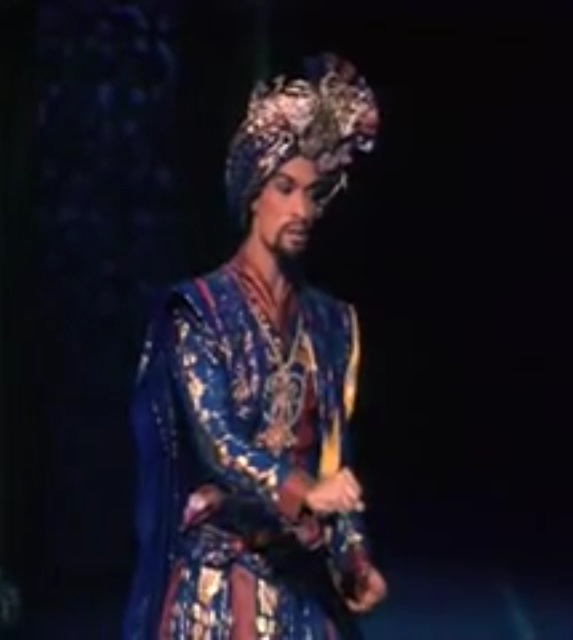
The Brahmin clenches his fist. Not Good... Francis Malovik.But first…the Brahmin corners Nikiya. He offers her his crown (and, yuk, the bald head beneath it). She uses the excuse that they are of different castes to try to get him to go away: she is only a lowly servant (pantomime gesture of lifting a water jug to her shoulder). But finally she has to just push him away.
When all depart, the lovers can finally meet and dance ecstatically. Unaware that the Brahmin is spying on them, Solor swears eternal love and fidelity on the sacred fire. The Brahmin clenches his fist and swears to crush his rival.

The Rajah clenches his fist. Really not good... Jean-Marie Didière.

SCENE 2: AT THE PALACE OF THE RAJAH
Less sacred girls dance to please the Rajah and his court. He calls for his daughter, Gamzatti, to tell her that she is to be married, if she agrees, to the handsome man in a portrait on display: Solor. Gamzatti likes what she sees and exits. Solor enters, but is horribly surprised by the news. He cannot admit that he is already betrothed to another (to a dancer, no less); nor can he bring himself to disobey his sovreign. Nodding, he decides to figure this one out later.
Nikiya has been summoned to perform her usual ritual dance to bless an event at court. Carried about by the Slave (in the pas d’esclave), she strews flowers upon the princess. Neither Nikiya nor Gamazatti realizes that she is facing “the other woman.”
The Brahmin arrives and demands to see the Rajah. He spills the beans, as Gamzatti eavesdrops: Solor is in love with…that dancer. To the Brahmin’s horror the Rajah clenches his fist and pushes them downwards. He still wants Solor as a son-in-law, so Nikiya must be crushed instead.
The princess clenches her fist. It's Baaaaad!Gamzatti, toying with her bridal veil, summons the impertinent dancer. After first pretending to be her new friend she gets into action: “see that portrait of Solor? Well he’s mine now! Take this necklace, you pathetic worm, it’s worth more than you could earn in three lifetimes! Leave him to me!” Nikiya cannot believe that the love of her life could betray her like this and finally explodes. Just in time, the nursemaid grabs the knife from Nikiya’s hand. Gamzatti clenches her fist and swears to crush her rival.

INTERMISSION (20 minutes)

ACT II (43 minutes)
THE ENGAGEMENT PARTY AT THE PALACE
Baya IndièneGrand pageantry. All make spectacular entrances, especially Solor on an elephantine contraption (less spectacular is the droopy stuffed tiger his companions carry in). The conceit of a party allows for a series of colorful dances: with fans, with parrots, by the bridesmaids; by the airborne Golden Idol; by the Manou who balances a water jug on her head; by the “Indian fire dancers” who do a kind of can-can

…and finally it’s time for the:
Grand Pas de Deux, the celebration of Gamzatti and Solor’s engagement. It is a chance for the audience to enjoy glorious unabashed pyrotechnics. (Originally in Act IV, see note below)
Baya mortTheir dance just ended, Nikiya arrives to do her duty: yet another dance to consecrate a festive event. Distraught, she, keeps trying to catch Solor’s gaze. “Can this really be true? Can you abandon me just like that?” Gamzatti’s ayah gives the girl a basket of flowers – “from him.” The poor girl’s joy – he still loves me! – is shattered when the serpent hidden amongst the flowers bites her. Gamzatti sent the flowers, after first placing an asp in them. The lovelorn Brahmin offers Nikiya an antidote to poison, but Nikiya finally understands that Solor will never dare to renounce his caste and position for her sake. She prefers to die.
Only now does Solor realize what he has done.

INTERMISSION (20 minutes)

ACT III (40 minutes)
IN A PERFUMED GARDEN
Distraught, ashamed, still in love, Solor takes a giant dose of opium.
As he drifts to sleep the vision of an infinite number of idealized Nikiyas, clad in pristine white tutus and chiffon veils, waft into the garden. They are the Shades, bayadères who died for love and are fated to wander between this world and the next. You should be as stunned as Solor by the corps de ballet: dozens of soloist-caliber women sublimate their egos in order to achieve this kind of kaleidoscopic harmony. (Watch for three solos, given to the most talented young dancers). When Solor dances with the ghost of Nikiya each touch, each turn, brings them closer together. At one point, a long veil stretched between them symbolizes their connection. Solor literally jumps for joy in his solo. The act ends in triumph: Nikiya has forgiven him, therefore they shall never be parted.

Baya ombres

Notes:
Act III — “The Kingdom of the Shades” — serves as a starter or touring version for many companies.  Boiled down and sans elephant, all you need are: a ramp, a guy, a gal, and 24 to 32 pairs of thighs topped by white tutus ready to plié until they « feel the burn. »
Originally, there was even an Act IV! In it, Solor returns to earth and marries Gamzatti after all. This makes the gods angry, who then bury the entire wedding party under the the rubble of the imploding palace. This Samsonesque act has rarely been staged since WWI. Dramatically,  let’s be honest, anything is a letdown after Act III.  Solor comes off as a real creep for going back to his fiancée. But most of all, a collapsible set costs a fortune!

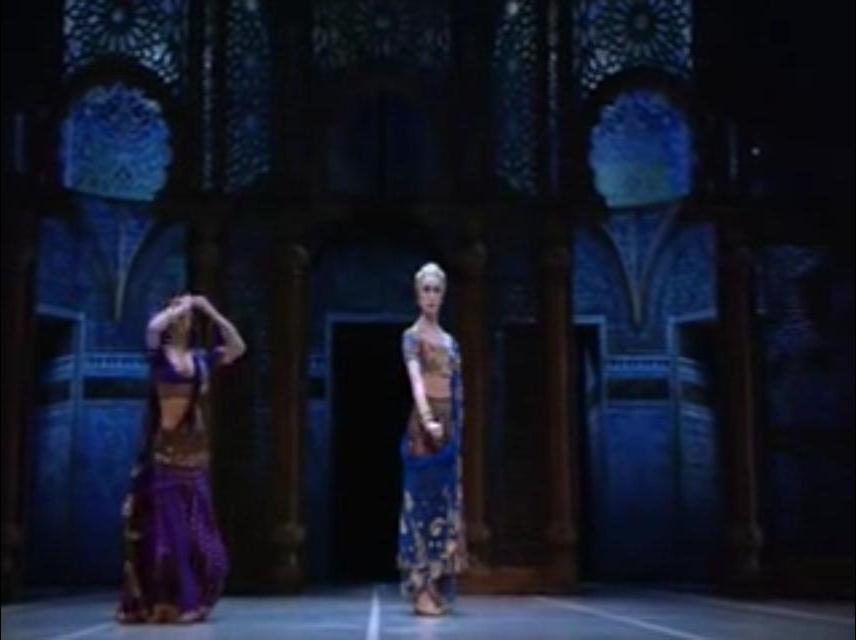
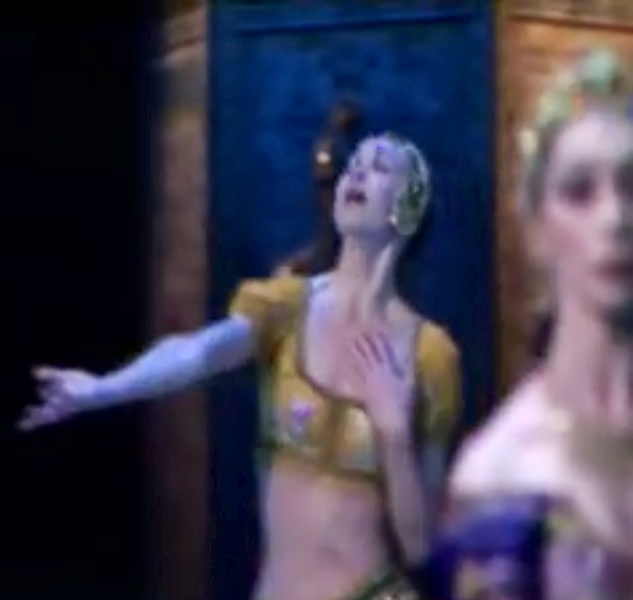
All pictures in this article are screenshots from the 1994 film with the original cast (Isabelle Guérin, Laurent Hilaire, Elisabeth Platel, Francis Malovik, Jean-Marie Didière, Lionel Delanoë, Virginie Rousselière, Gil Isoart).

5 Commentaires

Classé dans Hier pour aujourd'hui