Archives de Tag: Lénore Baulac

Les Balletos d’Or de la saison 2023-2024

Frémolle

Louis Frémolle par Gavarni. « Les petits mystères de l’Opéra ».

Il sont plus attendus, dans certains cercles nationaux comme internationaux, que les médailles d’or aux Jeux olympiques. Leur sélection est aussi secrète que celle des restaurants étoilés au guide Michelin. Et le sprint final aura été – presque – aussi tendu que les tractations en vue de la désignation d’une future tête de majorité parlementaire. Ce sont, ce sont – rrrrroulement de tambour – les Balletos d’Or de la saison 2023-2024!

*

 *                                      *

Ministère de la Création franche

Prix Création : le Boléro déstructuré d’Eyal Dadon (Hessisches Staatsballett. Le Temps d’Aimer la Danse).

Prix Recréation : Catarina ou la fille du bandit (Perrot/ Sergei Bobrov. Ballet de Varna)

Prix Navet : Marion Motin (The Last Call)

Prix Invention : Meryl Tankard (For Hedi, Ballet de Zurich)

Prix Jouissif : Les messieurs-majorettes de Queen A Man (Le Temps d’Aimer la Danse)

Prix Nécessaire : le Concours #4 des jeunes chorégraphes de Ballet (Biarritz)

Ministère de la Loge de Côté

Prix Je suis prête ! : Roxane Stojanov (Don Quichotte)

Prix Éternelle Oubliée : Héloïse Bourdon (au parfait dans Casse-Noisette, le Lac …)

Prix Intensité : Philippe Solano (le Chant de la Terre de Neumeier, Ballet du Capitole de Toulouse)

Prix J’ai du Style : Tiphaine Prevost (Suite en blanc, Ballet du Capitole de Toulouse)

Ministère de la Place sans visibilité

Prix de l’Inattendu : Marcelino Sambé et Francesca Hayward, Different Drummer (MacMillan, Royal Ballet)

Prix Ciselé : Chun-Wing Lam (La Pastorale de Casse-Noisette)

Prix Guirlande clignotante : Camille Bon (Off en Reine des Dryades / On en Reine des Willis)

Prix Voletant : Kayo Nakazato (La Sylphide, Ballet du Capitole de Toulouse)

Ministère de la Ménagerie de scène

Prix Biscottos : Mick Zeni (Zampano, La Strada, Sadler’s Wells)

Prix Félin élancé : Daniel Norgren-Jensen (Conrad, Ballet de Stockholm)

Prix Groucho bondissant : Arthus Raveau (Le Concert de Robbins)

Prix Souris de laboratoire : Léonore Baulac et ses poignants piétinements aux oreillers (Blaubart, Pina Bausch)

Prix Des Vacances : le petit âne (La Fille mal gardée) et la colombe (Les Forains), retirés des distributions à l’Opéra.

Ministère de la Natalité galopante

Prix Complicité : Inès McIntosh et Francesco Mura (Don Quichotte)

Prix Limpidité : Hohyun Kang et Pablo Legasa (Don Quichotte)

Prix Complémentarité : Bleuenn Battistoni et Marcelino Sambé font dialoguer deux écoles (La Fille mal gardée)

Prix Gémellité : Philippe Solano et Kleber Rebello (Le Chant de la Terre de Neumeier)

Prix Ça vibre et ça crépite : le couple Hannah O’Neill et Germain Louvet (ensemble de la saison)

Prix par Surprise : Sae Eun Park, émouvante aux bras de Germain Louvet (Giselle)

Ministère de la Collation d’Entracte

Prix Poivré : Bleuenn Battistoni et Thomas Docquir (In the Night de Robbins)

Prix Savoureux : Nancy Osbaldeston (La Ballerine dans le Concert de Robbins, Ballet du Capitole de Toulouse)

Prix Bourgeon : Hortense Millet-Maurin (Lise dans La Fille mal gardée)

Prix Fleur : Ines McIntosh (Clara dans Casse-Noisette)

Prix Fruit : Marine Ganio (Clara dans Casse-Noisette)

Prix – vé de dessert : Silvia Saint-Martin (Myrtha dans Giselle)

Ministère de la Couture et de l’Accessoire

Prix bariolé : la garde-robe dégenrée des gars de Car/Men (Chicos Mambo)

Prix poétique : Les Eléments et les Monstres de Yumé (Beaver Dam Company, Le Temps d’Aimer la Danse)

Prix Soulant Soulages : Yarin (Jon Maya et Andrés Marin, Le Temps d’Aimer la Danse)

Prix Ma Déco en Kit : Matali Crasset (Giselle, les décors et costumes. Ballet de l’Opéra national de Bordeaux)

Ministère de la Retraite qui sonne

Prix On aurait pu lui donner un Albrecht pour sa sortie : Audric Bezard

Prix « C’est qui ces gens bruyants de l’autre côté de la fosse ?» : Myriam Ould-Braham (les adieux).

Prix Musée d’Ontologie : L’exposition Noureev à la Bibliothèque Musée de l’Opéra

1 commentaire

Classé dans Blog-trotters (Ailleurs), Hier pour aujourd'hui, Humeurs d'abonnés, Retours de la Grande boutique

Alone together (Balanchine/Teshigawara/Bausch)

Agon/Grand Miroir/Le Sacre du printemps.
November 3 & 4, 2017, at the Palais Garnier.

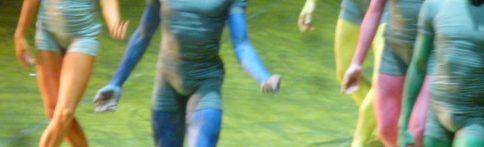
I’ve always hated it when the people around me peer in the dark at their programs, searching for the dancers’ names. Why not just look up and out at the dancers dancing? That was, alas, going on all around me during the entirety of Saburo Teshigarawa’s Big Mirror. The program could have easily listed: “the dancer daubed in pale green/in turquoise/in yellow… » That’s done for Robbins, no? Then the audience would at least have carried one name out the door with them: the one in drab grey shmeared all over with burgundy body-paint and – thankfully – allowed to keep her short brown hair un-dyed, is a dancer in the corps named Juliette Hilaire. She was all force, possessed with a ripe and percussive energy and strong sense of direction and intention that bounced back against a tepidly decorative score by Esa-Pekka Salonen (O.K. he wasn’t conducting this time).

The Teshigarawa, a new commission for the Paris Opera Ballet, is pretentious eye-candy. Nine dancers swirl around like droplets of paint, triplet-ing or quadruplet-ing or whatever, windmilling their arms non-stop like trees trying to shake off their last dead leaves for… exactly thirty minutes. Think Trisha Brown takes a small tab of speed. Some of the painted few get to mime conniptions from time to time, for whatever reason. Apparently, the choreographer read a bit of Baudelaire: a poem where music=sea=mirror=despair. I’m so glad the program book informed me as to this fact.

Then in the last minute to go, oh joy, some dancers actually touch, even catch at, each other. I guess some point was being made. I adore Jackson Pollock, but do not make me stand and stare for thirty minutes at one corner of a drip painting.

I was equally perplexed by the current incarnation of Pina Bausch’s normally devastating Rite of Spring. Nine containers of dirt dragged and spread across the stage during intermission – with the curtain raised – already sucks you into a strange canvas.

Yet, and I feel weird saying this: the casting wasn’t gendered enough. The women were great: lofty, loamy, each one a sharply drawn individual. Your eye would follow one in the massed group and then another and then another. Trying to choose between Léonore Baulac, Caroline Bance, and a stunningly vibrant Valentine Colasante got really hard. I found Alice Renavand’s richly drawn Chosen One (self-flagellating yet rebellious to the very end) more convincing than Eleanora Abbagnato’s extremely interiorized one.

But the men? Meh. If it’s Bausch, then the men should be as complex and fearsome as the heads on Easter Island. But here the men didn’t feel like a dangerous pack of wolves, not much of a pack/force/mob at all. They weren’t meaty, weighty, massively grounded.

One big point Bausch was making when she created this ballet way back in 1975 was that a group of men will congeal into a massive blob of testosterone when they decide to commit violence against any random woman. This is why the program never tells you which of the women will ultimately become the “Chosen One.” (Alas the Opera de Paris website does). The point is not who she is, but what she is: a female. Any of these women could die, all the men know it. That needs to be played out. The conductor, Benjamin Shwartz, can take part of the blame. The score of Rite has rarely sounded so pretty.


So in the end, I should have left the theater after each of the two enchanting renditions of Balanchine’s Agon that started the evenings. Oh, the men in this one! Audric Bezard eating through space with his glorious lunges, the feline force of his movements, and his hugely open chest. Mathieu Ganio bringing wry classic elegance to the fore one night; Germain Louvet connecting Baroque to jazz throughout each of his phrases the next. Florian Magnenet gave clarity and force to just a strut, for starters…

Dorothée Gilbert has a deliciously self-aware way with the ralenti, and infuses a slightly brittle lightness into her every balance. Her meticulous timing made you really hear the castanets. Her trio with Bezard and Magnenet had the right degree of coltishness. In the girl/girl/boy trio, Aubane Philbert brought a bounce and go that her replacement the next night utterly lacked.

And Karl Paquette, looking good, proves to be in marvelous shape as dancer and partner. In “the” pas de deux – the one created for Arthur Mitchell and Diana Adams — he made his ballerinas shine. He let a melting but powerful Myriam Ould-Braham unwrap herself all over him (that little supported pirouette into a fearless-looking roll out of the hip that whips that leg around into an attitude penchée, ooh, I want to keep rewinding it in my mind until I die). They gave a good teasing edge to their encounter, all healthy strength and energy, their attack within each phrase completely in synch.

With the luminous Amadine Albisson, he got sharper edges, more deliberation. Instead of teasing this partner, Paquette seemed to be testing the limits with a woman who will give nothing away. Here the image I won’t forget is when he kneels and she stretchingly, almost reluctantly, balances on his back and shoulder. No symbiosis here, no play, but fiercely well-mannered combat.

Diana Adams et Arthur Mitchell créateurs du Pas de deux en 1957

My Dear One is mine as mirrors are lonely. W.H. Auden « The Sea and the Mirror »

1 commentaire

Classé dans Retours de la Grande boutique