

Archives de Tag: Sara Kora Dayanova

Paris Opera’s Romeo and Juliet : leave the studio, fill the stage!

Roméo et Juliette, Paris Opera Ballet, Opera Bastille, April 7, 8, and 17, 2026. Choreography by Rudolf Nureyev, Music by Sergei Prokofiev, Sets and Costumes [sort of] by Ezio Frigerio

Not one of the three evenings I attended was “bad.” But not one couple pierced me to the core, either. I realize I made a weird note during one performance: “Why is this ballet just not happening?”

Perhaps I could not concentrate because another tragedy was playing out on stage at the same time. What has the Paris Opera management done to Ezio Frigerio’s claustrophobically textured and vivid scenic environment? I thought I was hallucinating. No fountain? All the rich backcloths and detailed carvings replaced by what were basically sky templates enlarged off the internet? A cheap showroom bed plonked in the middle of an empty warehouse is now the crypt? Speaking of cheap, the regilt mobile flies were way too flashy.

The lighting design remains unchanged, yet the sets that the lighting refracted off have now mostly disappeared, along with about half the extras. The downstage “alea jacta est” dice players were rendered invisible both at curtain up and curtain down. The Duke of Verona, who appears upstage to force the warring clans to put down their swords was literally invisible all three nights. On the other hand, the guests entering the Capulet doors, who once had become shadows behind a scrim, are painfully visible as they head for the wings obscured by…nothing. Can it get worse? Yes. During the balcony scene, a spot hits the couple. Without the fountain, it lofts the shadow of their heads onto the bland backdrop that now only consisted of an out-of-focus polaroid moon. The result look exactly like an upside down “wow” emoticon.  Do better next time, guys.

*

 *                                                       *

April 7th
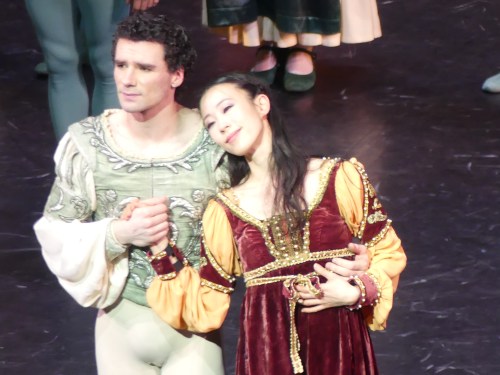
Paul Marque and Sae Eun Park Performance on April 7th.

I have come to like Sae Eun Park, the performer. I have come to like Paul Marque in the same vein. I continue to dislike seeing them dance together. When Park/Marque is cast they continue to radiate the calm of their clearly pleasant rehearsal room relationship. When they are alone or with others they can glow, they react. Germain Louvet catalyzed a striking vulnerability in Park’s Giselle.  In Sylvia, you just yearned for the wildly ardent Marque to end up happily ever after with Bluenn Battistoni…

They are very much “in like,” but their chemistry lacks radiance, abandon. There is no electric “spark” between them, only a comfort zone. Yet they continue to be scheduled as dramatic leads together …

Maybe something was off from the start because the first real potential girlfriend you had already seen — Sylvia Saint-Martin’s icy, dry, and monotone Rosalind — made you already wonder what was wrong with this Romeo. Why would any young man in his right mind waste time trying to flirt with a humorless poppet? Overheard during intermission: “there was no Rosalind tonight, just a bunch of identical girls.” Ouch.

Sae Eun Park’s Juliet was light and quick and warm, but soon you could see how she was always being carefully managed by Tybalt and Romeo – and even her father — when it came to sliding her down or manipulating her in any way whatsoever. The fact that she offered up the same gracious smile to each and every person quickly started to bore me. There was no sense of shock in her first encounter with Romeo in the Ball Scene, which came off as more of a hello. Park does lean into Marque with soft grace, but even when his mask falls off Park’s Juliet remains the same well-bred girl. His first kiss doesn’t light her up with more than a “that was nice.” Nor did the second.

In the balcony scene Marque’s Romeo was full out at first, open-bodied and visibly inspired to impress Juliet (that recklessly precise manège of double tours)… and then he reversed gears and became the “I won’t break this glass unicorn” careful partner.  Why? Honestly, Park looks as if she is in perfectly fine shape and uninjured. Despite the restraint, a certain soft charm did manage to evolve. Was I moved? No. Act Three just seemed endless until Marque’s Romeo, alone, began to storm his way unto his death. Park’s death scene was moving in equal measure. How odd, isn’t it, that both their most passionate moments occurred while the other was inert?

All the more pity as so many on stage April 7th had energy and wit to spare:

Jack Gasztowtt, aware and alert, fully present on stage as Benvolio.

What’s not to like about Francesco Mura’s bouncy and sly Mercutio, except for a terrible hairdo?

Jérémy Loup-Quer’s observant and actually likeable Tybalt definitely knows how to swish and slash his sword with relaxed authority. He was very much amused and reactive in the early scenes. Never a villain in the making. And that proved interesting: his courtly restraint as bad guy made Mercutio’s (and his own) fate all the more surprising.

Andrea Sarri’s Paris quickly evolved from fatuous plot device into husband material early on.  He gave this dead-end role heft and elegance.

Sara Kora Dayanova’s Lady Capulet was a vortex of emotions, born out of the wisdom distilled by her years of on-stage experience. Most haughtily Shakespearian whilst she handed out swords during the ball scene, Dayanova’s later howl of desperation, not anger, stilled the house. Splendid and deeply alive on stage even when just walking – Dayanova doesn’t get a picture or a bio in the illustrated program. As if she were an extra? That’s just wrong. I heartily wish the Paris Opera Ballet would show more respect for those soloists who have given their lives to this company as they age gracefully and evolve more fully into character roles.

A young friend, who saw exactly the same cast a week later, hesitated when I interrogated him. “Oh it was excellent, so well-performed, the couple was really nice and then…At the end when he threw her body around, it was very aesthetic.” Alas he used code words for: your brain is on, not your heart. You are observing the process. He spoke too much about how he loved the costumes, bad sign. He was more captivated by the chemistry between Gastowtt’s Benvolio, Mura’s Mercutio, and Quer’s Tybalt. Now there he saw sparks flying, now there bloomed a galvanizing subtext he couldn’t shake out of his head.

*

 *                                                       *

April 8th
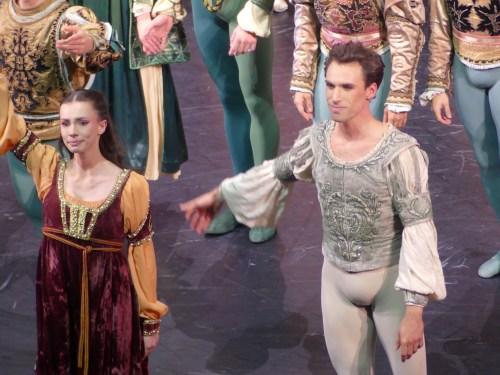
Bleuenn Battistoni and Thomas Docquir. Performance on April 8th

The next night, after another impeccably danced performance, again I left the theater hungry for more. Unlike American critics, I have not so far felt I’d experienced what they sneeringly call the “too perfect” performances of the Paris Opera Ballet. But on the second night I started – for the first time ever – to muse that the principals just might have been over-rehearsed. Is that possible?

Even before Juliet’s entrance, I’d been tempted by what Hohyun Kang’s fluffy and flirty Rosalind had to offer. Kang is one of those soloists who keeps catching the light. Pablo Legassa’s limber and graphic Tybalt could have been naughtier (on the 17th, Nicola di Vico will carve out a splashily dashing silent movie villain who really has the ear of Katherine Higgins’s chillingly ambitious Lady Capulet). Andrea Sarri’s Mercutio had joyous energy to spare. Keita Bellali used the role of Paris to display his silky control and gorgeous lines as a peacock would. Bellali even managed to indicate that he might have some secret passions simmering just below the surface, too.

Everything Bluenn Battistoni’s Juliet does flows so naturally that you take her unforced – but powerfully developed — technique for granted. Her Juliet on April 8th accelerated, decelerated, nuanced little flicks of leg or hand, slowly loosened up. Her dance is beautifully silky…but it wasn’t until the third act that she took over the narrative and made it impossible not to watch her.

Her Romeo was Thomas Docquir. His trajectory in this company has been awkward. Every time I’ve seen him over the years he’s clearly been concentrating on extending his lines and technique, especially in the service of the tricky syncopations and changes of direction in Nureyev’s ballets. But something never quite happened. Endlessly cast as a perfectly acceptable Rothbart “de service” one season, then miscast as a mild Frollo, with a Prince Desiré in between (where he seemed petrified by imposter syndrome). And here? …here he was deeply sweet and finally relieved from whatever it was that had been holding him back. So I was rooting for him.

Docquir’s Romeo is very much in the vein of Tony in West Side Story, a passionate pacifist. He really draws in the audience when he pleads “I don’t, I won’t, I can’t” when prodded by his friends or by Tybalt. But with his Juliet, alas, once again, sparks just didn’t happen until the last act. Thomas Docquir – like Paul Marque the night before – kept disappearing into partner mode.

*

 *                                                       *

April 17th
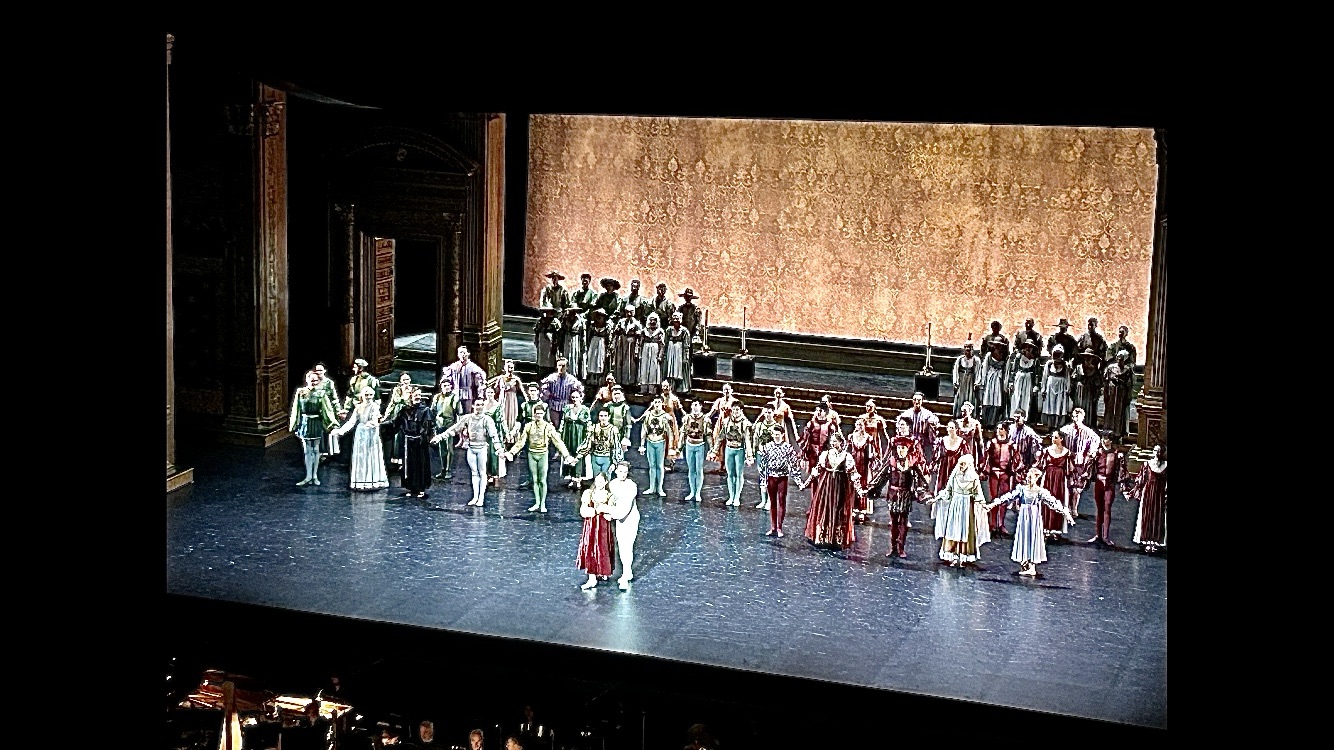
Romeo & Juliet. Performance on April 17th.

And then, unexpectedly, Thomas Docquir was thrust into a new partnership with Valentine Colasante on April 17th due to Guillaume Diop cancelling due to injury. And maybe this wasn’t such a bad idea.

While this couple also didn’t make me cry, the fact that they had been working in different directions with equal intensity in rehearsals gave their interactions a spontaneity that had been lacking in the other pairings.

Colasante’s playful “don’t worry, I won’t break” Juliet just wants to dance with her besties and no one, not even this rather cute Paris (Bellali again) was going to make her simply smile at everyone and obey. I sighed along with her easy loping pensive walk out onto the terrace and into the Balcony Scene. Docquir’s “Maybe Tonight” attitude made her visibly brighten. The duet on the 17th had an amplitude that was lacking on the 7th or 8th, perhaps due to the fact that when a new partner comes at you with a different center of gravity, then you are forced to concentrate on getting through the moment, rather than perfecting the look. So what if a few landings are hard, some lifts a bit short, and maybe timing is sometimes half a beat away from in-sync? In a dramatic ballet is partnering supposed to be predictably pretty?  Imperfection creates a sense of spontaneity. When Docquir’s Romeo struggled both intentionally and unintentionally with Colasante’s drugged body near the end, it felt raw. This drama was happening here and now on stage, not copy-pasted from a rehearsal studio.
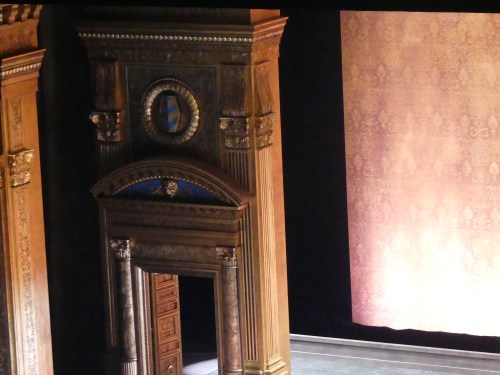
Empty backdrops and over-guilded decor for this revival…

1 commentaire

Classé dans Retours de la Grande boutique

Giselle in Paris : Ut Pictura Poesis

Dorothée Gilbert/Mathieu Ganio (February 11th) and Amandine Albisson/Hugo Marchand (February 15th matinée)

Act One(s)

Gilbert/Ganio.Caelum non animum mutant qui trans mare currunt. Their skies may change, but not the souls of those who chase across the sea. Ceux qui traversent la mer changent de ciel, non d’esprit (Horace, Epistles)

Gilbert’s Giselle, a more fragile and melancholy version of her naïve and loving Lise of La Fille mal gardée, was doomed from the start, like the Flying Dutchman. In those joyous “catch me if you can” jétés and arabesques with Ganio’s equally interiorized and gentle and devoted Albrecht, Gilbert’s suspended phrasing and softened lines started to make me shiver. What I was seeing was the first act as remembered by the ghost of the second. Gestures were quiet, subtle, distilled for both protagonists as in a 19th century sepia print: the couple was already not of this world. I have rarely been so well prepared to enter into the otherworld of Act II. Those on the stage and in the audience were as one soul, drawn into reminiscing together about daisies in tears and about “what might have been.”

La Giselle de Gilbert, une plus fragile et mélancolique version de sa naïve Lise de La Fille mal gardée, était condamnée dès le départ, comme le Hollandais volant. Avec ces joyeux jetés « Attrape-moi si tu peux » et ses arabesques avec l’Albrecht également doux, intériorisé et dévoué de Ganio, Gilbert suspendait le phrasé et adoucissait les lignes […] Et si on assistait au premier acte vu par les yeux du fantôme du deuxième ?

Albisson/Marchand. Carpe diem, quam minimum credula postero. Seize the day, and care not to trust in the morrow. Cueille le jour présent, en te fiant le moins possible au lendemain (Horace, Epodes)

At the matinee on the 15th, we enter another world, this time fully in the present, with a joyous and self-assured pair blissfully unaware of what lies in store. Down to earth, they make no secret of their mutual attraction, neither to each other nor before the village. When Albisson’s daisy predicts “he loves me not,” clearly this is the first time a cloud has passed before the sun in her sky. Gilbert’s Giselle seemed to withdraw into a dark place upon her mother’s cautionary tale about the Wilis (the supremely dignified Ninon Raux at both performances). Albisson’s Giselle seemed more bewildered by the brief sensation of being possessed by a force she could not control. “How can such awful things even be possible? Why am I shivering when there is sunlight?” Most often, the Albrechts stand back, turn their backs on mama, and let the heroine have her moment. But here Marchand’s intense concentration on what the mother was describing – as if he, in turn, was experiencing his first glimpse of the shadows to come, possessed by a force he could not control either –made the moment even richer. Aurora and Desiré had just been told that, in the end, they would not live happily ever after. Marchand, as with the daisy, kept on trying to make everything work out. There are some Albrecht’s who try to shush Bathilde over Giselle’s shoulder [“Let me explain later”], and those who don’t. Marchand tried.

Pour la matinée du 15, on entre dans un autre monde, cette fois pleinement dans le présent, avec un duo béatement ignorant de ce que l’avenir leur prépare. […]

La Giselle de Gilbert semblait s’enfoncer dans les ténèbres au moment des avertissements de sa mère sur les Willis (la suprêmement digne Ninon Raux lors des deux représentations). La Giselle d’Albisson semblait plus déconcertée par la brève sensation d’être possédée par une force qu’elle ne pouvait contrôler. « Comment de si horribles choses seraient-elles seulement possibles ? Pourquoi tremblé-je sous le soleil ?»

To Bathilde – rendered unusually attentive, warm, and reactive by Sara Kora Dayanova – Gilbert mimed winding thread (another Lise reference), twirling her fingers delicately downward. Her mad scene had the quality of a skein of silk becoming unravelled and increasingly hopelessly knotted and pulled in all directions. Albisson mimed sewing in big healthy stitches instead. Her physically terrifying mad scene – just how can you fling yourself about and fall down splat like that without injury? — reminded me of the person just served divorce papers who grabs a knife and shreds all her partner’s clothes and smashes all she can get her hands on, and then jumps out the window.

À l’intention de Bathilde – rendue exceptionnellement attentive, chaleureuse et réactive par Sara Kora Dayanova – Gilbert mimait le filage de la laine (une autre référence à Lise), tortillant délicatement ses doigts vers le bas. Sa scène de la folie avait cette qualité de l’écheveau de soie devenant désespérément dénoué et emmêlé à force d’être tiré dans toutes les directions. Albisson mimait plutôt la couture à points larges et décidés. Sa scène de la folie, physiquement terrifiante, – jusqu’où peut-on se démener violemment et s’effondrer à plat sans se blesser ? – m’a rappelé ces personnes recevant les papiers du divorce qui saisissent un couteau, déchiquètent les vêtements de leur partenaire et brisent tout ce qui leur tombe sous la main avant de sauter par la fenêtre.

Second Act(s)

Permitis divis cetera. Leave the rest to the gods. Remettez-vous en aux dieux (Horace, Epodes)

Gilbert’s Act II lived in the realm of tears. The vine-like way she would enfold Ganio in her arms – and I was smitten by the way he interlaced himself into all her gestures and thoughts – defined their couple. They reached for each other. Here, at the same moments, Albisson was less about tears than about how insistently she stretched her arms up towards the heavens just before re-connecting to Marchard’s avid hands. “I remember you swore to love me forever. And now I am certain you were true. The skies know this.”

L’acte II de Gilbert se situait dans une vallée de larmes. Sa façon d’enlacer Ganio de ses bras telle une vigne vierge – et j’ai été touchée de la manière dont Ganio s’entrelaçait lui-même dans ses gestes et dans ses pensées – définissait leur couple. […] Ici, aux mêmes moments, Albisson était moins dans les larmes que dans l’intensité de l’étirement des bras vers les cieux juste avant de reconnecter avec ceux avides de Marchand : « Je me souviens que tu as juré de m’aimer pour toujours et maintenant je suis certaine que tu disais vrai » […]

In Act II, Marchand doesn’t need to run around searching for Giselle’s grave. He knows where it stands and just can’t bear to deal with how real it is. He also knows how useless bouquets of flowers are to the dead. He has come to this spot in the hope that the vengeful Wilis of her mother’s horrifying tale will come to take him. But his un-hoped for encounter with Giselle in the “flesh” changes his mind. As in Act I, they cannot stop trying to touch each other. This pair risked those big overhead lifts with breathtaking simplicity, in the spirit of how, for their couple, love had been wrapped around their need to touch. The final caress bestowed by this Albrecht upon all he had left of the woman he would indeed love forever – the heavy stone cross looming above Giselle’s tomb — made perfect sense.

À l’acte II, Marchand […] sait combien les bouquets de fleurs sont inutiles aux morts. Il est venu là dans l’espoir que les Willis vengeresses […] le prennent. Mais sa rencontre inespérée avec Giselle en « chair » et en os le fait changer d’avis. Ces deux-là ne peuvent s’empêcher de se toucher. Ils ont osé le grand porté par-dessus la tête avec une simplicité époustouflante. […] La caresse finale que donne Marchand à tout ce qui lui reste de cette femme qu’il aimera toujours – la lourde croix de pierre surplombant la tombe de Giselle – avait tout son sens.

Hilarion (one and only).

Pallida Mors aequo pulsat pede pauperum tabernas/Regumque turris. Pale Death knocks with impartial foot at poor men’s hovels as at rich men’s palaces. La pâle mort frappe d’un pied indifférent les masures des pauvres et les palais des rois. (Horace, Epodes)

Audric Bezard, both times. Both times elegant, forceful, and technically on top as usual, but different and creative in his approach to this essential – but often crudely crafted — character. With Gilbert, Bezard reacted in a more melancholy and deeply worried manner. Some neophytes in the audience might have even mistaken him for a protective older brother. Hilarion opens the ballet with his mimed “she loves me not” and the way he nuanced it then and thereafter built up a backstory for Gilbert: « I grew up with the girl, everyone – even me – assumed we would live happily ever after. Why is this happening? » But, alas, “that nice boy next door” can sometimes be the last thing a girl wants, even if he be soulful and cute. Bezard’s rhythm in mime is magnificent in the way it takes its time inside and along the lines of the music. You see thoughts shaping themselves into gesture. With Albisson, one saw less of that long-term story. I appreciated his alternate approach, more reminiscent of the impetuous in-the-moment passion Bezard had already demonstrated as a leading partner to this same ballerina in other dramatic ballets…

Audric Bézard les deux fois. Chaque fois […] créatif dans son approche de ce personnage essentiel – mais si souvent interprété trop crûment.

Avec Gilbert, Bezard réagissait d’une manière plus mélancolique et soucieuse. […] Hilarion ouvre le ballet avec sa scène mimée « Elle ne m’aime pas » et la façon dont il la nuançait ici et plus tard fabriquait un passé à Gilbert : « J’ai grandi avec cette fille, et tout le monde – moi y compris – était persuadé que nous serions heureux pour toujours. Pourquoi cela arrive-t-il ? » […] La façon qu’à Bezard de rythmer sa pantomime est magnifique en ce qu’il prend son temps à l’intérieur et aux côtés de la musique. […] Avec Albisson, on voyait moins une histoire au long cours. J’ai apprécié cette approche alternative réminiscence de l’impétuosité de l’instant que Bezard avait déjà développé dans un rôle principal aux côtés de la même ballerine.

Myrtha(s):

Nunc pede libero pulsanda tellus. Now is the time to beat the earth with unfettered foot. Il est temps maintenant de battre le sol avec des pieds sans entraves. (Horace, Odes).

If Valentine Colasante’s Queen of the Wilis on the 11th proved the very vision of a triumphant and eerie ectoplasm so beloved by 19th century Victorians, Hannah O’Neill’s on the 15th seemed instead to have risen out of an assemblage of twigs and bones (which is not potentially a bad thing). Let me explain.

As a dancer, Colasante’s elongated neck now connects to eased shoulders that send the word down her spine, releasing pulsating energy. The result? Probably among the most perfectly fluid series of bourrées I have ever seen. The feet or legs should start from the head, from the brain, but most often they do not. These tiny tippy-toe steps – pietinées in French — often seem to have been designed to make dancers look like scuttling crabs. Colasante’s bourrées, so fluid and expressive and instantly in character, were those of someone who has really evolved as an artist. Control and release extended out from a really intelligent core informing her big, juicy, regal jumps and expressive back [Myrtha spends a lot of her time downstage facing away from House Right]. Mind-body intelligence infused even the tiniest of Colasante’s calm and unhurried gestures. Each of the umpteen times she had to mime “thanks for your thoughts and prayers, but now you must die ” — raise arms, clench fists, bring them down across the wrists– Colasante gave that gesture variety, reactivity, and lived in the moment.

[Le 11] Le cou de [Valentine] Colasante désormais allongé se connecte à des épaules déliées qui transmet le mouvement dans toute sa colonne vertébrale, libérant et pulsant de l’énergie. Le résultat ? Probablement parmi les plus fluides séries de piétinés qu’il m’ait été donné de voir. Car les pieds ou les jambes doivent commencer de la tête, du cerveau même ; et cela arrive si peu souvent. […] Ce contrôlé -relâché se diffusait depuis un centre très « intelligent » et infusait de larges, de savoureux et souverains sauts ainsi qu’un dos intelligent.

https://www.instagram.com/p/B8CBcfMI4WR/?utm_source=ig_web_copy_link

For the moment, O’Neill is on a learning curve and her stage presence has retrograded to more serious and studious than I would like for her to be doing at this point in her career. It’s if she’s lost that something so fresh and lively she used to have. Yes, you might say, “who do you think you are to expect fresh and lively from a Queen of the Zombies?” O’Neill did the job with full-out dedication, but seemed so…dry, despite perfectly executed steps. She needs to add some more mental flesh to the twigs and bones of her overly reserved phantom. My mind drifted way too often in the direction of impressive technical details. I couldn’t believe that this was really Myrtha, not the dancer named Hannah O’Neill. Until then, during both performances, I had completely been swept into the zone by all of the dancers described above as well as by the delicious demi-soloists and corps de ballet

Pour l’instant, [Hannah] O’Neill semble en phase d’apprentissage et sa présence scénique a rétrogradé vers quelque chose de plus sérieux et studieux qu’il ne le faudrait à ce stade de sa carrière. […] O’Neill a « fait le travail » avec une totale implication mais semblait tellement … aride, en dépit des pas parfaitement exécutés. Il lui faudrait ajouter de la chair émotionnelle sur les os de son trop réservé fantôme.

Hannah ONeill

Cléopold saw a distinct delicacy in her version of Myrtha from where he was sitting, and I do not wish to be harsh. But in a poetic story-ballet, technique must learn to serve the story above all else.

Ut pictora poesis. As in painting, so in poetry. Telle la peinture est la poésie (Horace, Ars Poetica).

2 Commentaires

Classé dans Retours de la Grande boutique