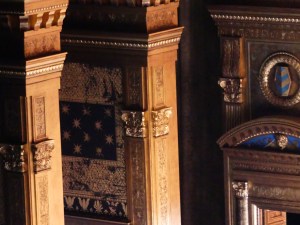
 Roméo et Juliette, Paris Opera Ballet, Opera Bastille, April 7, 8, and 17, 2026. Choreography by Rudolf Nureyev, Music by Sergei Prokofiev, Sets and Costumes [sort of] by Ezio Frigerio
Not one of the three evenings I attended was “bad.” But not one couple pierced me to the core, either. I realize I made a weird note during one performance: “Why is this ballet just not happening?”
Perhaps I could not concentrate because another tragedy was playing out on stage at the same time. What has the Paris Opera management done to Ezio Frigerio’s claustrophobically textured and vivid scenic environment? I thought I was hallucinating. No fountain? All the rich backcloths and detailed carvings replaced by what were basically sky templates enlarged off the internet? A cheap showroom bed plonked in the middle of an empty warehouse is now the crypt? Speaking of cheap, the regilt mobile flies were way too flashy.
The lighting design remains unchanged, yet the sets that the lighting refracted off have now mostly disappeared, along with about half the extras. The downstage “alea jacta est” dice players were rendered invisible both at curtain up and curtain down. The Duke of Verona, who appears upstage to force the warring clans to put down their swords was literally invisible all three nights. On the other hand, the guests entering the Capulet doors, who once had become shadows behind a scrim, are painfully visible as they head for the wings obscured by…nothing. Can it get worse? Yes. During the balcony scene, a spot hits the couple. Without the fountain, it lofts the shadow of their heads onto the bland backdrop that now only consisted of an out-of-focus polaroid moon. The result look exactly like an upside down “wow” emoticon. Do better next time, guys.
*
* *
April 7th
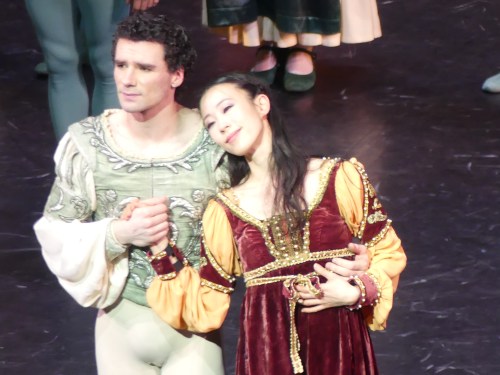
Paul Marque and Sae Eun Park Performance on April 7th.
I have come to like Sae Eun Park, the performer. I have come to like Paul Marque in the same vein. I continue to dislike seeing them dance together. When Park/Marque is cast they continue to radiate the calm of their clearly pleasant rehearsal room relationship. When they are alone or with others they can glow, they react. Germain Louvet catalyzed a striking vulnerability in Park’s Giselle. In Sylvia, you just yearned for the wildly ardent Marque to end up happily ever after with Bluenn Battistoni…
They are very much “in like,” but their chemistry lacks radiance, abandon. There is no electric “spark” between them, only a comfort zone. Yet they continue to be scheduled as dramatic leads together …
Maybe something was off from the start because the first real potential girlfriend you had already seen — Sylvia Saint-Martin’s icy, dry, and monotone Rosalind — made you already wonder what was wrong with this Romeo. Why would any young man in his right mind waste time trying to flirt with a humorless poppet? Overheard during intermission: “there was no Rosalind tonight, just a bunch of identical girls.” Ouch.
Sae Eun Park’s Juliet was light and quick and warm, but soon you could see how she was always being carefully managed by Tybalt and Romeo – and even her father — when it came to sliding her down or manipulating her in any way whatsoever. The fact that she offered up the same gracious smile to each and every person quickly started to bore me. There was no sense of shock in her first encounter with Romeo in the Ball Scene, which came off as more of a hello. Park does lean into Marque with soft grace, but even when his mask falls off Park’s Juliet remains the same well-bred girl. His first kiss doesn’t light her up with more than a “that was nice.” Nor did the second.
In the balcony scene Marque’s Romeo was full out at first, open-bodied and visibly inspired to impress Juliet (that recklessly precise manège of double tours)… and then he reversed gears and became the “I won’t break this glass unicorn” careful partner. Why? Honestly, Park looks as if she is in perfectly fine shape and uninjured. Despite the restraint, a certain soft charm did manage to evolve. Was I moved? No. Act Three just seemed endless until Marque’s Romeo, alone, began to storm his way unto his death. Park’s death scene was moving in equal measure. How odd, isn’t it, that both their most passionate moments occurred while the other was inert?
All the more pity as so many on stage April 7th had energy and wit to spare:
Jack Gasztowtt, aware and alert, fully present on stage as Benvolio.
What’s not to like about Francesco Mura’s bouncy and sly Mercutio, except for a terrible hairdo?
Jérémy Loup-Quer’s observant and actually likeable Tybalt definitely knows how to swish and slash his sword with relaxed authority. He was very much amused and reactive in the early scenes. Never a villain in the making. And that proved interesting: his courtly restraint as bad guy made Mercutio’s (and his own) fate all the more surprising.
Andrea Sarri’s Paris quickly evolved from fatuous plot device into husband material early on. He gave this dead-end role heft and elegance.
Sara Kora Dayanova’s Lady Capulet was a vortex of emotions, born out of the wisdom distilled by her years of on-stage experience. Most haughtily Shakespearian whilst she handed out swords during the ball scene, Dayanova’s later howl of desperation, not anger, stilled the house. Splendid and deeply alive on stage even when just walking – Dayanova doesn’t get a picture or a bio in the illustrated program. As if she were an extra? That’s just wrong. I heartily wish the Paris Opera Ballet would show more respect for those soloists who have given their lives to this company as they age gracefully and evolve more fully into character roles.
A young friend, who saw exactly the same cast a week later, hesitated when I interrogated him. “Oh it was excellent, so well-performed, the couple was really nice and then…At the end when he threw her body around, it was very aesthetic.” Alas he used code words for: your brain is on, not your heart. You are observing the process. He spoke too much about how he loved the costumes, bad sign. He was more captivated by the chemistry between Gastowtt’s Benvolio, Mura’s Mercutio, and Quer’s Tybalt. Now there he saw sparks flying, now there bloomed a galvanizing subtext he couldn’t shake out of his head.
*
* *
April 8th
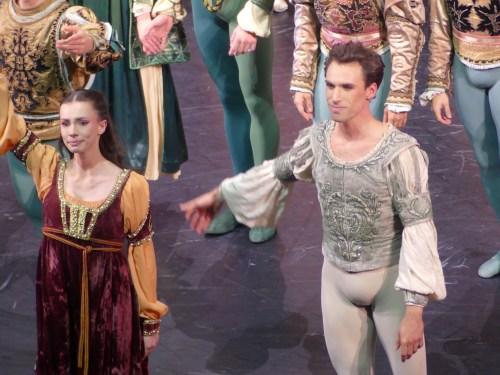
Bleuenn Battistoni and Thomas Docquir. Performance on April 8th
The next night, after another impeccably danced performance, again I left the theater hungry for more. Unlike American critics, I have not so far felt I’d experienced what they sneeringly call the “too perfect” performances of the Paris Opera Ballet. But on the second night I started – for the first time ever – to muse that the principals just might have been over-rehearsed. Is that possible?
Even before Juliet’s entrance, I’d been tempted by what Hohyun Kang’s fluffy and flirty Rosalind had to offer. Kang is one of those soloists who keeps catching the light. Pablo Legassa’s limber and graphic Tybalt could have been naughtier (on the 17th, Nicola di Vico will carve out a splashily dashing silent movie villain who really has the ear of Katherine Higgins’s chillingly ambitious Lady Capulet). Andrea Sarri’s Mercutio had joyous energy to spare. Keita Bellali used the role of Paris to display his silky control and gorgeous lines as a peacock would. Bellali even managed to indicate that he might have some secret passions simmering just below the surface, too.
Everything Bluenn Battistoni’s Juliet does flows so naturally that you take her unforced – but powerfully developed — technique for granted. Her Juliet on April 8th accelerated, decelerated, nuanced little flicks of leg or hand, slowly loosened up. Her dance is beautifully silky…but it wasn’t until the third act that she took over the narrative and made it impossible not to watch her.
Her Romeo was Thomas Docquir. His trajectory in this company has been awkward. Every time I’ve seen him over the years he’s clearly been concentrating on extending his lines and technique, especially in the service of the tricky syncopations and changes of direction in Nureyev’s ballets. But something never quite happened. Endlessly cast as a perfectly acceptable Rothbart “de service” one season, then miscast as a mild Frollo, with a Prince Desiré in between (where he seemed petrified by imposter syndrome). And here? …here he was deeply sweet and finally relieved from whatever it was that had been holding him back. So I was rooting for him.
Docquir’s Romeo is very much in the vein of Tony in West Side Story, a passionate pacifist. He really draws in the audience when he pleads “I don’t, I won’t, I can’t” when prodded by his friends or by Tybalt. But with his Juliet, alas, once again, sparks just didn’t happen until the last act. Thomas Docquir – like Paul Marque the night before – kept disappearing into partner mode.
*
* *
April 17th
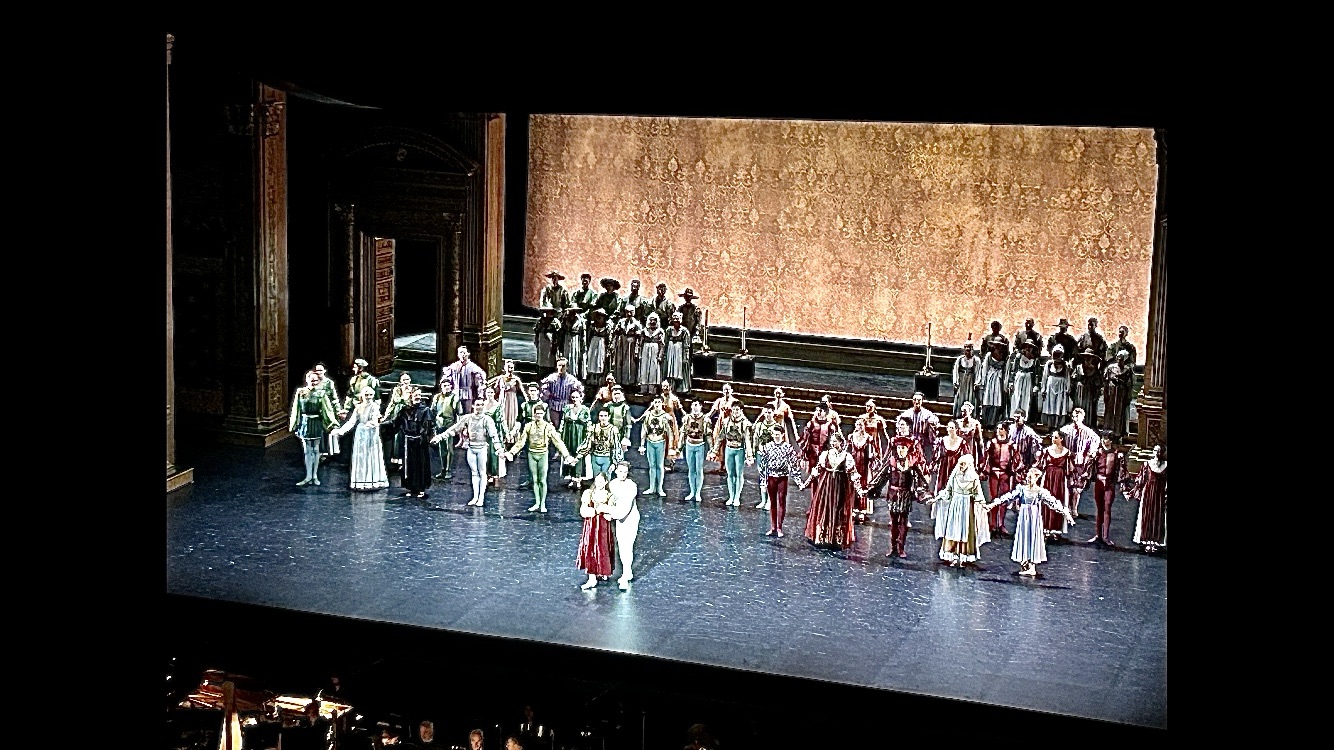
Romeo & Juliet. Performance on April 17th.
And then, unexpectedly, Thomas Docquir was thrust into a new partnership with Valentine Colasante on April 17th due to Guillaume Diop cancelling due to injury. And maybe this wasn’t such a bad idea.
While this couple also didn’t make me cry, the fact that they had been working in different directions with equal intensity in rehearsals gave their interactions a spontaneity that had been lacking in the other pairings.
Colasante’s playful “don’t worry, I won’t break” Juliet just wants to dance with her besties and no one, not even this rather cute Paris (Bellali again) was going to make her simply smile at everyone and obey. I sighed along with her easy loping pensive walk out onto the terrace and into the Balcony Scene. Docquir’s “Maybe Tonight” attitude made her visibly brighten. The duet on the 17th had an amplitude that was lacking on the 7th or 8th, perhaps due to the fact that when a new partner comes at you with a different center of gravity, then you are forced to concentrate on getting through the moment, rather than perfecting the look. So what if a few landings are hard, some lifts a bit short, and maybe timing is sometimes half a beat away from in-sync? In a dramatic ballet is partnering supposed to be predictably pretty? Imperfection creates a sense of spontaneity. When Docquir’s Romeo struggled both intentionally and unintentionally with Colasante’s drugged body near the end, it felt raw. This drama was happening here and now on stage, not copy-pasted from a rehearsal studio.
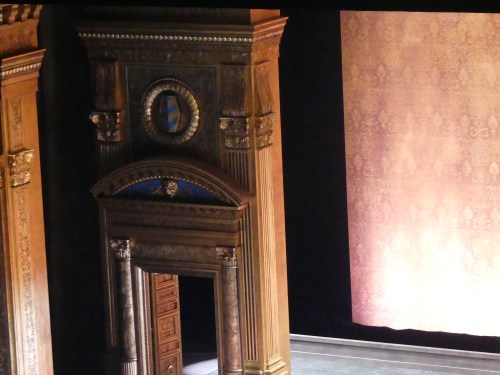
Empty backdrops and over-guilded decor for this revival…


 La Belle au bois dormant. Ballet de l’Opéra de Paris. Représentation du 11 avril 2025.


 James
James Albertina
 Cléopold
 Fenella
 Les Balletonautes
 Mini Naila
