Archives de Tag: Ines MacIntosh

My Spring Season 2025 in Paris 2/2 : A Beauty Binge with Nymphs on the side.

In-Between The Beauties

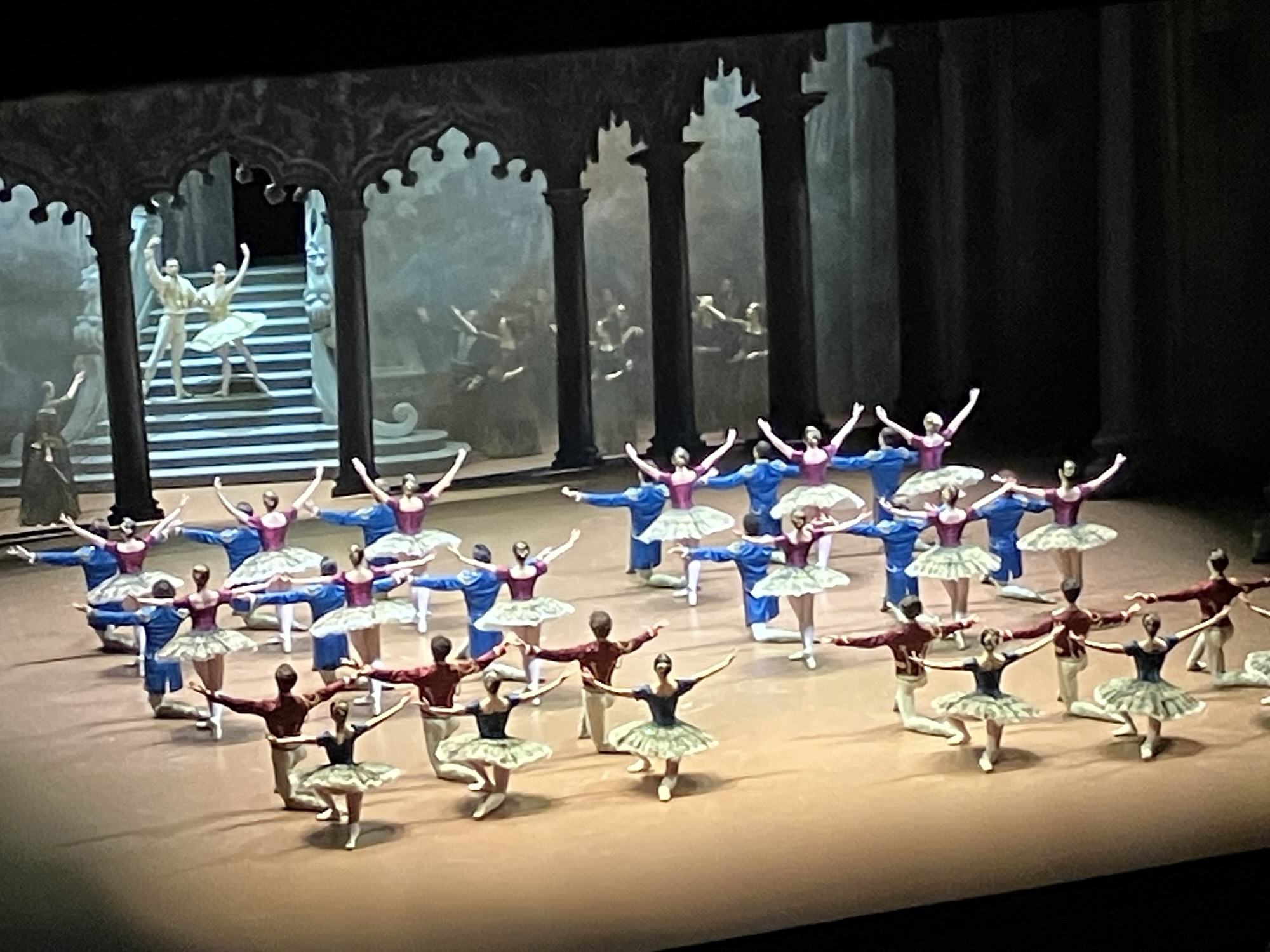
Sylvia : ensemble.

Manuel Legris’s Sylvia, Palais Garnier, May 8th & 9th

Sandwiched in there, between Belles, we were treated to a short run of a revival/re-do of the ballet Sylvia, which had disappeared from the Paris repertoire.

I had never seen Darsonval’s 1979 version, alas. I will always regret how the Paris Opera then also deprogrammed the one I knew:  John Neumeier’s late 1990’s visually stunning version but esoteric re-interpretation of the story. It did take a while to figure out that Eros and Orion had been conflated into the same dancer by Neumeier,  yet the choreographer’s vivid sense stagecraft worked for me emotionally. All the better that Neumeier’s original naïve shepherd, Aminta/Manuel Legris himself, decided to try to piece together a new version that reached back to the ballet’s classic roots.

It was particularly odd to see most of the Sleeping Beauty casts now let loose/working overtime on this new production. While the dancers gave it their all, quite a few of the mythical beings were sabotaged by a production that included some very distracting costumes and wigs.

The Goddess Diana sports a basketweave ‘80’s Sheila Easton mohawk that would make any dancer look camp. In the role, a rather ferocious Roxane Stojanov held her head up high and ignored it, while the next evening a tepid Silvia Saint-Martin disappeared underneath the headgear to the point I had forgotten about her by the time she reappeared on stage near the conclusion. The interactions between Diana and Endymion make no sense whatsoever, particularly when you are at the top of the house and cannot see what is happening on the little raised platform at the back of the stage. Imagine trying to follow the plot when you can only see a bit of someone’s body wiggling, but without a head. Note to designers:  go sit up at the top of the house and do some simple geometric calculations of vectors, please.

To add to audience discomfort (hilarity?) with the staging at some point Eros, the God of Love, will abruptly rip open the raggedy cloak he’d been disguised in (don’t ask) in order to flash his now simply  gold-lamé-jockstrap-clad physique. On the 9th, Jack Gasztowtt managed to negotiate this awkward situation with dignity. On the 8th, having already gotten mega-entangled in his outerwear just prior to the reveal, Guillaume Diop didn’t. Seriously cringey.

There are many more confusing elements to this version, including the strong presence of characters simply identified as “A Faun” (Francesco Mura both nights) and “A Nymph” (a very liquid Inès MacIntosh on the 8thand a  floaty  Marine Ganio on the 9th).  But what’s with the Phrygian bonnets paired with Austrian dirndls? The Flames of Paris meet the Sound of Music on an Aegean cruise?

In Act 3, some characters seem to wear Covid masks. So please keep the choreography, but definitely junk these costumes!

Despite these oddities, dancers were having serious fun with it, as if they had been released from their solemn vow to Petipa while serving Beauty.

On the 8th of May, Germain Louvet’s fleet of foot and faithful shepherd Aminta charmed us. His solo directed towards Diana’s shrine touched in how grounded and focused it was. His Sylvia, Amandine Albisson, back after a long break, seemed more earthbound and more statuesque than I’d ever seen her, only really finding release from gravity when she had to throw herself into and out from a man’s arms.  But when Albisson does, gravity has no rules. Usually you use the term “partnering” to refer to the man, but I always have the feeling that she is more than their match. When I watch Albisson abandon all fear I often think back to Martha Swope’s famous photograph of Balanchine’s utterly confident cat Mourka as she flies in the air. When it’s Albisson, everything gravity-defying, up to and including a torch lift, feels liberatingly feline rather than showy or scary.

Here the hunter Orion is less from Ovid and more of a debauched pirate straight out of Le Corsaire. On the 8th, Marc Moreau at first moved with soft intention, clearly more of a suitor than a rapist where Sylvia was concerned. You felt kind of sorry for him. His switch to brutality made sense: being unloved is bad enough for a guy, being humiliated by a girl in front of his minions would make any gang leader lash out.

Marc Moreau (Orion), Amandine Albisson (Sylvia) and Germain Louvet (Aminta)

On the 9th, I had to rub my eyes. Bleuenn Battistoni – that too demure Beauty – provided the relaxed and flowing and poignant princess I had hoped to see way back in March. Nothing dutiful here. Already in the first tableau, without doing anything obviously catchy, her serene and more assertive feminine authority insured that the audience could immediately tell she was the real heroine – an eye-catching gazelle. Maybe Beauty is just too much of a monument for a young dancer? Inhibiting?  Ironically, at the end of the season, I would see Albisson let loose as Beauty. The tables will have turned.

I was drawn to Paul Marque’s melancholy and yearning shepherd Aminta. At a certain point, Sylvia will be prodded by Diana to shoot her suitor. Albisson did. Here Battistoni (and who in any case would obey Saint-Martin’s dry Diana?) clearly does by accident, which made the story juicier. Battistoni’s persona was vulnerable, you stopped looking at the “steps” even during the later Pizzicati solo, which she tossed off with teasing and pearly lightness. Everything I had hoped for in Battistoni’s Beauty showed up here.
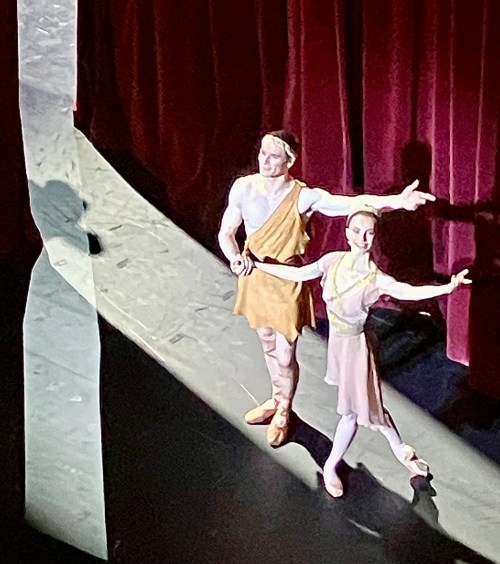
Sylvia : Paul Marque et Bleuenn Battistoni

*

 *                                    *

The Belles Are Ringing

La Belle au Bois Dormant’s second series. Opera Bastille, June 27th,July 6th and 7th.

Guillaume Diop et Amandine Albisson (Désiré et Aurore le 7 juillet).

And then, boom, Albisson full out in Sleeping Beauty on July 7th.  As fleet of foot as I knew her to be, neither allegory nor myth but a real and embodied character. Whereas she had seemed a bit too regal as Sylvia, here came the nymph. Delicate and gracious in the way she accepted the compliments of all of her suitors, Albisson created a still space around her whence she then began to enchant her princes. She looked soundless.

Guillaume Diop, who had proven a bit green and unsettled earlier this series, woke up his feet, leaned into his Second Act solo as he hadn’t before – a thinking presence, as someone remarked to me – and then went on to be galvanized by his partner and freed by the music.

Perhaps Diop, like everyone else on the stage, was breathing a sigh of relief. For this second series of Beauties in June/July, the brilliant and reactive conductor Sora Elisabeth Lee replaced the insufferable Vello Pähn. During the entire first series in March and April, this Pähn conducted as slowly and gummily if he were asleep, or hated ballet, or just wanted to drag it out so the stagehands got overtime. With Sora Elisabeth Lee, here the music danced with the dancers and elated all of us. During the entire second series, Bluebirds were loftier, dryads were more fleet-footed. Puss and Boots had more punch and musical humor. Sora Elisabeth Lee gave the dancers what they needed: energy,  punchlines, real rhythm. This was Tchaikovsky.

So this second series was a dream.

On July 6th, Germain Louvet proved that he has grown into believing he can see himself as a prince. I say this because I was long perturbed by what he said as a young man in his autobiography (written before you should really be writing an autobiography).  An assertive prince, a bit tough and perfectly cool with his status as Act Two starts. And then he began unfurling his solo, telling his story to the heavens. His arms had purpose, his hands yearned. And when he saw his Beauty, Hannah O’Neill, it was an OMG moment.

As it had been destined to be. O’Neill’s coltish and gracious and sleek, sweetly composed and well-mannered maiden from Act One was now definitely a damsel in need of a knight in shining armor. She was his dream, no question. She began her Second Act solo as if she were literally pushing clinging ivy aside, her arms moving slowly and filling into spaces at the end of each phrase. No wonder that Louvet’s prince became increasingly nervous seconds later while trying to find his girl in among the sleepers. You could feel his tension. “Are they all dead? Was the Lilac fairy just fooling with me?” And, oh, Act Three. The way he presented his belle, the way they danced for each other.
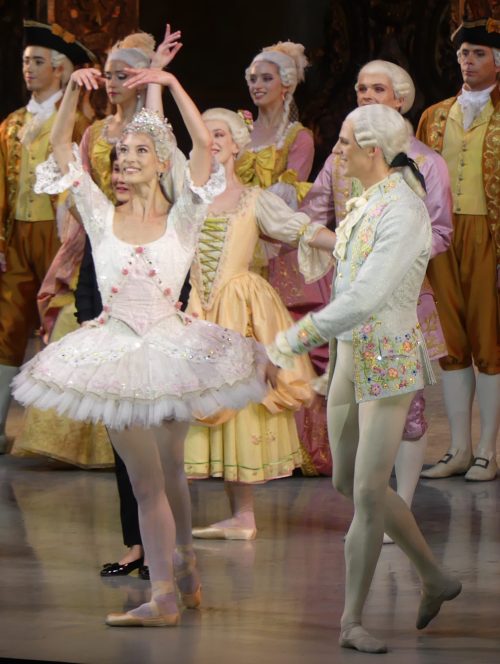
Hannah O’Neill (Aurore) et Germain Louvet (Désiré)

But of all the Beauties, I will never forget Leonore Baulac’s carefree and technically spot-on interpretation, maybe because I just can’t find a way to describe this June 27th performance in words. Fabulous gargouillades? The way she made micro-second connections with all four of her suitors (and seemed to prefer the one in red)? The way everything was there but nothing was forced? The endless craft you need to create the illusion of non-stop spontaneity? The way Marc Moreau just suited her? Those supported penchées and lean backs in the Dream Scene as one of the most perfect distillations of call and response I have ever seen?

Both Baulac and Moreau sharply etched their movements but always made them light and rounded and gracious. Phrases were extended into the music and you could almost hear whispered words as they floated in the air. They parallelled each other in complicity and attack to the point that the first part of the final pas de deux already felt as invigorating as a coda.
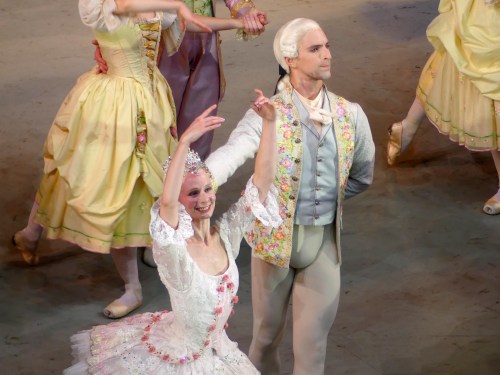
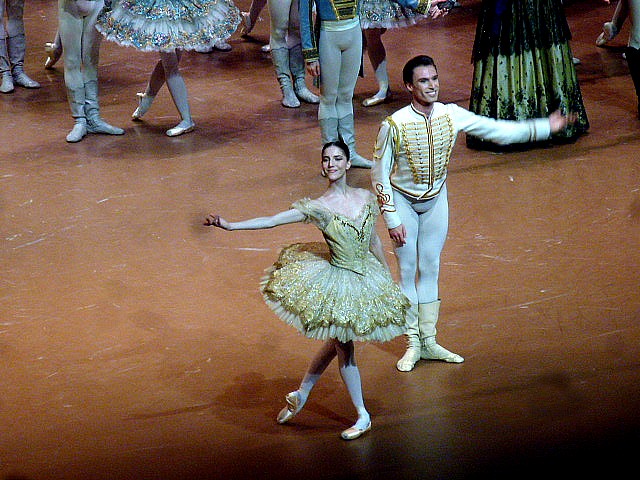
Léonore Baulac et Marc Moreau (Aurore et Désiré).

You can never get enough of real beauty. Let’s hope 2025’s Paris fall season will be as rich in delight.

Commentaires fermés sur My Spring Season 2025 in Paris 2/2 : A Beauty Binge with Nymphs on the side.

Classé dans Retours de la Grande boutique

Better Late than Never. My Spring Season 2025 in Paris : A Beauty Binge: 1/2

Sleeping Beauty/La Belle au Bois Dormant. Paris, Opera Bastille.

March 11, 13, 22 and April 3rd, 2025.

Stagecraft

Sleeping Beauty made me fall in love with ballet but at the same time, each time I see it, I begin wonder just why at some point (I still cannot pinpoint when), this ballet starts taking too long. Something could be cut. But what, where, when? And why?

I’m still stuck pondering this question decades later, even as this ballet makes me feel like a bee just gob-smacked by all the pollen out there on stage, bemusedly happy to just sit and watch a swarm of dancers bumble around in all the colors of its endlessness.

March 13th and April 3rd. During first intermission, I met up with some young American dancers. To my dismay, they assumed that Bluenn Battistoni had just graduated from the Paris Opera Ballet school and was being given her first big chance. I tried to argue that the French style, like the French people, is modest and reserved, more about perfection rather than chutzpah. (The company has been eternally misunderstood by those many American critics who value flash). But I didn’t even manage to convince myself. Battistoni’s dancing is absolutely stunning and technically polished, but her stage presence was way too reserved – over-calm — this performance. I’m not saying she needs to sell out, just learn to catch the limelight a little more. She’s completely assured but not assertive enough. With the right coach I am sure Battistoni will move from inward-looking glow into eye-catchingly demure radiance.

Battistoni, on the second night, channeled a newly skippy feel to her hops and gargouillades. She was asserting herself more, aha, but remained soft-spoken.

Bleuenn Batistoni (Aurore) et Guillaume Diop (Désiré)

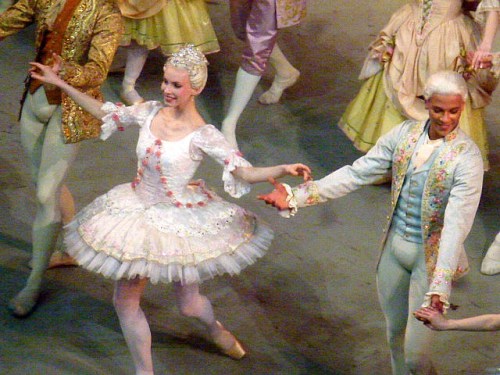
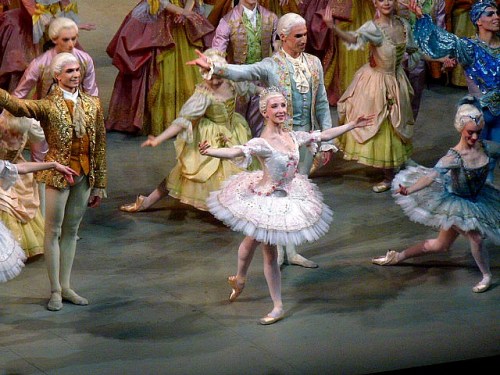
Inès McIntosh on March 11th was more extraverted but she, like Battistoni, would probably be better served right now by Balanchine’s clever abstraction of Sleeping Beauty’s formal magic: Theme and Variations. That is not to say that McIntosh didn’t offer a powerful mini-mad scene after her finger was pricked. McIntosh has undeniable presence, but she hasn’t yet grown into projecting that kind of distillation of womanliness offered by so many of the Auroras I’ve seen from Fonteyn on down.  In the Vision Scene, she just didn’t know how to project vulnerability and yearning.   At the end of the evening I left the theatre humming Don Q instead of SB.

Ines McIntosh. Aurore

March 22nd. Powerful yet demure radiance is exactly what Héloïse Bourdon embodies these days. She just glows. In her one shot this season as Princess Aurora, I was delighted by how she reminded me in her solos of where the choreography and music echo bits and pieces of her Fairy godmothers’ variations. The Prologue had come together to shape the personality of this princess. Bourdon’s hard-earned stagecraft (don’t get me started again on all the reasons she should have promoted ages ago) offers a gift to the audience. You don’t have to be a balletomane to feel that something big is happening, but if you are a balletomane you relish her mastery of both steps and nuance all the more. I was bewitched.

Bourdon Docquir March 22

On other nights I was reduced to sitting back and basking in the authority and easy confidence of the same Bourdon’s repeated brief stints as Sixth Fairy during the Prologue. This variation is normally given to THE Lilac Fairy, but alas Nureyev morphed Lilac into a separate and, when not mimed with authority, utterly insipid panto role. Why turn the juiciest solo into a random outing with no follow-through? Instead of a powerful ballerina/catalyst, THE fairy turns out to be a random junior dancer in a cut-out costume dominated by a big wig à la Lina Lamont from Singing in the Rain insipidly miming – with one cast exeption – “Oh Carabosse, you shouldn’t have come. No, no, no.”

Bourdon’s suitors in Act One clearly appreciated this well-bred Aurora in bloom.  “A rose? How kind of you.” She wasn’t “selling it” in a flashy way, nevertheless the people sitting near me literally screamed at the end of the adagio and a young man right behind me gasped in shock when she pricked her finger. Yeah, sure, vox populi. But I was equally enthralled by such gracefully and authoritatively danced intelligence. During the Vision scene, Bourdon’s control and release and way of finishing each phrase now evoked memories of the way she had danced at her birthday party. Each act had you plunge deeper and deeper into all the facets and colors that are buried in a diamond.

Of course, Bourdon has one great advantage over the other two Auroras I saw: on-stage experience in the ballet. The last time this ballet was given in Paris was over a decade ago, so neither Battistoni nor McIntosh have had the luxury to start out as a little fairy, get the music and production into their bones and muscle memory, watch and learn from the stars while in the wings or milling about dressed for a mazurka. Stagecraft takes years.

Part of my reticence about the Beauties could be blamed on the hard-working and well-meaning Prince Desirés of both Thomas Docquir and Guillaume Diop. As most of the company’s male principals had decided to hang out over at the Palais Garnier and devote themselves to performing in Mats Ek’s Appartment rather than be involved in this run, basically there were few men left.

Both, as if they were relief pitchers, were scheduled to partner at least two if not three ballerinas. Where is the rehearsal time then to craft intimacy in dance and drama with your partner? Where is the time to work on your own role?

As I noted to myself during Act Two: “McIntosh seems better on her own and fills the space when she is the dream.” Act Three: “Fish dives with Docquir not thrilling. Steps executed, zero connection, she seems like a doll instead of a woman. Isn’t this supposed to be a wedding?”

Perhaps Thomas Docquir (March 11th and March 22nd) has simmered too long in secondary roles, including endless iterations of Rothbart, to be “the one.”  He has clearly been working on refining his technique (solid from the start but now more polished, elastic, finessed, held up high) and elongating his lines. But, seriously, it is now time for Docquir to build up his self-confidence and stop avoiding the spotlight. When he came out on the stage in Act Two…both times few in the audience caught on that he was supposed to be the star.  His Vision scene solo was made for some nice lines, yet the longing was missing. He didn’t ever challenge McIntosh to do that one percent more and when I next saw him with Bourdon my always accentuate-the-positive seatmate made an interesting comment. “If even he can’t believe that he is a prince, then why should she believe him? [pause] Then why should I?”

Guillaume Diop (Désiré)

Guillaume Diop (March 13th and April 3rd) is so talented and cheerfully radiant – and known — that even if he’s sometimes just a bit too all over the place (not only Etoile but  in-demand fashion icon), the audience just takes to him before he even takes a second step. I saw him twice with Battistoni and clearly he learns fast and carries over new ideas from performance to performance. By the second performance I saw, the partnering between their had developed. Intense eye-contact led to easier connection.

He’s a very attentive partner – boy does he just know how to hold out his hand and whip his girl into pirouettes with concentrated nonchalance — and as a soloist he has impressive elevation and strength (those barrel turns). But he has got to keep working on refining his feet, still just a bit forgotten as they are too far away from his head, and he especially needed to re-ground his plié (I winced a few times on the 13th). While he knows how to stretch out of his balances, he’s begun to sit back on his standing leg and is not pulling up enough through his hip…a sign of being tired. He’s dancing too much and this worries me. Nevertheless, I am curious to how partnering a much more seasoned stage partner during the next run – Amandine Albisson — might galvanize him. Two young-uns is cute. Young talent rubbing up against stagecraft often results in more.

To be Continued…

2 Commentaires

Classé dans Retours de la Grande boutique

Paquita à l’Opéra : ballerines d’hier et d’aujourd’hui

P1220788Paquita (Deldevez-Minkus / Pierre Lacotte d’après Joseph Mazilier – Marius Petipa). Ballet de l’Opéra de Paris. Représentations des 18, 23 décembre 2024 et du 1er janvier 2025.

Paquita, créé en 1846 à l’Académie royale de musique, est un ballet qui embrasse un des aspects du romantisme : la couleur locale. Joseph Mazilier, qui avait été dans ses années de carrière active de danseur un interprète virtuose (il fut le créateur du rôle de James dans La Sylphide), semblait moins attiré par l’aspect éthéré de la danse, par le surnaturel, que par les oripeaux nationaux ou historiques. Paquita s’apparente à la tradition de la danse romantique représentée par Fanny Elssler qui avait étourdi Paris en 1836 avec sa capiteuse Cachucha dans le « Diable boiteux » de Jean Coralli. Le premier essai chorégraphique de Joseph Mazilier avait d’ailleurs été créé pour Fanny Elssler, en 1839. Dans « La Gipsy », la belle autrichienne, sommée par une partie des abonnés de quitter les terres, ou plutôt les airs, de Marie Taglioni (sa reprise du rôle de la Sylphide avait provoqué une émeute dans la salle), incarnait Sarah, jeune fille de noble extraction enlevée dans son enfance par des Bohémiens.

À cette époque, dans le ballet, on ne reculait pas devant les petits recyclages. En 1846, Carlotta Grisi, la nouvelle coqueluche de Paris, que les Histoires simplifiées de la Danse présentent comme la danseuse qui a fait la synthèse entre les styles ballonnés de Taglioni et tacquetés d’Elssler, avait besoin d’un nouveau ballet. Ce fut donc Paquita où l’héroïne était, elle aussi, une enfant dérobée.

Dans cette recréation de 2001 par Pierre Lacotte, on a été tenté de trouver à quelle grande ballerine de l’Histoire les interprètes sur scène aujourd’hui nous faisaient le plus penser.

*

 *                                        *

Cela tombe bien. Pour les trois représentations auxquelles on a pu assister, les interprètes du rôle-titre avaient des auras de ballerine. Ce n’est pas donné à tout le monde. Dans le monde chorégraphique d’expression classique, il y a de grandes danseuses et, parfois, des ballerines.

img_6723

Paquita. Final. 18 décembre 2024. Marc Moreau et Léonore Baulac.

Léonore Baulac est de ce dernier type. À l’acte un, pour sa première apparition, tout son travail de pirouettes est extrêmement filé. Les ports de bras sont élégants et souples et le mouvement continu. Ravissante, elle évoque par sa blondeur et cette manière assez indéfinissable de rayonner sur scène, Carlotta Grisi, la créatrice du rôle. Par sa pantomime, elle accrédite une Paquita dont l’inné (sa naissance noble) prend le pas sur l’acquis (sa culture gitane). Dans le passage au tambourin, elle s’apparente plutôt à une Sylphide apparaissant au milieu de ses compagnes qu’à une bacchante. Marc Moreau, un Lucien d’Hervilly qui fabrique d’emblée un personnage de fiancé en plein doute (très proche du James de La Sylphide justement), se montre fasciné comme s’il était face à une vision. Techniquement, il est également dans le beau style. La technique saltatoire est ciselée. Il ne retombe que brièvement, lors du Grand Pas, dans sa tendance aux finals soviétique (bras métronomiques et levé de menton). On croit à ce couple dont le badinage amoureux à la rose de la scène 1 a de la fluidité.

Les deux danseurs s’en sortent avec les honneurs pendant la scène de la taverne qui souffre un peu de sa transposition de Garnier à Bastille. Les distances entre les quelques éléments de décor, l’armoire à jardin, la table et le vaisselier à cour, ont certainement dû être augmentées : combien de temps Iñigo peut-il rester la tête enfoui sous un manteau pour permettre à l’héroïne de courir vers son amant et lui délivrer l’information du complot par le biais de la pantomime ? Dans le rôle du gitan amoureux et jaloux, Pablo Legasa, une fois encore utilisé à contre-emploi (il a l’air d’être lui-aussi un enfant aristocrate dérobé), parvient à émouvoir dans sa déclaration d’amour rejetée de la scène 1 après avoir conquis la salle avec sa première variation.

Au soir du 23 décembre, Antoine Kirscher, brio en berne et moustache postiche en goguette n’aura pas le même chien. Son Iñigo frôlait l’insipidité.

P1220814

Ines McIntosh et Francesco Mura (Paquita et Lucien d’Hervilly). 23 décembre 2024.

On a heureusement une autre ballerine sur scène : Inès McIntosh. Sa version de Paquita est pourtant force différente de celle de sa prédécesseure. Inès McIntosh met plus en contrepoint l’inné (la noble ascendance) et l’acquis (l’éducation gitane). Moins naïve, plus primesautière, Paquita-Inès utilise son buste, son cou et les épaulements naturels et ondoyants directement pour séduire, telle une Fanny Elssler dans « La Gipsy ». Une petite pointe de brio technique vient rajouter à cette caractérisation délicieusement aguicheuse. Dans sa première variation, McIntosh exécute des tours attitude devant très rapides mais comme achevés au ralenti. Elle cherche clairement à séduire Lucien, Francesco Mura, plus compact que Moreau, le bas de jambe nerveux qui cadre fort bien avec sa condition de militaire. Ses épaulements ont également du chic et il dégage une mâle présence. La déclaration d’amour entre les deux amants a du peps. La scène des éloignements-retournements, coquetterie de l’une, badinage de l’autre, sont bien réglés. Avec McIntosh-Mura, on est clairement sur le registre de l’attraction charnelle.

La scène 2 réserve aussi son lot de bons moments. La pantomime est vive. L’épisode de la chaise où Lucien manque d’assommer Paquita est très drôle.

P1220857

Héloïse Bourdon et Thomas Docquir (Paquita et Lucien d’Hervilly). 1er janvier 2025.

Le 1er janvier, s’il faut filer la métaphore des ballerines romantiques, Héloïse Bourdon évoque Pauline Duvernay dans la cachucha immortalisée par une gravure durant la saison londonienne de 1837 où elle dansait en alternance avec Elssler. On trouve en effet dans sa Paquita tout le charme de l’Espagne de pacotille agrémenté de l’élégance de l’école française. Tout chez mademoiselle Bourdon est contrôlé et moelleux. Elle sait minauder sans affectation et énoncer clairement sa pantomime.

P1220835

Andrea Sarri (Inigo). 1er janvier 2025.

Cela fait merveille durant la scène de taverne où jamais elle ne paraît pressée par le temps dans ses interactions avec l’Iñigo truculent, presque bouffe d’Andrea Sarri (qui trouve le bon équilibre entre la précision des variations dessinées par Lacotte et le relâché requis par le rôle). En Lucien, Thomas Docquir, qui remplace Jérémy-Loup Quer, a une belle prestance et de belles qualités de ballon à défaut d’être aussi immaculé techniquement que sa partenaire. Il a néanmoins du feu en amoureux qui fait fi des conventions sociales. Sa pantomime lors de sa déclaration d’amour repoussée de l’acte 1 est touchante à force d’être décidée. Lors de la seconde demande où Paquita accepte Lucien, on se remémore exactement les circonstances de la première demande non-aboutie. Héloïse Bourdon sait nous rappeler sa pantomime de l’acte 1 afin de nous faire mieux saisir celle de l’acte 2. De nos trois distributions, elle est sans doute celle qui réussit le mieux à connecter les deux parties du spectacle.

*

 *                                        *

On aura sans doute remarqué que les descriptions se concentrent sur l’acte 1. C’est que pour tout dire, le défaut de cette Paquita est bien sa deuxième partie. Après l’entracte, la messe est dite. Les deux héros ont échappé à l’acte 1 aux manigances du traitre Don Lopez Mendoza et de l’amoureux éconduit Iñigo. Le dénouement heureux, au milieu d’une scène de bal 1820 bien réglée pour le corps de ballet, ne parvient guère à soutenir l’intérêt dramatique. Personnellement, je préférerais que le ballet s’achève sur le pas de deux romantique final, en tutu long pour la ballerine,  concocté par Lacotte.

Le 16, Baulac et Moreau parvenaient à créer un moment intime avec ce pas de deux avant la grand-messe du grand pas classique de Petipa. Le 23, le couple McIntosh-Mura était un peu plus à la peine dans le partenariat.

D’une manière générale, on peut se montrer satisfait de l’exécution du Paquita Grand pas, même s’il contraste trop avec la reconstitution de Lacotte. En 2001, le chorégraphe avait d’ailleurs laissé à Elisabeth Platel le soin de le remonter. Pour cette reprise, on est content de constater que les dames du corps de ballet sont toujours à leur affaire. Léonore Baulac montre beaucoup de grâce suspendue même dans les parties difficiles de la chorégraphie tandis qu’Inès McIntosh montre qu’elle n’a pas peur des doubles tours fouettés. Mais c’est sans doute Héloïse Bourdon qui nous laissera un souvenir durable sur cette partie. Elle interprète en effet un grand pas immaculé. Bourdon a cette sérénité dans la grande technique qui vous met sur un nuage. Elle brille au milieu du corps de ballet, aussi bien dans l’entrada que durant l’adage. Dans sa variation elle est comme au-dessus de sa technique : les pirouettes finies en pointé quatrième, la série des tours arabesque et attitude, les fouettés, tout est superbe.

P1220838

Héloïse Bourdon et Thomas Docquir (Paquita et Lucien d’Hervilly). 1er janvier 2025.

C’est peut-être le seul des trois soirs où ce Grand pas de Petipa ne nous a pas paru interpolé de manière pataude dans le ballet à l’instar du pas de trois de l’acte 1 qui donne invariablement l’impression d’assister à une soirée parallèle. Que font en effet ces deux donzelles en tutu à plateau et ce toréador d’opérette en pleine montagne ? Le 16 décembre, on a néanmoins le plaisir de voir Clémence Gross et Hoyun Kang défendre les variations féminines et, le 1er janvier, Célia Drouy interpréter avec délicatesse la deuxième variation tandis que Nicola Di Vico fait preuve d’une indéniable sûreté technique dans sa variations à double-tours en l’air.

img_6736

Paquita, 18 décembre 2024. Léonore Baulac, Marc Moreau et Pablo Legasa

En 2001, parlant de la partition de Deldevez, Pierre Lacotte disait qu’elle était truffée de longs passages qu’il avait fallu couper. Peut-être aurait-il été judicieux d’utiliser certaines de ces pages pour donner une chance aux personnages secondaires d’exister un peu. Du mariage planifié entre Lucien et Doña Serafina, on sait bien trop peu de choses. Il y a peu de chance que le public non-averti comprenne que l’élément de décor en forme de pierre était un monument en l’honneur du père assassiné de l’héroïne. Doña Serafina est escamotée sans ménagement (et c’est fort dommage quand elle est interprétée par la très élégante Alice Catonnet), en quelques secondes, à la fin de la scène 1 de l’acte 2. On est loin d’une Effie ou d’une Bathilde qui ont un rôle effectif à jouer dans l’action.

C’est ce genre de détails d’importance qui fait d’un ballet non pas un simple divertissement bien réglé mais une œuvre solide, prête à parler à de nombreuses générations successives de balletomanes.

Commentaires fermés sur Paquita à l’Opéra : ballerines d’hier et d’aujourd’hui

Classé dans Hier pour aujourd'hui, Humeurs d'abonnés, Retours de la Grande boutique

Opening Night at the Paris Opera Ballet. Will We Get Into The Groove?

P1220672

Défilé. Dorothée Gilbert.

The Défilé du Corps de Ballet de L’Opéra de Paris

+ An Evening of Forsythe/Inger (and Stromile)

October 9, 2024

After months of being forced to sit on the sidelines (and literally stay out of the way) in Paris due to the Olympics, shortly followed by Fashion Week parasiting normally public spaces, encore!, I really needed to feel I was back at home at the Palais Garnier and get back into the groove. To be lifted out of my seat by cheering dance instead of being forced to watch basketball. Instead, my reward for being a good and patient Parisian turned into maybe the dullest, most monotonous, outing I’ve experienced in quite a while.

Yes, I am grumpy. Here’s why.

On September 14th, I had decided to ignore the last Olympic Grande parade on the Champs Elysées and instead burrowed down into the Opéra Bastille’s Amphithéatre to watch a public rehearsal with some young dancers cast in the upcoming revival of William Forsythe’s Blake Works. This hour-long session was not at all about the pursuit of the Perfect Ten. Albeit physically demanding, ballet is an art, not a sport. You don’t need to nail it. The goal is not getting a ball into a little basket, nor scoring a goodie bag.

Instead of breaking records, another question proved more pressing. Not all that long after this ballet had been created for the Paris Opera Ballet in 2016 “how to keep Blake Works alive and how to keep it feeling new” clearly obsessed both the new cast as well as the spectators. After the rehearsal was over, one audience member during Q&A asked about “getting it right.” Ayman Harper’s — a Forsythe veteran — response summarized what he was here to do: to get the dancers to “feel and go with the flow.”

During this public rehearsal, the Paris company’s ballet master – Lionel Delanoë, himself the winsome and sharp creator of a role in Forsythe’s masterpiece, “In The Middle” – did not stop beaming at the dancers from his front row seat in this intimate space. Harper, a guy with a slouch and an oomph and fun hair, kept saying: “That was beautiful. Just beautiful. But maybe you could try this?”

Roughly (as I was not doing steno), Ayman Harper pitched it like a dude:

“ There is no authoritative version of any Forsythe ballet. Bill believes that once you do that – fix it, nail it – a work of art is dead. If you impose the way you must move every single second onto the dancers, if you give them too much information and over-explain it, you will have killed it and put it in a box. Art needs to be like air, inhaled and exhaled.” This rehearsal master (eight years in Frankfurt) also added why “Bill” insists upon remaining so loose about the future of his works. “The man himself could say, ‘ooh! Now I have the chance to change something that has been bothering me for years/oh that bores me now/um, I just don’t need to insist upon it this way. Your body is different so just do it your way’.” This approach is not about the “après moi le deluge” attitude of the many long-dead dance makers who still engender bodice-ripping fights from beyond the grave amongst their legal heirs. This “guardian of the temple’s” attitude was more about “if the dancers learn to love to do it, then we can all share in the fun.” This is a very cool idea. But does “making it work for you” really keep a ballet alive? Can new generations not just outline, but live in, the step? Do new kids even know what the ancient word “groove” even means? Will they ever feel it?

Jazz has always been both structured and unstructured, too. Coach Ayman Harper kept playing with making the dancers feel/pounce upon/vary the rhythms, push the musicality out into a personal space. Ground a step. Pull one in. Forget about being “in a pirouette.” “Let yourself just follow the impulse. No imitation, no study-the- video, no make it look nice. Listen, listen, listen to the music.Groove. Let yourself go. Be here now. (Heads nodding to the sounds, concentrating) 5-6-7-8 GO!” That’s how you keep it alive.

“The steps are there-ish. Just trust the music. More that than that, play with the music!” And then he asked. “Maybe try a staccato here, hunhah, hunhah, make us look at your arms doing what your feet are doing down below. Go inside the music, hunh, hunh. One, two? What about one uh! two? One uhuha two? What feels good? “

The ballet coach’s kids struggled at first. But you could see a glimmer. When they get it, they will light a forest fire.

*

 *                                  *

P1220719

Blake Works. Curtain calls

This infinity of possibilities was not necessarily confirmed at the Fall Season Paris Opera Ballet Gala [redux] on October 9th (The “Opening Gala,” now stretches across several nights. I didn’t manage to score tickets to the first).

After the Grande Défilé du corps de ballet — an annual autumn delight of floofy tutus, white satin, all the company simply walking forward to us in waves encased in their unattainable style and elegance — the mood dropped as we were forced to watch, after a short pause:

A neo-Forythian pastiche by a My’Kal Stromile. Jesus, there are just too many neo-Forsythers out there. Oh boy, was this Word for Word a downer. The costumes were by CHANEL (all caps in the program). Maybe that was the point as Paris Fashion Week (s) had just happened?

So hats off to Jack Gasztowtt for his energy and the way he took his assignment as well as his role as partner to Hannah O’Neill most seriously despite the inanity of the entire ballet. The rest of the cast fussed and fluffed about in their lush costumes by CHANEL. A lot of bourrés (piétinées in French) were involved, Guillaume Diop (a young Etoile so often so good) seemed to be channelling runway attitude. He was relaxed and poised…but way too “lite.” The always “there” Valentina Colasante had nothing left to work with as she hopped and stretched her infinite lines in a void. Rubens Simon catches the eye, tries, but had little to do. But what can you do if there is no point in the first place? Overall, this thing did not engender the feeling that “a good time had been had by all.”

I could not even vaguely comprehend why the audience was being forced to watch My’Kal Stromile’s intermezzo until the cleverly snarky end. Aha. During the Defilé du Corps de Ballet prior, all the dancers of the company and the school had descended the raked stage with superb and stately aplomb in order to salute their devoted fans from the lip of the stage. Here, as the finale of Stromile’s Word for Word finally arrived, the dancers turned their backs to us and stalked equally elegantly and solemnly back to upstage, like models done with the runway. Wow, how clever. Who’d a thunk it? I felt nothing.

I needed a drink. Surprise! Not only was the Grand Foyer privatized for a corporate evening, so was the Avant Foyer along with the Glacier. After the Paris Olympics, the last thing I needed was to be kept out of, yes, yet another fan zone because I didn’t have a QR access code. I scored a place squeezed to the side under a low ceiling to grumble to myself and then spill half my glass because someone in the packed crowd had bumped hard into my elbow.

Second Act, here comes the Forsythe (ooh ForsytheS!). This will get me back up on Cloud Nine, I know it.

No it didn’t.

Before Blake Works will finally happen, let’s insert Forsythe’s Rearray, a once spectacular duo that had been composed upon the bodies of Sylvie Guillem and Nicholas LeRiche.

P1220714

Takeru Coste, Roxane Stojanov & Loup Marcault-Derouard. Forsythe’s Rearray.

Now it’s a trio? All I can say is that the actor-dancer Takeru Koste’s ever-growing gravitas becomes all the more eye-catching. He pulls you into his moves. There’s no story in this duo, now trio, but he gives the piece a badly-needed mysterious sostinato. All I can say is that for Roxanne Stojanov – or for any dancer until the end of time — stepping into Guillem’s shoes is often just too daunting. Stojanov has her own way of moving and is always committed to what she does. This pièce d’occasion is just not just for her at this point in her career. Poor junior soloist Loup Marcault-Derouard tried with little to do, to make an impression. He kind of did. But what can you do if you are cast as the pointless third wheel in a pointless bore?

The lights go half up and down as we twitch in our seats during the pause. Here it comes, Forsythe’s well-rehearsed Blake Works!!!

In the sour aftertaste of everything up to now, I really, really, needed to wallow in a luminous ballet you could only describe as Petipa meets Woodstock. I really needed the feeling of an Ancient meets a Modern at a bar: you graze him with your elbow, he lurches back and then lurches forward and catches your wrist. You look into each other’s eyes and it starts. He’d almost fallen off his stool, so you end up on the dance floor where you show off your ballet moves while he grooves. The disco light shimmers and pulses and you are more alive and in the flow than you will ever be ever again.

It was a nice enough Blake Works, albeit sometimes too studied. Dancing Forsythe should always about suddenly something will happen that you didn’t expect and you are figuring out on the spot just how to skedaddle on and in and out from there. I always like to remind people that Forsythe himself was once, long ago and far away, the Long Island champion of a now forgotten ‘60’s dance called “The Mashed Potato.” Anything is possible.

As the coach had said:” Do it your own way. If I impose the way you must move every second, give you too much information, over-explain it, I will have killed it and put it in a box. Art needs to be like air, inhaled and exhaled without needing to think about having to do it.”

Inès MacIntosh, Caroline Osmont, Pablo Legasa: all had bounce and go and jazz. No poses, just pauses within the music. That’s good. . . Hohyun Kang has a spark and draws your eye to her. Kang tries, but for the moment she is sometimes too diffident. On the other hand, the chic and of course competent Hugo Marchand quietly had his own fun but made zero attempt to engage the audience, so utterly cool and disengaged that he turned me off. I guess he’s saving all his energy for Mayerling next month. To me, he was just slumming.

P1220721

Hohyun Kang, Florent Melac & Léonore Baulac. Forsythe’s Blake Works I.

The always vibrant and focussed and breathing Léonore Baulac, who has this ballet in her bones, was seconded by a discretely powerful Germain Louvet. Louvet’s cool and manly presence made you forget that François Alu had even ever had a part in this, let alone created the role. Louvet was more about catching than pushing his partner around. Their duet,“The Color In Anything,” breathed in a very new way. Both partnering and being with a partner in real life can turn into who dominates. Here, the duet evolved into questions about finessing the complexities of living on stage together instead of offstage anger suddenly dragged out under the spotlight. I prefer it done this way. Beaulac and Louvet made Blake Works work for them and for us in equal measure.

Alas, after yet another claustrophobic intermission, my brain was simply too fried, my mood too dark, to take in any more neo-classic post-modern ballets. I had no grey cells left for Johan Inger’s inventive Impasse. I was fascinated and Inger does absolutely get people moving about in satisfying ways. I just couldn’t get into it, alas. But I’d like to see it again once day – just in another context. How weird is that?

Frankly, for a gala, shouldn’t you vary the program? Too much of one thing is both too much and not enough.

Commentaires fermés sur Opening Night at the Paris Opera Ballet. Will We Get Into The Groove?

Classé dans Retours de la Grande boutique