Archives de Tag: New York City Ballet

Balanchine : Une introduction américaine

P1040775Dans le Playbill pour la soirée du 30 avril au New York City Ballet, un encart spécial était réservé au cofondateur de la compagnie, Georges Balanchine dont c’était le trentième anniversaire de la mort. Opportunément, cette soirée ouvrait également la « spring season » de la compagnie. Les saisons de ballet à New York, comme l’expliquait jadis notre cousine d’Amérique, sont radicalement différentes des saisons européennes : non pas des séries plus ou moins longues de programmes étalées entre septembre et juillet mais deux saisons principales où, en six semaines, on danse intensément et jusqu’à deux fois par jour en faisant tourner une trentaine d’opus réunis en bouquets divers.

Pour ouvrir la saison, le NYCB propose une série de spectacles sur des musiques de compositeurs américains. La soirée Balanchine alternera avec une soirée Robbins, une soirée Robbins-Balanchine et une soirée consacrée au compositeur Richard Rodgers.

Pour tout dire, Balanchine ne sort pas nécessairement grandi de cette soirée américaine. En réunissant dans un même programme des pièces créées dans le but d’achever des soirées de ballet sur une note légère et virtuose, on donne du spécialiste ès-magnification de Tchaikovsky, de l’unique chorégraphe ayant durablement collaboré avec Igor Stravinsky, l’image d’un homme qui a été trop souvent séduit soit par de la mauvaise musique (Souza pour Stars & Stripes), soit par des orchestrations douteuses (Gershwin revu et sucré par Hershy Kay pour Who Cares ?) ou enfin par de la musique plaisante mais facile (Gottschalk pour Tarentella), la présence de Charles Ives dans le programme (Ivesiana) était en cela une exception.

Les ballets eux-mêmes semblaient brosser la culture américaine populaire dans le sens du poil. Who Cares, qui ouvrait la soirée, rappelait que Balanchine avait travaillé un temps pour Broadway avant d’être en mesure de créer sa compagnie. Un corps de ballet d’une dizaine de danseuses, cinq demi-solistes masculins (en bleu électrique), cinq demi-solistes féminines (en rose fuchsia), un soliste masculin et trois ballerines, exécutent une chorégraphie sur-vitaminée à l’architecture furieusement classique mais émaillée d’emprunts aux danses théâtrales comme on les pratique autour de la 42e rue. Les garçons sont entreprenants et les filles développent la jambe avec l’assurance de Rockettes. Quand c’est bien interprété, cela peut-être roboratif à défaut d’offrir beaucoup de matière à penser. Mais hier soir, il était évident que la pièce n’était pas encore rentrée dans les jambes du corps de ballet. Les lignes étaient assez imprécises, les jambes pas toujours très tendues et les déboulés descendaient un peu trop souvent de pointes. Les numéros qui se succèdent n’ont pas été sans apporter quelques bonheurs. L’assurance à la fois mâle et juvénile de Robert Fairchild est à compter parmi ceux-ci. Cet artiste a véritablement progressé depuis la dernière fois qu’il m’avait été donné de le voir en 2009 ; l’aimable garçon, technicien efficace, s’est mué en un véritable Leading Man. Outre sa propreté technique et son rayonnement personnel, on a apprécié les subtiles variations qu’il introduisait dans son partenariat avec les trois étoiles féminines. Très sexy avec Tiler Peck (une danseuse d’aspect solide mais dotée d’un saut très réactif et experte du relâché lascif), gentleman avec Ana Sophia Scheller (à la jolie ligne délicate, au phrasé précis à défaut d’être varié) ou encore grand frère avec Abi Stafford.

On ne boude jamais son plaisir devant une représentation de Tarentella ; et quand ce pas de deux humoristique est dansé par un des plus jolis couples de la compagnie – Megan Fairchild et Joaquin de Luz – celui-ci est à son comble. De Luz ne se contente pas de faire feu des quatre fers, enchaînant pirouettes multiples et jetés en tout genre saupoudrés de clin d’yeux au caractère napolitain. Il parvient à être drôle sans être bouffon et distille ainsi ce genre de mâle assurance qui constituait l’aura du créateur du rôle, Edward Villella. Megan Fairchild, quant à elle, danse très « tongue-in-cheek » (ou second degré, si vous préférez) : lorsque vient le moment d’amorcer le fameux grand plié exacerbé sur pointe, en dépit de la musique de Gottchalk qui fait la course avec les danseurs, elle prépare son effet, semblant dire : « vous l’attendez ?… » [Attente suspendue] « … Le voilà ! ».

C’est toujours à la fois émouvant et exaltant de voir des danseurs tutoyer un répertoire.

Avec Star & Stripes, on retourne au folklore américain (comme son nom l’indique, le ballet est un hymne à la bannière et à l’armée américaines). Sur de célèbres marches de Philip Sousa, là encore boursouflées par Hershy Kay, une quarantaine de danseurs des deux sexes mènent cinq campagnes vêtus de croquignolets uniformes colorés. Les filles portent des gants blancs (impitoyables pour les lignes du corps de ballet) et des chaussettes de la même non-couleur dans leur pointes pour figurer des guêtres (impitoyables pour la ligne). Erica Pereira, en rouge, parvient à jouer la majorette sans perdre une once de l’élégance que lui confère son joli corps de liane. On aimerait pouvoir en dire autant de Savannah Lowery (2eme campagne, en bleu), qui danse sa variation à la trompette la tête dans les épaules et, plus grave, avec la délicatesse d’une division blindée – j’ai horreur des anachronismes. Son partenariat avec Daniel Ulbricht (le triomphateur bondissant et moelleux de la quatrième campagne) lors du final était des plus disgracieux. Heureusement, la quatrième campagne était menée par Ashley Bouder qui jouait les risque-tout pour notre plus grand plaisir. Sa danse a du chien et cette pointe de second degré qui garde sa fraîcheur à un ballet qui, sans cela, pourrait paraître tonitruant. Son partenaire, Andrew Veyette, a fait une démonstration de force à défaut d’une démonstration de style.

P1040777Ivesiana faisait doublement figure d’O.V.N.I. en plein milieu de cette soirée truffée de bonbons sucrés. D’une part, le choix musical contrastait violemment avec celui des autres ballets, le compositeur Charles Ives mélangeant les influences musicales au shaker et flirtant avec l’atonalité. D’autre part, l’ambiance ésotérique de la pièce était aux antipodes de l’aimable climat de pochade des autres pièces. Le premier tableau, « Central Park in the Dark » voit une jeune fille aux cheveux lâchés (la très longiligne et poétique Ashley Laracey) évoluer, telle une somnambule, dans une sorte d’inquiétante flore-faune (un corps de ballet féminin vêtu d’académiques aux tons automnaux, allant du mauve pâle au vert d’eau saumâtre). Un garçon (Zachary Catazaro, ténébreux) fait irruption. La rencontre est brève et brutale. On croirait assister au pas-de-deux central d’Agon (qui ne sera créé que trois ans plus tard) joué en avance rapide. La jeune fille tente de s’échapper, jouant à saute-mouton avec le corps de ballet. Le garçon quitte finalement la somnambule, la laissant chercher son chemin dans la nuit au milieu des végétaux humains qui l’entourent, absorbée bientôt comme eux par l’obscurité. Dans le second mouvement, « The Unanswered Question », créé pour Allegra Kent, Janie Taylor (aux longs cheveux de sirène), élusive, portée par quatre danseurs en noir, échappe sans cesse à son partenaire Anthony Huxley. Ce mouvement, sans doute le plus irréductiblement moderne du ballet, gagnera à être répété. Trop souvent la question a vacillé sur son fondement, ce qui a gêné mon sens cartésien. Mais voila que, tel un clair de lune révélé enfin par l’espacement des nuées nocturnes, intervient un pas de deux enjoué : « In the Inn » où Amar Ramasar, précis, élégant et primesautier est aux prises avec une nymphette entreprenante – la vision balanchinienne de la fille américaine ? –  en la personne de Sara Mearns, hélas pas au meilleur de sa forme. L’éclaircie est de courte durée, dans  le bref « In the Night », le corps de ballet, fantomatique, semble mécaniquement retourner à la tombe… Better to stay in the inn…

Dois-je l’avouer, en dépit de certains aspects datés, c’est ce Balanchine un peu abscons que je préfère.
Commentaires fermés sur Balanchine : Une introduction américaine

Classé dans Blog-trotters (Ailleurs), Voices of America

Balanchine (2/3) : Sérénade, un ballet sans histoires (?)

Sérénade, NYCB, Saratoga.

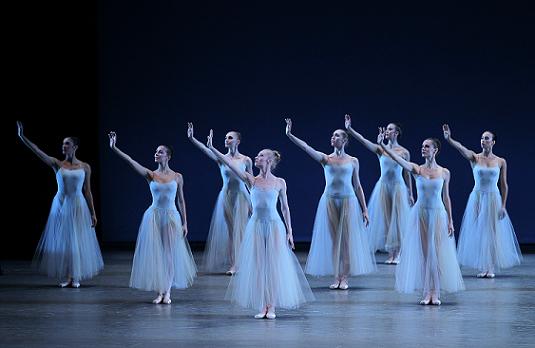
Première chorégraphie créée par Balanchine sur des danseurs américains, en 1934, Sérénade est devenu l’une des pierres de touche de l’oeuvre du chorégraphe et du répertoire du New York City Ballet. Déçu par son expérience parisienne des ballets 1933 avec Boris Kochno, ancien secrétaire de Diaghilev et rédacteur du livret du Fils prodigue, le chorégraphe accepta l’invitation aux USA d’un jeune mécène, Lincoln Kirstein, mais posa comme condition à sa venue la création préalable d’une école de danse. Sérénade est sa première tentative de montrer ses élèves à un public. Les deux premières eurent lieu non dans un théâtre mais dans les propriétés de riches donateurs. L’histoire de la création est assez connue et ressassée. Balanchine aurait utilisé les qualités très hétérogènes de ses élèves, le nombre fluctuant des élèves assistant à ses cours ainsi que certains événements anecdotiques survenus pendant les répétitions (une fille tombe et pleure ; une fille arrive en retard).

Dans sa biographie de Balanchine, Bernard Taper écrit :

De temps à autre au cours des années [Balanchine] est revenu à Sérénade et y a retravaillé d’une façon ou d’une autre –ajoutant certains éléments, en omettant d’autres, consolidant ou étendant certains rôles. Le ballet semble lui servir d’archétype, ou peut-être de journal ou encore de carnet de notes dans lequel quelques unes de ses maximes favorites doivent être préservées.

Le déroulement du ballet.

Partie 1 (andante et Allegro) : Dans la lumière bleutée, sur La Sérénade pour cordes de Tchaïkovsky, un groupe de 17 danseuses se tient en formation de papillon (une en pivot et deux groupes de 8 en losange) dans une pose identique (pieds parallèles bras droit tendu et poignet cassé en l’air). Les bras droits se replient sur la poitrine, les pieds s’ouvrent en première puis en un dégagé respiré avec un port de bras de la couronne à la seconde engageant tout le haut du buste. L’allegro commence alors. Parmi les virevoltantes filles du corps de ballet, une soliste se distingue. À la fin du mouvement, les filles s’immobilisent dans la formation et la pose d’entrée. La soliste arrive en retard et s’avance, troublée. Elle est rejointe par un soliste masculin.

Partie 2 (valse) : Ils dansent un pas de deux enjoué. La scène est traversée par les filles du corps de ballet. L’une des filles mène la danse.

Partie 3 (Finale-Thème russe- 4e mouvement de l’œuvre) : Cette dernière (deuxième soliste) prend la tête d’un groupe de filles du corps de ballet. Elles glissent au sol et mêlent leurs ports de bras [l’une des « maximes » favorites de Balanchine]. Le thème russe réunit alors tout le corps ballet féminin et le couple de solistes. Au plus fort de la danse, la première soliste trébuche et s’effondre au sol, son chignon se défait.

Partie 4 (Élégie. Troisième mouvement de la Sérénade) : La jeune femme est au sol, elle est rejointe par un autre soliste masculin, guidé tel un aveugle par une troisième soliste cheveux lâchés. Le garçon semble attiré par la première soliste mais danse avec les deux filles. Le trio est brièvement rejoint par la soliste du thème qui a, elle aussi, lâché ses cheveux. Le corps de ballet féminin traverse la scène en courant. Il est rejoint par quatre garçons.

Le moment de la rencontre s’achève, le garçon abandonne comme à regret la première soliste et « s’envole » avec la seconde. Restée seule, la jeune fille dévastée est portée par les quatre garçons suivie des autres filles. Ainsi haut perchée, elle répète le port de bras cambré de la première partie.

Les « arguments » de Balanchine.

Il est difficile d’expliquer un ballet « sans histoire ». C’est pourtant la méthode que Balanchine a employé dans son livre « Complete Stories of the Great Ballets ». Dans l’édition française, il annonce, péremptoire :

J’ai parlé des petits détails de Sérénade parce que beaucoup de gens s’imaginent qu’il y a une histoire cachée sous ce ballet. Il n’y en a pas […] La seule est l’histoire de la musique, une danse, si vous voulez, dans la lumière de la lune.

Mais Balanchine adorait troubler les esprits de ses exégètes comme de ses interprètes.

Dans l’une des premières interprétations critique de son ballet, Edwin Denby écrivait :

Il se devait de trouver une façon pour les Américains d’avoir l’air élégant et noble [en scène] tout en n’étant pas embarrassés de l’être. […] En se concentrant sur la forme et sur tout l’ensemble [du corps de ballet], Balanchine a pu contourner les incertitudes des danseurs en tant qu’individus

Balanchine a tranché :

Trop chichi ! J’essayais juste d’enseigner à mes élèves quelques petites leçons et de faire un ballet qui ne montrerait pas combien ils dansaient mal.

Avec Edward Villella, ses ellipses furent même d’un goût très douteux. Mr B., d’un ton sarcastique, accusa Hitler de lui avoir volé sa pose initiale du ballet pour créer son salut nazi.

Pourtant, un soir de 1959, emporté comme tout un chacun par la teneur émotionnelle de son œuvre, on sait que le chorégraphe se laissa aller à quelques confidences sur « l’histoire cachée » de son ballet.

Quand le rideau fut baissé et que l’ami [de Balanchine] eut loué l’œuvre, Balanchine répondit, avec un plaisir évident, « Oui, ça résiste pas mal –si on pense que ça a vingt-cinq ans. Pour un ballet, c’est une longue vie.

Les deux hommes traversèrent la rue vers un café pendant l’entracte. Tout en buvant, Balanchine parla de quelques thèmes dramatiques de Sérénade. « C’est comme le destin », dit-il, à propos d’un passage. « Chaque homme traverse ce monde avec sa destinée dans le dos. Il rencontre une femme – elle compte pour lui mais sa destinée a d’autres plans » […] « As-tu jamais dit cela à tes danseurs quand tu chorégraphiais le ballet ? »

Balanchine recula avec horreur : « Dieu m’en garde ! »

Dans ses mémoires, Suzanne Farrell, la dernière muse du maître, fait référence à cette interprétation de la troisième soliste. Toute jeune danseuse, en 1962, elle fut distribuée en tournée sur « l’ange noir ».

Balanchine a toujours vu le destin sous la forme d’une femme. Elle mène l’homme aveuglé à sa destinée, seulement pour l’en éloigner encore.

Suzanne Farrell donne offre également une sorte de clé universelle pour ce ballet.

Il n’y a pas d’histoire, et cependant, il y a quantité d’histoires, beaucoup d’humeurs, beaucoup d’émotions, beaucoup d’amours. Mais elles sont abstraites, les danseurs ne sont pas humains, leurs mouvements représentent des forces, des énergies et ces énergies sont gênées, tournoyant telles des forces de la nature et puis s’apaisant avant de se relever.

C’est donc dit.

Sérénade est un ballet sans histoire qui vous en contera une.

La vôtre…

2 Commentaires

Classé dans Hier pour aujourd'hui

Balanchine in Paris & NYC : Can I offer you a glass of ballet?

NYCB, June 1 : Concerto Barocco, Tschaikovsky Pas de Deux, Fancy Free, Symphony in C

I was lucky enough to be in Paris a little over a week ago and had the opportunity to view some footage of the Paris Opera Ballet performing Symphony in C. Initially, I didn’t want to watch it. OK, actually the first time Cléopold tried to show it to me I think I ran away yelling about how I wanted to be surprised in New York (as I had done for Serenade). He suggested that, just maybe, studying and watching videos beforehand wouldn’t make the first performance less magical, but rather the opposite: knowing a little about what you’re seeing actually makes the performance way more fun and easier to understand. Go figure, he was right. As. Always.

What a treat! Watching the Paris Opera version made me excited to see it in New York, but what I noticed most, and actually one of the aspects that I continue to love about the Paris Opera in general, is how totally in control the dancers are. Every movement is deliberate and had a calmness or coolness about it. They never looked rushed or harried even though the piece is not what I would call serene, the music is quite fast, and the steps are very technically demanding.

This makes an excellent contrast to New York City Ballet, which I love for their energy and fire. Yes, every movement still has an intense level of precision and concentration (see: Whelan, Wendy), but the attitude behind the exact same steps is totally different. I wouldn’t call NYCB rushed, and they weren’t behind the music either, but every step felt fast and had sharpness. The dancers at NYCB have an attack that the Paris Opera does not use very often (exceptions: Forsythe, McGregor, etc). Please, please understand that I’m not saying that one is better than the other in any sense, just that they’re very different, and it’s fun to notice!

NYCB always dances with a high level of attack and energy because Balanchine wanted it that way. He even loved when people fell as it signified that they were really giving everything they had on the stage. On the other side of the pond, Paris Opera feels softer and has a lightness that I rarely see in New York. It’s like a velvety cabernet vs. a glass of champagne. Both are fantastic, but totally different.

Honestly, I could say the same thing about the companies’ respective homes. I live in New York, where everything is fast. In fact, everything happens NOW, and you’re probably late for something. “What are you waiting for, dear? Dance now! Do it now! You could get hit by a bus later!” Want to guess who said that? (It was Balanchine.) If there’s a piece that exemplifies the NYC speed, it would be Glass Pieces by Jerome Robbins (which they’re doing next spring. Oh yes, I’m excited already!). Paris, by contrast feels slower as a city. Yes, there were times when I was stressed and rushed there, but I’m trying to talk about the city’s atmosphere. How many people do you see power walking through a market? How many people run around with Starbucks cups because they need their caffeine fix right now? Some yes, but I would lay you money that they’re American students studying abroad. You feel the cities’ energy in the street, and you absolutely see it in their dancing. What a pleasure to be able to know and love both!

Next time: NYCB’s A Midsummer Night’s Dream.

Commentaires fermés sur Balanchine in Paris & NYC : Can I offer you a glass of ballet?

Classé dans Blog-trotters (Ailleurs), Humeurs d'abonnés, Voices of America

The Ballet Season Might Be Better Than Christmas

New York City Ballet May 2 and 4

Yes, I know I’m late. Sorry about that.

Serenade

Right off the bat, I have to tell you that these performances were my first Serenades, first Firebirds, first Kammermusik no. 2, and first DGV: danse a grande vitesse. If you’ve seen these pieces a million times, my opinion may sound like a three year old who has just figured out that spinning in a circle really fast makes you giggly: very excited and mildly insane. I would apologize for that, but, again, I’m excited and insane, so apologies are not currently on the top of my list. On that note… on we go!

It might seem weird to say that I saw professional dancers become ballerinas, but it happened and I’m still reeling. That moment in the very beginning of Serenade was breathtaking, and all they did was turn out their feet and put their arms in first position. How many times have you done that in class? How many times have you done it beautifully? How many times have you tried to do it beautifully? Serenade isn’t Balanchine’s most complicated ballet by any stretch of the imagination; it’s simple, but it’s also lovely, joyful and sad at the same time. It embodies everthing I’ve grown to love about Balanchine: he tells a story with no plot and somehow, even though the audience may disagree as to the « meaning » of the ballet, (does she die? is she just heartbroken?), the only part that matters is your personal reaction to what you’ve just seen. Balanchine didn’t make Serenade to shock or transgress; he used the natural movements of the few dancers he had in 1939 to create a ballet that makes the audience feel. Simple.

From NYCBallet’s Facebook Account

In the weeks leading up to the performance, I shut myself off from Serenade. I made my friends fast forward through videos, refused to listen to the music, and avoided interviews about it. I wanted the experience to be as genuine as possible. The music makes me slightly misty when I listen to it on the subway, so you can imagine my reaction upon seeing it for the first time after weeks of self-inforced quarantine (yes, I cried). Since these two nights were the first times I had ever seen it, I can’t really talk about the choreography, but I can talk about the dancers:
Janie Taylor danced the lead both nights. (Sara Mearns was apparently injured on Friday, drat!) I am convinced that Taylor is made mostly of liquid mercury. She doesn’t seem to put any force or huge amounts of effort into her dancing, yet she’s graceful and sinuous. It’s like she slithers, it’s both beautiful and incredibly disconcerting and is especially suited to Serenade. I also loved her in Afternoon of a Faun; she does well in these plotless stories !

Ashley Bouder is someone I’ve always considered a powerful dancer and at her best when she gets to be a very fast one. She’s Taylor’s opposite. Bouder tends to explode into the scene and give 100% of her energy every moment she’s on stage, so I felt that, though I certainly could find no technical faults, Serenade was not her best fit. This particular ballet needs dancers that are just slightly more subtle in their expression. I do love her, though, and she did get to dance in something much more suitable. I saved it for last.

Kammermusik No. 2

So, I’m supposed to write about Kammermusik no. 2 now, but the problem is, I didn’t really care for it, so I paid less attention than I should have, which means I have very little to say. I know Kn2 is supposed to be important because it’s one of the examples of Balanchine giving the men in his company a real chance to shine as a group, but I feel like one could say the exact same thing about Agon. The critics that I read said that Kn2 is « fun. » Well,  yeah, of course it is. It’s a fast Balanchine ballet. In my humble opinion, it’s just not the best one. I could see Agon instead and get wonderful male corps work, penches on heels, and all the fun of Kn2 with a better pas de deux. In conclusion, I won’t be terribly dissapointed if this one goes out of the rep for another 8 years. Moving on.

Tchaikovsky Pas de Deux

This was without question the best TPdD I’ve ever seen. Holy mother of everything, Joaquin de Luz was fantastic. As always, he was a total ham (big smile and winks) and looked like he was having a great time. I just expect to be blown away by him every time at this point, so while he made me very happy, it was actually Tiler Peck that really blew everything out of the water. I’ve seen her dance before, but I never really paid that much attention to her as there was always another dancer that I was interested in on the stage with her (usually Mearns or Fairchild), but when she had the stage to herself, she seemed to decide that it was going to be her moment, and she was more than a match for De Luz. By the last death-defying jump into the fish, everyone, including my not-easily-impressed ballet teacher, was yelling and applauding like mad. Oh, that was fun! More please!

Firebird

Honestly, I’m disappointed. Kowroski is fine as the Firebird. She has the perfect body for the role, and she can move her hands and feet like a bird would/should, but… something’s kind of missing. I had the same problem with her last year in Diamonds. Technically fine, but just kind of boring. The second night I saw her, she fell during the first pas de deux, but that could happen to anyone. The part that bothers me is that, unlike say, Ashley Bouder, she didn’t get up, shake it off and keep going. She was more cautious for the rest of the ballet, and that disappointed me. Ask La Cour was her partner both nights, and, quite frankly, I’ve never liked him. Facial expressions are a foreign concept to him, but he must be a very in-demand partner, because he’s in almost everything. You’d think then, that he would have learned to point his feet by now. No dice. The monsters, which according to both Jacques d’Amboise’s and Jock Soto’s autobiographies are supposed to be absolutely terrifying, look more like muppets. Would you be terrified if Kermit jumped on your lap? Neither was I. Then they kind of just stand in the corner and punch the air. One of them lost their wig the second night. I felt bad for that dancer, but it was rather hilarious. I’m so sad that I don’t like Firebird, because its history is wonderful. Maria Tallchief loved dancing it, and it’s a legend in the Balanchine cannon… I just don’t get why. Maybe I need to study it more.

DGV: Danse A Grande Vitesse

I. Loved. This. Ballet. Between Alice in Wonderland at the Royal and this, Wheeldon might be my new favorite choreographer currently alive. (I’m still completely in love with Neumeier and Kylian, though. No Worries.) It’s hard to explain, but in a word, it was just powerful. Very much like the train it was made after (the TGV for all the non-frenchies out there). This is what Peter Martins tried to do in Fearful Symmetries, but I must say that DGV squashed FS like the high-speed train it is. Just… wow.

I am so so happy that I saw Ashley Bouder dance alongside Wendy Whelan in this. As I mentioned, Ashley is just a firecracker, and it looked this ballet had been made specifically for her. She was a perfect ball of concentrated energy. Watching Whelan, though, was like watching a laser; she’s totally focused on what she’s doing, which lets her execute all the fast, powerful steps precisely, but also makes her able to take that concentration into a pas de deux where she seemed to radiate control and poise. The woman is a national treasure. Given maturity, I think Bouder could get to this level in a few years, and that transition is going to be an absolute joy to witness.

Sorry everyone, I couldn’t find any footage of the actual ballet and neither could Cléopold or James, so it truly must not exist. I humbly submit some of the music for your listening pleasure.

All in all ? Not too shabby a start to the ballet season! Symphony in C is next up for me at NYCB with brand new costumes. I’m already excited!

Commentaires fermés sur The Ballet Season Might Be Better Than Christmas

Classé dans Blog-trotters (Ailleurs), Voices of America

David Hallberg is Going to Make Me Homeless

The challenge: Go to the ballet approximately once per week while simultaneously never missing a ballet class (no Tuesdays or Thursdays) and working around travel plans. As a quick explanation for those of you in Paris who haven’t bought ballet tickets in New York, the process is slightly different. Here, instead of tickets coming out a few weeks before each production, every ticket for the entire season goes on sale at the same time. This results in poverty for about a month and internal battles about exactly how much ballet I can see.

What follows is a transcription of me fighting with myself over which tickets to buy. For reading purposes, the irrational side of my brain will be abbreviated to IB, and the (slightly) more reasonable side will be RB. I hope you’re entertained by my burgeoning schizophrenia.

The scene: Sitting at my work computer, currently with a single brain. The calendar for the NYCB season opens and my brain is immediately torn in half. The ballet battle begins.

Irrational Brain: Serenade and Firebird on the same night?! Buy every single ticket! NOW!

Rational Brain: Um, yes, that would be lovely, but don’t you want to see, you know, other things too? Also, I know you tend to get carried away here, but please remember you have to pay rent and buy food at some point.

IB: (sigh) Fine… two of them? Please? One includes Kammermusik No. 2 and the other has DGV: Danse a Grande Vitesse, neither of which you’ve seen so it’s totally justifiable, right?

RB: Done and done.

IB: Wait a second… by other things you don’t mean that I should go to the new Martins and Millepied night out of sheer obligation to the idea of “newness” do you?

RB: It would be a learning experience, and you need to push yourself more! Come on, what have those two choreographers ever done to make you actively avoid them?

IB: Ocean’s Kingdom and Black Swan respectively. Absolutely not. Veto declared. You can’t make me!

RB: Fine, be that way. What about Symphony in C? You’ve always wanted to see that, and June 1 has Concerto Barocco, Tschaikovsky Pas de Deux plus Fancy Free.

IB: Deal… What about A Midsummer Night’s Dream?

RB: Yes, but only one. You still have ABT and Paris Opera Ballet to buy.

IB: (sulks for a bit while looking up the ABT schedule and then…) Mother of everything sacred, David Hallberg is doing Apollo!

RB and IB simultaneously: Forget food, buy that ticket immediately!

RB: Hmm that night Osipova is doing Ratmansky’s new Firebird… that could be interesting. It would make a nice contrast to Balanchine’s. Let’s see… what else?

IB: Bayadere? That one’s beautiful!

RB: Correction, Nureyev’s is beautiful in Paris. You literally fell asleep last time you saw it at ABT. Also do you really want to see ABT’s corps de ballet as the Shades?

IB: Fine, but you don’t get to bring up the corps every time.

RB: If they could stand in a straight line I wouldn’t have to. Onegin?

IB: YES! With Julie Kent? Oh… she’s partnering Bolle.

RB: Hmm you know, that could be good. A man with this photo as his Twitter profile could probably pull off “pompous jerk” really well. Also, Kent makes everything magical, and you’ve never seen it.

IB: Done. Let’s see…obviously Steifel’s retirement in Corsaire. That’s just a given. What about Romeo and Juliet? Oh! Hallberg’s dancing… Why can’t he partner someone other than Osipova? Just for a change.

RB: Not everyone will partner Julie Kent. Get over it. Also, you thought Osipova was charming in Coppelia and actively wondered if she could pull off a young, dramatic role like Juliet; she could be fantastic! And you get to see Hallberg again, so stop complaining.

IB: Angel Corella is retiring! He’s dancing Swan Lake with Herrera… is that worth it?

RB: Yes, yes, it is. I wonder what ABT is going to do about its lack of male dancers? Oh, look! They’re giving Simkin a Swan Lake, and Hammoudi has one too! Too bad they’re on Wednesdays at 2:00. That could have been interesting.

IB: Ugh, can’t I just skip work those days? I want to see!

RB: No. Moving on. Paris Opera, what to see?

IB: Um, all of them, obviously. Is that seriously even a question?

RB: Yeah, that’s not really up for debate, is it? I think we’re done here!

IB: I think so! Alright, so it looks like we have:

May 2nd: NYCB Serenade, Tschaikovsky Pas de Deux, Kammermusik No. 2, Firebird

May 4th: NYCB Serenade, DGV: Danse a Grande Vitesse, Firebird

June 1: NYCB Concerto Barocco, Tschaikovsky Pas de Deux, Fancy Free, Symphony in C

June 6: NYCB A Midsummer Night’s Dream

June 8: ABT Onegin (Kent, Bolle)

June 11: ABT Apollo, Firebird, Thirteen Diversions (Hallberg, Osipova, Company)

June 18: ABT Romeo and Juliet (Hallberg, Osipova)

June 28: ABT Swan Lake (Corella, Hererra)

July 7: ABT Le Corsaire (Steifel, Murphy)

July 11: POB French Masters (Company)

July 18: POB Giselle (Gilbert, Hoffalt)

July 20: POB Orpheus and Eurydice (Gillot, Bullion)

Are we good? Does that cover it? Should I buy more? I feel like I should probably buy more.

RB: Did…did you just trick me into spending the rent and food money again? How do you do this EVERY season?!

IB: It’s a God-given talent. Or crippling financial addiction. Take your pick.

Weeks later…

Cleopold, being the wonderful person/editor that he is, suggested that it would benefit this little article to add links to the three ballet calendars I referenced (which I did). However, in adding said calendars, it was necessary to actually look at them, which led to the following….

RB: OK, just looking for the link, just going to highlight the link and put it in the article. Don’t even think about looking-

IB: There is a Cojocaru/Kobborg Romeo and Juliet on a non-ballet class day that you didn’t even consider last time! What is wrong with you?! That’s mandatory viewing, especially after Cleopold and Fenella loved it so much! How could you not want to see Cojocaru die smiling?

RB: No. You already spent all your ballet money! Don’t you click that link, don’t you dare-

IB: But look, Hallberg is doing Swan Lake! You know you have to see that!

RB: Yeah, with Semionova! Do you even remember how bored you were last year? You saw her running off stage after she killed herself!

IB: Don’t care! Hallberg. As. Siegfried.

RB: No no no no no no

IB: (buys tickets)

RB: …You do realize that now you’re not allowed to buy wine for the next two weeks.

IB: Worth it.

6 Commentaires

Classé dans Blog-trotters (Ailleurs), Humeurs d'abonnés, Voices of America

On Ballet and Pop Culture Part III: The Eleventh Commandment: Thou Shalt Not Bore The Audience

The ballet season after BS premiered, NYCB and ABT both pricked up their ears and decided it would be an opportune time to perform Swan Lake. They were right, and actually there were sold out performances. Obviously, this is a short-term solution. Natalie Portman is NYCB’s honorary spring gala chair this season and so far the reaction I’ve heard can be summed up as “eh.” This brings us to the big question: can ballet companies take this upswing in interest and translate it into new ballet converts before everyone stops caring? If so, how?

On March 22 The Royal Ballet did something absolutely brilliant: they live streamed their entire day of rehearsals. They also included interviews with dancers, musicians, the artistic director and costume/scenery archivists as well as archived rehearsal videos. The interviewers even asked questions from people watching from Facebook and Twitter. THAT is how you advertise. I didn’t care too terribly much about the Royal Ballet until that day. Sure I knew who Cojocaru and Kobborg were (again, guest stars), and Marianela Nunez, of course, but beyond that… not a thing. Now I consider myself a fan. I watched all day, and it was fascinating. Yes, I had to do work at this thing I call my “job” where I get “paid” so I can, you know, live, but the RB was in my ear all day long, even if I was forced to use the computer screen to do other things. I saw rehearsals for Alice in Wonderland, Polyphonia, a new Liam Scarlett ballet, Sweet Violets, as well as Pagoda and Romeo and Juliet. (Now I really want to play with swords.) After seeing the Alice rehearsal I immediately bought the DVD on Amazon and am so excited to watch it. As an aside, it’s been like two weeks. Where the heck is my DVD, Amazon?! The day concluded with an exclusive look at a rehearsal of Wayne McGregor’s new collaboration with musician Mark Ronson, Carbon Life, followed by a Q&A session. The lesson that should be taken away from all this? The program made me sincerely care about this company. And there it is: the key to my generation’s collective heart is, apparently, access. In a world of Facebook and Twitter, the idea that ballet is a world unto itself simply can’t fly anymore. On one hand, this makes me a bit sad. I love the mystical aspect of ballet, the idea that dancers are just so far removed from this world that they could never be touched by something as mundane as YouTube is beautiful, romantic and sad (Sylphide anyone?). But I have to say, Ashley Bouder posting her backstage Instagram pics on Facebook and laughing about her falls on Twitter makes me care more about her; it makes me want to buy tickets to see her, and more tellingly I have. Programs like this make ballet accessible to the unwashed, unlearned (aka uninitiated) masses. They make it far less scary, and they make what seemed to be a boring leisure activity reserved only for rich snobs, absolutely enthralling. THIS WORKS. I want to see almost everything they rehearsed, I want to follow them avidly, and I really hope they tour here so I can see them in person. I would even consider taking a side trip to London if I could get tickets.

That said, let’s talk about attempts to appeal to a new and younger audience that do not work. All of them can be summed up in a single word: pandering. Let’s begin with a general example. You’re a painter and you really want people to look at, appreciate and buy your paintings because hey, it’s art but you still need money to survive. Do you A) explain to people why you paint the way you do, what it means to you, and a bit about your technique or B) start to paint pictures of bunnies because, really, who doesn’t love bunnies? The answer is A, right? So why, why in God’s name would any company try to sell a ballet based on anything other than the quality of the ballet itself? I’m going to start with McGregor’s new piece, since I just finished watching that rehearsal. Now, since I haven’t seen it, I can’t say if it’s good or bad, it may even be great! However, most of the marketing surrounding Carbon Life has been about the costumes and music, so I feel pretty justified in saying that I do not care, at all, that the costumes were designed by Gareth Pugh. Sorry. I also don’t care that Mark Ronson did the music. Since they’ re trying so very hard to be young and cool by using a punk designer and popular music, the audience might initially be large and maybe even made up exclusively of 20 year olds; I don’t know what’s going to happen. What I do know is if the piece is bad overall, no ungodly fashion budget will save it. None. Because here’s the flip side to this social media thing: if something is bad, everyone will know in a matter of seconds. Personally, I don’t want to see this ballet. The choreography looked like everything McGregor has already done (and everything that Forsythe did before that).

Another great example of really obvious pandering is NYCB’s recent flop Ocean’s Kingdom. Music was by Sir Paul McCartney (they got a freakin’ Beatle!) with costumes by Stella McCartney. Choreography was by Peter Martins, of course, but somehow no one cared about that part. To very quickly sum up: the music was obvious, the costumes were cracked out, and the choreography was utterly forgettable. I wrote a review if you’re interested which you can see here, but really, all you have to do is watch this and you’ll have an idea (fair warning, I will use literally any excuse to show that clip because it makes me laugh so hard I cry… I am apparently 5 years old. However, it really does work here if you check out Daniel Ulbricht’s outfit ).

To be clear, I’m not against costumes, and I don’t think that every ballet should be danced in a black leotard and pink tights. If I thought for a second that I could get away with it, I would wear a tutu to go grocery shopping, or more accurately, just never take it off. I spent weeks looking for Sylvia’s dress for a special event (still looking, if you find it please message me. I will love you forever). When costumes (and music and setting) actually enhance the ballet and not distract from it, those extra details can make a production go from good to absolutely magical. Take the Paris Opera Ballet’s recent production of La Source: Jean Guillaume Bart’s choreography was riveting on its own, but when you add Christian Lacroix’s costumes and the set design… just wow. Every aspect of the ballet, choreography, music, costumes and scenery merged beautifully to create the finished product. You don’t even have to stick with tutus! Look at John Neumeier’s version of Sylvia: You can dress your nymphs in leather vests and helmets and put your goddess in a tuxedo; it gets the point across without being flashy and the dancers can move. Costumes are important and ideally help tell the story and set the mood, but they should never be the point. We have fashion shows for that.

So finally, here’s what I think needs to happen if we want to keep this ballet wave going: education. If we can show why ballet merits attention, I honestly think people will go and appreciate it, but once there’s an audience there has to be great ballet to watch. Essentially: explain why ballet is awesome and then prove it.

2 Commentaires

Classé dans Blog-trotters (Ailleurs), Humeurs d'abonnés, Voices of America

On Ballet and Pop Culture Part I: Hello and How to Get Punched at the State Theater

Hello Everyone,

I haven’t posted my own critiques here yet, but you may recognize me from my grammatically atrocious comments left on those by Cléopold, James, and Fenella. I’m working on the grammar part, but in the meantime let me very briefly introduce myself. I’m 24 years old and currently living in New York working in an industry completely unrelated to the arts. To keep myself sane, I take lots of ballet classes and go to every performance I can. If I’m not at Alvin Ailey, I’m probably at Lincoln Center.

Since I haven’t had any performances to see since the winter ballet season, Cléopold suggested I write a little something on the state of ballet and pop music. Well, I tried, but somehow the idea blew up in my face and what I was left with was the monster that follows. For everything I write, please feel free to agree, disagree, add your own opinion, or call me an idiot in the comments. My schedule for the spring season is posted, so if you’re in NYC come hang out with me at the ballet!

Happy Reading,

Mini Naila

Ballet is something of a cult. For dancers, it’s an art form that requires more than just hard work in the classroom and onstage, it demands devotion bordering on obsession. Teachers can command as much respect from their students as religious leaders, and stars have their own crews of besotted fans that will viciously defend their favorite if challenged. Walk into The State Theater (and no, I will not call it by its other name) on a performance night and mention that you think Sarah Mearns is awful. I dare you. Heck, ballet was founded in France by Louis XIV: a man who wanted his subjects to see him as Apollo (the sun GOD… cultish much?). Chances are, if you’re reading this you probably see yourself in one or more of these categories. For all this, though, it’s easy to forget that the ballet world is a pretty small one. As of the writing of this article Ashley Bouder, principal dancer with New York City Ballet, has 4,807 followers on Twitter (more on that later), David Hallberg (the ‘it’ dancer of the moment) has only 2,999, Pointe Magazine has slightly less than 12,000, while Kim Kardashian has 13,958,170. I say this not out of a sense of disgust (although, yes, that is pretty gross) but to illustrate that ballet probably wouldn’t be considered “mainstream” culture by your average Joe.

Lately, though, there has been an increase in attention from sources that would definitely qualify as mainstream, which I would argue began with the premiere of Black Swan. Before you jump down my throat, I am very aware that Center Stage came out in 2000, but it only grossed $16,401,324 in the US and received exactly 0 Oscar nominations, making it more a ballet cult favorite and guilty pleasure. Since the really noticeable spike has happened only in the past few years, I’m starting with Black Swan. Feel free to yell at me in the comments about why I’m wrong should you so desire.

Remember when Black Swan came out? I don’t know about you, but after about a week everyone I talked to was a ballet expert. “Oh, you take ballet? Have you seen Black Swan? Natalie Portman is such an amazing dancer!” Worse than ballet experts, they were advocates for the poor mistreated ballerinas… all of whom suddenly had an eating disorder and/or mental stability issues. (Incidentally, when Sarah Lane, soloist with American Ballet Theatre, had the audacity to mention that no, you can’t become a ballerina in a year and that she had done all the actual dancing, everyone was outraged.) I’m sure you, as someone who reads a ballet blog, were slightly annoyed to explain that Black Swan, or BS for short (hah!), isn’t quite a documentary about company life. However, there was an amazing result from all of this: people were talking about ballet! Friends who normally could not care less were suddenly asking questions about Swan Lake! Why did the director use certain pieces of music when he did? What was the deal with all the competition? Do dancers really sleep with company directors for parts? It actually made people curious! So, what always follows after a major success? Satire of course! First came Saturday Night Live’s version starring Jim Carey which, I must admit, is pretty funny. There are a ton of parodies out there, but I think the absolute best has to be Sassy Gay Friend’s take on the movie. After making fun of the movie got old, advertisers caught on (as they always do). The two most recent examples of this are Levis and Adidas but there was also AT&T, Chloé, and Methodist Hospital in Houston, all of which premiered after 2010. My personal favorite cannot be a result of the Black Swan push as it came out in 2006, but I’m including it anyway because it’s hilarious: Isenbeck beer (take a minute of your day to watch that, you won’t be sorry). Recently, the ballet craze has jumped to prime time: ABC Family is currently putting together a new show starring Broadway’s Sutton Foster, Bunheads, about life working in a small town dance studio. In book news, Sophie Flack, a former NYCB dancer, just published a young adult novel, also called Bunheads about being a ballet dancer in the super-competitive Manhattan Ballet Company (hmm, wonder which real life company that could be about?). Go back to movies and you’ll find the new short film Prima which is premiering this year at the Tribeca Film Festival and last year’s documentary First Position. If you really want to see the ballet takeover, look no further than Oprah herself who interviewed NYCB principal, Jennifer Ringer. Saving the very best and most popular among the young adult demographic for last, who can forget Stephen Colbert’s interview with David Hallberg? (And who knew Colbert could do a tour en l’air?! Seriously, do yourself a favor and watch both of those. ) Have I made my point yet? I could go on. If you have a favorite that I’ve missed please post it in the comments because I would really love to see it!

To be continued: What’s happening now, and why in God’s name, why?

Commentaires fermés sur On Ballet and Pop Culture Part I: Hello and How to Get Punched at the State Theater

Classé dans Blog-trotters (Ailleurs), Humeurs d'abonnés, Voices of America