
L’Histoire de Manon on May 3, 2012
 I was chatting with a charming young woman during intermission as we waited our turn at the bar. The bartender gazed into her doe-like eyes and then seemed to need to read her smiling lips in order to understand that all she was asking for was a glass of white wine. He murmured “sept euros” (outrageous price) several times because he couldn’t see the money on the counter before him. Then he turned to me, sloshed the rest of the bottle in a glass, pushed it over the counter and exclaimed cadeau, Madame, car c’est la fête ce soir!
Youth and beauty prove an intoxicating mix.
People behave differently towards beautiful girls. They get stared at, fussed over, petted, and rarely hear the word “no.” Beautiful girls begin to think that’s normal. Beautiful girls have it easy. [This applies to beautiful boys, too. Read Daniel Hamermesh’s recent “Beauty Pays.” His research shows that in the US men of equal qualifications are not equal: over a lifetime, handsome men earn thirteen percent more than the least handsome].
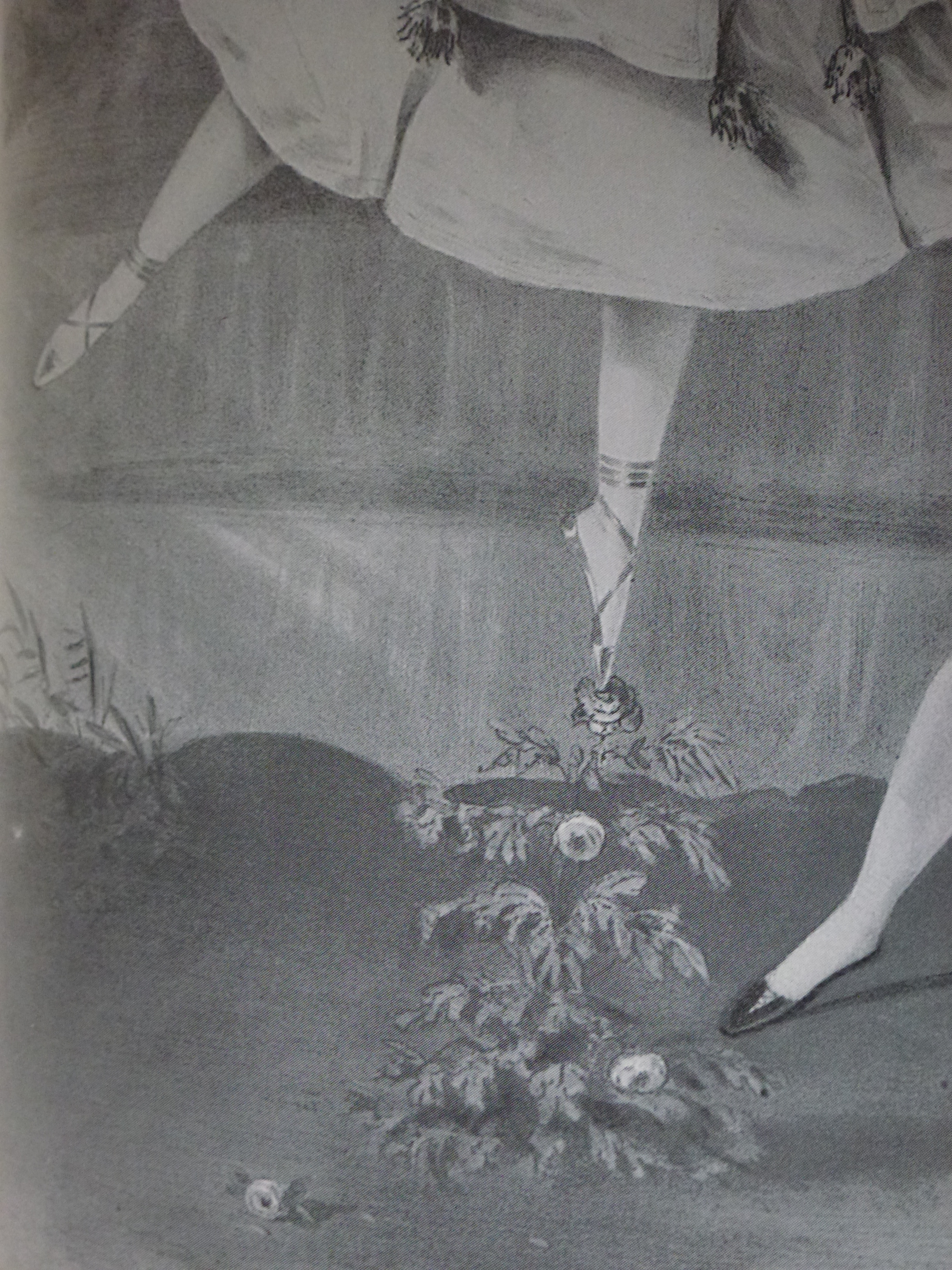 May 3rd’s Manon, Isabelle Ciaravola, is a beautiful woman. You can’t decide whether you want to lock the binoculars on the doe-like eyes in her heart-shaped face or on her tapering legs and perfectly-arched feet. But more to the point, she is most intelligent in the way she uses that beauty to serve ballet. You can banish the word “gymnast” when watching her legs move. Yes, the arches would make any dancer scream with jealousy, but the way she dances through them even more. She’s one of the few who make me regularly forget that she’s wearing pointe shoes. As the ballerinas in impossible Romantic lithographs (see Taglioni’s image on the left) you feel it just might be possible for her to pause, barefoot, on tippy-toe, atop a flower. Her arms never stop furling and unfurling as she melts from one phrase into the next. Her face glows, always alive and responsive, her eyes alight.
Ciaravola’s eyes are never brighter than when interacting with a partner. In Mathieu Ganio she’s found her ideal counterpart. He is just as beautiful for exactly the same reasons. When they work together their lines and alignment, their similar musicality, their phrasing and theatrical instincts merge to make them seem like the two halves of one soul. The harmony appears so natural you actually wonder if they need to rehearse. Sibley and Dowell used to make me feel this way.
I’ve enjoyed watching Ganio grow from the 19-year old baby étoile into a real man. And this brings up a question. Our culture appears to no longer simply fear growing old but even tries to avoid growing up while at the same time demanding more and more camera-ready “authenticity.” If Manon and Des Grieux are supposed to be teenagers, can any performers but teenagers be believed by a modern audience?
It’s a sad fact that actors and dancers will attest to: for most of your career your body and your interpretive skills develop, mature, or fade at wildly different rates. I am sooo tired of hearing the same old about whether a woman no longer age fifteen should be permitted to play Juliet or whatever. But is youth all you need to project youthfulness? Do you need to have acne, pigtails, and awkward manners? Is being young tied to the calendar or is it a state of mind? Ciaravola opted for the latter.
As she must know what it means to be beautiful, Ciaravola used it. Her Manon exhaled a kind of emotional virginity, a sense that life would always be fun because people are nicer to beautiful girls (and if people act weirdly around you, well that’s kind of funny too). You could almost see the outlines of a cocoon sheltering the utter innocence of this pampered and oblivious child. Ciaravola’s Manon, even as her love for Des Grieux continually grew and deepened along with her irresponsibility, seemed incapable of understanding that anything bad could ever happen to her. As late as the second bedroom duet, her stubborn refusal to give up either her lover or all the pretty baubles made perfect sense. Beautiful girls have a right to “have it all.” This made Act III all the more heartbreaking. Manon lost her will to live when forced to face the way the world too often works: filled with ugly-hearted people who envy youth and beauty and seek to destroy it. You must abandon that doe-eyed and childish innocent trust in others, which is perhaps the most beautiful thing of all, in order to survive in the adult world.

 James
James Albertina
 Cléopold
 Fenella
 Les Balletonautes
 Mini Naila
 Les Balletonautes