Archives de Tag: plot summary

LESS IS MORE: Dances at a Gathering vs. Psyché (plot summary)

The choreographer Jerome Robbins, who died in 1998, considered the Paris Opera Ballet his second (third?) home.  He adored coming here to personally coach our dancers.  Only the New York City Ballet, his home base, has more of his ballets in its active repertory.

Creator of over 60 ballets and co-director – with George Balanchine – of the New York City Ballet, Robbins lived a triple life: commuting between Lincoln Center and Broadway and Hollywood. As the dance-maker, director, or “doctor” of many of the greatest musicals – such as On The Town, Peter Pan, Gypsy, Forum, Fiddler, and most famously, West Side Story — Robbins earned 5 Tony Awards and 2 Oscars.

That his musical, The King and I, is now playing at Paris’s Théâtre du Châtelet and his ballet “Dances at a Gathering” can be caught at the Palais Garnier, highlights this multilayered legacy. Whether his dancers wore 19th c. imperial Thai headdresses or wispy chiffon and pointe shoes, Robbins always sought ways for movement to seem a natural extension and expression of a deeper narrative.  An instinctive storyteller, even his most plot-less ballets betray glimmerings of plot.

Alexei Ratmansky, one year old when Robbins’s Dances premiered, grew up in the Soviet bloc in an atmosphere where the old-fashioned (such as the big 19th century narrative ballets at the Bolshoi) held on by its toenails.  During his youth, it had become possible to take peeks at bits of the glamour of the abstract plot-less-one-act and the decadent musicals of far-off America

Abstraction has long been justified by the joke that our vocabulary of leaps and spins does not quite include the words for “this is my mother-in-law.” But nowadays, the story ballet has come back into fashion.  Ratmansky’s challenge is to craft steps and combinations that will speak to you without a word being spoken. Especially as the story of Psyche revolves around her…mother-in-law.
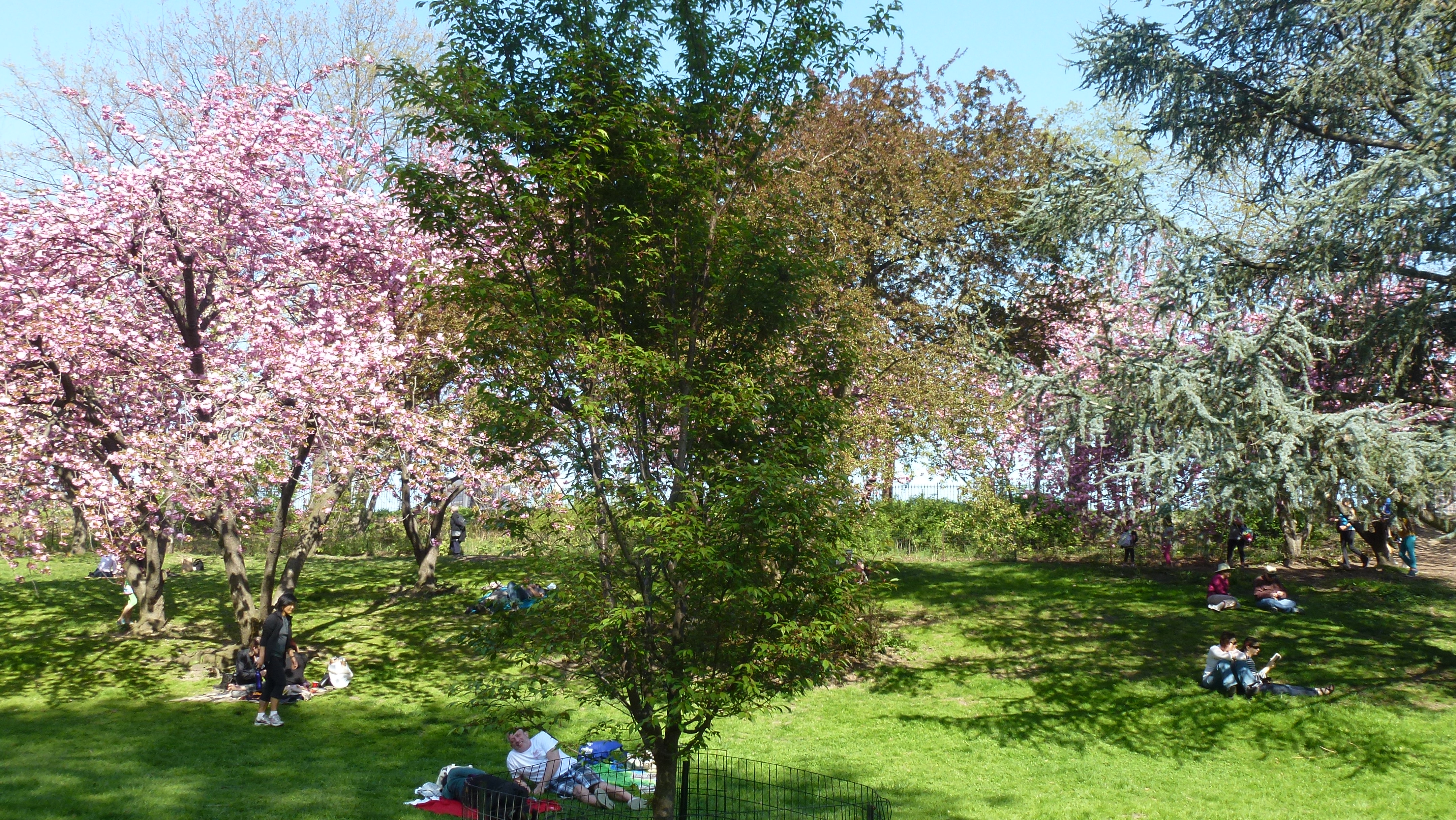
 

NYC, Central Park. A blue sky with shades of green and purple...

NYC, Central Park. A blue sky with shades of green and purple…

DANCES AT A GATHERING (1969)

Choreography by Jerome Robbins

Music by Frederick Chopin

There is an irony to be found in fact that the storyteller Robbins’s ballet masterpiece has no plot.  Circumstances, and a bit of stress fatigue, dictated its construction according to dancer lore.  Too respectful of the guru Balanchine’s authority – who nevertheless always assured that his co-director had access to rehearsal space at the New York State Theater – Robbins, feeling the urge to take on Chopin, never seemed to have insisted upon a normal rehearsal schedule. Instead he noodled around (to put it mildly: tried, discarded, reinserted, agonized, tortured both steps and bodies) with whatever dancers whenever they had a half an hour to spare. Each half-an-hour was used to carve out perhaps thirty seconds of steps to be reworded later…  The structure of “Dances” reflects its episodic – almost anarchic — birth.

Crafted by and for specific American dancers, this ballet in fact carries more than a hint of Slavic soul.  Of the seventeen sections, lilting mazurkas – a Polish dance in swift triple time  -dominate eight of them.  Little gestures such as a click of the heels, one arm akimbo while the other sweeps grandly up and out, a tilt of the head, all bring folk dance to mind.  One could find further irony in that while every bit of Chopin’s music tickles your feet and emotions, the dance pieces he inspires remain mysteriously both full and empty of story, including the very first abstract ballet ever, Fokine’s 1907 Chopiniana.

In the end, the story is that there is no story, as life really has none either: “In the room the women come and go, talking about Michelangelo.”  Think of this ballet as not merely something to watch, but as snippets of ongoing conversations caught on the sly…just let your eyes follow someone around this picnic on a late summer afternoon on Sheep’s Meadow in Central Park or on the banks of Chopin’s native Vistula. The boy in brown or green or violet; the girl in yellow or blue or mauve…pick one or two or three and amuse yourself by imagining which one you would want as a relative.

By the way, Robbins broke new ground by finally daring to reject the supremacy of  never-perfect orchestral accompaniment. He plonked a simple rehearsal piano on the apron of downstage right.  Basta! Until his piece – and that same year, Eliot Feld could have claimed to have gotten there first in his haunting Brahms-inspired sextet Intermezzo– ballet always meant puffy music.  Balanchine, bless his heart, certainly brought out the best in Stravinsky but – for Christ’s sake – do Gershwin’s songs really need to be pumped up by Hershey Kay?

Maybe.  For some odd reason, be it lack of cymbals or symbols, a portion of the audience always nods off during the understated moods in “Dances.”  Too soft, not dramatic enough.  It’s like the way Mozart snoozes some people out. In either case, I’ve yet to figure out why.  Unless…

There is a key moment late in the ballet when The Boy in Brown, watched by the others, kneels and stretches out his hand to softly caress the floor.  There lies the story, and the reason why dancers love this ballet more than earthlings: it’s about being home.  Regular families get together on Sundays in parks and playgrounds; the family of dancers gathers daily in the studio. Each performance together, then, is their version of Thanksgiving.

Chantilly

The Castle of Chantilly…or Cupid’s enchanted domain?

PSYCHE ( 2011)

Choreography by Alexis Ratmansky

Created for the Paris Opera Ballet

Music by César Franck (1890)

While “Dances” boasts of no plot, no orchestra, no sets, no fancy costumes, and all depends on the subtle flick of a dancer’s wrist…here you have got the whole nine yards.  Big loud music with chorus that keeps thundering along from climax to climax.  Whoop-de-doo sets, almost psychedelic in impact and certainly unnerving, by Karen Kilimnik. Adeline André’s flower-powered costumes will certainly give you something to talk about after the show.  Your discussion may center, however, upon whether the arrangement of steps helped or hindered the narrative.

Here follows a summary of Apuleius’s 2nd century telling of the story of Cupid and Psyche, with hints as to how it is staged tonight:

Once upon a time in ancient Greece, Venus – the goddess of love – grew very angry at a king (we never see him).  But was it his fault that the youngest of his three daughters, Psyche, had been blessed with such spectacular beauty that men came from far and wide just to stare at her?  Was it her fault that these men forgot all about keeping the fires lit in Venus’s temples? (hint: smoke rising).  Compared to Venus (in red), when it comes to vanity or bossing people around, Snow White’s stepmother was a pussycat.

She sends her son, Cupid, to put a stop to this annoying situation (this is about where the ballet starts)While his mission is to use his magic arrows to make Psyche fall in love with the ugliest creature on the planet, once Cupid sets eyes on her…guess what happens.  The problem, then, is how to get around mom.

Cupid concocts a plan.  First, he renders all men indifferent to Psyche’s looks.  Time passes and everybody – including her sisters – gets married.  The king, confused, seeks advice from Apollo and leaves horrified by the god’s instructions — which of course had been planted by Cupid.  The king must leave Psyche, dressed in mourning (black chiffon), on a mountaintop where she will be united to – or perhaps devoured by — a monster.

Obedient, fearful, bathed in tears, Psyche falls asleep while awaiting her fate.  But instead of a monster, four Zephyrs – the gentlest of winds, dressed in ripped shower-curtains – appear and waft her (now in sparkly pastel chiffon) away to a magical flower-filled meadow alongside a stream.  In the distance she can see a palace fit for a god, covered in gold and silver.  Soft and disembodied voices tell her to fear not and to await the arrival of her new mate at nightfall.  That would be Cupid.

In the dark, she cannot see her lover – and has been warned that she must never look upon him (blindfold) – but realizes that this cannot be a monster (during a pas-de-deux cleverly devised so that the dancers never look at each other, a real challenge as eye-contact provides a huge help in partnering).  And so the blissful days and nights pass, until Venus finally figures out what’s going on.

Uh, oh. Venus sends Psyche’s two sisters to plant seeds of doubt in her mind. (These are the two girls with fidgety movements dressed in violent blue and acid green topped with fright wigs).  Psyche, like Belle, hasn’t talked to a real person in ages and proves vulnerable to her sisters’ insinuations.

On their advice, Psyche prepares a lamp and a knife – should her bedmate indeed turn out to be a winged serpent with fangs– and waits for dark. Upon discovering Cupid’s shattering beauty, her hands begin to shake and a drop of hot oil lands on his shoulder.

A moment later he vanishes, having whispered that “where there is no trust, love cannot exist.”  Psyche, in despair, begins wandering through hill and dale.  It takes her a while to figure out that Cupid has run home to mommy.  The only solution is to kneel before her mother-in-law and humbly beg forgiveness.

Not so easy.  Claiming that Cupid hovers between life and death from, like, something that can be solved with a Band-Aid, Venus devises all kinds of impossible tasks Psyche must first perform as penance (hopefully failing or, better yet, dying in the process).

But all kinds of kindly creatures decide to help or at least do no harm (insects, sheep, dogs, eagles, plants).  Since the premiere almost three years ago, the costumes have been toned down.  The girl Flowers still look like flowers. But the Animals and Insects no longer wear the obvious, only the boys’ spastic gestures are left to clue you in as to what species (I kind of miss the loony giraffe costume).

As she does when depressed, Psyche falls asleep again. (Sent to hell by Venus in order to ask to borrow Persephone’s beauty secrets Psyche, figuring that she must be looking pretty worn-out by now, can’t resist peeking into the box which contains…sleep).

Finally cured, Cupid is ready to forgive Psyche but…only once Jupiter agrees to grant her immortality and Hermes carries the girl up to Mount Olympus (we see neither) will Venus relent (air kiss).

Thus love (Cupid/Eros) is eternally united with the soul (what the word “psyche” literally means).  By the way, Psyche’s emblem in art is the butterfly, which seems to be missing from the decor.
1 commentaire

Classé dans Retours de la Grande boutique

Orphée et Eurydice : a plot summary

P1070147An opera by Christoph Willibald Glück (1762)
Staged and choreographed by Pina Bausch (1975)
Sung in German, danced by the Paris Opera Ballet

Orpheus – a musician so gifted that the sound of his lyre and arc of his voice can make rivers change course, wild animals lie down to be petted, and rocks cry — dares to journey to the underworld in search of his beloved wife, Eurydice. This, one of the greatest love stories of ancient Roman mythology, provided the plot for not only the very first opera created in 1607 – Monteverdi’s Orfeo — but has inspired more than one hundred other operas or ballets.

Pina Bausch’s modern and expressive take on Glück’s richly emotional score solves the conundrum of how to return ballet to its rightful place in an operatic evening. Bausch took dance too seriously to provide mere divertissements. Here she blesses each singer with a danced double, as in Glück’s original version: bodies and voices interact and complete each other. This intricate coupling of song and movement creates a symbiosis that you could say resembles a great marriage. One that has, already, lasted much longer than the brief and tragic one of Orpheus and Eurydice…

PART ONE: (1 hour 20 minutes)

FIRST TABLEAU: Mourning
Her snowy wedding veil now a shroud, Eurydice had died from a serpent’s bite on her wedding day. In her motionless arms: red roses symbolizing her husband Orpheus’s passionate love. Orpheus, devastated by grief at the loss of his turtle-dove, refuses to be consoled by the nymphs and shepherds who mourn with him.

But Orpheus is the greatest singer on earth. Despite daring to speak of the cruelty of the gods, his cries of despair sound so beautiful that they soften the hearts of these very same gods. Love arrives with a message: Orpheus will be allowed into Hades. If his music can disarm the guardians of the gates of Eternity, then he might be able to do what no living being had ever done: bring his wife back from the realm of the dead.

But there is one condition. Should he succeed in wrenching his wife from the arms of death, Orpheus must not look at her – nor explain why — before they have returned to this earth.  Orpheus is suddenly worried for he has never lied, or been less than utterly honest, to Eurydice before.

SECOND TABLEAU: Violence
Orpheus enters a horrible dark and smoky cave by the river Styx, where the waters of woe pour into those of lamentation… and soon dissolve into the stream of oblivion. His wife just beyond reach, Orpheus must confront the three-headed guardian of the Underworld, the hound Cerberus (three male dancers in leather butcher’s aprons) and a swarm of Furies. You may be surprised that these screeching female avengers destined to torment sinners move about more like merely nervous and tired souls yearning for rest. That is because in Ovid’s vivid description, Orpheus proves the only mortal to make the implacable Furies not only relent, but weep. So if at first sight the Furies scream “no!” they do finally allow Orpheus to pass, swayed by how his beautiful music embodies the power of such loving devotion.

THIRD TABLEAU: Peace
Orpheus and Eurydice are reunited in the Elysian Fields, that exquisite and peaceful meadow in paradise where “blessed spirits” enjoy an eternity free from those violent human emotions that make us suffer so in mortal life. (The French term for this place is Les Champs-Elysées). Having already taken a drink from the river of forgetfulness and feeling rather blissed out, Eurydice is startled by how Orpheus seems both panicked and utterly cold at the same time. Did he come all this way only to turn away from her? Why, then, should she abandon this new « life? »

INTERMISSION (20 minutes)

PART TWO: (30 minutes)

FINAL TABLEAU: Death
As she is being led back to earth Eurydice, unable to understand why Orpheus stubbornly refuses look at her, can only imagine that it must be because he no longer loves her. In that case, she would rather be dead. Her despair grows, and Orpheus struggles to maintain his self-control.

This situation always makes me think of a very long car ride, where you are stuck in the back and wind up wanting to strangle the driver, there, in the front, with his back to you, who has been feeding you monosyllables for hours. Even if that means wrecking the car in the middle of Idaho. And I’m not the only one who feels this way. Now is the time for you to re-view Jean Cocteau’s dark-hearted film.

Alas, unable to stand it any longer, Orpheus suddenly turns to face Eurydice, to reassure and embrace her. At that very instant she falls dead, this time forever. Orpheus loses the will to live, even to move. In a poignant and emotionally raw final tableau, he allows death to take him too.

NOTE:

The opera’s libretto provides a happy end, where human frailty is forgiven and love conquers all. Bausch decided to cut Glück’s last two scenes. Her somber finale, with music from the lament we heard at the outset, is probably more suited to our pessimistic times, and rhymes well with the choreographer’s feral sensitivity to the complexity of life and love.  Her company in Wupperthal was/lives on as a coven of strong women who make big statements, most often in clad in those dresses that swish and swoop and make you move differently from normal – one way to signify the female in all her power.  Her men embrace extremes: clad in suits, or leather, or almost nothing at all.  They are either grindingly dominant or utterly fragile.  Bausch understood how, while we like to dream of love, too often we suffer from the urge to tear each other (and ourselves) apart. The Paris Opera Ballet is the only company outside Bausch’s own to have been deemed capable of doing justice to not just one but two of her masterpieces — the other being her pungent and loamy Rite of Spring, which will hopefully soon return to the repertoire.

4 Commentaires

Classé dans Hier pour aujourd'hui

A not too biased plot summary of Don Quixote/Quichotte

NB : voir en dessous pour la traduction française.

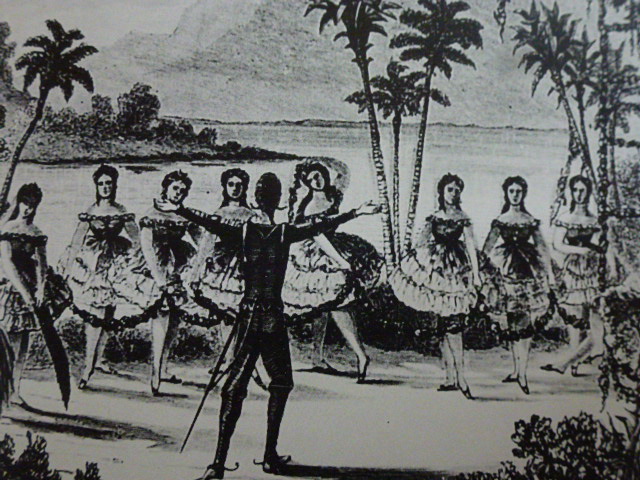
La scène des Dryades, Saint Petersbourg. Gravure russe.

A minor episode from the second volume of Miguel Cervantes’s novel Don Quixote de la Mancha – “Gamache’s Wedding” – is spun out into a comic evening-length ballet. While the mime playing the Don keeps crossing the stage in his single-minded pursuit of courtly love, the real heroes are two thwarted but resourceful young lovers. This is a ballet of many colors: exuberant stylized folk dances (Spanish and gypsy) contrast with the classical purity of the poetic “dream scene;” and slapstick gives way to an explosion of spectacular pyrotechnic dancing in the final “wedding scene.”

As Cleopold points out, even the choreographer of record re-tooled his original within two years and then again…and this ballet has been added onto and fussed over by each generation and every company ever since. For Paris, Rudolf Nureyev scanned and chewed over every version he could find in search of, for lack of a better word, the truth. He sought to create a dramatically-correct structure that would allow the dancers to feel less silly. By instilling some kind of additional logic into the plot and action (details, really) and adding yet more dance, he reshaped this ballet chestnut into an even more satisfying soufflé.

PROLOGUE: IN DON QUIXOTE’S ROOMS

The mimed prologue brings us into the world of Don Quixote, an impoverished gentleman obsessed with the days of chivalry. We see the exasperation of his starving entourage: his servants and the rotund monk Sancho Panza. While this fat man of God tries to hold onto the chicken he has just stolen, the Don prepares to go out and right the world’s wrongs.

ACT I: A SQUARE IN BARCELONA

The high-spirited and strong-willed Kitri, the innkeeper’s daughter, leaps into view. She is soon joined by the man she loves: the dashing Basilio, a barber. Her father, Lorenzo, interrupts them. He refuses to let his gorgeous daughter marry such an impecunious suitor. Lorenzo has a much better catch in mind: the idiotic Gamache, a foppish aristocrat.

The sexy Street Dancer, joined by the toreador Espada and his matadors — and then by Kitri’s two girlfriends — all entertain the crowd with dances until the Don arrives astride his mangy horse. The earthy antics of Sancho Panza (which consist mostly of looking up under the womenfolk’s skirts) distract the crowd. When Don Quixote espies Kitri, he mistakes her for the sweet and inexistant “Dulcinea,” his imaginary ladylove. Kitri humors the elderly knight and joins him in an old-fashioned minuet.

When Sancho Panza’s unsuccessful attempt to steal a fish creates a disturbance, Kitri and Basilio run away together.

ACT II

SCENE 1: A GYPSY CAMP IN THE SHADOW OF A WINDMILL

Finally all alone in the middle of nowhere, Kitri and Basilio come to realize just how serious their flirtatious love affair has become. When set upon by gypsies, the couple appeals for help. Kitri’s gold earrings play a cameo role. By the time Lorenzo, Gamache, the Don, etc., catch up with them, the young lovers have become unrecognizable in borrowed gypsy garb. Kitri is particularly brazen, jiggling her shoulders and rattling her new fake jewelry right under the noses of her pursuers. The guests are next treated to a puppet show, which tells the story of…young lovers on the run. The Don, always one more step away from the real world, first tries to rescue the puppets but then espies a giant monster: the famous windmill. Challenging it to a joust, the Don rushes to the attack. Even the orchestra goes oooh! The windmill wins.

ACT II

SCENE 2: A FOREST GLADE (THE DON’S DREAM)

We now share the vision that appears to a terribly wounded Don Quixote. He hallucinates that Dulcinea/Kitri leads him to a magic land: the kingdom of the dryads (mythical wood nymphs). Here Kitri, Cupid, the Queen of the Dryads, and a bevy of identically dressed ballerinas all dance only for him. The knight’s idea of heaven turns out to be a pure and abstract classical ballet: a realm of soft colors and music, beautiful tutus, complex geometric patterns, gentle and harmonious movements, which provide the setting for extremely technically difficult solos for each ballerina.

ACT III

SCENE 1: A TAVERN

The bullfighter Espada and his friends are rejoined by Kitri and Basilio, still in their exotic disguise. Lorenzo, et al., also catch up with them. Kitri’s father is adamant that his daughter must marry Gamache – the stupid suitor from act 1 — but Basilio has one more trick up his sleeve. “Distraught,” Basilio “stabs” himself and lies “dying” center stage. Kitri begs the Don (miraculously recovered from the windmill’s conk on his head) to help the course of true love. Her father finds himself forced at swordpoint to bless their union. This, of course. means that Basilio may miraculously recover from his wound. The Don and Gamache decide to finally have it out. (When the guys are “on,” this bit can turn into the Minister of Silly Walks meets Mr. Bean).

ACT III

SCENE 2: THE WEDDING PARTY

No extensive miming of wedding vows here, merely a joyful party where Kitri and Basilio express their relief, like any newlyweds, at finally being united.

We get to see these two burst into a brilliant grand pas de deux, a rite of ballet which follows a template as codified as any ceremony. A bouncy entrance for both. A sudden burst of private emotions brings them together to dance in slow harmony. Then the hero will jump for joy. Then the heroine will begin to trill [When she whips out her fan, start – discreetly – to rub your head and pat your stomach along to the music, to demonstrate just how much you are in sync to this subtle demonstration of technical mastery]. Then they will both try to outdo each other in the final coda but finish having decided that fabulous partnering is in fact the secret to a great marriage.

All on stage join together to celebrate. The guest of honor, Don Quixote, decides to take his leave and sets out in quest of new adventures. I bet that, after today’s events, he will only find boredom.

Un épisode mineur du second volume du Don Quichotte de la Mancha de Miguel Cervantes -les noces de Gamache- est monté en épingle jusqu’à devenir un ballet comique en deux actes. Tandis que le mime qui joue le Don ne cesse de traverser la scène en quête d’amour courtois, les vrais héros sont deux amants certes contrariés mais jamais à court d’idées. Voila un ballet aux multiples couleurs : d’exubérantes danses de caractère stylisées (espagnoles et gitanes) contrastent avec la classique pureté de la scène du rêve ; et la grosse farce fait place à une explosion spectaculaire de pyrotechnie dansée dans la scène nuptiale finale.

Comme Cléopold l’a fait remarquer, le chorégraphe d’origine a lui-même revisité son original deux ans après la création et encore après … et son ballet a été revu et tarabiscoté par les générations suivantes. Pour Paris, Rudolf Noureev a passé en revue et digéré toutes les versions à disposition, à la recherche, en l’absence d’un vocable plus approprié, de la « vérité ». Il aspirait à créer une structure dramatique correcte qui permettrait aux danseurs de ne pas se sentir insipides. En instillant un peu de logique supplémentaire dans le livret et dans l’action (quelques détails seulement), et en ajoutant encore un peu plus de danse, il a accommodé ces restes de ballet pour en faire un consistant plat de résistance.

PROLOGUE : DANS LA CHAMBRE DE DON QUICHOTTE

Le prologue mimé nous transporte dans le monde de Don Quichotte, un gentilhomme fauché obsédé par l’époque de la chevalerie. On sent l’exaspération de son entourage affamé : ses serviteurs et le rondouillard moine Sancho Panza. Tandis que l’aimable gyrovague essaye de rester en possession du poulet qu’il vient juste de chiper, le Don se prépare à sortir afin de redresser les torts qui pullulent en ce monde.

ACTE I : UNE PLACE DE BARCELONE

La vivace et têtue Kitri, la fille de l’aubergiste, nous saute littéralement aux yeux. Elle est bientôt rejointe par l’homme qu’elle aime : le beau Basilio, barbier de son état. Son père, Lorenzo, les contrarie. Il refuse de laisser sa superbe fille épouser ce prétendant impécunieux. Lorenzo a un bien meilleur candidat en tête : le ridicule Gamache, un aristocrate suranné.

La pulpeuse danseuse de rue, rejointe par Espada le toréador, ses compagnons matadors ainsi que par les deux amies de Kitri divertissent la foule de leurs danses jusqu’à ce que Don Quichotte arrive à califourchon sur va vieille rosse. Les badineries rustiques de Sancho (qui consistent en gros à regarder sous les jupes des filles) distraient la foule. C’est alors que Don Quichotte s’avise de la présence de Kitri qu’il confond avec la douce et imaginaire « Dulcinée », la dame de ses rêves. Kitri divertit le vieux gentilhomme et danse avec lui un désuet menuet.

à la faveur du trouble causé par la tentative manquée de Sancho pour voler un poisson, Kitri et Basilio prennent la poudre d’escampette.

ACTE II

SCENE 1 : UN CAMP GITAN A L’OMBRE D’UN MOULIN A VENT

Enfin seuls au milieu de nulle part, Kitri et Basilio réalisent soudain combien leur bluette est devenu une affaire sérieuse. Capturé par des gitans le couple leur demande de l’aide. C’est une boucle d’oreille en or de Kitri qui décide de leur sort. Quand Lorenzo, Gamache, le Don etc. les rejoignent, les jeunes amants sont devenus méconnaissables, dissimulés sous des oripeaux gitans. Kitri se montre particulièrement effrontée, agitant ses épaules et faisant sonner ses nouveaux bijoux de pacotille juste sous le nez de ses poursuivants. Les invités se voient ensuite donner un spectacle de marionnettes qui conte l’histoire de … deux jeunes amants en fuite. Don Quichotte, jamais vraiment les deux pieds sur terre, essaye d’abord de voler au secours des marionnettes puis aperçoit un monstre géant : le fameux moulin. Le provoquant en combat singulier, il fonce tête baissée. Même l’orchestre fait « Hiiiiiiii » ! C’est le moulin qui gagne.

ACTE II

SCENE 2 : UNE CLAIRIERE (LE RÊVE DE DON QUICHOTTE)

Nous assistons maintenant à la vision qui apparait à Don Quichotte, cruellement blessé. Dans son hallucination, Dulcinée/Kitri le conduit dans une contrée magique : le royaume des dryades (de mythiques nymphes des bois). Là, Kitri, Cupidon et la Reine des dryades, ainsi qu’une cohorte de ballerines habillées de manière identique dansent toutes pour lui. L’idée que se fait le chevalier du Paradis prend la forme d’un pur moment de danse classique abstraite : un domaine de couleurs et de musique suaves, de beaux tutus, de figures géométriques complexes, d’élégants et harmonieux mouvements, écrin approprié pour les très techniques solos de chacune des ballerines.

ACTE III

SCENE 1 : UNE TAVERNE

Le Torero Espada et ses amis sont rejoints par Kitri et Basilio toujours dans leur déguisement exotique. Lorenzo & Cie les rattrapent finalement. Le père de Kitri est inflexible dans sa résolution de marier sa fille à Gamache -le stupide prétendant du premier acte- mais Basilio a plus d’un tour dans son sac. « Dérangé », celui-ci se« poignarde » et gît, « mourant » en plein milieu du plateau. Kitri supplie Don Quichotte (miraculeusement rétabli de son mouliné sur la caboche) d’aider la cause de l’amour vrai. Le père se trouve bientôt forcé de donner son consentement à la pointe de l’épée. Cela donne le signal à Basilio pour guérir miraculeusement de sa blessure. Don Quichotte et Gamache décident finalement d’en découdre (quand les gars sont bien dedans, la scène peut ressembler à la fille adultérine des Monty Python et de Mister Bean).

ACTE III

SCENE 2 : LES NOCES

Pas de grande scène de mime pour ce mariage mais avant tout une joyeuse réception où Kitri et Basilio expriment leur soulagement, comme tous jeunes mariés, d’être enfin unis. On verra ces deux-là se lancer dans un brillant pas de deux, un rituel balletique qui suit une routine aussi réglée qu’une cérémonie. Une entrée bondissante pour les deux suivie d’une soudaine effusion les unissant dans une danse de calme harmonie (adage). Puis, le héros saute de joie (variation I). Puis l’héroïne se met à roucouler (variation II) [Quand elle commencera à agiter son éventail, entreprenez de -discrètement- vous frotter la tête et l’estomac en même temps, avec panache, pour montrer toute votre sympathie à cette discrète démonstration de maîtrise technique]. Enfin, ils essaieront chacun de se surpasser l’un l’autre dans la coda, tout ça pour finir par convenir qu’un fabuleux partenariat est le secret de tout bon mariage. Tous se joignent à eux pour célébrer la noce.

L’invité d’honneur, Don Quichotte, décide alors de s’éclipser pour aller vers de nouvelles aventures. Je pense qu’après les évènements de cette folle journée, il ne pourra que se raser.

Libre traduction de Cléopold

2 Commentaires

Classé dans Hier pour aujourd'hui

A very biased plot summary for La Bayadere

LA BAYADERE [the temple dancer]
Choreography by Rudolf Nureyev (1992) after Marius Petipa (1877)
Music (not that bad, if not lazily played) by Ludwig Minkus

L’article en Français

Even before he would create the great trilogy with Tchaikovsky – Swan Lake, Sleeping Beauty, and The Nutcracker – the French-born choreographer Marius Petipa produced several classic ballets in Russia all using the same formula: an exotic setting, a dramatic love triangle (as in most operas), and an acclaimed “dream scene” (which the French call a ballet blanc) where the hero sees his beloved multiplied into 32 ballerinas clad in identical tutus. This particular ballet had never been shown outside of Russia until the Kirov troupe brought its production to Paris in 1961 (along with Rudolf Nureyev).
Try to not take the “orientalist” aspects of this melodrama too seriously. Let yourself enjoy this fruity depiction of “local color” set in some kind of fantasy India, created by artists who had never been there except in their imaginations. Get swept away by passion as it was experienced in the 19th century!

ACT I (48 minutes)
SCENE 1: AT THE TEMPLE OF FIRE AND WATER
The noble warrior Solor sends his companions off to catch a tiger for the Rajah. It’s only an excuse to be alone, for Solor summons the Fakir and orders him let Solor’s beloved, the virginal temple dancer Nikiya [aka LA Bayadère] know that he will be waiting for her in the garden. Their love is secret and forbidden: they belong to different castes.
Solor hides and watches the entry of the Grand Brahmin, keeper of the sacred flame. He summons the priests and the bayadères (dancers of the sacred temple), as the fakir and fire-worshippers lacerate themselves before the altar. Finally, Nikiya performs her ritual dance. When she and her sisters bring water to the exhausted faithful, the Fakir passes along Solor’s message.
The Brahmin clenches his fist. Not Good... Francis Malovik.But first…the Brahmin corners Nikiya. He offers her his crown (and, yuk, the bald head beneath it). She uses the excuse that they are of different castes to try to get him to go away: she is only a lowly servant (pantomime gesture of lifting a water jug to her shoulder). But finally she has to just push him away.
When all depart, the lovers can finally meet and dance ecstatically. Unaware that the Brahmin is spying on them, Solor swears eternal love and fidelity on the sacred fire. The Brahmin clenches his fist and swears to crush his rival.

The Rajah clenches his fist. Really not good... Jean-Marie Didière.

SCENE 2: AT THE PALACE OF THE RAJAH
Less sacred girls dance to please the Rajah and his court. He calls for his daughter, Gamzatti, to tell her that she is to be married, if she agrees, to the handsome man in a portrait on display: Solor. Gamzatti likes what she sees and exits. Solor enters, but is horribly surprised by the news. He cannot admit that he is already betrothed to another (to a dancer, no less); nor can he bring himself to disobey his sovreign. Nodding, he decides to figure this one out later.
Nikiya has been summoned to perform her usual ritual dance to bless an event at court. Carried about by the Slave (in the pas d’esclave), she strews flowers upon the princess. Neither Nikiya nor Gamazatti realizes that she is facing “the other woman.”
The Brahmin arrives and demands to see the Rajah. He spills the beans, as Gamzatti eavesdrops: Solor is in love with…that dancer. To the Brahmin’s horror the Rajah clenches his fist and pushes them downwards. He still wants Solor as a son-in-law, so Nikiya must be crushed instead.
The princess clenches her fist. It's Baaaaad!Gamzatti, toying with her bridal veil, summons the impertinent dancer. After first pretending to be her new friend she gets into action: “see that portrait of Solor? Well he’s mine now! Take this necklace, you pathetic worm, it’s worth more than you could earn in three lifetimes! Leave him to me!” Nikiya cannot believe that the love of her life could betray her like this and finally explodes. Just in time, the nursemaid grabs the knife from Nikiya’s hand. Gamzatti clenches her fist and swears to crush her rival.

INTERMISSION (20 minutes)

ACT II (43 minutes)
THE ENGAGEMENT PARTY AT THE PALACE
Baya IndièneGrand pageantry. All make spectacular entrances, especially Solor on an elephantine contraption (less spectacular is the droopy stuffed tiger his companions carry in). The conceit of a party allows for a series of colorful dances: with fans, with parrots, by the bridesmaids; by the airborne Golden Idol; by the Manou who balances a water jug on her head; by the “Indian fire dancers” who do a kind of can-can

…and finally it’s time for the:
Grand Pas de Deux, the celebration of Gamzatti and Solor’s engagement. It is a chance for the audience to enjoy glorious unabashed pyrotechnics. (Originally in Act IV, see note below)
Baya mortTheir dance just ended, Nikiya arrives to do her duty: yet another dance to consecrate a festive event. Distraught, she, keeps trying to catch Solor’s gaze. “Can this really be true? Can you abandon me just like that?” Gamzatti’s ayah gives the girl a basket of flowers – “from him.” The poor girl’s joy – he still loves me! – is shattered when the serpent hidden amongst the flowers bites her. Gamzatti sent the flowers, after first placing an asp in them. The lovelorn Brahmin offers Nikiya an antidote to poison, but Nikiya finally understands that Solor will never dare to renounce his caste and position for her sake. She prefers to die.
Only now does Solor realize what he has done.

INTERMISSION (20 minutes)

ACT III (40 minutes)
IN A PERFUMED GARDEN
Distraught, ashamed, still in love, Solor takes a giant dose of opium.
As he drifts to sleep the vision of an infinite number of idealized Nikiyas, clad in pristine white tutus and chiffon veils, waft into the garden. They are the Shades, bayadères who died for love and are fated to wander between this world and the next. You should be as stunned as Solor by the corps de ballet: dozens of soloist-caliber women sublimate their egos in order to achieve this kind of kaleidoscopic harmony. (Watch for three solos, given to the most talented young dancers). When Solor dances with the ghost of Nikiya each touch, each turn, brings them closer together. At one point, a long veil stretched between them symbolizes their connection. Solor literally jumps for joy in his solo. The act ends in triumph: Nikiya has forgiven him, therefore they shall never be parted.

Baya ombres

Notes:
Act III — “The Kingdom of the Shades” — serves as a starter or touring version for many companies.  Boiled down and sans elephant, all you need are: a ramp, a guy, a gal, and 24 to 32 pairs of thighs topped by white tutus ready to plié until they « feel the burn. »
Originally, there was even an Act IV! In it, Solor returns to earth and marries Gamzatti after all. This makes the gods angry, who then bury the entire wedding party under the the rubble of the imploding palace. This Samsonesque act has rarely been staged since WWI. Dramatically,  let’s be honest, anything is a letdown after Act III.  Solor comes off as a real creep for going back to his fiancée. But most of all, a collapsible set costs a fortune!

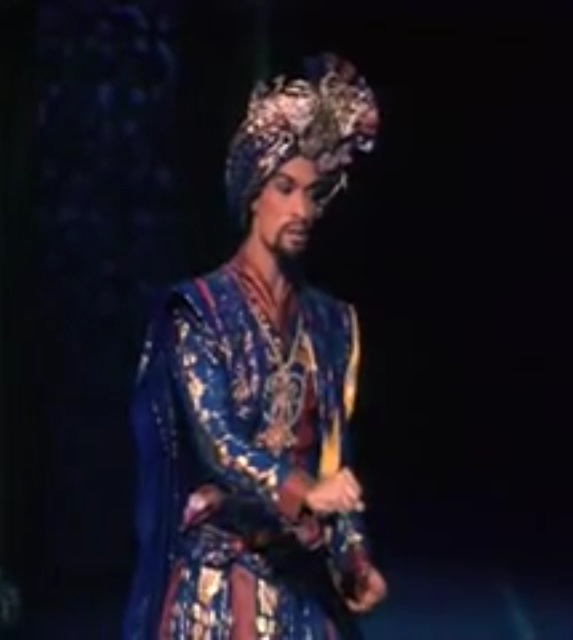
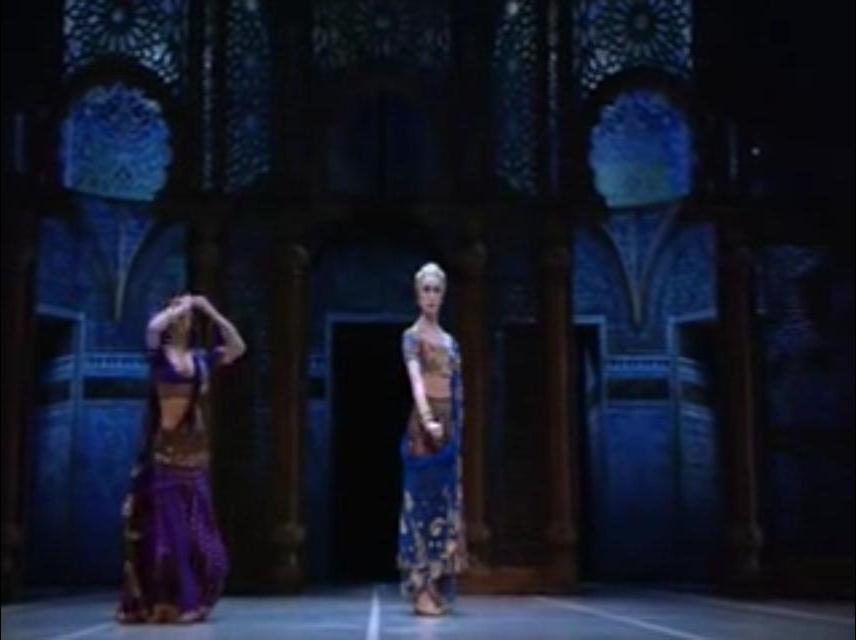
All pictures in this article are screenshots from the 1994 film with the original cast (Isabelle Guérin, Laurent Hilaire, Elisabeth Platel, Francis Malovik, Jean-Marie Didière, Lionel Delanoë, Virginie Rousselière, Gil Isoart).

5 Commentaires

Classé dans Hier pour aujourd'hui