Archives de Tag: Mats Ek

Pensées disparates

Divagations durant Dances At a Gathering

Mais combien y a-t-il d’histoires dans un sourire de Clairemarie Osta?

Quand le piano chuchote, on regarde mieux pour sentir ce qui se passe.

Danser un temps sur deux, comme la danseuse verte lors de son premier solo, demande du chic et une musicalité comme en suspens. Une définition possible d’Agnès Letestu.

Une vrai troupe, c’est miraculeux.

Daniel Stokes, à revoir.

Avec Chopin, il y a toujours quelqu’un qui chantonne dans la loge d’à côté.

Ratiocinations devant Apartement

À quoi reconnaît-on une œuvre banale? On n’a nul besoin de la voir une deuxième fois.

Jeux d’enfants : l’adulte qui a chorégraphié cela fait semblant. L’enfance est chez Robbins.

Marche des aspirateurs : pourquoi Fleshquartett me tympanise-t-il de soupe irlandaise?

Danser devant la scène : gentil pour les fonds de loge.

À double tranchant: on ne se pencherait pas s’il fallait.

Un bon danseur résiste à tout.

1 commentaire

Classé dans Humeurs d'abonnés, Retours de la Grande boutique

Not in my appartement.

After Dances at a Gathering on Saturday night, I only wanted to stand quietly with the one I love and fantasize about how we could possibly try any of those lifts in our living room. Then, Appartement took me brutally back to the fact that our living room really needs a new coat of paint.

For:
a) the music
b) the program notes
c) the fragile beauty of the dancers
…all contributed to my distress.

a) The music. Imagine this: a Celtic folk group takes poppers, plugs in the amps, and tries to play acid rock variations on Steve Reich. When, near the end, the guy playing a thing that kind of looked like a violin got a solo where nobody danced but “police, do not cross” tape stretched accross the stage – that’s it, not a dancer in sight for endless minutes — I found myself fervently wishing he were no longer there. That he had devolved into a chalk-drawn silhouette on the ground as the tape had promised.

b) The program’s “To read before the performance” section couldn’t manage to make a single link between the two ballets. One paragraph on Robbins, one on Ek and et voilà! as if perfectly cooked. Robbins’s Dances at a Gathering “is a luminous exploration of a community joyfully celebrating dance as it wells up out of Chopin’s music.” (L.Gilbert, trans. R. Neel). For Appartement, the editor needed to cite Ek in an old article from Le Figaro: “something about everyday life without heels [“high” is omitted in translation, we see plenty of heels mostly waved in the audience’s direction] and points[sic], and diametrically opposed to everything the building [Palais Garnier] suggests.” If I were grading this paper, I would say: 1) what is your thesis then? 2) needs conclusion to pull concepts together 3) I cannot grade this until you do a rewrite.

c) Yet the company is blessed with beautiful dancers who commit themselves heart and soul to whatever. And do it as beautifully as they can. But all I did was sit there worrying about the impact of this movement on their knees and ankles. Every tiny articulation (and Ek’s movements are always definitely pat-your-head-and-rub-your-stomach challenging) rang clearly to the last row. While a piece like Dances isn’t easy on the body either, it takes you on a voyage where you don’t find yourself analysing every single complex component of movement as it happens.

Muriel Zusperreguy and Alessio Carbone make a perfect and passionate pair with split-second timing. I mused about how I would love to see them in Giselle together – either regular size or Ek. His version of that ballet reaches out to balletomanes in a humane and sophisticated way. For despite Giselle’s woes, at least she didn’t roast her baby in a gas oven [when Zusperreguy pulled it out at the end of the duet and dumped it into her stricken partner’s arms, the roar of laughter from the audience at this punch line truly sickened me].

Vincent Chaillet’s grapple with the couch made me think of both my cat’s daily manoeuvres and Ben Vereen’s boneless Fosse slither (thus this dancer gave me a moment of grace). I want to see Adrien Couvez travel back in time and join Forsythe’s company of twenty years’ ago. God, it was good to see Vincent Cordier doing something other than King in Sleeping Beauty while there’s still time, using his regal presence to make something out of a nothing part. And it’s time for Marie-Agnès Gillot to get back into a goddamned tutu and dance in those ballets which are indeed “everything the building suggests.” She once gave us the softest of Paquita’s, where her feet lovingly caressed the floor, the most thrilling of Lilac Fairies where her gorgeous arms made the air around her seem thick and liquid…why does she insist on dancing in pieces where she keeps needing to sport knee pads?

This ballet gives me three choices. 1) down not one but several drinks before and after 2) go stick head in a bidet until, et voilà!, perfectly drowned. But if so, could I do it on stage at the Garnier as Gillot did? At least, as it’s the first scene, it would be a beautiful death. For I would die knowing that I would never have to endure the rest of this piece ever again. 3) buy paint for living room.

Appartement is one of those pieces that derives its chic from telling you: “Yes, you are getting old. You no longer think ugly is as cool as you once thought it was.” So… the day when the Theatre de la Ville – the Parisan temple of modern dance — decides to present this program,  but Ek precedes Robbins (where the “this is not your comfy Palais Garnier” aspect of Appartement would perhaps actually prove funny), I might just try to believe in such conceptually “sophisticated” programming.  For years now in Paris, ballet has been too apologetic and modern too full of itself.  Both audiences are about the same age.

After enduring these 47 minutes of depressing ideas, images, and music, when I walked out onto the splendid swirling vista of the Avenue de l’Opéra, all I could see was garbage on the ground, ugly posters, ugly people.

1 commentaire

Classé dans Humeurs d'abonnés, Retours de la Grande boutique

Sylvie Guillem au TCE : C’est des gens qui dansent ensemble… ou pas.

TCE, Jeudi 15 mars 2012 [6000 Miles away : Rearray, William Forsythe, mus. David Morrow / 27’52 », Jiri Kylian, mus. Rick Haubrich / Memory, Mats Ek, Niko Rölcke / Bye, Ek, mus. Beethoven Sonate pour piano op. 111]

On ne va pas voir un spectacle avec Sylvie Guillem pour titiller la nostalgie. On sait qu’il ne s’agira pas d’un récital de poncif et qu’il n’y aura pas de mort du cygne dans la pudique lumière bleutée. Et pourtant, à voir son incarnation du Rearray de Forsythe, son perpetuum mobile, ses changements de point de départ du mouvement et de poids au sol, aux côtés de Nicolas Le Riche, on se sentait convoqué à une étrange et délicieuse expérience de mémoire involontaire. Ce sentiment d’énergie vitale, c’est bien celui qu’on ressentait au théâtre du Châtelet dans les années 90 lorsqu’on voyait le ballet de Frankfurt présenter son répertoire. Sylvie agrippe le sol avec des pieds qui semblent aimantés et puis soudain c’est l’avant-bras qui, polarisé, paraît subir plus que les autres membres l’attraction terrestre. Et puis il y a ces fulgurantes extensions, ces poses parfaites et abstraites qui jaillissent de presque nulle part comme une branche de sylphion apparue dans le désert d’une préparation inachevée. On est loin des mignardises qu’on nous sert désormais trop souvent sous l’étiquette du maître de Frankfurt. S’agit-il d’un pas de deux ? D’un duo ? De deux solos entremêlés ? Ces courts moments chorégraphiques entre Guillem et Le Riche, entrecoupés par l’extinction des rampes de lumières, qui ne racontent pas une histoire, ne dépeignent pas de personnages, dégagent cependant un envoutant parfum d’humanité.

Le second duo, 27’52’’, chorégraphié par Jiri Kylian, partage de nombreux points communs avec la chorégraphie de Forsythe : un couple de danseurs (Lukas Timulak et Aurélie Cayla) en habits de tous les jours, jean et –éventuellement- T-shirt, se croise, se confronte et se s’entremêle sur le plateau dont le seul décor est un jeu de lumière et quelques lais de Lino, à la fois couverture et linceul. Mais le propos (la mort ? une séparation ?) parait plus appuyé. Jiri Kylian, qui a subi de plein fouet « l’onde de choc Forsythe » dans les années 90 (on retrouve du partnering décentré, de grandes développés succédant à des positions quasi fœtale) s’est montré plus inspiré dans d’autres pièces. On aurait aimé un peu moins de pathos et plus de lyrisme, cette qualité si propre au maître tchèque. Mais cela reste tellement préférable aux chorégraphies glaciales et mécaniques « post-forsythienne » qu’on voit si souvent aujourd’hui.

Dans les années 90, Jiri Kylian avait brièvement réuni autour de lui William Forsythe et Mats Ek dans le cadre de son NDT3 (une compagnie qui avait ambition de donner un espace d’expression aux interprètes qui avaient passé la quarantaine). Dans « Memory », sur la musique de Niko Rölcke, Mats Ek donnait à voir, dans son style expressionniste, sa vision du « vieillir ensemble ». Là ou Kylian a porté un regard sombre et presque chargé d’amertume, Ek, même dans un décor aseptisé d’appartement suédois, a délivré une vision remplie de tendresse et d’auto-dérision. Un bras ballant, ou la tête qui dodeline, Ana Laguna rayonne de sérénité et de confiance aux côtés de son mari chorégraphe à la présence bonhomme.

L’opus qui clôt la soirée, également de Mats Ek, a été créé sur Sylvie Guillem. C’est, rompant avec le thème filé de la soirée, un solo. C’est une réflexion sur la solitude mais qui est remplie de tout un petit peuple d’intervenants par le truchement d’un écran de projection (un procédé abondamment utilisé par Kylian). C’est dans cet espace rectangulaire, à la fois porte, bulle et miroir qu’apparait d’abord Guillem, attifée comme ces femmes-enfant qui n’ont pas tout à fait le deuil de leur improbable garde-robe de lycéenne. D’abord projetée sur l’écran, elle sort enfin à petits pas, comme effrayée par le monde extérieur, ses dangers ou ses frimas. Mais très vite, derrière la vieille fille, par la magie combinée de la chorégraphie et du mouvement plein et juste qui caractérise la danseuse, ce n’est pas tant les misères du célibat trop longtemps prolongé, mais bien le spectacle de la volonté farouche de cette femme, par-delà les déceptions et les frustrations, de rester conforme à elle-même. La danse de Mademoiselle Guillem n’est pas que miraculeusement préservée. Elle respire l’optimisme, contre vents et marées.

Ce diaporama nécessite JavaScript.

Commentaires fermés sur Sylvie Guillem au TCE : C’est des gens qui dansent ensemble… ou pas.

Classé dans Hier pour aujourd'hui, Humeurs d'abonnés, Ici Paris

Sylvie revient ! (évocation cavalière)

Sylvie Guillem fait une halte à Paris pour « 6000 miles away », un titre qui résume assez bien sa carrière voyageuse. Au programme du spectacle, des valeurs sûres de la chorégraphie du second XXe siècle: William Forsythe, Jiří Kylián et Mats Ek.

On a tant déversé de superlatifs sur Mlle Guillem que le mythe fait parfois écran. Il y a la présence scénique, l’aisance technique, le levé de jambe spirituel (d’autres, moins malines, croient que ce n’est qu’une question de hauteur), le goût du risque et la versatilité aussi. C’est sans doute la dernière ballerine dont on ait polémiqué à l’Assemblée nationale et la seule à avoir été invitée au 20h00 de TF1 un jour de semaine (c’était du temps où la télévision regardait ailleurs que son nombril).

Bref, se produirait-elle dans Guignol, la salle serait toujours pleine. Mais il se trouve qu’elle choisit plutôt bien ses apparitions. Ces dernières années, on a pu la voir dans des créations de Russell Maliphant ou d’Akram Khan, et elle s’est même essayée, avec Maliphant et Robert Lepage, à la conception d’Eonnagata, un spectacle intéressant, où ses possibilités était sous-exploitées. Car les années ne semblent pas altérer la fraîcheur de l’interprète, comme le montre une comparaison des vidéos pirate de sa Manon de 2011 (à Milan) avec celles des années 1990 dans le même rôle avec Laurent Hilaire.

Au Théâtre des Champs Élysées, on la verra dans Rearray, duo intimiste de William Forsythe, dont le mouvement semble ne s’arrêter jamais, ainsi que dans un solo de Mats Ek, qui exploite ses talents pour la comédie. La soirée sera complétée par une pièce de Kylián interprétée par Aurélie Cayla et Lukas Timulak, et – pour les chanceux qui assisteront à l’une des quatre premières représentations -, par Memory, un duo interprété par Ana Laguna et Mats Ek en personne.

Un petit tour et puis s’en va vers d’autres horizons. Mlle Guillem, nommée étoile de l’Opéra de Paris à 19 ans, a bien fait du chemin depuis. En termes de notoriété et d’autorité artistique, c’est notre Noureev !

Du 15 au 22 mars au Théâtre des Champs Élysées.

Commentaires fermés sur Sylvie revient ! (évocation cavalière)

Classé dans Hier pour aujourd'hui, Humeurs d'abonnés, Ici Paris

A Very Biased Aperçu (there is no plot to summarize) of the pairing of Jerome Robbins with Mats Ek: buy your tickets now?

Dances at a gathering, Jerome Robbins (Chopin, 1970)

versus

Appartement, Mats Ek (FleshQuartet, 2000)

I hate visiting apartments with perfectly designed yet sterile décor, not a book in sight. Worse than that, a book unread chosen for its beautiful binding. I hate “high concept” evenings at the ballet even more. This season has proved more than irritating due to its tacky/cheaply conceptual programming: ooh, let’s do the opera and ballet versions of Cinderella and Manon. All that results in are confused patrons who wind up at the wrong theater for the wrong art form (I witnessed that).

Programming a satisfying double-bill should also be considered an art. Handled with care. Phedre and Psyche earlier this season didn’t work for me, either. Yes, gods wreak havoc on humans. So what’s the bigger connection?

The adorable Horst Koegler summarized “Dances at a Gathering” as…”a ballet about the feeling of togetherness.” Joyous yet delicately melancholy. Pairing it with “Appartement” – a cruel and violent dissection of the cost of remaining alone (that head stuck in the bidet, that man wrestling with a couch)sets up an overly violent contrast and does both of these great works a wretched disservice.

Yeah, right, as the blurb says: “both ballets are about relationships.” [I am not making this up, the season program uses the phrase « rapports humains » as if it were some heretofore unknown selling point]. Um, ALL ballets are about relationships. Even if you dance a solo on a bare stage you are caught up in a relationship with the audience at the very least.

Moreover, Lefevre’s rather wry justification of her choices on the Opéra’s official website –  « ils dansent ensemble » [they dance together] makes me want to have a relationship with a gas oven.  Well, yes, in general, dancers do indeed regularly dance together on one and the same stage…and to then illustrate this point with a clip from « Appartement, » where not a single one of the five soloists interacts with the other, indicates a rather cavalier attitude towards the intelligence of the paying audience.

As Christopher Fry makes a character howl in The Lady’s Not For Burning: just  » Where in this small-talking world can I find/A longitude with no platitude? »

I know of many who are already planning to pay full price to watch “Dances” and then leave and go get dinner during “Appartement.” Fine for the box office, but cruel to the dancers, who try to give us all they have to give and find themselves in a half-empty house.  Especially as one of the unsung virtues of this strange programming is that both pieces require large casts to perform little solos as if in a « tasting menu. »  One of the pleasures these evenings might offer would be to discover a dancer — up front for even thirty seconds — whom one had never looked at before.

“Dances” was created on and for strong and mature personalities – at NYCB for Kent, Leland, Mazzo, McBride, Verdy, Antony Blum, Clifford, Maoriano, Prinz, and the unstoppable Eddie Villella – yet the Royal Ballet’s version shortly thereafter proved equally powerful. Yes, Nureyev of course, and then others whom you never realized they had it in them: Ann Jenner, for example, glowed. Robbins had somehow picked up on “l’air du temps.” On both New York and London dance stages, the late sixties and early seventies were filled with expressive artists who remained underappreciated – especially those who were female – caught painfully out of the spotlight due to the public’s obsession with Fonteyn and Farrell.

All you need to understand “Dances” is to take a good look at the huge painting (over 16 feet-more than 5 meters-long) that hung for over thirty years in each of Patrick O’Neal’s succesive Lincoln Center venues (call it Saloon/Baloon/ or restaurant).: “Dancers at the Bar” by Robert Crowl, ca. 1969.* It gathers together 33 dancers and dance-loving people (including the conductor Robert Irving, who is the one who convinced me that Minkus’s music isn’t all that bad if played as if it were music).

In the painting, several members of the first New York and London casts of “Dances” stare down at you: the elegant Monica Mason and tender Antony Dowell, the uncategorizable Lynn Seymour and the ever-underrated David Wall, along with the beautifully eccentric Leland and the handsome Prinz…while others just pausing on their ways to ABT or Stuttgart join them. This painting unites a pantheon of lithe and tired dancers just waiting, waiting, to shed their street clothes and transform themselves into whom they really were meant to be.
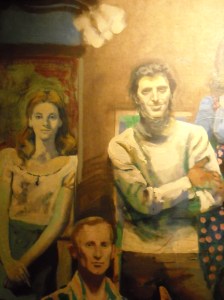
Ed Villella, Sara Leland and Heinz Clauss

Up until now, Paris also drew upon its strongest company members to make these very fragile masterpieces work. If you can’t tell them apart, the person next to you will soon be asleep (as I witnessed at « Dances » when NYCB passed through a dull phase. In the first row, that shouldn’t be possible).

These ballets could offer an ultimate thrill:  nothing is more satisfying than having a dancer force you to change your preconceived notions about what they can or cannot do.  Don’t let them become pretty books unread.

* Unfortunately, even flying to New York won’t allow you to see the painting anymore. Donated by the O’Neal family to NYCB after the last of their restaurants closed recently, it now hangs in the main rehearsal hall in the New York State Theater (which some now insist be called the David Koch Theater). Perhaps some day it will be placed in one of the public spaces of the building. For further information about the painting’s story, see Doris Perlman’s article in a 1997 issue of the American Dance Magazine.


3 Commentaires

Classé dans Hier pour aujourd'hui, Humeurs d'abonnés