

Défilé. Dorothée Gilbert.
The Défilé du Corps de Ballet de L’Opéra de Paris
+ An Evening of Forsythe/Inger (and Stromile)
October 9, 2024
After months of being forced to sit on the sidelines (and literally stay out of the way) in Paris due to the Olympics, shortly followed by Fashion Week parasiting normally public spaces, encore!, I really needed to feel I was back at home at the Palais Garnier and get back into the groove. To be lifted out of my seat by cheering dance instead of being forced to watch basketball. Instead, my reward for being a good and patient Parisian turned into maybe the dullest, most monotonous, outing I’ve experienced in quite a while.
Yes, I am grumpy. Here’s why.
On September 14th, I had decided to ignore the last Olympic Grande parade on the Champs Elysées and instead burrowed down into the Opéra Bastille’s Amphithéatre to watch a public rehearsal with some young dancers cast in the upcoming revival of William Forsythe’s Blake Works. This hour-long session was not at all about the pursuit of the Perfect Ten. Albeit physically demanding, ballet is an art, not a sport. You don’t need to nail it. The goal is not getting a ball into a little basket, nor scoring a goodie bag.
Instead of breaking records, another question proved more pressing. Not all that long after this ballet had been created for the Paris Opera Ballet in 2016 “how to keep Blake Works alive and how to keep it feeling new” clearly obsessed both the new cast as well as the spectators. After the rehearsal was over, one audience member during Q&A asked about “getting it right.” Ayman Harper’s — a Forsythe veteran — response summarized what he was here to do: to get the dancers to “feel and go with the flow.”
During this public rehearsal, the Paris company’s ballet master – Lionel Delanoë, himself the winsome and sharp creator of a role in Forsythe’s masterpiece, “In The Middle” – did not stop beaming at the dancers from his front row seat in this intimate space. Harper, a guy with a slouch and an oomph and fun hair, kept saying: “That was beautiful. Just beautiful. But maybe you could try this?”
Roughly (as I was not doing steno), Ayman Harper pitched it like a dude:
“ There is no authoritative version of any Forsythe ballet. Bill believes that once you do that – fix it, nail it – a work of art is dead. If you impose the way you must move every single second onto the dancers, if you give them too much information and over-explain it, you will have killed it and put it in a box. Art needs to be like air, inhaled and exhaled.” This rehearsal master (eight years in Frankfurt) also added why “Bill” insists upon remaining so loose about the future of his works. “The man himself could say, ‘ooh! Now I have the chance to change something that has been bothering me for years/oh that bores me now/um, I just don’t need to insist upon it this way. Your body is different so just do it your way’.” This approach is not about the “après moi le deluge” attitude of the many long-dead dance makers who still engender bodice-ripping fights from beyond the grave amongst their legal heirs. This “guardian of the temple’s” attitude was more about “if the dancers learn to love to do it, then we can all share in the fun.” This is a very cool idea. But does “making it work for you” really keep a ballet alive? Can new generations not just outline, but live in, the step? Do new kids even know what the ancient word “groove” even means? Will they ever feel it?
Jazz has always been both structured and unstructured, too. Coach Ayman Harper kept playing with making the dancers feel/pounce upon/vary the rhythms, push the musicality out into a personal space. Ground a step. Pull one in. Forget about being “in a pirouette.” “Let yourself just follow the impulse. No imitation, no study-the- video, no make it look nice. Listen, listen, listen to the music.Groove. Let yourself go. Be here now. (Heads nodding to the sounds, concentrating) 5-6-7-8 GO!” That’s how you keep it alive.
“The steps are there-ish. Just trust the music. More that than that, play with the music!” And then he asked. “Maybe try a staccato here, hunhah, hunhah, make us look at your arms doing what your feet are doing down below. Go inside the music, hunh, hunh. One, two? What about one uh! two? One uhuha two? What feels good? “
The ballet coach’s kids struggled at first. But you could see a glimmer. When they get it, they will light a forest fire.
*
* *
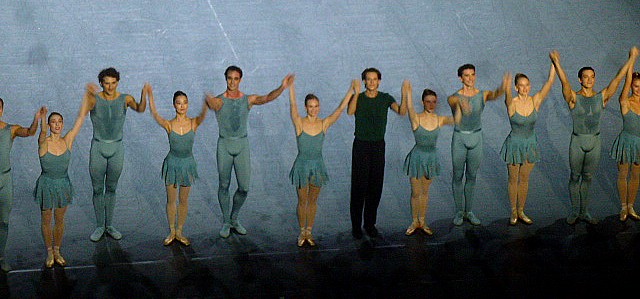
Blake Works. Curtain calls
This infinity of possibilities was not necessarily confirmed at the Fall Season Paris Opera Ballet Gala [redux] on October 9th (The “Opening Gala,” now stretches across several nights. I didn’t manage to score tickets to the first).
After the Grande Défilé du corps de ballet — an annual autumn delight of floofy tutus, white satin, all the company simply walking forward to us in waves encased in their unattainable style and elegance — the mood dropped as we were forced to watch, after a short pause:
A neo-Forythian pastiche by a My’Kal Stromile. Jesus, there are just too many neo-Forsythers out there. Oh boy, was this Word for Word a downer. The costumes were by CHANEL (all caps in the program). Maybe that was the point as Paris Fashion Week (s) had just happened?
So hats off to Jack Gasztowtt for his energy and the way he took his assignment as well as his role as partner to Hannah O’Neill most seriously despite the inanity of the entire ballet. The rest of the cast fussed and fluffed about in their lush costumes by CHANEL. A lot of bourrés (piétinées in French) were involved, Guillaume Diop (a young Etoile so often so good) seemed to be channelling runway attitude. He was relaxed and poised…but way too “lite.” The always “there” Valentina Colasante had nothing left to work with as she hopped and stretched her infinite lines in a void. Rubens Simon catches the eye, tries, but had little to do. But what can you do if there is no point in the first place? Overall, this thing did not engender the feeling that “a good time had been had by all.”
I could not even vaguely comprehend why the audience was being forced to watch My’Kal Stromile’s intermezzo until the cleverly snarky end. Aha. During the Defilé du Corps de Ballet prior, all the dancers of the company and the school had descended the raked stage with superb and stately aplomb in order to salute their devoted fans from the lip of the stage. Here, as the finale of Stromile’s Word for Word finally arrived, the dancers turned their backs to us and stalked equally elegantly and solemnly back to upstage, like models done with the runway. Wow, how clever. Who’d a thunk it? I felt nothing.
I needed a drink. Surprise! Not only was the Grand Foyer privatized for a corporate evening, so was the Avant Foyer along with the Glacier. After the Paris Olympics, the last thing I needed was to be kept out of, yes, yet another fan zone because I didn’t have a QR access code. I scored a place squeezed to the side under a low ceiling to grumble to myself and then spill half my glass because someone in the packed crowd had bumped hard into my elbow.
Second Act, here comes the Forsythe (ooh ForsytheS!). This will get me back up on Cloud Nine, I know it.
No it didn’t.
Before Blake Works will finally happen, let’s insert Forsythe’s Rearray, a once spectacular duo that had been composed upon the bodies of Sylvie Guillem and Nicholas LeRiche.
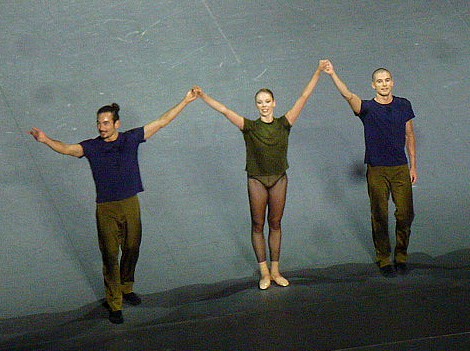
Takeru Coste, Roxane Stojanov & Loup Marcault-Derouard. Forsythe’s Rearray.
Now it’s a trio? All I can say is that the actor-dancer Takeru Koste’s ever-growing gravitas becomes all the more eye-catching. He pulls you into his moves. There’s no story in this duo, now trio, but he gives the piece a badly-needed mysterious sostinato. All I can say is that for Roxanne Stojanov – or for any dancer until the end of time — stepping into Guillem’s shoes is often just too daunting. Stojanov has her own way of moving and is always committed to what she does. This pièce d’occasion is just not just for her at this point in her career. Poor junior soloist Loup Marcault-Derouard tried with little to do, to make an impression. He kind of did. But what can you do if you are cast as the pointless third wheel in a pointless bore?
The lights go half up and down as we twitch in our seats during the pause. Here it comes, Forsythe’s well-rehearsed Blake Works!!!
In the sour aftertaste of everything up to now, I really, really, needed to wallow in a luminous ballet you could only describe as Petipa meets Woodstock. I really needed the feeling of an Ancient meets a Modern at a bar: you graze him with your elbow, he lurches back and then lurches forward and catches your wrist. You look into each other’s eyes and it starts. He’d almost fallen off his stool, so you end up on the dance floor where you show off your ballet moves while he grooves. The disco light shimmers and pulses and you are more alive and in the flow than you will ever be ever again.
It was a nice enough Blake Works, albeit sometimes too studied. Dancing Forsythe should always about suddenly something will happen that you didn’t expect and you are figuring out on the spot just how to skedaddle on and in and out from there. I always like to remind people that Forsythe himself was once, long ago and far away, the Long Island champion of a now forgotten ‘60’s dance called “The Mashed Potato.” Anything is possible.
As the coach had said:” Do it your own way. If I impose the way you must move every second, give you too much information, over-explain it, I will have killed it and put it in a box. Art needs to be like air, inhaled and exhaled without needing to think about having to do it.”
Inès MacIntosh, Caroline Osmont, Pablo Legasa: all had bounce and go and jazz. No poses, just pauses within the music. That’s good. . . Hohyun Kang has a spark and draws your eye to her. Kang tries, but for the moment she is sometimes too diffident. On the other hand, the chic and of course competent Hugo Marchand quietly had his own fun but made zero attempt to engage the audience, so utterly cool and disengaged that he turned me off. I guess he’s saving all his energy for Mayerling next month. To me, he was just slumming.
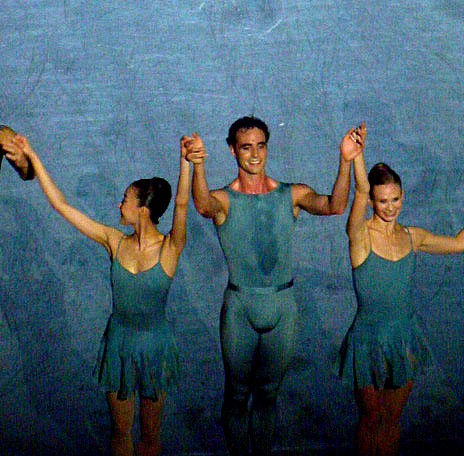
Hohyun Kang, Florent Melac & Léonore Baulac. Forsythe’s Blake Works I.
The always vibrant and focussed and breathing Léonore Baulac, who has this ballet in her bones, was seconded by a discretely powerful Germain Louvet. Louvet’s cool and manly presence made you forget that François Alu had even ever had a part in this, let alone created the role. Louvet was more about catching than pushing his partner around. Their duet,“The Color In Anything,” breathed in a very new way. Both partnering and being with a partner in real life can turn into who dominates. Here, the duet evolved into questions about finessing the complexities of living on stage together instead of offstage anger suddenly dragged out under the spotlight. I prefer it done this way. Beaulac and Louvet made Blake Works work for them and for us in equal measure.
Alas, after yet another claustrophobic intermission, my brain was simply too fried, my mood too dark, to take in any more neo-classic post-modern ballets. I had no grey cells left for Johan Inger’s inventive Impasse. I was fascinated and Inger does absolutely get people moving about in satisfying ways. I just couldn’t get into it, alas. But I’d like to see it again once day – just in another context. How weird is that?
Frankly, for a gala, shouldn’t you vary the program? Too much of one thing is both too much and not enough.
 A Quiet Evening of Dance. William Forsythe. Festival d’Automne. Théâtre du Châtelet. 5 novembre 2019.
 James
James Albertina
 Cléopold
 Fenella
 Les Balletonautes
 Mini Naila
 Les Balletonautes