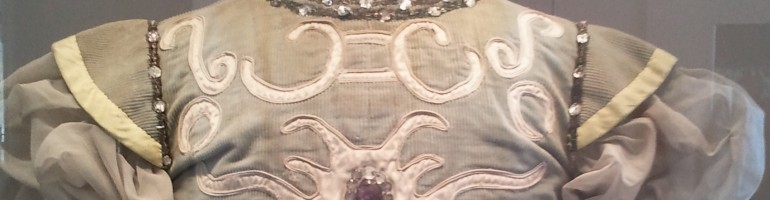
Gluck’s Sémiramis/Don Juan. Ballet du Capitole. October 26th and 27th, 2024.
I once sat next to an annoying frat boy at an Upper East Side dinner party who thought a clever conversation starter was “I adore Berlioz. What kind of music do you like?” I sighed. “Oh, anything that I feel I could dance to, so I’m not into Berlioz.” Eyebrows pointed in alarm, he sneered, “so you like disco?!” and then talked to other people for the rest of the night. OK, I still do have fond memories of dancing like a demon to disco. But I with hindsight I realize what else I could have said: “I’m into dance, yes, but most of all I love it when I can watch bodies find a story and their own truth in music.”
*
* *
Settled back in my seat in Toulouse in October, that long forgotten exchange popped up while I listened to Jordi Savall conduct the dance suite from Christoph Willibald Glück’s Iphigenia. The audience is treated to an extended overture before even one dancer will set a foot on the stage. As the straight-backed and craggy Savall elegantly led his brilliantly cheery Orchestre Le Concert des Nations into the final rousing chaconne, I definitely felt I had heard a story displayed through music. I felt like dancing.
I was really intitrigued by the fact that what followed would be re-imaginings of the first ever story ballets, revisited. Of course the choreographies have been lost, but here you would have authentic 18th century scores, neither intended as intermezzi in a larger opera (think Les Indes galantes, for example) nor bits of hit songs squished together in the typical patchwork ballet scores of that time (think Ivo Kramer’s subtly re-invented La Fille mal gardée, in the Ballet du Capitole’s repertoire/archives). In its time, “real” music for a ballet was revolutionary. Can this music still make us feel?
Sémiramis

Ballet du Capitole de Toulouse. Programme Gluck. Photographie David Herrero.
Ángel Rodriguez’s ballet to the music for Glück’s ballet Sémiramis followed apace. As there was no plot summary in the program, odd, hummm, I’d read up about the original play by Voltaire and was ready for anything…except to be served up something rather abstract. A divertissement, after all that?
Of course, silly, I don’t think I would have wanted to witness a dancing Semiramis waving around a vial of poison or being stabbed to death in slow-motion mime either, but here we ended up from the start back to the plotless dance interlude. Rodriguez’s piece, albeit a quite skilful and visually absorbing “divertissement,” was exactly the genre that Glück and the long-forgotten choreographer Gaspare Angiolini were trying to get away from in the first place.
We start – in silence, odd, as we have a lot of Glück to get through– with a giant lump/tumulus center stage that begins to winkle out some women.
The lump turns out to be a mass of iridescent fabric that will spend its time slowly spooling itself up to the rafters (until its inevitable swoosh back down in order recreate the tumulus from before).
The women squeak like birds as they rise up from the lump as if lofted by strings. They wiggle arms and waggle fingers, rise and swoon, swoop and then bend their knees, trace some kind of semaphoric language in the air. Later they will form circles. Men next emerge from the fabric lump. The music does start at some point and from then on these seven men and seven women continue to spiral around each other, touch and go, bodies hang off bodies and are carefully placed back on the ground in various configurations. There’s a duet for two who cup their hands for some reason.
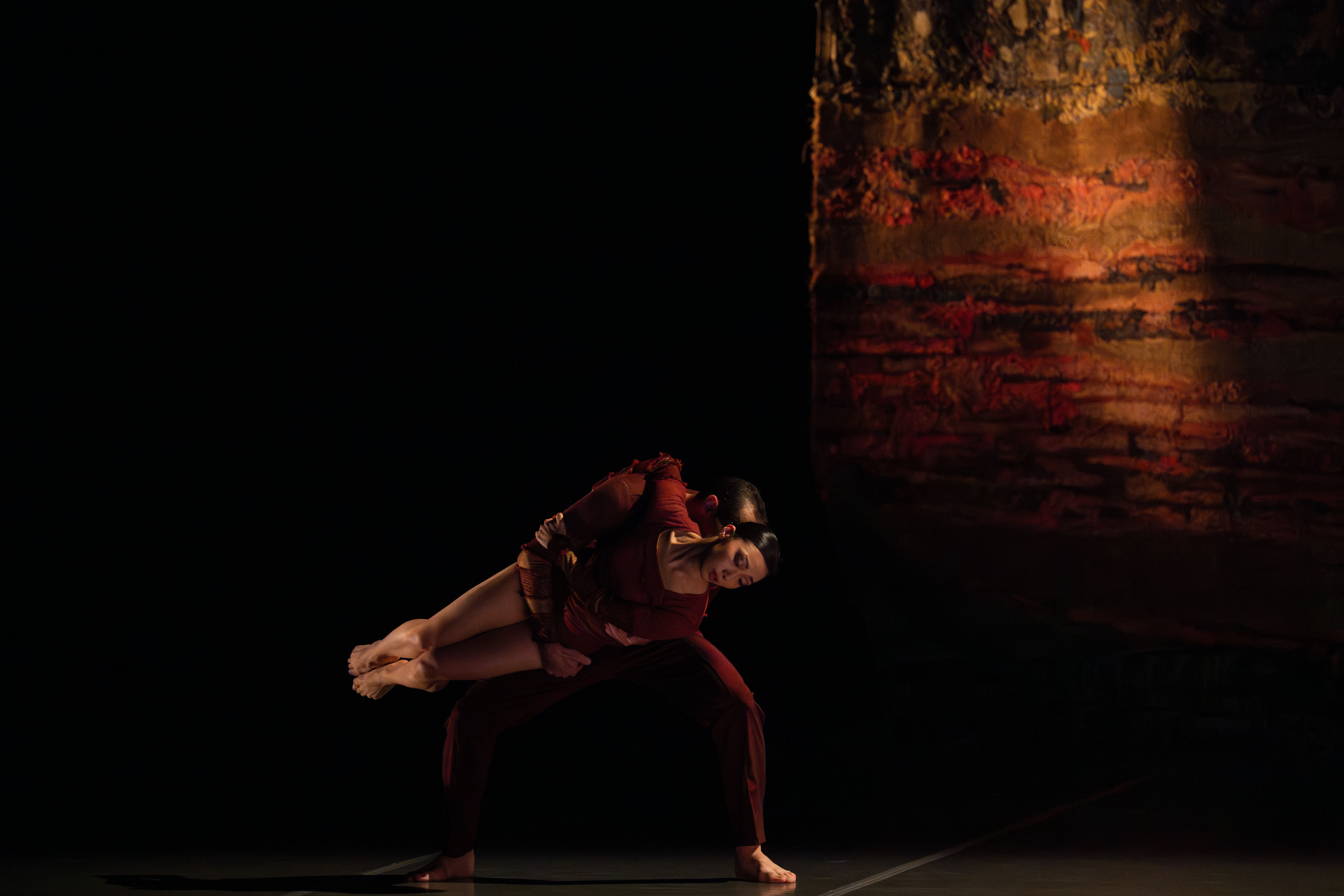
Ballet du Capitole de Toulouse. Programme Gluck. Sémiramis. Kayo Nakazato & Jeremy Leydier. Photographie David Herrero.
The lifts are almost always horizontal, with bent knees and flexed feet, gently Kylian in feeling. At some point, random lone women successively meander straight across the back of the stage just in front of the ever-rising backcloth. This visual distraction was not the best of ideas because: at just about the same moment during both matinees my eyes hooked onto the cloth (ooh it’s gone from gold to blue!) and my mind drifted towards memories of those poignant moments when Thierry Malandain takes fabric and makes it a real partner in the story.
Even if I found my mind channelling too many other choreographers who do all this better, I can’t say I was bored. Sémiramis was pleasantly soothing. The dancers were utterly committed (and in the case of Philippe Solano, explosive). But by the time we got to the troupe all running forward in slow motion — oh Lord, that gimmick — I felt a bit stuck.

Ballet du Capitole de Toulouse. Programme Gluck. Philippe Solano. Photographie David Herrero.
Much later, I ran across a really touching text by Ángel Rodríguez in the Capitole’s magazine. The choreographer dedicates this piece to his mother and all the other women who hold up at least half of the sky. Did I see happening onstage? Not really. But it’s a lovely idea.
*
* *
Don Juan

Ballet du Capitole de Toulouse. Programme Gluck. Photographie David Herrero.
Edward Clug found a better balance between plot and abstraction in his Don Juan. As Molière is mother’s milk to the French – everybody here is forced to study his plays in high school – light references were all this audience needed in order to situate themselves in the goings on.
Could this piece travel outside of France? Most possibly: the tragedy of Semiramis is niche. The Latin Lover, for better or worse, is a universal cliché.
We begin and end with the vivid image of the dancers hovering (glowering?) in a semi-circle around a man on the ground in an upside-down Christ pose, only to smother and then extract him from a mosh pit of arms and legs. In this piece, too, arms and knees get bent, feet get flexed, but here all these limbs serve to push the idea of a story into the foreground.
The set and props by Marko Japelj, and costumes by Leo Kulas, are minimal yet perfectly evocative. Moveable semi-transparent dark partitions pierced by Neo-Mauresque arabesques were wheeled around to create spaces you could recognize (a convent, a secluded garden, the dinner party). A giant “stone” horse gets rolled in to advance the action, along with a stiff red skirt that was inhabited and incarnated in multiple and specifically recognisable ways.
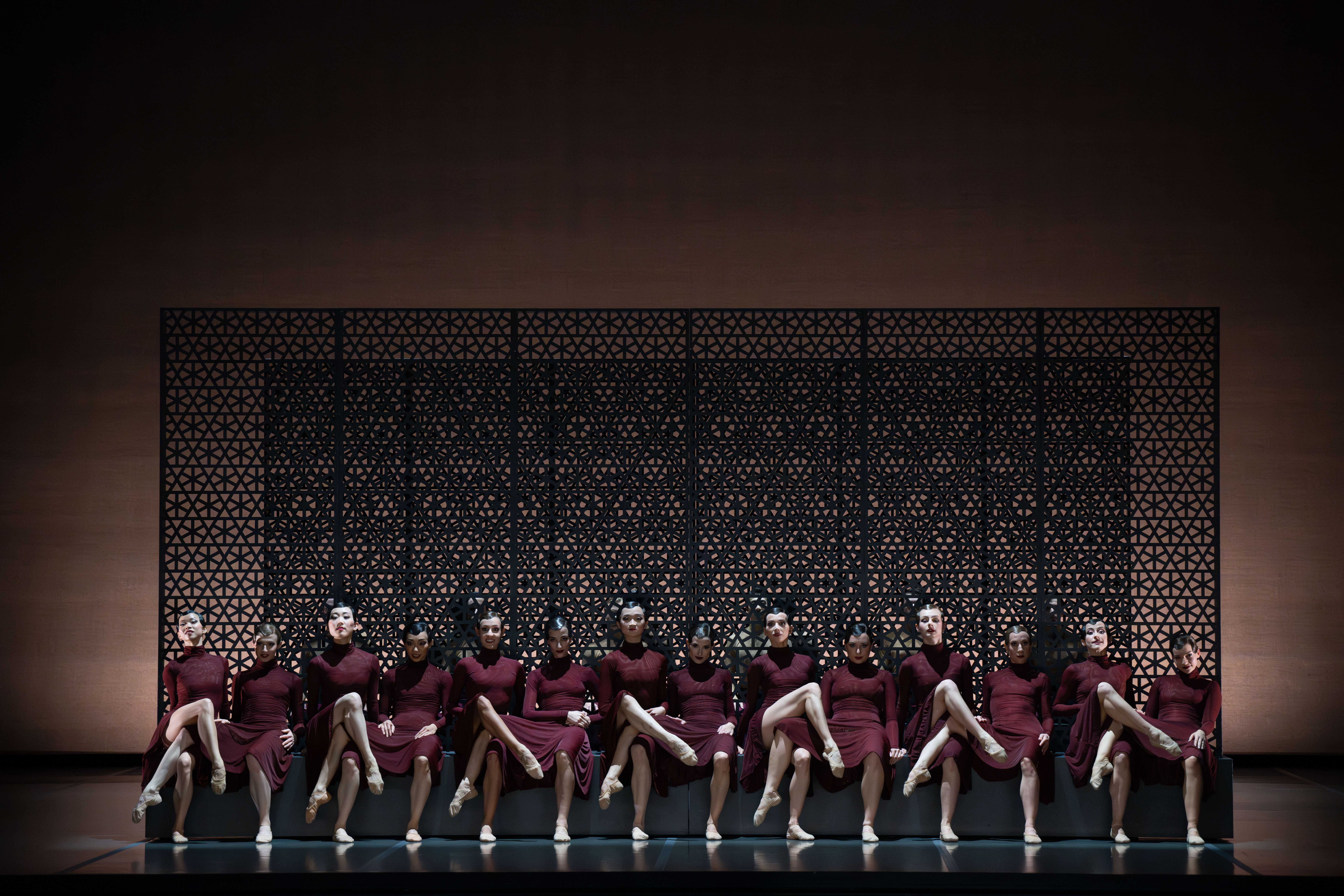
Ballet du Capitole de Toulouse. Programme Gluck. Photographie David Herrero.
Yes, this is very hard to describe, but it works.
During the October 26th Saturday matinee, Alexandre De Oliveira Ferreira’s Don was a peacock from the start, emerging from the puddle with flounce and go, ready for the sighs and air kisses that were his due: a cheery Teflon Narcissus, chillingly incapable of feelings or regrets right down to the moment he meets his sorry end. On Sunday, Ramiro Gómez Samón’s shaped a more sensual, sexually-ambiguous, and more ambivalent Don. His interpretation proved perhaps more compelling and seductive, to me.
On Saturday, Marlen Fuerte Castro’s Donna Elvira was implacable and forceful from start to stop. She seemed to incarnate The Commander (whom we never see) more than his confused child. To me, Solène Monnereau’s alternately soft and sharp and more womanly Elvira seemed more true to Molière (and later Da Ponte): she used her body to trace a theatrical (albeit abstracted) arc from confused woman in love, to woman disappointed in love, to Fury bent upon revenge.

Ballet du Capitole de Toulouse. Programme Gluck. Kleber Rebello et Solène Monnereau. Photographie David Herrero.
My only real quibble is the lack of “screen time” devoted to that trope – the scheming lovable rascal who speaks power to power (or at least to the audience) – the manservant Sganarelle (Leporello to some of you). He’s the audience’s ally. Dinner party trash-talking Don Juans may seem handsome at first but, boy, those Sganarelle-types always turn out to be so much more fun once you get them out there on the dance floor.
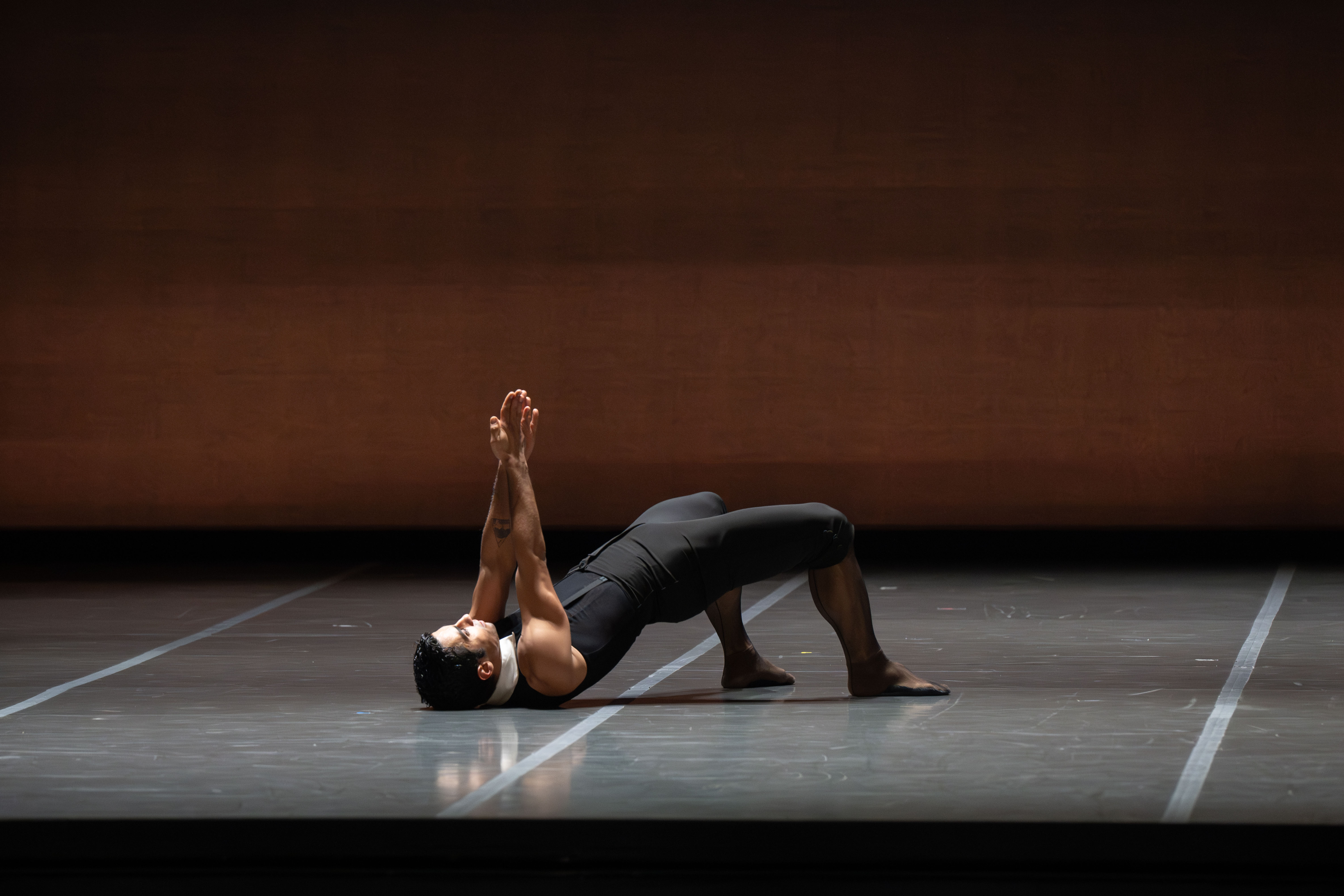
Don Juan. Philippe Solano (Sganarelle). Photographie David Herrero
Philippe Solano’s version of Sganarelle – a speedy, elastic, and sarcastic presence — had the snarky wit of a court jester. Kleber Rebello a day later, differently delicate and perhaps even more sarcastic, also spoke to me. What a pity the choreographer did not think to give them the last word. Both times, when it was all over, during the happy (and deserved) applause, my mind flew back to the way Paul Taylor gives his “little girl” a pause and a sweeping arms-out bow at the very end of Esplanade, a moment that the dancer can choose to execute either with reverence or with sass. I would have loved have seen that done here.
If you are in Barcelona in March, or Paris in May, snap up tickets to see the Ballet du Capitole dance to the music of a fabulous tiny orchestra. You won’t regret it, and may even find you may feel like dancing. Why not ?
 James
James Albertina
 Cléopold
 Fenella
 Les Balletonautes
 Mini Naila
 Les Balletonautes