
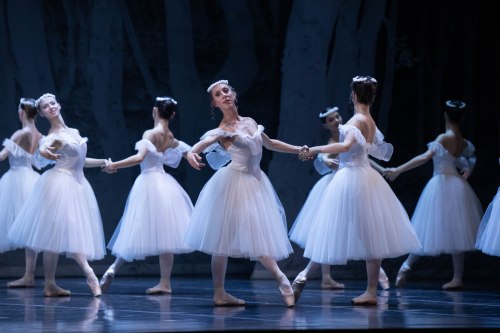
La Sylphide. Ballet du Capitole de Toulouse. Tiphaine Prevost. Photographie David Herrero
In Toulouse, one cast danced from the outside in, the other from the inside out. One was clean and sufficed for a Saturday night out, but the second cast on a Sunday matinée took us on a journey.
I’ve become so accustomed to the Paris Opéra’s Taglioni/Lacotte Schneitzhoeffer score that I was refreshed by the way Lovenskiold’s music begins in a proto-Verdian fashion. A quick explosion of tutti brass and drums instantly gives way to the plangent tone of a solo cello and then crescendos begin again.
As dandelion puffballs waft across a scrim during the overture, we see the back-story: while walking along the heath, the little boy James exasperates his girl companion. Effie cannot see the delightful ageless fairy beckoning to him. The boy’s fate is sealed: he will always be chasing after what he cannot catch.
But that’s his choice. Are you, or will you be, Team Syphide or Team Effie, up in the air or feet planted on the ground?
To my surprise, be it Bournonville or Lacotte,, sometimes I find myself rooting for Effie, the all too human girl. During both performances last weekend in Toulouse, I found myself solidly Team Effie, for very different reasons.
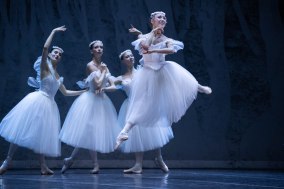
La Sylphide. Alexandra Surodeeva. Photographie, David Herrero.
Saturday, October 21
It’s really a matter of taste, but I have never been fond of the modern Russian classical ballet style. It’s too “top model.” There the point is to get from one camera-ready pose to the next rather than exploring danced-through phrases. A case in point: I cringed each time Alexandra Surodeeva launched clearly and deliberately from flat-footed arabesque to, hop!, full-pointe. No full-footed juicy relevés initiated by plié and the toes, just a haul-up using the hamstrings and the butt muscles. The extended leg gets stuck up in the air like a salute. The snapshot will be gorgeous as Surodeeva has beautiful lines. Her fluffy ronds de jambe and batterie just after yet another pose then left me cold. Her rather earthbound leaps in hard shoes led to noisy landings (in a pose). So for me, this Sylphide just didn’t happen. Surodeeva was just too much of a technically strong dancer, too healthy, too embodied. Her arms, both stiff and flappy, seemed more Balanchine than Bournonville. Each double pirouette turned out rather wobbly and approximate, which seemed odd for such a polished technician.
Instead, Nancy Osbaldeston’s feminine and elfin Effie won me over. Why was she not cast in the principal role? She’s delicate and dancey, soft on the ground and fleet of foot, and her phrasing, and the way she shapes her steps… lets you hear the music. Just lovely.
On this Saturday, Alexandre De Oliviera Ferreira’s goofy and bouncy Gurn – his beautifully expansive explosion of a solo lifted the house — matched with Rouslan Savdenov’s equally unromantic James. Poor Effie, what a choice! Alas, Savdenov, who can reach out and stretch in the direction of his movements in the soli, sculpting beautiful shapes out of thin air, was just not believable as a dreamer. Indeed, he played the role from the outside. “I will now pretend to see a vision in white, I will now pretend to get mad, now I will now smile big, now my face will go blank as I manage the manège.” I felt sorry for him. He was like a light bulb with the switch awry. But he was dancing by himself, I guess.
Simon Catonnet’s Madge was strong and funny and crisp, but — surprisingly for this gifted character dancer – his pantomime as the witch was emphatic without being effective and clear. A bit Sturm und Drang. Once the overture gets out of the way, the score becomes positively Rossinian in the way all the downbeats call for their match in mime. Catonnet’s Madge, beautifully limber down to her fingertips, seemed to be listening to her own music.

La Sylphide. Ballet du Capitole de Toulouse. Simon Catonnet (Madge) et Alexandre De Oliveira Ferreira (Gurn). Photographie David Herrero.
What made everything work at both performances was the really, really, together corps that often included soloists from the other day. The company is light and noiseless and together and without any stiff gestures or poses. The really charming Scottish reel in Act One brought the house down both times. The plethora of fairies filling the stage in perfect unison in Act Two brought sighs from the audience.
In Act Two, Savedanov’s James continued his aggressive pursuit of the sylph, who did those abrupt relevés again. When Surodeeva-Syphide’s wings fell off, I was shocked for the wrong reason. I had never noticed that she had borne wings in the first place.

La Sylphide. Kayo Nakazato. Photographie David Herrero.
Sunday , October 22
Due to an injury, the third cast Sylphide ended up dancing with the first cast James. As the fairy and human never partner but only touch each other once, this is do-able. But what about the mime, the connection? Will they pull off the drama, inhabit space so much together you imagine they actually have been touching throughout?
The answer became yes.
Kayo Nakazato’s Sylphide, as of the opening tableau, was pliant and in the music. In the first scene, here you had feet rolling without a need to hop up, a body in movement between poses, a smooth and silky presence. She danced it all out soundlessly. Her smooth and un-posed movements and the supple and alive nape of the neck let that almost feline aspect of all fairies come out. “Catch me if you can! Pet me if you can! In the meantime, I will just perch up on a shelf, watching you, as I settle down my fluffy self. I know you want me.” Legs never higher up than needed, beautiful cupped-in and un-showy delicate lines. In Act Two, she caught a butterfly! I had seen simply two hands clap the night before, uncertain what that had meant. When she would die, in a final arc just like a butterfly pierced by a pin, the audience held its breath.
Her James, Ramiro Gómez Samón, was really talking to himself and to his vision throughout. He gazed at the women he was torn between and then tried to look into his heart. His smile was melancholy, distant. He even managed to remind us (through light mime) that he had been the little boy in the prologue. He was bigger than Savdenov, rounder with a softer plié. In this role where you are supposed to be as fanciful as nut who chases after butterflies, Gómez Samón’s James was clearly more at ease with all the choreographic changes of direction and changes of heart. That this Sylphide looked into his eyes really helped.
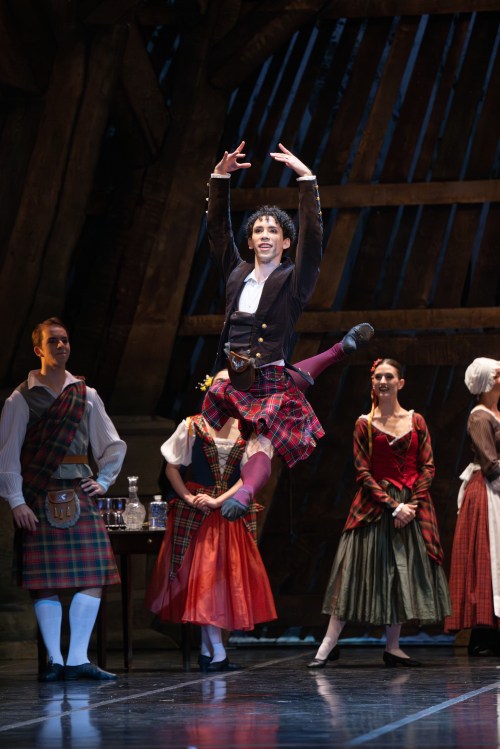
La Sylphide. Ramiro Gomez Samón (James). Photographie David Herrero.
Kléber Rebello’s Gurn proved to be an actor and dancer more “French” than yesterday’s, more subtle. “Oh, of course, I always loved you. And by the way, why exactly are we in this mess in the first place? Don’t forget – no stress — I’m here for you.” But also, just who wouldn’t want to marry Rebello’s Gurn after his first act solo? What placement, uplifted ballon, épaulement, pliés that go somewhere! Seriously, girlfriend, this one is boyfriend material.
Rebello was definitely the more dignified spurned suitor. He eagerly responded to every mood of Tiphaine Prévost’s anxious and alive Effie, so clearly worried about her fiancé’s sanity from the start. He even managed to make gentle uplift out of the fact that the only girl available to dance the reel with him was a little one. Whereas De Oliviera Ferreira’s Gurn dutifully disappeared into the second row with his partner, Rebello’s Gurn kept presenting the girl to her advantage. A real gentleman.
Kudos go to Tiphaine Prévost’s Effie, too, who made her role as The Girl Next Door both beautiful and believable up to the end. Her bride on that walking diagonal at the finale had accepted a “marriage of reason” that will probably turn out well, but she was clearly not happy to be back in that accursed forest again. Nor was the mother, Solène Monnnereau for both performances, who elegantly and subtly reacted in kind to each of her successive daughter’s moods.
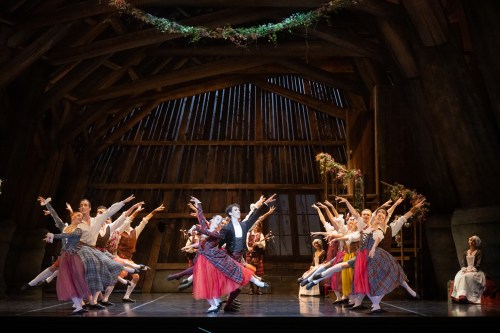
La Sylphide. Ballet du Capitole. Tiphaine Prévost (Effie) et Ramiro Gomez Samón (James). Photographie David Herrero.
And what a witch! Jérémy Leydier’s scary and grumpier Madge seemed to almost snake out of the fireplace in Act One. His timing and force made me think of a gnarly wisteria carefully planning to take all the time it needed to rip apart an iron grille…his masterful mime made James’s doom all that more inevitable and preordained. Maybe I’m Team Madge? Like mom, she’s an inventive cook and only wants to keep you from marrying Mr. Wrong.
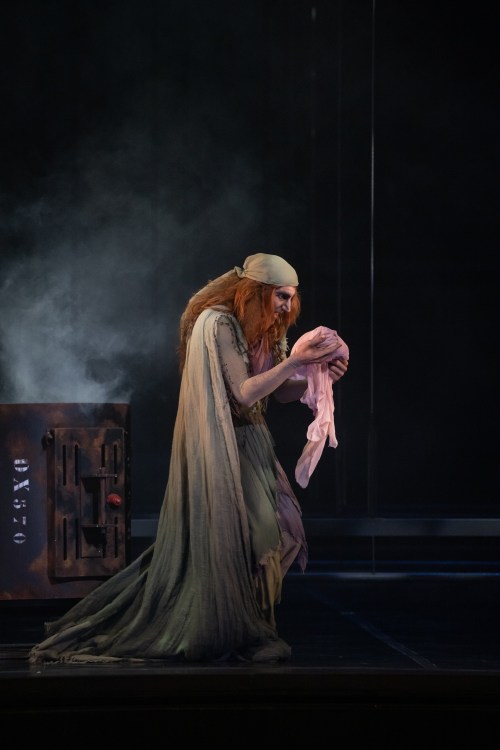
La Sylphide. Jérémy Leydier (Madge). Photographie David Herrero.
 James
James Albertina
 Cléopold
 Fenella
 Les Balletonautes
 Mini Naila
 Les Balletonautes